分类: world

  • Maersk is still shipping weapons parts to Israel despite denial, new report says

    Maersk is still shipping weapons parts to Israel despite denial, new report says

    A joint investigation released Monday by the Palestinian Youth Movement (PYM) and Oxfam Denmark has thrown into sharp question public claims from Danish shipping conglomerate Maersk that it has refused to transport weapons to Israel since the outbreak of the 2023 Gaza conflict. The investigation, the centerpiece of the grassroots #MaskOffMaersk accountability campaign, alleges that Maersk has overseen the consistent shipment of critical small arms parts and large explosive components to top Israeli weapons manufacturers, in direct contradiction of the firm’s stated policies.

    According to the report’s authors, the shipments include small-caliber bullet and rifle parts identical to those used in the 2024 killing of 6-year-old Palestinian child Hind Rajab, a death that drew international outcry, as well as thousands of other civilian casualties in Gaza. The cargo also includes empty casings for the 900-kilogram MK-84 “bunker buster” bombs that the Israeli military has deployed extensively across Gaza and southern Lebanon.

    Investigators cross-referenced shipping records and official bills of lading to trace a steady stream of components from 10 suppliers – nine based in the United States, and one in India – to Israeli defense contractors via Maersk-owned vessels. The largest intended recipient is Elbit Systems, Israel’s biggest weapons manufacturer, which acquired former state-owned defense producer IMI Systems in 2018. Between October 2023 and July 2025 alone, the report documents more than 1.42 million kilograms of bullet cores and brass cartridge casing cups shipped from three U.S. firms to IMI, parts destined for 5.56 mm and 7.62 mm rifle ammunition, the standard rounds used by Israeli infantry forces.

    Additional shipments identified in the report include MK-84 bomb casings from U.S. defense giant General Dynamics, 230-kilogram MPR-series general-purpose bomb parts from Elbit Systems of America, and mortar system components from four additional U.S. suppliers. India’s Sri Kaliswari Metal Powders also used Maersk vessels to ship aluminum powder for explosive manufacturing to Israel, according to the investigation.

    “Their actual practice is to completely ignore the policies that they have on the books,” Nadya Tannous, international coordinator for the #MaskOffMaersk campaign, told Middle East Eye in an interview. “Our question to Maersk is: What’s a weapon? You don’t ship weapons, so what is a weapon?”

    When reached for comment by Middle East Eye on the report’s allegations, Maersk reiterated its longstanding public position: “From the outset of the conflict, we have maintained a strict policy of not shipping weapons or ammunition to Israel. As the conflict escalated, we have further enhanced our screening and acceptance procedures and implemented additional compliance measures. Our compliance processes for military-related cargo are based on EU, US, and Danish laws including the Wassenaar Arrangement, the EU’s common military list and the International Traffic in Arms Regulations as well as UN resolutions.”

    Elbit Systems, which generates roughly $2 billion in annual revenue and employs 20,000 people globally, supplies approximately 85 percent of Israel’s drones and land-based military equipment. The Gaza health ministry reports that at least 72,980 people have been killed and 173,170 wounded in Israel’s ongoing military campaign in Gaza, and UN Special Rapporteur for Palestine Francesca Albanese noted in a 2024 report that Israeli defense firms including Elbit have reaped massive profits from the conflict, describing the Gaza war as a “profitable venture” for the sector. Elbit has long been a target of pro-Palestinian activism across Europe and North America over its ties to Israeli military operations.

    Unlike many other pro-Palestinian campaigns targeting corporate ties to Israel, the PYM-Oxfam Denmark report does not call for a broad boycott of Israel. Instead, the campaign is explicitly calling for a global consumer and industry boycott of Maersk, and demanding immediate policy change from the shipping giant. Tannous emphasized that the campaign is part of a broader push to hold corporations accountable for facilitating what pro-Palestinian activists and numerous international legal experts have labeled genocide in Gaza.

    “We don’t want policy statements, we want material change from the company,” Tannous said. “This campaign is part of a larger nexus of accountability for the Israeli government and the Israeli military. It falls within the corporate accountability campaign for those corporations that facilitated the genocide.”

    The report lays out three clear demands for Maersk: immediately halt all shipments of weapons components to Israel, conduct comprehensive independent human rights audits of all global operations, and end all commercial activity that supports Israeli military operations, warning that continued shipments leave the company open to charges of complicity in war crimes and genocide in Gaza.

    This is not the first time Maersk has faced public pressure over its links to Israeli military activity. Protests have been held consistently outside the firm’s Copenhagen headquarters for more than two years, with a large demonstration held just last month over Maersk’s role in resupplying Israel amid its multi-front regional conflicts. Multiple countries have already moved to restrict military cargo shipments to Israel, with Spain banning the use of its ports for military-bound cargo to Israel in May 2024.

    Tannous noted that Maersk’s near-ubiquitous presence in global port infrastructure makes the company a fair target for collective action by people of conscience around the world. “Maersk is everywhere, right? They’re in every port, for the most part, they use our roads, they use our bridges, they use our public infrastructure,” she said. “What does it mean for us as people of conscience around the world, who majority understand and know that this genocide is ongoing, it’s wrong… to not lose hope in terms of being able to actually affect change for those in power? We demand accountability. There are many methods to do that, and we hope that this report is one of the ways of offering really valuable and precise information.”

    Public records show Maersk’s leadership has sent mixed signals on its military cargo policies in recent months. In March 2025, Maersk’s CEO told shareholders that the firm never transports weapons to active conflict zones, but allows other types of military-related cargo – though he declined to clarify the exact distinction between the two categories. The company has also not publicly revised its policy on transporting components for F-35 fighter jets, which the Israeli Air Force has used extensively to bombard residential areas of Gaza. In a July 2025 statement, Maersk only noted that the full F-35 supply chain is controlled by a coalition of partner governments, an argument that echoes previous framing used by other firms tied to weapons exports to Israel.

    That same July 2025 statement did include one major concession: Maersk announced it would reassess all commercial ties to firms linked to illegal Israeli settlements in the occupied West Bank, a move that came after months of sustained pressure from pro-Palestinian activists. The company stated it already adheres to international standards for responsible business practice, and will align any operational changes with guidance from the United Nations High Commissioner for Human Rights (OHCHR). The OHCHR first published a database of firms operating in and profiting from illegal Israeli settlements in 2020, naming more than 100 companies that contribute to human rights abuses against Palestinians.

    In the same July statement, Maersch also pushed back against Albanese’s 2024 report on corporate complicity in human rights abuses in Palestine, claiming her report drew on unvalidated third-party data.

  • Albanians protest against Kushner-backed project threatening the environment

    Albanians protest against Kushner-backed project threatening the environment

    Mass public demonstrations against a $1.6 billion luxury coastal resort development led by former U.S. President Donald Trump’s son-in-law Jared Kushner have stretched into their fourth consecutive day in Albania, fueled by widespread public anger over untransparent planning and irreversible threats to unique coastal ecosystems.

    Thousands of demonstrators have packed the capital city of Tirana all week, raising alarm over the project’s potential to destroy sensitive habitats located at the proposed construction site on Albania’s southern Adriatic coast. The development footprint encompasses the uninhabited Sazan Island, as well as the ecologically rich wetlands and coastal habitats that surround the landmass, with early groundwork already underway in recent weeks. Kushner’s private equity firm, Affinity Partners, is one of the primary backers of the large-scale tourism project.

    In a recent media interview, Ivanka Trump, Kushner’s wife and former U.S. first daughter, recalled how the pair first encountered Sazan Island during a leisure trip. “We were on a friend’s boat, and we stopped for a swim. Effectively, that’s how we found it,” she explained. “We swam to the island. We went on a hike, barefoot all the way up to the top, and we were just captivated.”

    Protestors have directed their criticism not only at Affinity Partners but also at Albanian Prime Minister Edi Rama and his ruling Socialist Party administration, which has positioned itself as a vocal supporter of the development. For Rama, the resort project is a core pillar of his agenda to transform Albania into a premium international tourist destination, boost foreign direct investment, and advance the country’s bid for European Union membership. The prime minister has argued the initiative would inject an estimated $4.6 billion in total investment into Albania’s economy, generate thousands of local jobs, and upgrade critical national infrastructure. Rama won a fourth consecutive term in 2025 on a platform centered on attracting foreign investment and advancing EU accession.

    Yet more than 40 domestic environmental organizations have signed an open letter to the government demanding an immediate halt to all construction activities. The site is recognized as one of the most biologically diverse areas along the Adriatic coast, serving as a critical stopover for hundreds of migratory bird species. The coastal waters adjacent to Sazan Island are also one of the last remaining protected refuges for the critically endangered Mediterranean monk seal, while the wetlands host populations of pink flamingos and Dalmatian pelicans among more than 200 recorded bird species. Many protestors have carried cutout images of pink flamingos to rallies to highlight the threat the development poses to these vulnerable animal populations.

    Aleksandr Trajce, executive director of the Protection and Preservation of the Natural Environment in Albania (PPNEA)—the country’s leading conservation organization—told reporters the entire project process has been marked by a complete lack of public accountability. “From start to finish there has been a total lack of transparency,” Trajce said. “We have seen no public consultation or public documentation regarding permits, and so now what we are saying is, if they remove the bulldozers, remove the fence and restore the habitats to what they were, then we can start talking.”

    While Rama has stated he is open to meeting with protest representatives to discuss their concerns, he has also ruled out any possibility of canceling the project. “There is absolutely no chance that the investment will stop as long as I am here,” the prime minister confirmed this week.

    Developers involved in the initiative have pushed back against criticism, framing the project as environmentally responsible and beneficial to local communities. “Our focus remains on responsible stewardship, environmental enhancement, job creation and creating long-term value for local communities. We respect the ongoing public and institutional processes,” said Asher Abehsera, chief executive of Sazan Real Estate Development LLC, which is co-developing the project alongside Affinity Partners.

    The Albanian protests are not the first controversy surrounding Kushner’s development projects in the Balkan region. Previously, Kushner planned to build a Trump International Hotel in Belgrade, Serbia, but withdrew from the project earlier this year after a senior Serbian government minister was arrested on charges of abuse of office tied to the development’s approval process. More recently, Kushner drew widespread international criticism for announcing a proposal to develop a “New Gaza” with luxury skyscrapers, coastal tourism hubs, and dedicated commercial districts. Analysts speaking to Middle East Eye described the Gaza plan as a clear example of private actors attempting to profit from conflict and humanitarian disaster in the occupied Palestinian territories.

  • India called on to arrest Israeli reservist holidaying in country

    India called on to arrest Israeli reservist holidaying in country

    A Brussels-based non-governmental organization has launched a formal legal push to force Indian authorities to detain an Israeli army reservist accused of committing war crimes in Gaza during his holiday in the country’s northern Himalayan state of Himachal Pradesh.

    The Hind Rajab Foundation (HRF) submitted an urgent legal complaint on Tuesday to three key Indian bodies: national police, the Ministry of Home Affairs, and the country’s immigration bureau. The filing names the suspect as Eitan Gilboa, a member of the Israel Defense Forces’ 271st Combat Engineering Battalion who is currently traveling in India.

    In the complaint and a public statement accompanying it, HRF detailed its months-long investigation into Gilboa’s actions during the ongoing military campaign in Gaza. The organization alleges that Gilboa directly took part in and publicly celebrated the systematic leveling of entire residential neighborhoods in Gaza as an act of collective retaliation against Palestinian civilians. These actions, HRF argues, qualify as explicit war crimes under India’s 1960 Geneva Conventions Act.

    To back its claims, HRF points to social media content originally shared by Gilboa’s mother, which captures multiple instances of the reservist participating in and commemorating the destruction of civilian infrastructure across southern Gaza, including in the heavily bombed areas of Khan Younis and Rafah.

    The legal filing emphasizes that as a signatory to the Fourth Geneva Convention, India carries a binding international legal obligation to hunt for and prosecute any individual accused of grave breaches of the treaty, regardless of their nationality. This requirement is laid out explicitly in Article 146 of the convention.

    HRF has laid out three clear demands for Indian officials: immediately take Gilboa into custody, file a formal First Information Report (FIR) to open a criminal investigation into the allegations, and if arrest is not pursued, order the reservist’s immediate deportation from Indian territory.

    “Eitan Gilboa is not a tourist. He is a war criminal currently enjoying the hospitality of India while fleeing the consequences of his crimes,” HRF director Dyab Abou Jahjah, a prominent Lebanese political activist, said in a statement. “India must not allow Indian soil to become a safe haven for those who celebrate the destruction of civilian lives,” he added.

    Local Indian activist Shrishti Khanna, speaking to independent outlet Middle East Eye, noted that mass tourism from Israeli veterans to Himachal Pradesh is a decades-long trend, with thousands of former and active Israeli military personnel vacationing in the state since the 1980s. Khanna argued that the current complaint exposes a long-standing pattern of complicity by the Indian government, one that has deepened dramatically under Prime Minister Narendra Modi’s administration. Modi has overseen increasingly close political, military and ideological alignment with Israel, Khanna said, resulting in Israeli occupying forces being treated as harmless holidaymakers rather than potential suspects requiring scrutiny and legal accountability.

    Khanna added that she does not expect Indian authorities to actually move forward with an arrest and prosecution, but said that “even if no action is taken, the complaint itself will create a permanent public record of India’s position on this issue.”

    This legal action is the latest in a series of efforts by HRF to hold alleged Israeli war criminals accountable across the globe. To date, the organization has filed more than 90 similar criminal complaints in 30 different national jurisdictions, pursuing investigations and litigation against individuals suspected of participating in war crimes against Palestinians.

    The complaint comes amid sustained international and domestic pressure on the Indian government over its long-standing military relationship with Israel. New Delhi has continued to approve and ship arms to Israel throughout the current military campaign in Gaza, a policy that has drawn widespread criticism from human rights groups and civil society activists who argue the weapons are being used to commit widespread human rights abuses against Palestinian civilians.

  • ‘Taking our jobs’: Yemeni workers lose out to lower-paid Ethiopian migrants in low-skilled sectors

    ‘Taking our jobs’: Yemeni workers lose out to lower-paid Ethiopian migrants in low-skilled sectors

    Decades of ongoing conflict have reduced Yemen, already one of the Arab world’s poorest nations, to a state of systemic economic collapse, leaving millions of citizens fighting for daily survival. For the country’s low-skilled working-age population, the challenge of securing stable employment to support families has grown even more dire amid a growing wave of transient East African migrants, who have reshaped local low-wage labor markets.

    Zahed al-Zabidi, a 30-something Yemeni native originally from conflict-battered Hodeidah governorate, knows this struggle intimately. Seven years ago, he relocated to the southern port city of Aden in search of more reliable work, leaving behind a life of inconsistent day labor that barely put food on the table for his five family members. For more than 15 years, Zabidi has made his living washing dishes and cleaning dining spaces at local restaurants – work that requires no formal education or specialized training, the only kind of employment he can access. Where he once had no trouble securing shifts, opportunity has all but dried up in recent years.

    Zabidi blames the growing competition from Ethiopian migrants passing through Yemen on their way to Gulf Cooperation Council nations. “I worked at several restaurants in Aden, but the situation gets worse every day because Ethiopian migrants are taking our jobs, and many restaurants have started hiring them,” he explained. “Ethiopian migrants are ready to work for any amount, so restaurant owners prefer them and fire us.” Zabidi once earned 130,000 Yemeni Riyals, roughly $83, per month – a sum already barely enough to cover his family’s basic needs – before he was replaced by an Ethiopian worker who accepted just 80,000 Yemeni Riyals ($51) for the same role. For Zabidi, that lower wage is impossible to accept: unlike many transient migrants, he has a family of five to support, and the reduced rate cannot cover even the most basic household expenses.

    Today, Zabidi remains out of work, traveling from restaurant to restaurant across Aden seeking any open position, with no luck. His family now survives on just bread and tea for most meals, with meat only appearing on their table when a charitable neighbor shared it during the Eid al-Fitr holiday. “It is difficult for a jobless person like me to buy good food for his family. We are only eating to survive,” Zabidi said. Now, he is planning to leave Aden to seek work on farms in Lahj governorate, where relatives already work, even though he has no prior experience in agricultural labor. “I don’t have experience in farming, but I will learn it from my relatives and try my best to work there,” he said.

    Official data underscores the scale of Zabidi’s crisis: Yemen’s national youth unemployment rate hit 32.39 percent in 2024, with the hardest impacts falling on low-skilled workers like him who rely on informal, unskilled roles. The United Nations estimates that 22.3 million Yemenis – nearly three-quarters of the country’s total population – require some form of humanitarian assistance or protection support in 2025.

    The influx of migrants that has reshaped Yemen’s labor market is part of a long-running regional migration pattern. Yemen’s strategic position on the southwestern edge of the Arabian Peninsula has made it a key transit hub for decades for migrants fleeing conflict and poverty in East Africa and the Horn of Africa, most notably Ethiopia and Somalia, who seek better economic opportunity and safety in Saudi Arabia and other wealthy Gulf states.

    According to the International Organization for Migration (IOM), 110,144 migrants have entered Yemen since the start of 2025, 97 percent of them Ethiopian and 3 percent Somali. More than 90 percent of these new arrivals list Saudi Arabia as their final destination, with only 10 percent planning to settle in Yemen permanently. For most, the country is nothing more than a temporary stopover as they coordinate the next leg of their dangerous journey.

    Because migrants only need enough income to cover immediate daily survival costs while they wait to continue north, most are willing to accept extremely low wages that Yemeni heads of household cannot afford to work for. One Ethiopian migrant, who gave his name as Ramadan, explained this dynamic in a brief interview with Middle East Eye. “We plan to reach Saudi Arabia, and while we are here, we need to eat, so we work just like anyone else,” he said. Ramadan, who has picked up basic Arabic during seven months working at an Aden restaurant, added: “I love Yemen and Yemenis, and I don’t want to make anyone unhappy. Yemenis are our brothers, and we share the same suffering.”

    Restaurant owners in Aden openly admit that they prefer to hire Ethiopian migrants for low-wage cleaning and dishwashing roles for this reason. Ali, an Aden restaurant owner who spoke to MEE on condition of anonymity, acknowledged that the lower labor costs and higher willingness to work long hours make migrants the more attractive option for business owners. “The Ethiopian migrants work hard and they clean the restaurant better than some Yemenis. Moreover, they accept lower wages and don’t complain,” Ali said. “While some Yemeni workers frequently demand higher wages and require a lot of time off, that is not the case with Ethiopians, who work silently and dutifully perform any task requested of them. As a businessman, I prefer to employ Ethiopians for these roles because they work longer hours for less pay.”

    Economic analysts note that while the migrant influx exacerbates strain on low-wage Yemeni workers, it is not the root cause of the country’s unemployment crisis – that stems from the 10-year ongoing civil conflict that collapsed Yemen’s national economy. “These migrants work in cleaning, strenuous domestic labour and farming, especially Qat farming, where they accept low wages,” explained economic expert Wafeeq Saleh. “These low wages are not enough for a Yemeni to eke out a decent living for a family, creating unfair competition in the labour market between Yemeni workers and Ethiopians.”

    Saleh added that shifting cultural norms have already pushed more Yemenis into these once-shunned low-skilled roles. “There used to be a relative reluctance among Yemenis to take up cleaning jobs because it was culturally viewed as ‘shameful’, but the severe economic crisis has contributed to the fading away of this culture, and Yemenis are now in dire need of any opportunity,” he said.

    Even many Yemeni workers who have lost jobs to migrants do not oppose migrants working, but rather call for uniform wage standards that eliminate the unfair advantage low-wage transient migrants give employers. “I am not against Ethiopian migrants working, but I am against the low salaries that encourage restaurant owners to hire them,” Zabidi said. “If we received the same salary for the same working hours, restaurant owners would prefer us.”

  • Putin says there is no point meeting Zelensky over ending Ukraine war

    Putin says there is no point meeting Zelensky over ending Ukraine war

    Fresh tensions have flared in the 3-year-old Russia-Ukraine conflict after Russian President Vladimir Putin turned down a public request from Ukrainian leader Volodymyr Zelenskyy for one-on-one negotiations to end the full-scale war that launched in 2022.

    Zelenskyy published an open letter Thursday that formally called for face-to-face talks with Putin, arguing that the international community cannot afford to wait for renewed U.S. focus on the conflict to push forward peace processes. The letter included a defiant, occasionally mocking tone toward the Russian leader — including jabs at his decades in power and recent Ukrainian drone strikes on Russian territory, one of which targeted St. Petersburg just days prior, which Zelenskyy framed as a “visit” to Russia. The Ukrainian president also called for an immediate ceasefire to precede formal negotiations.

    Putin pushed back against the request Friday during remarks at Russia’s annual St. Petersburg International Economic Forum, dismissing the letter as “rude” and arguing it was never intended to set the groundwork for genuine dialogue. “Was it a way to create the conditions for a face-to-face meeting or a way not to set up a face-to-face meeting? I think it was the second,” Putin told attendees.

    The Russian leader doubled down on his long-held negotiating position, which holds that a ceasefire cannot come before binding peace agreements are reached. He warned that a temporary pause in fighting would only allow Ukrainian forces to regroup and rearm, while Moscow’s core demands remain unaddressed. “The only point [of a ceasefire] is for the Ukrainian side to halt the advance of our armed forces. But we need agreements — not for six months, not for three months, but for the long term,” Putin said. “Let the experts get to work and come up with some solutions. After that, we can meet.”

    Putin reaffirmed that military operations will continue until Russia achieves its stated war aims, which include Ukraine ceding control of the four Donetsk, Luhansk, Kherson, and Zaporizhzhia regions and permanently abandoning its bid to join NATO. Kyiv has repeatedly rejected these demands, refusing to surrender any sovereign territory and noting that Russia launched its full-scale 2022 invasion eight years after annexing Ukraine’s Crimean Peninsula, arguing territorial concessions would only embolden future Russian aggression.

    When asked directly whether he would meet Zelenskyy for talks, Putin responded clearly: “I don’t see any point for now.”

    While Zelenskyy’s overture was met with cautious hope in some international circles, including the White House, where former U.S. President Donald Trump said a meeting between the two leaders “would be great,” the conflict on the ground continued to escalate even as diplomatic efforts stalled.

    On the same day as Putin’s remarks, Ukrainian military officials announced they had struck five vessels carrying unauthorized cargo in the Sea of Azov and off the coast of Russian-occupied Ukrainian territory. Robert Brovdi, commander of Ukraine’s drone forces, said the targeted ships were involved in stealing Ukrainian grain and transferring fuel and military supplies to Russian forces.

    Azerbaijan’s foreign ministry later confirmed that five civilians were killed in attacks on two of the ships, adding that the vessels were not Azerbaijani-flagged and did not specify who it held responsible for the casualties.

    In another separate incident, a Ukrainian drone detonated in the Romanian Black Sea port of Constanta this week. Ukrainian military operators said the drone was blown off course by Russian electronic warfare interference, marking an accidental incursion into NATO-member Romanian territory.

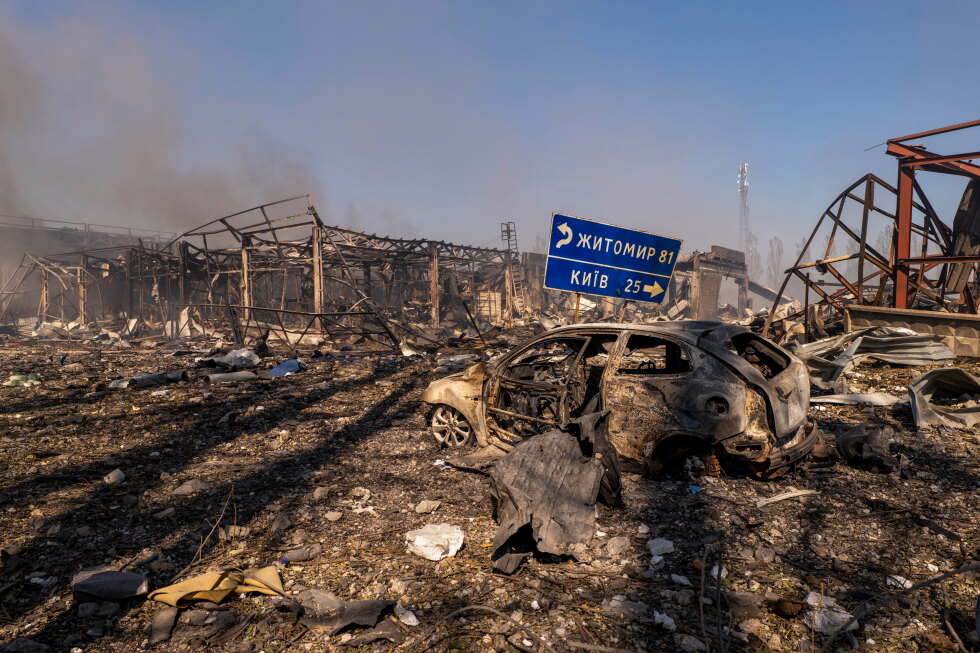
    Russia launched a wave of new attacks across Ukraine in the 24 hours prior, killing at least 13 people and wounding 70 more, Ukrainian emergency officials confirmed. Four workers died when a dairy factory outside Kyiv was hit, while a 35-year-old woman was killed in a drone strike on a Kherson petrol station, among other casualties reported across the country.

  • Finding moments of childhood in Gaza, one bubble at a time

    Finding moments of childhood in Gaza, one bubble at a time

    When the Global Sumud Flotilla set sail on May 18 to break Israel’s aerial, land and sea blockade of the Gaza Strip, its cargo held far more than life-sustaining basics. Alongside stockpiles of food, clean drinking water, infant formula and critical medical equipment targeted to Gaza’s collapsing healthcare system, the aid mission carried a surprising, gentle addition: portable homemade bubble play kits. These simple kits, crafted from just soap, water, rope and wooden sticks, are the core initiative of Bubbles Not Bombs (BNB), a grassroots humanitarian project dedicated to giving children trapped in war zones and displaced by conflict small, precious moments of respite through mindful bubble play.

    For 15 years, BNB operated under the umbrella of Dr Zigs, a Welsh eco-friendly toy company founded by 56-year-old Italy-born Paola Dyboski that frames play as a foundational tool to support children’s emotional wellbeing in crisis settings. Just recently, the initiative spun off to become an independent non-profit organization, expanding its reach to conflict-hit regions across the globe.

    Dyboski does not minimize the urgent need to deliver basic necessities to Gaza, where the Palestinian health ministry confirms more than 22,000 Palestinian children have been killed since the start of Israel’s military campaign launched after the October 7, 2023 Hamas-led attack. But she has long argued that play itself is a universal human right that no child, even in the midst of active conflict, should be denied.

    Currently, BNB is working to deliver physical bubble kits to children across Gaza and southern Lebanon, where ongoing Israeli military operations have killed more than 3,500 people and displaced nearly one million since March 2024. To bridge gaps in delivery amid restricted access, the organization has already shared simple, open-source digital instructions for making homemade bubbles using locally available materials, so children and caregivers can build their own kits without waiting for external shipments.

    Dyboski explains that the soft, fleeting nature of bubbles, with their inherent joy and lightness, offers children living with chronic trauma a tangible tool to process fear and grief, articulate unspoken difficult feelings, regulate their breathing, and stabilize their emotions amid constant chaos.

    That impact is visible on the ground in Gaza, where Mohamed Abushbeka has cared for his two young nieces since their father was killed in the first weeks of Israel’s military campaign. Last week, BNB reposted a video Abushbeka shared of his older niece, Batool, blowing bubbles inside an overcrowded displacement camp.

    “Bubbles give children these rare stretches of joy, safety, and escape from all the anxiety and brutal reality around them,” Abushbeka told Middle East Eye in an interview. He emphasized that bubble play helps children release overwhelming emotions they often lack the words to name, giving them a brief, tangible sense of freedom. “You see them running, laughing, chasing the bubbles as they float up, then suddenly fall and burst,” he said.

    He added that bubble play is uniquely accessible in a context where most resources are scarce: it is low-cost, simple to make, and children will repurpose any available materials, from plastic cups to discarded small tubes, to make their own wands. For caregivers working to preserve any shred of normal childhood for the next generation, protecting these small moments of play is non-negotiable, Abushbeka said. “One day, Palestinian children will laugh without fear, sleep without bombs, and grow up surrounded by peace instead of loss,” he wrote on his Instagram page.

    Leigh Evans, a Welsh emergency nurse, paramedic and activist with four medical aid missions to Gaza under his belt, has witnessed first-hand the constant trauma that shapes daily life for Gaza’s children, and the heartbreak of seeing them robbed of the chance to just be kids. “I think children’s need to play and develop as whole human beings should be a major part of what we count as essential aid,” Evans said.

    He reflected on how Gazan families work tirelessly to preserve small bits of normalcy even amid widespread destruction, recalling invitations to share meals in partially bombed-out homes, where families leaned on cooking and play to comfort their children when death could come at any moment. Evans has long integrated BNB’s bubble kits into his solidarity work: he joined the Global Sumud Flotilla mission, used bubble play during the 2025 Global March to Gaza, blew bubbles during a peaceful Red Line solidarity rally in West Wales last week, and joined activists in a direct action outside Israeli weapons manufacturer Elbit Systems in March, where bubble play was used to disrupt production of munitions deployed in Gaza.

    “Bubbles are wonderfully therapeutic,” Evans said. “They offer a small but incredibly powerful form of psychological relief for children in conflict zones, letting them be children in a place where they would otherwise have no space for that.”

    Sabine Choucair, a Lebanese performer and co-founder of Clown Me In, an organization that brings arts programming to children in crisis zones, frames bubbles as uniquely magical for young people. “Bubbles are magical, like small globes that reflect everything around children,” she explained. “They bring kids together and give them a low-stakes way to experiment and play.”

    Choucair, who has 20 years of experience performing for children in refugee camps and disaster zones across the world, recently partnered with BNB by sharing a video of her original activity “Pop the Fear”, where children are invited to name their fears, visualize placing them inside a bubble, pop the bubble to release the fear, then blow new bubbles to make space for joy and hope.

    Speaking of the ongoing crisis in Lebanon, where children are once again displaced, forced out of school, and forced to re-live the trauma of bombardment and home loss, Choucair pushed back against the narrative that mental health and play support are secondary to basic aid. “Imagine re-living the loss of your home, hearing drones and bombs again, and being out of school once more,” she said. “How are we supposed to survive if our mental state is destroyed?”

    Mental health experts echo this framing, noting that even when basic survival needs are unmet, psychosocial support for children facing repeated bombardment, displacement and grief is not a secondary priority—it should be a core component of any emergency response. A powerful video from the Gaza-based Sameer Project illustrates this impact, showing a young girl channeling her fear of shelling and famine into popping bubbles, before sharing her wish to be reunited with her mother, who was killed in the conflict.

    “It’s a simple but deeply effective way to help children process trauma,” Dyboski said. “Creating moments of play is healing. They can feel a sense of control and make the experience their own.”

    Beyond Gaza and Lebanon, BNB has already begun distributing bubble kits to children in Myanmar and at Cox’s Bazar in Bangladesh, home to the world’s largest refugee camp. The organization is working to expand access to Sudan in partnership with local group Let’s Have Hope, though shipment challenges have delayed entry to date. It also plans to send kits to children in the Democratic Republic of Congo and Ethiopia’s Tigray region, both sites of ongoing protracted conflict.

    “We need to make sure children not only survive but are also able to grow into human beings who can live, love and function fully,” Evans said. Citing UNICEF data that an estimated 473 million children worldwide currently live in active conflict zones, Dyboski says the work is far from over. “We’ve got a lot of children to reach.”

  • Ukraine strikes cargo ships and admits Romania drone blast as Putin prepares for key speech

    Ukraine strikes cargo ships and admits Romania drone blast as Putin prepares for key speech

    Fresh developments in the ongoing Russia-Ukraine war have unfolded rapidly across the Black Sea region, Ukrainian territory and diplomatic circles this week, mixing targeted military strikes, accidental security incidents and renewed calls for direct peace negotiations.

    Ukrainian drone forces announced overnight strikes against five unmarked vessels operating in the Sea of Azov and coastal waters surrounding the Russian-occupied Ukrainian ports of Mariupol and Berdyansk. According to Robert Brovdi, commander of Ukraine’s drone units, the targeted ships had covered their identifying markings and disabled radar transponders to conduct two illicit activities: smuggling stolen Ukrainian grain out of occupied territory and moving military supplies and fuel for Russian forces. Brovdi did not reference any casualties in his statement, and Ukraine has not formally claimed responsibility for any fatalities linked to the strikes.

    The strikes came just one day after Ukrainian President Volodymyr Zelensky made an unexpected public call for a face-to-face summit with Russian President Vladimir Putin to negotiate an end to the nearly three-year full-scale conflict. In an open letter released Thursday, Zelensky argued that waiting for renewed US diplomatic focus on the war was a strategic mistake, and that sustainable peace could only be achieved through direct, high-level engagement between the two warring parties. He also proposed a full ceasefire to take effect for the duration of any negotiations – a condition Putin quickly rejected in comments made hours later.

    In simultaneous Russian strikes across multiple Ukrainian regions over the 24-hour reporting period, local officials confirmed at least 13 civilian deaths and more than 70 injuries. The deadliest single attack targeted a dairy factory on the outskirts of Kyiv, where four workers were killed. Other fatalities and injuries were recorded in Kherson, Kharkiv, Sumy, Zaporizhzhia, Chernihiv and Dnipro regions, with damaged infrastructure including food storage warehouses, a postal facility and a local school, per Zelensky’s account.

    Diplomatic reactions to Zelensky’s peace summit proposal have been divided, with Western powers expressing broad support. US former President Donald Trump told reporters Thursday that a meeting between the two leaders would be positive, adding he expected both sides would make the necessary compromises to advance talks. The European Union and France have also backed the initiative. The Kremlin confirmed it had received Zelensky’s letter, with spokesperson Dmitry Peskov indicating Putin would address the proposal during his planned address at a major St. Petersburg economic forum on Friday.

    Speaking to reporters Thursday ahead of the forum, Putin offered a muted response to the proposal before even reviewing the letter’s text. While he claimed Russia remained “willing to reach an agreement” with Ukraine, he repeated longstanding Russian preconditions for any deal: Ukraine must cede full control of the four partially occupied regions of Donetsk, Luhansk, Kherson and Zaporizhzhia, and permanently abandon its bid to join NATO. He also repeated Russia’s disputed claim that Zelensky’s presidency is illegitimate, arguing no new election has been held since his term expired in 2024 – a claim that ignores Ukraine’s legal suspension of elections under ongoing martial law imposed after Russia’s 2022 full-scale invasion. Ukraine has repeatedly rejected territorial concessions, stating any surrender of land would only encourage further Russian aggression.

    Parallel to strikes and diplomatic moves, a stray Ukrainian naval drone exploded off Romania’s Black Sea coast on Friday near the major port of Constanta, marking the third security incident involving stray military ordnance on Romanian territory in a single week. Initial reports from Romanian authorities confirmed the drone self-detonated near an oil terminal, causing significant damage to a moored ship and adjacent warehouse infrastructure but no casualties. Constanta’s regional governor Adrian Teodor Picoiu told local media outlet G4Media that Ukrainian intelligence indicates the drone was one of a five-drone formation, with a second drone detonating inside Ukrainian territory. Ukraine later confirmed the drone belonged to its navy, blaming Russian electronic warfare interference for knocking the vessel off course into neutral Romanian waters. The remaining three drones are still unaccounted for, though officials have stated there is no ongoing public safety risk.

    This incident comes on the heels of two other recent security breaches in Romania, a NATO member that shares a long border with Ukraine. Just days earlier, a stray naval mine washed up on a Black Sea beach 50 kilometers north of Constanta, and a week prior a Russian drone crashed into an apartment building in the eastern Romanian border city of Galati, injuring two civilians. Romanian officials confirmed the Galati drone was Russian, though Moscow has dismissed the accusation as unsubstantiated.

    Complicating the picture of the Sea of Azov strikes, Azerbaijan’s foreign ministry announced Friday that five of its citizens were killed in overnight drone attacks on two cargo vessels, the *Natra* and *Zirkon*, in the Taganrog Bay area of the Sea of Azov. The ministry clarified the ships do not belong to Azerbaijan and did not name the party responsible for the strikes. Russia has pinned the attack on Ukraine, but Kyiv has not issued any immediate response to the Russian accusation, nor has it linked the Azerbaijani deaths to its claimed strikes on looting cargo vessels.

  • Truck breakdown in Niger strands passengers and leaves at least 49 dead in the Sahara Desert

    Truck breakdown in Niger strands passengers and leaves at least 49 dead in the Sahara Desert

    A devastating tragedy has unfolded in the arid Sahara Desert of northern Niger, where at least 49 people have lost their lives to dehydration after their transport vehicle broke down and left the group stranded for days without access to water, local authorities confirmed. All of the deceased were citizens of Niger, traveling back to their homes after attending a major religious gathering in neighboring Mali when the mechanical failure occurred, according to an official online statement released Thursday by the governorate of Niger’s Agadez region. The incident took place more than 80 kilometers west of the remote border town of Assamaka, a location situated near the tri-border intersection of Niger, Mali, and Algeria. Remarkably, two members of the traveling group managed to survive the deadly ordeal. After the truck stalled, the pair trekked more than 50 kilometers across unforgiving desert terrain to reach a water source, then continued on to Assamaka to alert local government officials to the emergency. Investigative delegates dispatched to the remote crash site by Agadez Region Governor General Ibra Boulama Issa have since pieced together key details of the journey: the ill-fated truck originated from the Malian town of Talhandek, located roughly 300 kilometers from the Niger-Mali border, and had been en route for several days before the breakdown occurred. As of Friday, authorities have not yet confirmed the exact cause of the vehicle’s mechanical failure, nor the precise number of days the stranded passengers waited for rescue before water supplies ran out. Officials described the on-scene findings as profoundly distressing: dozens of lifeless bodies were discovered both underneath the immobilized truck and scattered across the surrounding desert sand. Official photographs published by the governorate show the grim scene, with personal clothing and belongings scattered among the remains across the arid landscape. In a detailed statement, the Agadez governorate explained that once the truck broke down, passengers and crew were unable to make repairs despite repeated efforts. Trapped in one of the world’s harshest environments, where summer temperatures regularly exceed 40 degrees Celsius and no permanent water or supply outposts exist for hundreds of kilometers, survival became impossible for all but two travelers. The 49 victims were laid to rest in mass graves at the site of the incident, a recovery and burial operation that local officials described as an exceptionally difficult, emotionally draining mission for all personnel involved. This deadly desert incident comes amid a string of escalating security and humanitarian crises across the Sahel region, with frequent unrest and unregulated cross-border travel leaving many travelers vulnerable to life-threatening hazards in remote border zones.

  • Feared global hunger crisis ‘coming to pass’ as Mideast war lingers: UN

    Feared global hunger crisis ‘coming to pass’ as Mideast war lingers: UN

    Three months into the ongoing Middle East conflict sparked by cross-border strikes in late February, the United Nations World Food Programme (WFP) confirmed Friday that dire earlier predictions of a soaring global hunger crisis are no longer a hypothetical threat — they are becoming reality.

    When the conflict first erupted and roiled global energy markets, WFP analysts issued a stark warning in March: if oil prices held steady near $100 per barrel through the end of June, an additional 45 million people across the world would fall into acute food insecurity. That would add to the nearly 320 million people already facing urgent hunger at the start of 2026.

    Weeks of fraught negotiations, marked by hostile rhetoric and repeated outbreaks of violence, have failed to secure a ceasefire deal that would reopen the Strait of Hormuz, the world’s most critical chokepoint for global oil supplies. Jean-Martin Bauer, director of WFP’s food and nutrition analysis service, told reporters that the worst-case scenario the agency warned of is now materializing. “The closure of Hormuz is translating into increased hunger,” he explained, noting that prices for staple foods including wheat and rice have skyrocketed as costs are passed down global supply chains. “Unfortunately, the pessimistic projections that were made earlier this year are coming to pass, and we need to act.”

    The crisis has sent shockwaves far beyond the Middle East, generating cascading cross-border spillovers that hit vulnerable nations the hardest through fuel price hikes, food inflation, lost income, and disrupted trade routes. When these new pressures combine with pre-existing structural vulnerabilities in low-income nations, they rapidly erode food security and livelihoods, WFP’s analysis found.

    Take Somalia as a pressing example: the East African nation already has 6 million people facing acute hunger. By the end of 2026, WFP projects an additional 2.5 million Somalis will be unable to cover their basic food needs, pushing the share of households unable to afford essential goods to nearly 60%, up from 47% in 2025.

    Bauer warned the world is now facing a return to the crippling global cost-of-living crisis that followed Russia’s 2022 full-scale invasion of Ukraine. But unlike 2022, when the global humanitarian community was able to mobilize rapid, well-funded support, the system is now stretched thin by deep cuts to international aid funding, particularly following U.S. policy shifts after Donald Trump’s return to the White House. “In 2022, humanitarian programmes were better funded. Humanitarians were in places where they are no longer,” Bauer said.

    Compounding this strain, logistical disruptions and broad inflation tied to the Middle East conflict have pushed up the cost of delivering aid worldwide. WFP’s analysis warns the humanitarian system is facing an unprecedented double squeeze: rapidly growing demand for assistance paired with soaring delivery costs, which has created major gaps in coverage. The agency now expects to serve 1.5 million fewer people in 2026 than its original planning target. If the conflict drags on for six months, more than 9 million vulnerable people could lose critical food assistance entirely.

    In Somalia alone, the WFP risks completely running out of food to distribute within months, Bauer revealed. The agency is bracing for a “pipeline break” as soon as next month, when no food will be available to distribute to vulnerable communities. The hardest hit will be young children under five, a group already at extreme risk of malnutrition, and one Somali district already faces an active threat of famine. “This is a very serious situation that requires immediate attention,” Bauer said.

    With no clear path to a ceasefire in the Middle East, the global food security outlook is likely to worsen further before it improves. The conflict is far from the only threat facing global food systems, Bauer added: a high-likelihood strong El Niño event is on track to supercharge climate instability in the coming months, which could further disrupt crop production and food markets, adding more pressure on vulnerable populations through 2027.

  • Family questions rescue efforts for Sherpa guide found alive on Everest

    Family questions rescue efforts for Sherpa guide found alive on Everest

    In the shadow of the world’s highest peak, a remarkable story of survival has emerged from Nepal’s Mount Everest, where a veteran Sherpa guide is now recovering in a Kathmandu hospital after spending an entire week stranded on the mountain’s notoriously dangerous upper slopes. The ordeal, however, has sparked fierce anger from the guide’s family, who are blaming systemic negligence and inequity for the costly delay in launching his rescue, and have already initiated formal legal and regulatory action against the responsible parties.

    Fifty-seven-year-old Dawa Sherpa was located by chance on Thursday, crawling across frozen snowfields near the Khumbu Icefall, just above Everest’s base camp, seven full days after he was first reported missing. He was immediately evacuated by air to the capital Kathmandu, where he was reunited with relatives who had already begun funeral rites for him, having abandoned all hope of finding him alive. HAMS Hospital, the facility treating Dawa, confirmed in an official statement Friday that he remains in stable condition despite suffering from frostbite, severe dehydration, and soft tissue damage to his thighs as he recieves ongoing care.

    Dawa was last spotted on May 29 descending from the high slopes, alongside two foreign climbers who both made it safely back to base camp — leaving Dawa unaccounted for. The pair was among the final groups on the mountain as the 2024 spring climbing season drew to a close, when fixed routes and safety infrastructure on the mountain are normally disassembled. His last confirmed position was at the Yellow Band, a rocky outcrop located above Camp 3, roughly 7,200 meters above sea level, far above the 5,300-meter base camp.

    The two foreign climbers with Dawa that day have confirmed the circumstances of his disappearance. British climber Chris Thrall, who was part of the group, posted an explanation to his Instagram account noting that he was forced to prioritze evacuating Polish climber Mariusz Chmielewski, who was already suffering from severe frostbite and declining health. Thrall explained that after Dawa spent 19 hours in Everest’s deadly “death zone” above 8,000 meters, the group made the decision to descend through the Khumbu Icefall, leaving Dawa behind with no option to mount an immediate search. Initial helicopter search efforts launched after Dawa was reported missing failed to locate the stranded guide.

    It remains unclear why Dawa and his climbing party were still on the high slopes after Nepali authorities had already begun removing fixed ladders from the route on May 29. The guide was ultimately spotted by a crew from the Sagarmatha Pollution Control Committee, an organization that handles installing and maintaining fixed ladders and ropes on Everest’s climbing routes at the start of each season, then removes gear and cleans up waste from the mountain after the climbing window closes.

    Dawa’s family has made clear their frustration over the week-long delay in launching an aggressive search for the guide. They have filed a formal police complaint against Dawa’s employer, Kathmandu-based expedition operator Himalayan Traverse, and submitted an official grievance to Nepal’s Department of Tourism, the government body that regulates all mountaineering activity in the country.

    Speaking on behalf of the family, Dawa’s nephew Karma Gelje Sherpa called the delay a direct result of clear negligence on the part of the expedition company. He also raised allegations of unequal treatment for local guides versus foreign climbers, saying: “If he had been a foreign climber, rescue would definitely have been organized much faster and prompt, but he happened to be an old Nepali.”

    Himalayan Traverse, the company that employed Dawa, did not respond to requests for comment on the allegations when contacted by reporters on Friday. The family’s legal action comes amid growing scrutiny of safety standards and treatment of Sherpa guides on Mount Everest, where overcrowding, poor regulation, and unequal access to rescue resources have been the subject of ongoing debate in mountaineering circles in recent years.