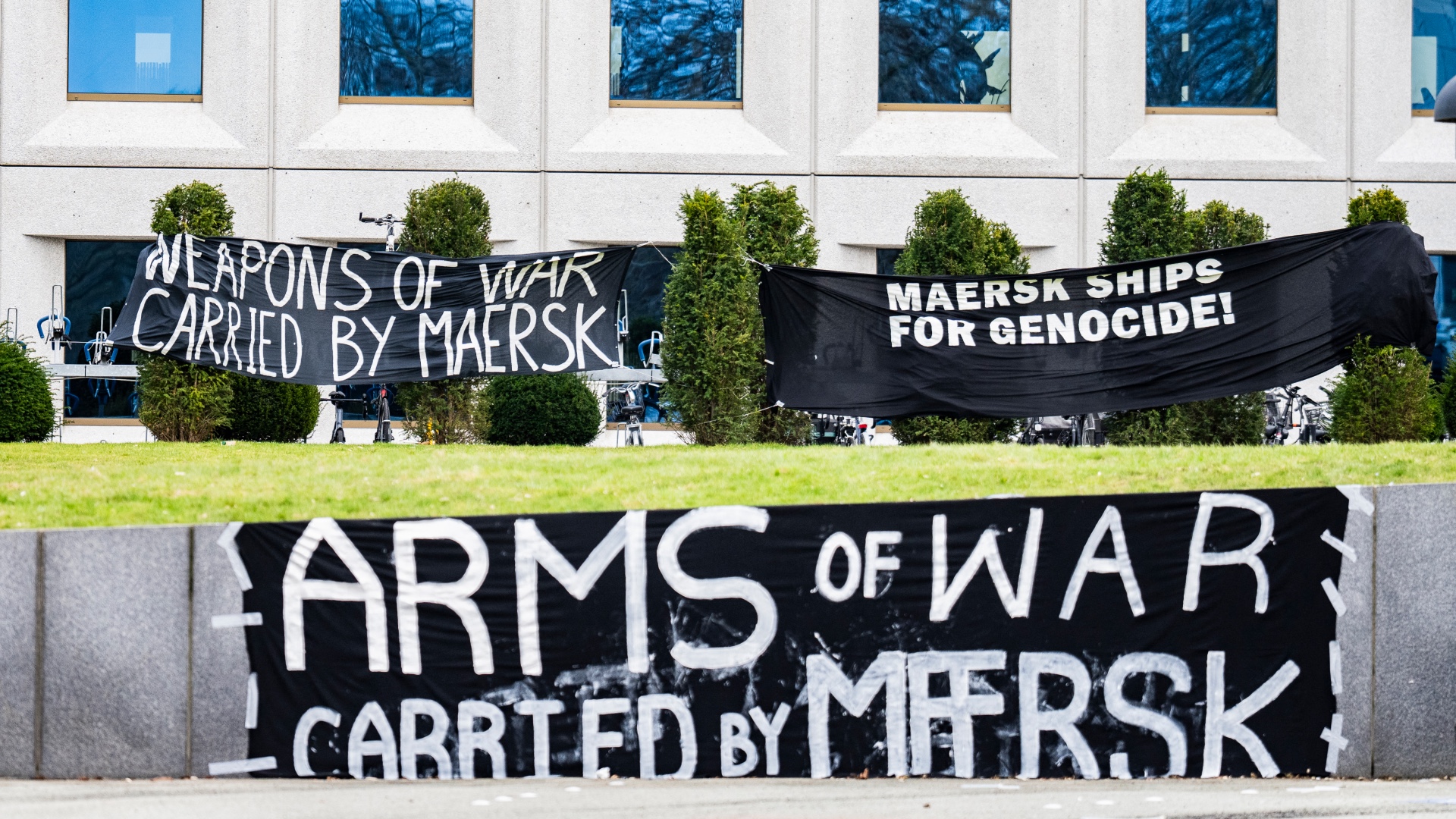
A joint investigation released Monday by the Palestinian Youth Movement (PYM) and Oxfam Denmark has thrown into sharp question public claims from Danish shipping conglomerate Maersk that it has refused to transport weapons to Israel since the outbreak of the 2023 Gaza conflict. The investigation, the centerpiece of the grassroots #MaskOffMaersk accountability campaign, alleges that Maersk has overseen the consistent shipment of critical small arms parts and large explosive components to top Israeli weapons manufacturers, in direct contradiction of the firm’s stated policies.
According to the report’s authors, the shipments include small-caliber bullet and rifle parts identical to those used in the 2024 killing of 6-year-old Palestinian child Hind Rajab, a death that drew international outcry, as well as thousands of other civilian casualties in Gaza. The cargo also includes empty casings for the 900-kilogram MK-84 “bunker buster” bombs that the Israeli military has deployed extensively across Gaza and southern Lebanon.
Investigators cross-referenced shipping records and official bills of lading to trace a steady stream of components from 10 suppliers – nine based in the United States, and one in India – to Israeli defense contractors via Maersk-owned vessels. The largest intended recipient is Elbit Systems, Israel’s biggest weapons manufacturer, which acquired former state-owned defense producer IMI Systems in 2018. Between October 2023 and July 2025 alone, the report documents more than 1.42 million kilograms of bullet cores and brass cartridge casing cups shipped from three U.S. firms to IMI, parts destined for 5.56 mm and 7.62 mm rifle ammunition, the standard rounds used by Israeli infantry forces.
Additional shipments identified in the report include MK-84 bomb casings from U.S. defense giant General Dynamics, 230-kilogram MPR-series general-purpose bomb parts from Elbit Systems of America, and mortar system components from four additional U.S. suppliers. India’s Sri Kaliswari Metal Powders also used Maersk vessels to ship aluminum powder for explosive manufacturing to Israel, according to the investigation.
“Their actual practice is to completely ignore the policies that they have on the books,” Nadya Tannous, international coordinator for the #MaskOffMaersk campaign, told Middle East Eye in an interview. “Our question to Maersk is: What’s a weapon? You don’t ship weapons, so what is a weapon?”
When reached for comment by Middle East Eye on the report’s allegations, Maersk reiterated its longstanding public position: “From the outset of the conflict, we have maintained a strict policy of not shipping weapons or ammunition to Israel. As the conflict escalated, we have further enhanced our screening and acceptance procedures and implemented additional compliance measures. Our compliance processes for military-related cargo are based on EU, US, and Danish laws including the Wassenaar Arrangement, the EU’s common military list and the International Traffic in Arms Regulations as well as UN resolutions.”
Elbit Systems, which generates roughly $2 billion in annual revenue and employs 20,000 people globally, supplies approximately 85 percent of Israel’s drones and land-based military equipment. The Gaza health ministry reports that at least 72,980 people have been killed and 173,170 wounded in Israel’s ongoing military campaign in Gaza, and UN Special Rapporteur for Palestine Francesca Albanese noted in a 2024 report that Israeli defense firms including Elbit have reaped massive profits from the conflict, describing the Gaza war as a “profitable venture” for the sector. Elbit has long been a target of pro-Palestinian activism across Europe and North America over its ties to Israeli military operations.
Unlike many other pro-Palestinian campaigns targeting corporate ties to Israel, the PYM-Oxfam Denmark report does not call for a broad boycott of Israel. Instead, the campaign is explicitly calling for a global consumer and industry boycott of Maersk, and demanding immediate policy change from the shipping giant. Tannous emphasized that the campaign is part of a broader push to hold corporations accountable for facilitating what pro-Palestinian activists and numerous international legal experts have labeled genocide in Gaza.
“We don’t want policy statements, we want material change from the company,” Tannous said. “This campaign is part of a larger nexus of accountability for the Israeli government and the Israeli military. It falls within the corporate accountability campaign for those corporations that facilitated the genocide.”
The report lays out three clear demands for Maersk: immediately halt all shipments of weapons components to Israel, conduct comprehensive independent human rights audits of all global operations, and end all commercial activity that supports Israeli military operations, warning that continued shipments leave the company open to charges of complicity in war crimes and genocide in Gaza.
This is not the first time Maersk has faced public pressure over its links to Israeli military activity. Protests have been held consistently outside the firm’s Copenhagen headquarters for more than two years, with a large demonstration held just last month over Maersk’s role in resupplying Israel amid its multi-front regional conflicts. Multiple countries have already moved to restrict military cargo shipments to Israel, with Spain banning the use of its ports for military-bound cargo to Israel in May 2024.
Tannous noted that Maersk’s near-ubiquitous presence in global port infrastructure makes the company a fair target for collective action by people of conscience around the world. “Maersk is everywhere, right? They’re in every port, for the most part, they use our roads, they use our bridges, they use our public infrastructure,” she said. “What does it mean for us as people of conscience around the world, who majority understand and know that this genocide is ongoing, it’s wrong… to not lose hope in terms of being able to actually affect change for those in power? We demand accountability. There are many methods to do that, and we hope that this report is one of the ways of offering really valuable and precise information.”
Public records show Maersk’s leadership has sent mixed signals on its military cargo policies in recent months. In March 2025, Maersk’s CEO told shareholders that the firm never transports weapons to active conflict zones, but allows other types of military-related cargo – though he declined to clarify the exact distinction between the two categories. The company has also not publicly revised its policy on transporting components for F-35 fighter jets, which the Israeli Air Force has used extensively to bombard residential areas of Gaza. In a July 2025 statement, Maersk only noted that the full F-35 supply chain is controlled by a coalition of partner governments, an argument that echoes previous framing used by other firms tied to weapons exports to Israel.
That same July 2025 statement did include one major concession: Maersk announced it would reassess all commercial ties to firms linked to illegal Israeli settlements in the occupied West Bank, a move that came after months of sustained pressure from pro-Palestinian activists. The company stated it already adheres to international standards for responsible business practice, and will align any operational changes with guidance from the United Nations High Commissioner for Human Rights (OHCHR). The OHCHR first published a database of firms operating in and profiting from illegal Israeli settlements in 2020, naming more than 100 companies that contribute to human rights abuses against Palestinians.
In the same July statement, Maersch also pushed back against Albanese’s 2024 report on corporate complicity in human rights abuses in Palestine, claiming her report drew on unvalidated third-party data.