Fresh developments in the ongoing Russia-Ukraine war have unfolded rapidly across the Black Sea region, Ukrainian territory and diplomatic circles this week, mixing targeted military strikes, accidental security incidents and renewed calls for direct peace negotiations.
Ukrainian drone forces announced overnight strikes against five unmarked vessels operating in the Sea of Azov and coastal waters surrounding the Russian-occupied Ukrainian ports of Mariupol and Berdyansk. According to Robert Brovdi, commander of Ukraine’s drone units, the targeted ships had covered their identifying markings and disabled radar transponders to conduct two illicit activities: smuggling stolen Ukrainian grain out of occupied territory and moving military supplies and fuel for Russian forces. Brovdi did not reference any casualties in his statement, and Ukraine has not formally claimed responsibility for any fatalities linked to the strikes.
The strikes came just one day after Ukrainian President Volodymyr Zelensky made an unexpected public call for a face-to-face summit with Russian President Vladimir Putin to negotiate an end to the nearly three-year full-scale conflict. In an open letter released Thursday, Zelensky argued that waiting for renewed US diplomatic focus on the war was a strategic mistake, and that sustainable peace could only be achieved through direct, high-level engagement between the two warring parties. He also proposed a full ceasefire to take effect for the duration of any negotiations – a condition Putin quickly rejected in comments made hours later.
In simultaneous Russian strikes across multiple Ukrainian regions over the 24-hour reporting period, local officials confirmed at least 13 civilian deaths and more than 70 injuries. The deadliest single attack targeted a dairy factory on the outskirts of Kyiv, where four workers were killed. Other fatalities and injuries were recorded in Kherson, Kharkiv, Sumy, Zaporizhzhia, Chernihiv and Dnipro regions, with damaged infrastructure including food storage warehouses, a postal facility and a local school, per Zelensky’s account.
Diplomatic reactions to Zelensky’s peace summit proposal have been divided, with Western powers expressing broad support. US former President Donald Trump told reporters Thursday that a meeting between the two leaders would be positive, adding he expected both sides would make the necessary compromises to advance talks. The European Union and France have also backed the initiative. The Kremlin confirmed it had received Zelensky’s letter, with spokesperson Dmitry Peskov indicating Putin would address the proposal during his planned address at a major St. Petersburg economic forum on Friday.
Speaking to reporters Thursday ahead of the forum, Putin offered a muted response to the proposal before even reviewing the letter’s text. While he claimed Russia remained “willing to reach an agreement” with Ukraine, he repeated longstanding Russian preconditions for any deal: Ukraine must cede full control of the four partially occupied regions of Donetsk, Luhansk, Kherson and Zaporizhzhia, and permanently abandon its bid to join NATO. He also repeated Russia’s disputed claim that Zelensky’s presidency is illegitimate, arguing no new election has been held since his term expired in 2024 – a claim that ignores Ukraine’s legal suspension of elections under ongoing martial law imposed after Russia’s 2022 full-scale invasion. Ukraine has repeatedly rejected territorial concessions, stating any surrender of land would only encourage further Russian aggression.
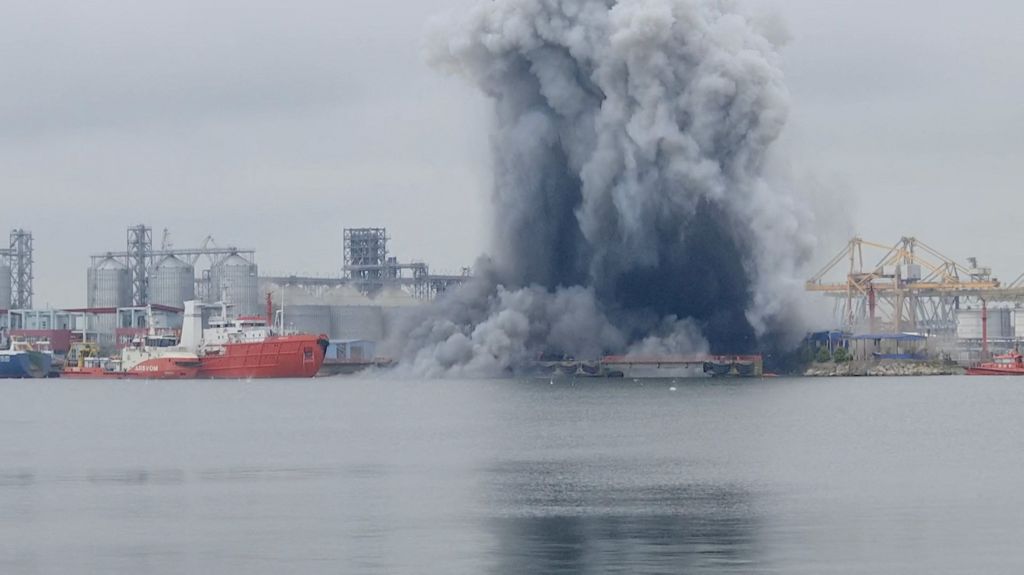
Parallel to strikes and diplomatic moves, a stray Ukrainian naval drone exploded off Romania’s Black Sea coast on Friday near the major port of Constanta, marking the third security incident involving stray military ordnance on Romanian territory in a single week. Initial reports from Romanian authorities confirmed the drone self-detonated near an oil terminal, causing significant damage to a moored ship and adjacent warehouse infrastructure but no casualties. Constanta’s regional governor Adrian Teodor Picoiu told local media outlet G4Media that Ukrainian intelligence indicates the drone was one of a five-drone formation, with a second drone detonating inside Ukrainian territory. Ukraine later confirmed the drone belonged to its navy, blaming Russian electronic warfare interference for knocking the vessel off course into neutral Romanian waters. The remaining three drones are still unaccounted for, though officials have stated there is no ongoing public safety risk.
This incident comes on the heels of two other recent security breaches in Romania, a NATO member that shares a long border with Ukraine. Just days earlier, a stray naval mine washed up on a Black Sea beach 50 kilometers north of Constanta, and a week prior a Russian drone crashed into an apartment building in the eastern Romanian border city of Galati, injuring two civilians. Romanian officials confirmed the Galati drone was Russian, though Moscow has dismissed the accusation as unsubstantiated.
Complicating the picture of the Sea of Azov strikes, Azerbaijan’s foreign ministry announced Friday that five of its citizens were killed in overnight drone attacks on two cargo vessels, the *Natra* and *Zirkon*, in the Taganrog Bay area of the Sea of Azov. The ministry clarified the ships do not belong to Azerbaijan and did not name the party responsible for the strikes. Russia has pinned the attack on Ukraine, but Kyiv has not issued any immediate response to the Russian accusation, nor has it linked the Azerbaijani deaths to its claimed strikes on looting cargo vessels.