When the Global Sumud Flotilla set sail on May 18 to break Israel’s aerial, land and sea blockade of the Gaza Strip, its cargo held far more than life-sustaining basics. Alongside stockpiles of food, clean drinking water, infant formula and critical medical equipment targeted to Gaza’s collapsing healthcare system, the aid mission carried a surprising, gentle addition: portable homemade bubble play kits. These simple kits, crafted from just soap, water, rope and wooden sticks, are the core initiative of Bubbles Not Bombs (BNB), a grassroots humanitarian project dedicated to giving children trapped in war zones and displaced by conflict small, precious moments of respite through mindful bubble play.
For 15 years, BNB operated under the umbrella of Dr Zigs, a Welsh eco-friendly toy company founded by 56-year-old Italy-born Paola Dyboski that frames play as a foundational tool to support children’s emotional wellbeing in crisis settings. Just recently, the initiative spun off to become an independent non-profit organization, expanding its reach to conflict-hit regions across the globe.
Dyboski does not minimize the urgent need to deliver basic necessities to Gaza, where the Palestinian health ministry confirms more than 22,000 Palestinian children have been killed since the start of Israel’s military campaign launched after the October 7, 2023 Hamas-led attack. But she has long argued that play itself is a universal human right that no child, even in the midst of active conflict, should be denied.
Currently, BNB is working to deliver physical bubble kits to children across Gaza and southern Lebanon, where ongoing Israeli military operations have killed more than 3,500 people and displaced nearly one million since March 2024. To bridge gaps in delivery amid restricted access, the organization has already shared simple, open-source digital instructions for making homemade bubbles using locally available materials, so children and caregivers can build their own kits without waiting for external shipments.
Dyboski explains that the soft, fleeting nature of bubbles, with their inherent joy and lightness, offers children living with chronic trauma a tangible tool to process fear and grief, articulate unspoken difficult feelings, regulate their breathing, and stabilize their emotions amid constant chaos.
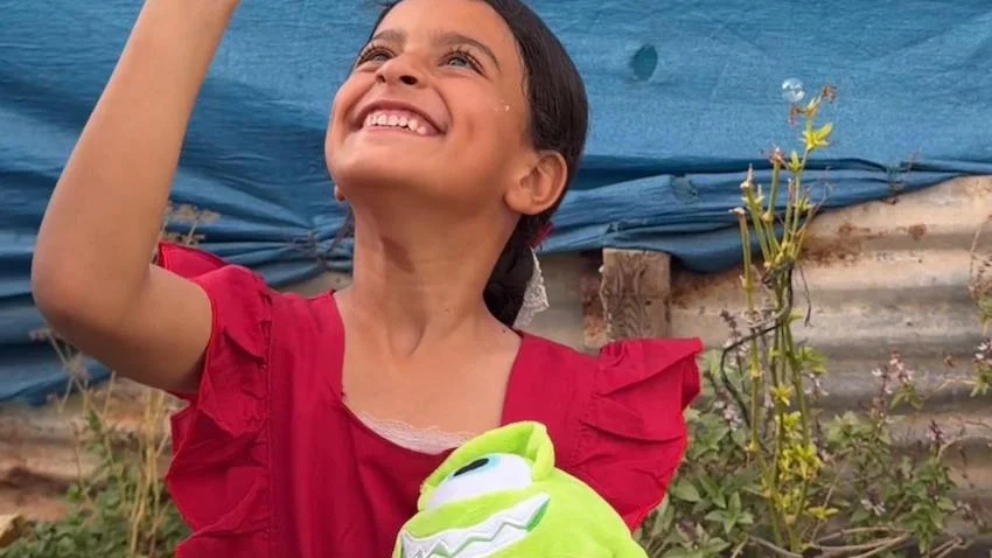
That impact is visible on the ground in Gaza, where Mohamed Abushbeka has cared for his two young nieces since their father was killed in the first weeks of Israel’s military campaign. Last week, BNB reposted a video Abushbeka shared of his older niece, Batool, blowing bubbles inside an overcrowded displacement camp.
“Bubbles give children these rare stretches of joy, safety, and escape from all the anxiety and brutal reality around them,” Abushbeka told Middle East Eye in an interview. He emphasized that bubble play helps children release overwhelming emotions they often lack the words to name, giving them a brief, tangible sense of freedom. “You see them running, laughing, chasing the bubbles as they float up, then suddenly fall and burst,” he said.
He added that bubble play is uniquely accessible in a context where most resources are scarce: it is low-cost, simple to make, and children will repurpose any available materials, from plastic cups to discarded small tubes, to make their own wands. For caregivers working to preserve any shred of normal childhood for the next generation, protecting these small moments of play is non-negotiable, Abushbeka said. “One day, Palestinian children will laugh without fear, sleep without bombs, and grow up surrounded by peace instead of loss,” he wrote on his Instagram page.
Leigh Evans, a Welsh emergency nurse, paramedic and activist with four medical aid missions to Gaza under his belt, has witnessed first-hand the constant trauma that shapes daily life for Gaza’s children, and the heartbreak of seeing them robbed of the chance to just be kids. “I think children’s need to play and develop as whole human beings should be a major part of what we count as essential aid,” Evans said.
He reflected on how Gazan families work tirelessly to preserve small bits of normalcy even amid widespread destruction, recalling invitations to share meals in partially bombed-out homes, where families leaned on cooking and play to comfort their children when death could come at any moment. Evans has long integrated BNB’s bubble kits into his solidarity work: he joined the Global Sumud Flotilla mission, used bubble play during the 2025 Global March to Gaza, blew bubbles during a peaceful Red Line solidarity rally in West Wales last week, and joined activists in a direct action outside Israeli weapons manufacturer Elbit Systems in March, where bubble play was used to disrupt production of munitions deployed in Gaza.
“Bubbles are wonderfully therapeutic,” Evans said. “They offer a small but incredibly powerful form of psychological relief for children in conflict zones, letting them be children in a place where they would otherwise have no space for that.”
Sabine Choucair, a Lebanese performer and co-founder of Clown Me In, an organization that brings arts programming to children in crisis zones, frames bubbles as uniquely magical for young people. “Bubbles are magical, like small globes that reflect everything around children,” she explained. “They bring kids together and give them a low-stakes way to experiment and play.”
Choucair, who has 20 years of experience performing for children in refugee camps and disaster zones across the world, recently partnered with BNB by sharing a video of her original activity “Pop the Fear”, where children are invited to name their fears, visualize placing them inside a bubble, pop the bubble to release the fear, then blow new bubbles to make space for joy and hope.
Speaking of the ongoing crisis in Lebanon, where children are once again displaced, forced out of school, and forced to re-live the trauma of bombardment and home loss, Choucair pushed back against the narrative that mental health and play support are secondary to basic aid. “Imagine re-living the loss of your home, hearing drones and bombs again, and being out of school once more,” she said. “How are we supposed to survive if our mental state is destroyed?”
Mental health experts echo this framing, noting that even when basic survival needs are unmet, psychosocial support for children facing repeated bombardment, displacement and grief is not a secondary priority—it should be a core component of any emergency response. A powerful video from the Gaza-based Sameer Project illustrates this impact, showing a young girl channeling her fear of shelling and famine into popping bubbles, before sharing her wish to be reunited with her mother, who was killed in the conflict.
“It’s a simple but deeply effective way to help children process trauma,” Dyboski said. “Creating moments of play is healing. They can feel a sense of control and make the experience their own.”
Beyond Gaza and Lebanon, BNB has already begun distributing bubble kits to children in Myanmar and at Cox’s Bazar in Bangladesh, home to the world’s largest refugee camp. The organization is working to expand access to Sudan in partnership with local group Let’s Have Hope, though shipment challenges have delayed entry to date. It also plans to send kits to children in the Democratic Republic of Congo and Ethiopia’s Tigray region, both sites of ongoing protracted conflict.
“We need to make sure children not only survive but are also able to grow into human beings who can live, love and function fully,” Evans said. Citing UNICEF data that an estimated 473 million children worldwide currently live in active conflict zones, Dyboski says the work is far from over. “We’ve got a lot of children to reach.”