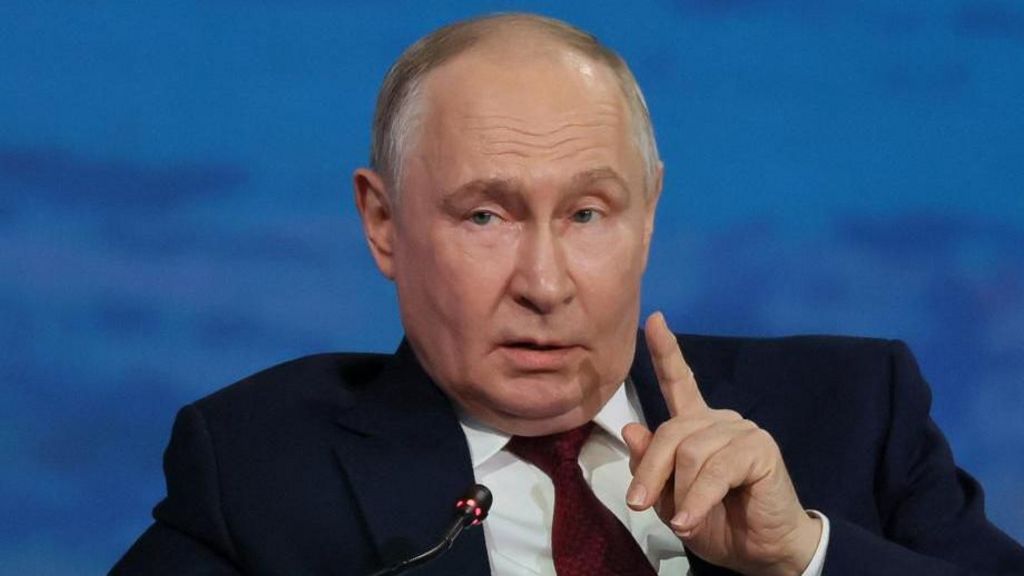
Fresh tensions have flared in the 3-year-old Russia-Ukraine conflict after Russian President Vladimir Putin turned down a public request from Ukrainian leader Volodymyr Zelenskyy for one-on-one negotiations to end the full-scale war that launched in 2022.
Zelenskyy published an open letter Thursday that formally called for face-to-face talks with Putin, arguing that the international community cannot afford to wait for renewed U.S. focus on the conflict to push forward peace processes. The letter included a defiant, occasionally mocking tone toward the Russian leader — including jabs at his decades in power and recent Ukrainian drone strikes on Russian territory, one of which targeted St. Petersburg just days prior, which Zelenskyy framed as a “visit” to Russia. The Ukrainian president also called for an immediate ceasefire to precede formal negotiations.
Putin pushed back against the request Friday during remarks at Russia’s annual St. Petersburg International Economic Forum, dismissing the letter as “rude” and arguing it was never intended to set the groundwork for genuine dialogue. “Was it a way to create the conditions for a face-to-face meeting or a way not to set up a face-to-face meeting? I think it was the second,” Putin told attendees.
The Russian leader doubled down on his long-held negotiating position, which holds that a ceasefire cannot come before binding peace agreements are reached. He warned that a temporary pause in fighting would only allow Ukrainian forces to regroup and rearm, while Moscow’s core demands remain unaddressed. “The only point [of a ceasefire] is for the Ukrainian side to halt the advance of our armed forces. But we need agreements — not for six months, not for three months, but for the long term,” Putin said. “Let the experts get to work and come up with some solutions. After that, we can meet.”
Putin reaffirmed that military operations will continue until Russia achieves its stated war aims, which include Ukraine ceding control of the four Donetsk, Luhansk, Kherson, and Zaporizhzhia regions and permanently abandoning its bid to join NATO. Kyiv has repeatedly rejected these demands, refusing to surrender any sovereign territory and noting that Russia launched its full-scale 2022 invasion eight years after annexing Ukraine’s Crimean Peninsula, arguing territorial concessions would only embolden future Russian aggression.
When asked directly whether he would meet Zelenskyy for talks, Putin responded clearly: “I don’t see any point for now.”
While Zelenskyy’s overture was met with cautious hope in some international circles, including the White House, where former U.S. President Donald Trump said a meeting between the two leaders “would be great,” the conflict on the ground continued to escalate even as diplomatic efforts stalled.
On the same day as Putin’s remarks, Ukrainian military officials announced they had struck five vessels carrying unauthorized cargo in the Sea of Azov and off the coast of Russian-occupied Ukrainian territory. Robert Brovdi, commander of Ukraine’s drone forces, said the targeted ships were involved in stealing Ukrainian grain and transferring fuel and military supplies to Russian forces.
Azerbaijan’s foreign ministry later confirmed that five civilians were killed in attacks on two of the ships, adding that the vessels were not Azerbaijani-flagged and did not specify who it held responsible for the casualties.
In another separate incident, a Ukrainian drone detonated in the Romanian Black Sea port of Constanta this week. Ukrainian military operators said the drone was blown off course by Russian electronic warfare interference, marking an accidental incursion into NATO-member Romanian territory.
Russia launched a wave of new attacks across Ukraine in the 24 hours prior, killing at least 13 people and wounding 70 more, Ukrainian emergency officials confirmed. Four workers died when a dairy factory outside Kyiv was hit, while a 35-year-old woman was killed in a drone strike on a Kherson petrol station, among other casualties reported across the country.