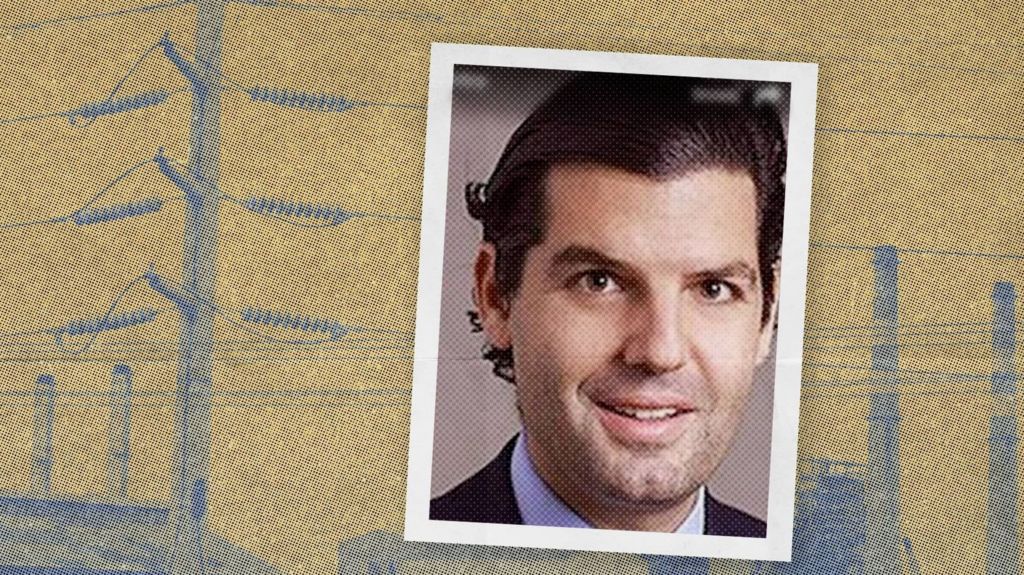
A blockbuster deal that grants the United States operational control over 17 of Venezuela’s most strategically valuable crude oil fields, holding an estimated 65 billion barrels of proven reserves, has drawn intense global scrutiny – and it all revolves around one polarizing Venezuelan business figure: Alejandro Betancourt López. The 46-year-old oil tycoon, who heads Barbados-registered North American Blue Energy Partners (Nabep), the little-known firm tapped to oversee production and sales of the oil assets, has called the agreement ‘the biggest in history’, per former US President Donald Trump. But Betancourt’s long, tangled history of political connections, cross-border corruption investigations, and pivoting between Venezuela’s opposing political factions has left many questioning how a figure with his background landed one of the most valuable energy contracts on the planet.
Born in Caracas in 1980 to a middle-class Venezuelan family, Betancourt earned a degree from Boston’s Suffolk University and has amassed an estimated personal net worth of roughly $2.6 billion. Reporters who have tracked his decades-long career trace his early rise not just to entrepreneurial acumen, as his official biography claims, but to high-level connections forged in his private school days. Venezuelan investigative journalist Alek Boyd, who has followed Betancourt’s work since 2011, notes that Betancourt built a close school friendship with Javier Alvarado Pardi, the son of a senior energy industry executive who would go on to hold top roles at Venezuela’s state-owned oil giant Petróleos de Venezuela (PDVSA) and serve as the country’s deputy energy minister.
That connection opened doors at the height of Venezuela’s 2009 national electricity crisis, when the younger Alvarado introduced Betancourt and his business partners to his father – despite the group having zero prior experience in power infrastructure. Shortly after, Derwick Associates, the engineering firm Betancourt co-founded with his cousin, secured 12 no-bid government contracts worth a collective $5 billion to build 11 new power plants across the country. It was during this era that Betancourt and a cohort of other young, rapidly wealthy Venezuelan entrepreneurs doing business with the Hugo Chávez-led government earned the nickname ‘bolichicos’, a portmanteau of ‘Bolivarian’ (referring to Chávez’s socialist revolution) and ‘chico’, Spanish for boy. Betancourt’s US legal team rejects the label, arguing it is a media-coined pejorative that unfairly lumps successful young entrepreneurs together regardless of individual conduct.
While Derwick has claimed it completed all contracted electrification projects, leading anti-corruption watchdogs have leveled serious fraud allegations against the firm. Transparency Venezuela and the Organized Crime and Corruption Reporting Project have claimed many of Derwick’s projects were left unfinished or built to substandard specifications. A 2018 Transparency Venezuela analysis estimated the 11 power projects should have cost just $2.1 billion – meaning the Venezuelan government overpaid by 138% for the work. Betancourt’s legal team has repeatedly dismissed these allegations as politically motivated smear campaigns, and the businessman has never been convicted of any wrongdoing connected to the claims.
Despite the controversy, Venezuelan authorities soon allowed Derwick to expand into the country’s lucrative oil sector. Over the following decade, Betancourt built a sprawling global business empire: he acquired a controlling stake in Spanish sunglasses brand Hawkers in 2016, took over banking assets in Switzerland and Africa, and according to Transparency Venezuela’s investigations, now controls a network of roughly 50 companies operating across 16 countries.
Betancourt’s international expansion has been matched by mounting legal trouble across five nations. In 2013, former US ambassador to Venezuela Otto Reich filed a civil lawsuit against Betancourt and two associates, accusing them of paying massive bribes to Venezuelan public officials in exchange for the Derwick contracts. The suit was dismissed in 2018, but new investigations soon followed. In recent years, judicial authorities in Spain, Switzerland, Andorra, and the United States have opened probes into Betancourt and other bolichicos over alleged ties to PDVSA-linked corruption schemes. No formal charges have ever been brought, and Betancourt has consistently denied all wrongdoing.
The tycoon made global headlines again in 2025, when he was detained twice by British police in London, where he had established residency in recent years. Shortly after the detentions, Spanish law enforcement raided Alamín Castle, Betancourt’s sprawling palatial estate in Toledo province. Both actions were connected to a money laundering investigation launched by Swiss public prosecutors, according to official reports. Betancourt’s attorney has argued the businessman is being unfairly targeted by association, saying: ‘This is a group of very successful young entrepreneurs… some have broken the law and others haven’t, but they’ve all been lumped together.’
So what led US officials to select Betancourt as the lead partner for the high-stakes Venezuela oil deal? US Secretary of State Marco Rubio laid out three clear justifications in an interview with Venezuelan journalist Sergio Novelli. First, Rubio argued Betancourt has a proven track record of bringing oil production online. Independent experts estimate Nabep currently produces roughly 180,000 barrels of crude per day, second only to Chevron’s 200,000 daily barrels in Venezuela, though other analysts have questioned the accuracy of these production figures. Second, Rubio noted that Betancourt faces no active investigations from US law enforcement. Third, and finally, Rubio emphasized that Betancourt has long been a prominent backer of the Venezuelan political opposition, a key alignment for US policy.
Unlike many other business figures who grew wealthy under Chávez, Betancourt never publicly aligned with the late president’s Bolivarian ideology. Industry analysts note he and his partners simply saw and seized a major business opportunity during the Chávez era, and quickly shifted alliances when Venezuela’s political landscape began to change. During Trump’s first term, Betancourt built a close working relationship with opposition leader Juan Guaidó, a connection that helped him forge ties with influential Trump-aligned US officials including former Latin America Special Envoy Mauricio Claver-Carone and former New York City Mayor Rudy Giuliani, according to journalist Alek Boyd.
When Betancourt participated in a 2019 attempt to oust sitting Venezuelan president Nicolás Maduro, Maduro retaliated by stripping him of his Venezuelan oil assets and forcing him into exile, where he split his time between Madrid and London. But Betancourt’s high-level US connections ultimately cleared the way for his return to the center of Venezuelan oil politics. In late 2025, US authorities reportedly pressured Swiss officials to withdraw their extradition request for Betancourt in British courts. Swiss authorities complied, and a London court lifted his travel ban last May. Betancourt’s attorney confirmed the ruling, noting that the lifting of the travel ban came after Switzerland failed to produce evidence requested by UK judges to support the extradition request, though the underlying Swiss investigation remains open.
In the immediate aftermath of the January 3 US military operation that resulted in the capture of Maduro, Betancourt stepped in as a key intermediary between the opposition and sitting Venezuelan officials, according to reporting from Axios. The outlet reports Betancourt contacted then-Vice President Delcy Rodríguez, now serving as Venezuela’s interim president, and convinced her to hold talks with Rubio. Betancourt’s attorney confirmed the account, clarifying: ‘He acted as an intermediary. He had nothing to do with Maduro’s departure, but since he had everyone’s trust, he became an intermediary.’ Earlier this week, Rodríguez publicly defended Betancourt, confirming he has no open legal cases pending against him in either Venezuela or the United States, noting: ‘Often a person is judged in the media before in the courts.’
For observers who have tracked Betancourt’s decades of navigating Venezuela’s volatile political and economic landscape, his rise to the center of the new US-Venezuela oil deal comes as no surprise. As investigative journalist Boyd summed up: ‘He’s very skillful. He always manages to be where he needs to be to avoid problems and make money.’