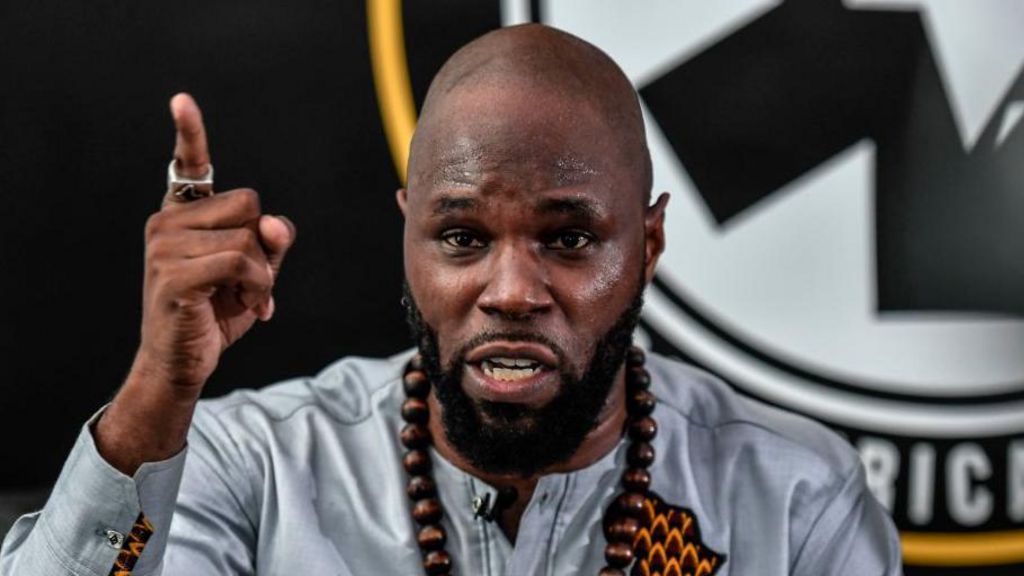
Controversial radical Pan-African anti-colonial activist Kemi Seba, 45, is currently behind bars in South Africa following his arrest last week during a sting operation in Pretoria, where authorities allege he was attempting to escape to Europe via Zimbabwe alongside his 18-year-old son and a South African Afrikaner nationalist leader. The detention caps decades of high-profile run-ins with law enforcement across multiple African and European nations, tied to Seba’s unflinching opposition to French post-colonial influence in West Africa and his open alignment with anti-French military juntas in the Sahel region.
Born Stellio Gilles Robert Capo Chichi in Strasbourg, France, to Beninese parents in 1981, Seba’s ideological trajectory began taking shape during his teenage years, when a trip to the United States exposed him to the black nationalist teachings of the Nation of Islam, the organization once led by prominent civil rights figure Malcolm X. Returning to France at 18, he stepped into a role as a national ambassador for the group, before a subsequent trip to Egypt led him to adopt Kemetism, a belief system rooted in ancient Egyptian theology.
In 2004, Seba founded Tribu Ka, a radical black segregationist movement that became a vehicle for spreading antisemitic rhetoric. The French government banned and dissolved the organization just two years later, handing Seba a one-month prison sentence for his role in leading the group. Undeterred, he relaunched the movement under the new name Generation Kemi Seba, and in 2008 he was handed a six-month prison sentence, four months of which were suspended, for reestablishing the banned group. Mounting legal and public pressure eventually pushed him to leave France for Senegal following his release.
Over the next 15 years, Seba built a large and loyal following across West Africa, particularly among young social media users, by centering his activism on ending what he frames as neocolonial French control of the region. A core pillar of his campaign has been the demand to abolish the CFA franc, the currency created by France in the 1940s for its African empire that remains pegged to the euro and backed by the French treasury, used today by 14 West African nations including Benin, Senegal, and Ivory Coast. In 2015, he launched Pan-Africanist Emergency, the NGO he still leads, which frames its mission as advancing black rights, African sovereignty, and social justice while combatting neocolonialism.
The high point of his anti-CFA activism came in 2017, when he burned a 5,000 CFA franc note at a protest in Dakar to denounce *Francafrique*, the term for France’s enduring post-colonial political and economic influence over its former African holdings. He was arrested immediately after the protest but acquitted days later on a technicality, with thousands of his supporters taking to the streets of Dakar to celebrate his release. A month later, Senegalese authorities, citing threats to public order, deported him back to France.
Deportations and arrests would become a recurring pattern across the region for Seba, who has been expelled from Togo, Guinea, and Ivory Coast over the past decade for his anti-French organizing and criticism of pro-French regional leaders. He has also been repeatedly detained in Benin, where he has been a vocal opponent of outgoing President Patrice Talon. In 2024, France stripped Seba of his citizenship in response to his activities; he publicly burned his French passport in protest, and just one month later, the military junta that seized power in Niger granted him a diplomatic passport and named him a special advisor to junta leader Brig Gen Abdourahmane Tchiani.
In the years since a wave of military coups swept the Sahel, bringing anti-French military regimes to power in Niger, Mali, and Burkina Faso that have cut military ties with Paris and aligned closely with Moscow, Seba has become one of the most visible and polarizing figures in pan-African politics. Chatham House Africa Programme researcher Paul Melly notes that Seba has shifted from early activism marked by widespread accusations of antisemitism to a near-exclusive focus on his anti-French, anti-colonial platform that resonates deeply with growing anti-French sentiment among young West Africans. Critics, including senior French officials, have repeatedly accused Seba of acting as a mouthpiece for Russian propaganda and maintaining ties to the Russian paramilitary group Wagner, claims that Seba has never publicly confirmed. In 2025, French authorities detained him on suspicion of links to Wagner before releasing him without charge.
Today, Seba faces his most serious legal jeopardy yet. He was arrested in South Africa last week on charges of violating immigration rules, having overstayed his visa by roughly two months after living in the country for five months. South African police confirm Seba is a wanted fugitive in both France and Benin, with extradition proceedings already underway. Benin’s special prosecutor Elonmario Metonou confirmed the country is preparing an official extradition request, after issuing two international arrest warrants for Seba in December 2025. The warrants stem from Seba’s alleged support for a foiled coup attempt against Talon’s government that same month; hours after the coup attempt, Seba published an online video calling the event a “day of liberation” for Benin. Benin has also added an additional charge of money laundering against the activist.
Two other people were arrested alongside Seba during the Pretoria sting: his son, Khonsou Seba Capo Chichi, and Francois van der Merwe, leader of the Afrikaner nationalist group Bittereinders, who authorities accuse of helping the pair organize their escape to Europe.
Seba has not yet issued any public comment on the charges against him, but leaders of his organization have pushed back aggressively against Benin’s allegations. Pan-Africanist Emergency international coordinator Hery Djehuty, the group’s second-in-command, told reporters that Benin’s claims will not “stand up to scrutiny,” describing the late addition of money laundering charges as a deliberate fabrication designed to strengthen the extradition request. Djehuty also denied widespread reports that Seba had applied for political asylum in South Africa.
In an official statement, Pan-Africanist Emergency called on its supporters to remain calm amid what it frames as a coordinated disinformation campaign against Seba led by pro-*Francafrique* media outlets. “Far from weakening him, these manoeuvres only strengthen the legitimacy and scope of his commitment to social justice, sovereignty, and African dignity,” the statement read. “History teaches an immutable truth: you cannot silence a people by breaking its bravest voices. There is an eternal Benin, just as there remains an African DNA of insubordination.”
Seba’s bail hearing is scheduled to take place on 29 April, with the timeline for any potential extradition still unclear as South African authorities have not yet confirmed which country will receive priority for the request.