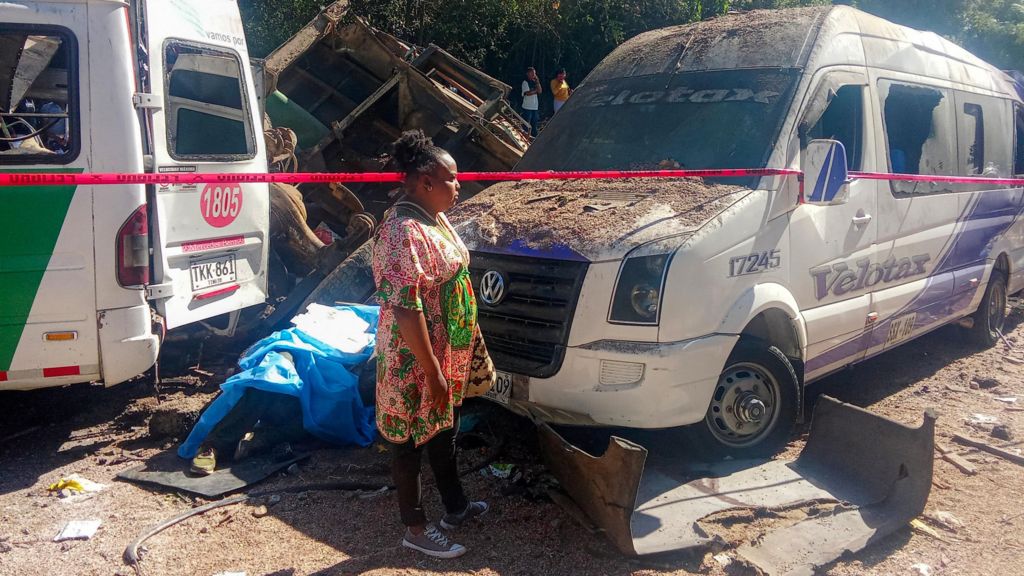
A devastating improvised explosive attack on a major Colombian highway has killed at least 14 people and left dozens of others critically wounded, among them several underage victims, in a region long plagued by insurgent violence. Colombian national authorities have directly linked the coordinated attack to dissident guerrilla factions operating in the country’s southern territory. The attack unfolded on a busy public highway in Cauca, a southern province that has faced persistent resurgences of armed conflict in recent years. Footage circulated from the blast site immediately after the explosion shows multiple passenger and civilian vehicles reduced to charred, crumpled wreckage, with debris scattered hundreds of meters across the asphalt. Witness accounts collected by Agence France-Presse confirm the force of the blast was powerful enough to throw bystanders several meters back from the roadside, leaving onlookers shaken and stunned.
Colombian President Gustavo Petro, whose current term ends later this year and who has centered his administration on a flagship “total peace” negotiation strategy with armed groups, publicly condemned the attack in a post to social media platform X. He labeled the perpetrators “terrorists, fascists and drug traffickers” and called on Colombia’s top military personnel to launch an immediate, full-scale response against the responsible factions. President Petro specifically tied the bombing to breakaway dissident groups originating from the Revolutionary Armed Forces of Colombia (Farc), Latin America’s one of the longest-running insurgent movements that formally disarmed following a 2016 peace deal with the Colombian government.
Local Cauca Governor Octavio Guzman echoed the president’s condemnation, sharing his own on-site footage showing upturned vehicles and deep craters pockmarking the highway. He described the bombing as an “indiscriminate” act of barbarism, stressing that the province cannot continue to bear the brunt of escalating violence without greater national support. Guzman also confirmed that the highway bombing is not an isolated incident: a wave of smaller coordinated attacks has swept through Cauca since the previous Friday. Among these parallel attacks was an assault on a military base in the nearby city of Cali that left two service members injured. Colombian Defense Minister Pedro Arnulfo Sánchez added that authorities also intercepted and disabled a vehicle-borne explosive device, hidden in a passenger bus, that failed to detonate earlier the same day as the highway bombing, an attack he attributed to drug trafficking cartel operatives with ties to armed insurgent groups.
The string of attacks comes exactly one month before Colombia’s scheduled May 31 presidential election, casting a shadow over the final stretch of campaigning and reigniting fierce debate over the government’s ongoing peace efforts. President Petro, a former guerrilla fighter himself, has pursued a controversial, multipronged negotiation strategy that has secured intermittent ceasefires and periods of reduced violence across many conflict zones, but has failed to reach lasting agreements with hardline Farc dissident factions that rejected the 2016 peace deal from the start. Those dissident groups have repeatedly stalled negotiations with Petro’s administration in recent years, and have gradually reclaimed territory in rural and southern regions of the country.
The election campaign has already been marred by deadly political violence: in June last year, right-wing presidential candidate Miguel Uribe Turbay was shot by a 15-year-old assailant at a campaign rally in the capital Bogotá, and died from his injuries two months later. Current polling puts leftist Senator Ivan Cepeda, a leading public supporter of Petro’s negotiation strategy with armed factions, in the lead ahead of next month’s vote.