分类: world

  • Rabbi who became mascot for Gaza genocide honoured by Israel on independence day

    Rabbi who became mascot for Gaza genocide honoured by Israel on independence day

    A firestorm of global and regional criticism has erupted after Israel announced that a controversial rabbi closely associated with the mass demolition of Palestinian residential structures in Gaza will receive one of the country’s highest civilian honors: lighting a ceremonial torch at the national Independence Day event. The annual celebration, scheduled this year for April 21, marks the 1948 establishment of the Israeli state — a date Palestinians commemorate as the Nakba, or “catastrophe,” which saw the forced displacement of more than 750,000 Palestinians from their ancestral lands.

    The selection of Rabbi Avraham Zarbiv, 54, for the honor came from populist right-wing Israeli Transport Minister Miri Regev, who named him as one of 12 torch-lighters chosen to represent citizens deemed to have made exceptional contributions to Israeli society. The high-profile ceremony is routinely attended by top Israeli government officials and senior military leadership.
    Beyond his work in Gaza, Zarbiv’s own background is rooted in contested occupied territory. He currently serves as a rabbinical court judge in Ariel, an Israeli settlement in the occupied West Bank that is illegal under international law. He resides in Beit El, another illegal West Bank settlement, where his personal residence was constructed illegally on privately owned Palestinian land. Just last week, an Israeli judicial oversight body received a formal complaint alleging that Zarbiv’s home violates Israeli domestic law as well, since it was built outside the officially marked boundaries of the settlement.
    Zarbiv gained nationwide notoriety in Israel during Israel’s military campaign in Gaza, where he spent more than a year working as an operator of a D9 bulldozer tasked with demolishing Palestinian civilian homes. He openly documented his work on camera, often filming himself while flattening residential structures while reciting passages from the Torah and blowing a traditional shofar. His incendiary public comments have drawn widespread condemnation: in one widely circulated video, with the rubble of destroyed Palestinian homes visible in the background, he declared, “You will have nothing left” and “We will flatten you and destroy you.” In another recording, he claimed Palestinian homes held “profound impurity” that required total destruction, arguing that “not a single tree is untouched by it.”
    In a January 2025 interview, Zarbiv claimed he demolished “50 homes on average per week” during his time in Gaza, describing the practice of bulldozing civilian structures as “an art form we’ve acquired.” He made further inflammatory remarks about displaced Palestinians, stating, “They have nothing to return to in Rafah and Jabalia… tens of thousands of families have no papers, childhood photos, ID cards, no homes – they have nothing.” He also claimed that “thousands of Palestinians were killed and left uncollected, to the point that they were reportedly eaten by cats and dogs because no one came to retrieve the bodies.”
    His notoriety has grown to the point that his name has entered colloquial Israeli usage as a verb: “to Zarbiv” now means to flatten a structure, in reference to his work in Gaza. A viral sticker depicting Zarbiv atop a D9 bulldozer has circulated widely across Israeli social media. Most recently, new footage has emerged showing Zarbiv participating in home demolitions in southern Lebanon, expanding his documented record of property destruction outside Gaza.
    Zarbiv has long faced legal pushback for his actions. In 2024, the Hind Rajab Foundation filed a formal complaint against him with the International Criminal Court (ICC), calling for his immediate arrest. The legal organization submitted substantial evidence drawn from Zarbiv’s own public interviews and social media posts, accusing him of violating the Geneva Convention and the Rome Statute through alleged attacks on civilian populations, the deliberate destruction of civilian property not justified by military necessity, and the intentional targeting of civilian infrastructure. Middle East Eye reached out to the Israeli Embassy in London to request comment on the controversy, but has not yet received a response.
    Leading Israeli media have also decried the decision to honor Zarbiv. In a recent front-page editorial, leading Israeli newspaper Haaretz argued that the choice of Zarbiv sends a clear message to the international community about current Israeli state values. “A country that chooses to honour and esteem someone who has become a symbol of the flattening of Gaza is telling the world that it sees him and his values as deserving respect and as representing the state,” the editorial read. It added, “Zarbiv indeed deserves to light an Independence Day torch: not because he is worthy of the honour, but because Israel has lost its way, its moral compass and its conscience. Using the Hebrew conjugation, it has ‘Zarbived’, if you will, Gaza and is proud of it. What Israel has done in Gaza is an indelible stain. Zarbiv represents the image of the state today.”
    This reporting comes from Middle East Eye, an independent outlet specializing in unrivaled on-the-ground coverage and analysis of the Middle East, North Africa and surrounding regions.

  • Israeli minister’s convoy hits and kills Palestinian boy in occupied West Bank

    Israeli minister’s convoy hits and kills Palestinian boy in occupied West Bank

    A fatal collision early Tuesday morning near the city of Hebron in the Israeli-occupied West Bank has claimed the life of a 16-year-old Palestinian teenager, sparking new scrutiny of ongoing Israeli settlement activity in the territory that is widely deemed illegal under international law.

    The victim has been identified by local authorities as Mohammad Majdi al-Jaabir, a resident of Hebron who was en route to school on his bicycle when the incident occurred just after 6 a.m. local time, according to Palestinian official news agency Wafa. The crash unfolded at the Beit Einun junction on Route 60, the main highway connecting to the controversial Kiryat Arba Israeli settlement, where al-Jaabir was rushed to a local hospital with critical injuries that ultimately proved fatal.

    The vehicle that struck the teen is operated by Magen, a private Israeli security firm contracted to provide protection for senior Israeli government officials. Initial regional reports differed on which minister the convoy was assigned to: one initial account linked the convoy to Orit Strock, Israel’s current settlement affairs minister, who resides in an illegal Hebron-area settlement. Other early reports associated the convoy with far-right National Security Minister Itamar Ben Gvir, who also maintains a residence in an illegal Hebron settlement.

    Ben Gvir’s office has since issued an official statement distancing the minister from the incident. The office claimed the vehicle “was not the minister’s and the minister was not at the scene,” and added that al-Jaabir had run a red light, a fault that the statement blames for causing the collision. The statement also confirmed that the vehicle’s driver had been taken to a local hospital for evaluation, with local media reporting the driver only sustained minor injuries. Israeli law enforcement authorities have confirmed they have launched a formal investigation into the circumstances of the crash, though no preliminary findings have been released to the public as of yet.

    The Kiryat Arba settlement, at whose access route the collision occurred, carries a particularly fraught history in the Israeli-Palestinian conflict. Founded in 1968, shortly after Israel seized the West Bank in the Six-Day War, it has long been a center of religious Zionist ideology and a stronghold for extremist pro-settlement factions. It is the burial site of Baruch Goldstein, an extremist Israeli settler who carried out the 1994 massacre of 29 Palestinian Muslim worshippers at Hebron’s Ibrahimi Mosque, including multiple children. The settlement also hosts Kahane Park, named for Rabbi Meir Kahane, founder of the Jewish supremacist movement Kach, which has been formally designated a terrorist organization by both the United States and Israeli governments.

    Today, more than 700,000 Israeli settlers—including multiple top officials in Israel’s current far-right government—reside in over 300 formal settlements and unauthorized outposts across the occupied West Bank and East Jerusalem. The global community has consistently held that all Israeli settlement construction in occupied Palestinian territories violates the Fourth Geneva Convention and international law, a position the Israeli government has rejected in recent years.

  • Mass trial for 486 alleged gang members begins in El Salvador

    Mass trial for 486 alleged gang members begins in El Salvador

    El Salvador has launched one of the largest mass criminal trials in the country’s modern history, with proceedings against 486 people alleged to be members of transnational criminal gangs getting underway this week. The unprecedented legal proceeding has drawn global attention as the Central American nation continues its aggressive crackdown on organized gang violence that has plagued communities for decades.

    Newly released surveillance footage from the country’s attorney general’s office offers a rare public look at the opening of the trial: hundreds of incarcerated men, grouped together in secured prison facilities, are participating in the court proceedings remotely via live video link. This remote format was chosen to address massive logistical challenges, as security officials warned that moving all 486 defendants to a single physical courtroom would create unacceptable public safety risks.

    Organized criminal gangs have long been a destabilizing force in El Salvador, driving high rates of homicide, extortion, and drug trafficking across the country. In recent years, the Salvadoran government has implemented sweeping anti-gang policies designed to dismantle these criminal networks, and this mass trial marks a major milestone in that ongoing campaign. Legal observers have noted that the scale of the proceeding is almost unmatched globally, and it will test the capacity of the country’s judicial system to process hundreds of cases while upholding due process standards.

    The defendants in the case face a wide range of criminal charges related to their alleged involvement in gang activities, including conspiracy to commit murder, extortion, drug trafficking, and organized criminal association. Authorities say the majority of the accused are linked to two of El Salvador’s most powerful and violent gangs, Mara Salvatrucha (MS-13) and Barrio 18. As the trial proceeds, national and international watchdogs will be monitoring to ensure that procedural rights are protected for all defendants, even as the government maintains its tough stance against gang-related crime.

  • When the map turns red: Inside the lives upended by Israel’s expulsion orders

    When the map turns red: Inside the lives upended by Israel’s expulsion orders

    On the morning of September 27, 2024, a new chapter of crisis opened for Lebanese civilians when the Israeli military began distributing digital warnings ordering residents to abandon their homes across wide swathes of the country. Within seconds of these alerts circulating via WhatsApp groups — marked with red highlights pinning targeted buildings, streets, and entire districts — panic spread. People crowded over their phone screens to identify local landmarks, narrow roadways quickly became choked with idling cars, and families poured into the streets, clutching small children and supporting elderly relatives to escape. In some residential areas, warnings landed mid-school day: administrators rushed students out onto sidewalks, where tearful children waited alone, stranded as their parents fought through gridlocked traffic to reach them.

    This pattern of sudden, short-notice expulsion orders paired with immediate airstrikes has become a devastating routine for Lebanese communities in the months following an initial 2024 ceasefire that paused two months of open conflict between Israel and Lebanon. By March 2025, four months after that truce took hold, these warnings still upend lives without warning.

    Twenty-nine-year-old Sarah, a resident of Lebanon’s south Beirut suburb of Dahieh, was preparing iftar at her parents’ Jamous Street home when an Israeli expulsion order popped up in her family’s WhatsApp group. Her young son was playing with a toy car in her childhood bedroom when the alert came, distributed by the Israeli military’s Arabic spokesperson on X without any clear timeframe for evacuation. “We didn’t know how much time we had,” Sarah recalled from Majdal Selem in south Lebanon. “The second I saw the map, I knew it was our building.” She grabbed her son, leaving his shoes behind, and ran out the door without grabbing even her purse or any personal belongings. By the time she reached the street, the entire neighborhood was in chaos: blocked roads, panicked residents fleeing in every direction, and nearby schools already emptied of students. “There were people who weren’t able to escape in time, and they were stuck in the area,” Sarah said. “The area wasn’t emptied in that time; it is not realistic. It is very crowded and densely populated. How could you empty it in two hours?”

    Sarah fled to her brother’s home in the mountains, where her mother 60-year-old Fatima arrived minutes after fleeing her office. When Fatima walked through the door, she turned straight to the news — and watched her lifelong home reduced to rubble in an Israeli airstrike. The home she had owned for 30 years, the first property she and her late husband had built together after decades of renting, was gone. She had designed every detail: added a custom sitting nook to the kitchen, filled the space with plants, painted custom doors, bottles, and furniture. A second-floor room housed 5,000 books, doubled as her art studio, and held her late poet husband’s un digitized handwritten manuscripts. A cabinet preserved the belongings of their son, killed by Israel in 2008 while working as a paramedic in south Lebanon: his work suit, watch, favorite fragrance, and nursing certificate. “These things will never be compensated,” Fatima said. “They will never come back to life and touch this wall, or this table.” All 100 of her completed artworks were destroyed in the strike.

    Clinical psychologist and psychotherapist Elie Abou Chacra frames this sudden loss of home and irreplaceable personal mementos as a profound psychological rupture. “The home is not just a place. It is part of the psychological system. It holds memory, routine, and a sense of control,” he explained. When an evacuation warning lands, the human brain immediately shifts to survival mode: time compresses, every decision becomes instinctive, and choosing what to save and what to leave becomes an impossible, traumatic calculation. For objects tied to lost loved ones, he added, losing these emotional anchors can feel like grieving the person all over again. Watching the destruction unfold in real time via phone or television screens deepens this harm, he noted: “The brain processes it as it is happening in the moment. It closes the door to hope instantly.”

    For many Lebanese civilians, the destruction comes even after they believed they had survived the worst of the conflict. In 2024, 29-year-old Nour and her husband Mohammad purchased a $115,000 flat in Haret Hreik, another Dahieh neighborhood, and invested an additional $55,000 to fully renovate the space from the ground up, updating wiring, plumbing, and interiors. “I kept reminding myself that I’m doing this once in my lifetime,” Mohammad said. The couple moved in by June 2024, but were forced to flee almost immediately when the 2024–2025 war broke out. Their expulsion order arrived on November 25, 2025 — one day before a planned ceasefire — while the couple was visiting Iraq. At first, Nour thought her brother-in-law’s news that their home was targeted was a joke. Two hours later, her father called to confirm the strike, and video of the destroyed flat flooded in. “I felt a deep, heavy helplessness when I was watching the videos,” Nour said. “We didn’t even get to enjoy it.” Beyond the crippling financial blow — Mohammad still pays off loans for a home that no longer exists — Nour lost irreplaceable personal heirlooms: her late mother’s clothing, her high school uniform signed by classmates, handwritten notes from friends. “If I were there, what would I have saved?” she paused. “Nothing. It’s either everything or nothing.”

    As conflict resumed after the fragile ceasefire, Israeli evacuation warnings expanded from targeting individual buildings to entire neighborhoods and districts. According to United Nations figures, roughly 20 percent of Lebanon’s total population has been displaced, with expulsion orders covering approximately a quarter of the country’s entire territory. On March 5, 2026, Israel issued its first mass evacuation order, covering 12 neighborhoods across large parts of Beirut and ordering hundreds of thousands of civilians to flee within hours. Entire districts emptied onto a single highway, leaving widespread chaos in their wake. That same day, 36-year-old Naima lost the six-year-old skincare clinic she owned in Dahieh’s Centre Tayyar, a building that housed 90 small clinics and businesses. “I spent more time there than at my home,” she said. “I cried for a few minutes. Then I prayed and told myself: people are losing their lives.”

    Official data from Lebanon’s National Council for Scientific Research confirms the scale of destruction: since March 2, 2026, more than 40,000 housing units have been partially or completely destroyed by Israeli strikes. On some days, over 1,000 homes are damaged or flattened, leveling entire neighborhoods. Widely circulated Israeli drone footage shows entire villages in south Lebanon being demolished in controlled explosions, with residents scrambling to identify their own homes in the clips. Some pay up to $200 for commercial satellite imagery just to confirm if any part of their property survived.

    Brigadier General Khaled Hamadeh, a political affairs researcher, classifies these mass expulsion warnings as a deliberate new form of psychological warfare targeting civilian populations. “What began as alerts for individual buildings expanded into mass displacement orders,” he noted. Over time, civilians have adapted in small, painful ways: they keep valuables packed, essentials ready, and structure their daily lives around waiting for the next alert. “The warnings shape how civilians behave, when they leave, when they return, and how they live,” Hamadeh explained.

    While international humanitarian law requires advance warnings before attacks that may put civilians at risk, legal experts note these requirements mandate specific, timely notices that allow for safe evacuation. Blanket warnings covering entire populated districts have raised questions about whether Israel is attempting to redraw Lebanon’s demographic map through forced displacement. A 2026 investigation by Amnesty International found that many Israeli warnings in Lebanon are “inadequate, ineffective or misleading”, failing to give civilians a realistic opportunity to escape. On the ground, the core question for ordinary people remains unanswerable: how do you pack up an entire lifetime in a matter of minutes?

    Hamadeh adds that Lebanon’s lack of a formal national early warning or civil defense alert system leaves civilians with no alternative but to rely on warnings from the attacking military itself, eliminating any state mediation and leaving communities completely disoriented. “In the moment, you have to decide which item deserves to survive,” Sarah said.

    Expulsion orders have fundamentally reshaped daily life across most of Lebanon, dictating when work ends, when schools close, and when families are forced to scatter. For Fatima, the trauma of loss did not end when her home turned to rubble. After the strike, she rented a new flat in Dahieh, and faced an impossible choice: treat it as a temporary stopgap, or build a new life there. She chose to invest fully, to push back against the pressure of displacement. “I decided to invest in it as if I am going to live there forever,” she said. “To show Israel that we are strong and their strategies will never weaken us.”

    Her new home survived the latest round of conflict, with only a few broken window panes. Even when displaced again, Fatima has not stopped creating art. She bought new brushes, new paints, and new canvases, and continues to paint, even when she cannot sell her work because pieces are often left behind in destroyed homes. She still centers her work on flowers. “If I don’t see a flower during the day,” she said, “I’d die.”

    This reporting was originally published by Middle East Eye, an independent outlet covering the Middle East, North Africa and global affairs.

  • Trump’s ‘Board of Peace’ held talks with DP World over Gaza reconstruction

    Trump’s ‘Board of Peace’ held talks with DP World over Gaza reconstruction

    Plans to rebuild the war-ravaged Gaza Strip have moved forward with behind-the-scenes discussions between a US-led reconstruction body and one of the world’s largest port and logistics operators, multiple sources familiar with the negotiations have confirmed to the Financial Times. The talks center on a potential role for DP World, the Dubai-state-owned multinational logistics firm, in overhauling Gaza’s access to critical supplies and long-term economic development, as Donald Trump’s controversial post-conflict vision for the enclave begins to take tangible shape.

    The Trump administration’s so-called Board of Peace, a Washington-aligned body launched in January to coordinate Gaza reconstruction, has held multiple communications with DP World representatives about a range of potential projects. The core proposal under discussion would task DP World with overseeing end-to-end supply chain management for humanitarian aid and commercial goods entering the blockaded territory. This includes planning for on-the-ground warehousing infrastructure, digital cargo tracking systems, and coordinated security arrangements for incoming shipments, the insiders say.

    Negotiations have also explored larger, long-term infrastructure projects: options include constructing a new deep-water port either within Gaza’s territorial boundaries or along the adjacent Egyptian coastline, plus the development of a dedicated free trade zone within Gaza to drive private sector growth. A draft proposal reviewed by the FT outlines DP World delivering a “secure and traceable supply chain system”, a “port-led economic ecosystem”, and “employment-generating trade platforms” for the war-shattered enclave, where 70% of infrastructure has been destroyed by Israel’s military campaign.

    This initiative aligns with long-stated priorities from Trump, who has repeatedly pushed for large-scale privatized redevelopment of Gaza in the wake of Israel’s military campaign. The former president turned current US leader has publicly shared AI-generated conceptual media depicting his vision for a “Gaza Riviera”, a proposal that sparked widespread outrage and mockery from Palestinian leadership, who argue the plan sidelined Palestinian sovereignty over their own territory.

    The Board of Peace, which consists of heads of state aligned with US foreign policy in the Middle East, has faced widespread global pushback since its launch. Most of the world’s national governments have refused to join the body, with critics arguing it deliberately undermines the United Nations’ long-standing central role in governance and humanitarian coordination in the occupied Palestinian territories.

    Insiders familiar with the talks emphasize that current entry arrangements for aid into Gaza are functionally unworkable for large-scale reconstruction. “You can’t rebuild Gaza like in their vision with 1,500 trucks a week being moved back-to-back through Israeli crossings,” one source told the FT. “You need bigger, more efficient and less bureaucratic entryways. Right now it’s like working through a straw.”

    In a statement to the Financial Times, a Board of Peace spokesperson confirmed the outreach process, saying: “We are speaking to multiple potential partners across multiple lines of effort. We are conducting… market research focused on how to identify best-in-class operators and next-gen solutions.”

    Any deal with DP World carries notable reputational and financial risks for all involved, however. The firm has been mired in controversy in recent months over long-concealed ties to disgraced convicted sex offender Jeffrey Epstein. Earlier this year, the company’s chairman stepped down after public revelations of his connections to Epstein, and a string of major international backers have suspended new investments. Thousands of emails exchanged between DP World CEO Sultan Ahmed bin Sulayem and Epstein were uncovered earlier this year, prompting investment firms in both the United Kingdom and Canada to halt future commitments to the company.

    Quebec’s La Caisse pension fund, one of DP World’s largest financial partners that holds a 45% stake in DP World Canada, announced it would pause all new investments until the company implements targeted governance reforms. British International Investment, the UK government’s foreign development arm that co-owns the Berbera Port in Somaliland alongside DP World, followed suit with its own pause on new capital commitments. DP World remains fully owned by a Dubai government holding company, and the firm contributes more than 36% of Dubai’s total GDP and roughly 12% of the United Arab Emirates’ overall national output, according to the company’s public data.

    The push for new infrastructure comes amid a persistent crisis for humanitarian aid operations in Gaza, even as Israel has rolled back some restrictive measures. Earlier this year, the Israeli Supreme Court ordered a freeze on a government ban targeting dozens of international aid groups, but the sector still faces crippling barriers to entry. The Israeli government had imposed strict new regulations requiring 37 nongovernmental organizations to turn over extensive personal information on all their Palestinian staff to continue operating. Alan Moseley, country director for the Danish Refugee Council in occupied Palestine, told AFP that both international staff and critical aid supplies continue to be blocked from entry. “Staff continued to be rejected, supplies continued to be rejected,” Moseley said, adding that almost no affected aid organizations have been able to deliver meaningful amounts of aid into Gaza over recent months.

  • Exclusive: Inside Hezbollah’s battle for Bint Jbeil and Khiam

    Exclusive: Inside Hezbollah’s battle for Bint Jbeil and Khiam

    For weeks, Israeli military forces carried out sustained bombardment on two southern Lebanese towns, Bint Jbeil and Khiam, launching repeated attempts to encircle the heavily symbolic and strategically critical settlements. As of the post-ceasefire assessment, neither town has fully fallen under Israeli occupation, a development that lays bare the distinct limitations of Israeli firepower in southern Lebanon and the inherent advantages that local terrain delivers to defensive forces, according to three sources close to Hezbollah speaking to Middle East Eye. One of the three sources has direct, firsthand knowledge of frontline combat operations in the region.

    The sources explain that Israeli ground advances were stalled not only by fierce organized armed resistance from Hezbollah, but also by the challenging physical landscape of southern Lebanon, the unique difficulties of urban combat, and the outsized political and military significance Israel itself assigned to these two targets. For Israeli military planners, the core objective was never simply to advance into the towns: it was to fully secure Bint Jbeil, Khiam and the surrounding areas to solidify control over Israel’s northern border with Lebanon. This failure to achieve that core goal raises major questions about the viability of any long-term Israeli military presence in southern Lebanon, and it also explains why Israel has continued to demolish civilian structures in areas it partially controls even after the April 15 ceasefire took effect, with the military actively broadcasting footage of this destruction across social media platforms.

    For Israeli leadership, Bint Jbeil has loomed as a particularly charged objective for decades. “At every round of fighting, there has always been the question of Bint Jbeil for the Israelis,” one Hezbollah-aligned source explained. “The city has haunted the Israelis and created some sort of PTSD.” This outsized symbolism dates back to May 2000, when Hezbollah’s late secretary-general Hassan Nasrallah delivered his iconic speech in Bint Jbeil immediately after Israel withdrew from southern Lebanon, famously describing Israel as “weaker than a spider’s web”. The town was already a decisive battleground in the 2006 Israel-Lebanon war, where Hezbollah secured a widely recognized victory, making it a top priority target in the 2026 offensive.

    In this latest conflict, Israeli operational objectives shifted significantly from the 2006 war. Initially, military planners set a broad goal: to isolate the entire Bint Jbeil district by seizing control of all key access routes, cutting off the town from surrounding settlements including Qawzah, Wadi al-Oyoun, Haddatha, Aitaroun, Wadi al-Skikiyyeh and Wadi al-Slouqi. Had this plan succeeded, it would have fully cut Bint Jbeil off from reinforcements and laid the groundwork for a long-term Israeli occupation of the area. But every Israeli attempt to achieve this encirclement failed, in large part because Hezbollah had studied Israeli tactics used in the Gaza Strip and prepared comprehensive countermeasures, the sources confirmed. Faced with this setback, Israeli commanders narrowed their operational scope, scaling back ambitions from isolating an entire district to besieging the core town of Bint Jbeil alone – a shift that represented a clear downgrading of strategic goals, moving from controlling open terrain to targeting a dense urban center that could be framed as a visible public relations victory.

    For Hezbollah, the failure of Israel’s initial encirclement plan counts as a major battlefield success. “Everything the Israelis claimed about enforcing a total siege on the town was inaccurate,” a second source noted. “There was pressure from several directions, yes, but even in the final moments, supplies and ammunition were still reaching us through the surrounding axes. Bint Jbeil remained an operations hub from which attacks were launched into other areas. No force in the world can impose a total siege on our terrain in this area.”

    Geographically, Bint Jbeil sits at the core of a strategic puzzle Israeli forces could not solve. The current conflict expanded to Lebanon in early March, after Hezbollah launched rocket fire in response to the killing of Ayatollah Ali Khamenei, pre-empting an Israeli invasion the group assessed was imminent. Israeli forces advanced into southern Lebanon from both eastern and western axes, pushing roughly 10 kilometers into Lebanese territory. To establish a continuous, stable controlled zone along the border, Israeli forces needed to link these two advance axes horizontally – a maneuver that required full control of Bint Jbeil. Without the town, the eastern and western sectors of the advance remain disconnected, leaving Israeli troops vulnerable as isolated pockets rather than forming a coherent defensive strip along the border.

    After the failure of the district-wide encirclement, Israeli forces launched a four-pronged advance on the town itself, moving in from Ain Ebel, Saf al-Hawa, Yaroun and Maroun al-Ras. Even then, Israeli forces never managed to secure full control of the urban center. According to the sources, the Israeli advance relied on limited, incremental incursions, booby-trapping abandoned buildings and burning structures on the town’s outskirts. The military also deployed remotely operated unmanned trucks packed with explosives, a tactic first honed in Gaza City, designed to draw Hezbollah fighters into open combat before detonating to destroy entire neighborhoods. This cautious approach, the sources argue, reflects a deliberate Israeli choice to avoid the heavy casualties that would come from direct close-quarters combat.

    To date, Israeli forces have failed to establish permanent, secured positions inside the town core. Key symbolic landmarks, including the “spider’s web” stadium where Nasrallah delivered his 2000 victory speech, the central grand mosque, and major religious compounds, all remain under Hezbollah control. Israeli troops never reached the town center, nor have they been able to eliminate Hezbollah’s fighting presence inside the settlement. The sources attribute this defensive success to years of intensive pre-conflict battlefield preparation by Hezbollah. “To illustrate the level of preparation with which the party fought in Bint Jbeil, the Hezbollah units inside the city twice attempted to kill the Israeli commander of the 52nd Battalion of the 401st Brigade by targeting his tank,” the second source said. “He survived both times by a miracle and is now in intensive care.” The fact that Hezbollah was able to identify the specific battalion and its commanding officer in advance demonstrates how thoroughly the group had studied Israeli order of battle ahead of the offensive, the source added.

    The sources also detailed one incident in Bint Jbeil’s al-Awini neighbourhood where the Israeli military activated the Hannibal Directive, a policy that orders heavy bombardment of an area where soldiers are at risk of capture to prevent them being taken alive. “After it lost contact with its soldiers, it began shelling within roughly 20 metres of their position, before eventually managing to retrieve them,” the source recalled. “We knew that any attempt to capture them would prompt it to shell both its own soldiers and ours.” Middle East Eye has requested comment from the Israeli military on the claims outlined in this report.

    The narrative of Israeli strategic failure holds equally true for Khiam, the second key southern Lebanese town. While Bint Jbeil serves as the critical link connecting Israel’s eastern and western advance axes, Khiam functions as a strategic gateway to inland Lebanese territory. Like Bint Jbeil, Khiam carries deep symbolic weight: it was the site of a notorious Israeli-backed prison during the 1982-2000 occupation, where hundreds of detainees faced systematic abuse and torture. To date, Israeli forces have failed to bypass Khiam, fully encircle the town, or seize control of its northern side. Hezbollah’s supply lines from the western Bekaa Valley have remained fully operational throughout the offensive, blocking Israeli forces from pushing further inland and derailing all plans to establish a stable controlled buffer zone along the border.

    The three Hezbollah-aligned sources argue that Israel’s repeated failures to seize full control of Bint Jbeil and Khiam point to broader strategic challenges: even a shallow buffer zone of less than 10 kilometers in southern Lebanon will be extremely difficult for Israel to sustain. Without full control of these two key settlements, Israeli advances into Lebanon are capped in depth, leaving Israeli troops with disconnected, vulnerable outposts, unsecured urban areas behind their lines, and intact Hezbollah supply routes that keep resistance forces supplied and reinforced.

    The sources acknowledge that Israel has made limited territorial gains during the offensive and has killed a large number of Hezbollah fighters, but they argue these gains have not added up to the sustainable, cohesive area of control Israel set out to achieve. The second source noted that Israel intentionally inflated the strategic importance of the battle for Bint Jbeil ahead of the offensive, a public relations gambit to frame any seizure of the town as a transformative victory. “The Israelis deliberately inflated the importance of this battle so that, if they succeeded in taking the city, it could be presented as proof of achievement,” he explained.

    As evidence that Hezbollah’s defensive capabilities remain intact, the source pointed to an ambush carried out by the group’s elite Radwan force against Israel’s Battalion 101, carried out shortly before the April 15 ceasefire took effect. “Within minutes, three Hezbollah fighters managed to hit 10 paratroopers, leaving them dead or wounded,” he said. The incident underscores Hezbollah’s approach to the conflict: it is not merely a static defense of fixed territory, but a sustained contest of endurance, mobility, and preventing Israel from securing the decisive symbolic victory it sought to cement its strategic goals.

  • French ambassador calls for South Africa to be at G20 after Trump bars country

    French ambassador calls for South Africa to be at G20 after Trump bars country

    Diplomatic friction between the United States and South Africa has escalated into a cross-bloc controversy ahead of the 2025 G20 summit hosted by the U.S., with France publicly backing South Africa’s right to participate as a full, voting member of the bloc.

    In a press briefing held in Johannesburg on Tuesday, French Ambassador to South Africa David Martinon made clear Paris’s official position: as a founding G20 member, France recognizes South Africa as a fully fledged member of the bloc, and thus it deserves a seat at all G20 proceedings, including this December’s summit scheduled at Trump National Doral Miami, U.S. President Donald Trump’s golf resort in south Florida.

    The dispute traces back to 2024, when Trump announced he would not extend an invitation to South Africa — the only African nation with permanent G20 membership — for the upcoming U.S.-hosted summit. The exclusion comes amid already strained bilateral relations between Washington and Johannesburg, sparked by the Trump administration’s unsubstantiated criticism of South Africa’s Black-led government, which it has labeled anti-white and anti-American. Trump has repeatedly pushed baseless claims that South Africa is orchestrating a coordinated campaign of violence against its white minority farming population, claims that have been thoroughly debunked by independent fact-checkers and South African officials.

    South African authorities have confirmed that beyond the main December summit, they have already been blocked from participating in the routine working-level G20 meetings held throughout the year leading up to the top-level leadership gathering. The South African government has described Washington’s exclusion as a punitive measure rooted entirely in false and misleading information.

    This is not the first rift between the two nations tied to G20 governance. Last year, when South Africa made history as the first African country to host the G20 summit, the U.S. boycotted the event. tensions boiled over during the traditional host handover ceremony ahead of the 2025 summit: the U.S. sent low-ranking embassy officials to accept the handover from South African President Cyril Ramaphosa, a move that South African officials deemed a deliberate insult, and they refused to proceed with the ceremony under those terms.

    Trump’s proposed exclusion of South Africa has already drawn pushback from across the G20 bloc, which operates on the core principle of consensus-based decision-making. Multiple member states have argued that no single country holds the authority to bar a full, standing member from official summit proceedings.

    The controversy also spilled over into preparations for the upcoming June G7 summit, which France is hosting this year in the alpine resort town of Évian-les-Bains. Last month, Ramaphosa’s spokesperson initially claimed that a personal 2024 invitation to Ramaphosa to attend the G7 as a guest had been rescinded by French officials, who cited pressure from the Trump administration to block South Africa’s participation. Ramaphosa later walked back his spokesperson’s comments, stating he was not aware of any U.S. pressure, a move widely interpreted as a diplomatic effort to de-escalate rising tensions.

    Addressing the G7 dispute on Tuesday, Martinon reiterated France’s official account: no invitation was ever retracted under U.S. pressure. Instead, France opted for a more streamlined guest list for the 2025 summit, extending guest invitations to the leaders of India, Brazil, Kenya and South Korea rather than adding additional non-member attendees. Quoting Ramaphosa’s own recent remarks, Martinon noted that South Africa is not a formal G7 member, so it cannot be uninvited from a forum it does not officially belong to.

    As the only African permanent member of the G20, South Africa’s exclusion would mark an unprecedented break with the bloc’s founding norms of inclusive representation, raising questions about the future of consensus governance in the grouping ahead of the December summit.

  • Stories behind the ‘Beijing Highway’ in Jamaica

    Stories behind the ‘Beijing Highway’ in Jamaica

    For years, Jamaica’s ambitious North-South connectivity project languished in bureaucratic and logistical limbo, mired in repeated delays that blocked much-needed economic and social progress for the island nation. That all changed after a high-profile official visit to China, a diplomatic and cooperation exchange that unlocked new momentum to move the long-stalled infrastructure initiative forward. Today, that transformative project—widely known to locals as the “Beijing Highway,” built with substantial development support from China—has reshaped daily travel across Jamaica.
    Before the highway opened, the cross-island journey from the northern coast to the southern capital region took a grueling two hours along winding, congested local roads. The new modern thoroughfare has cut that travel time to less than 30 minutes, slashing logistics costs for local businesses, boosting tourism access to Jamaica’s iconic northern beach resorts, and opening new development opportunities for inland communities that had long been cut off from key economic hubs.
    The project has not been without external scrutiny, however. As China’s infrastructure investment and diplomatic footprint expand across the Caribbean, the United States has raised public concerns over what it frames as growing Chinese influence in the region. But for Jamaica’s former prime minister Bruce Golding, those worries are unfounded. In a clear defense of Jamaica’s independent foreign policy and bilateral partnership with Beijing, Golding emphasized that all negotiations and cooperation between Jamaica and China have been rooted in the core principles of mutual respect and deep mutual understanding. “There is no danger in it,” Golding said of the bilateral relationship. He added that he hopes Jamaican leaders will maintain the courage and fortitude to safeguard the mutually beneficial partnership between the two nations.
    The “Beijing Highway” stands as a tangible example of how South-South development cooperation can deliver immediate, tangible benefits to participating nations, while highlighting the growing push among smaller developing countries to preserve their policy independence amid great power competition.

  • US, Iran ceasefire nears expiry as Hormuz tensions cloud talks

    US, Iran ceasefire nears expiry as Hormuz tensions cloud talks

    The fragile 14-day ceasefire between the United States and Iran is rapidly approaching its expiration deadline of Wednesday evening, leaving the future of diplomatic talks and security in the strategic Strait of Hormuz hanging in the balance. In recent public comments, former US President Donald Trump has cast severe doubt on the possibility of extending the truce, telling reporters that a prolonged ceasefire is “highly unlikely” and that military strikes would almost certainly resume if no new agreement is reached before the deadline.

    Despite Trump’s tough public stance, US officials have signaled that Washington remains willing to keep diplomatic pathways open. According to a report from Axios, which cited unnamed US government sources, Vice President JD Vance—who led the first round of direct face-to-face negotiations between the two delegations—will depart for Islamabad by Tuesday to continue exploratory discussions. Trump has also offered a conditional opening to high-level engagement: in an interview with The Washington Post, he confirmed he would be willing to meet with top Iranian leaders if negotiators manage to secure a preliminary breakthrough on core issues, though he later noted to Bloomberg that his personal presence at working-level talks is not a necessary step at this stage.

    Signals coming out of Tehran, however, remain deeply divided. Axios reported that Iran’s negotiating team received preliminary approval from the country’s supreme leadership on Monday night to continue talks with US representatives, but official government spokespeople have stopped short of publicly confirming Iran’s participation in a second round of negotiations.

    Earlier on Monday, Iranian Foreign Ministry spokesperson Esmaeil Baghaei stated explicitly that Tehran currently has no scheduled plans for a second round of talks, arguing that recent US actions do nothing to demonstrate Washington’s commitment to a genuine diplomatic resolution. Iranian Foreign Minister Seyed Abbas Araghchi doubled down on this criticism on Monday, framing ongoing US “provocative actions” and repeated ceasefire violations as the single largest barrier to advancing peace talks between the two nations.

    Speaking to The Washington Post on condition of anonymity, a senior Iranian official identified two core issues threatening the future of negotiations: the uncompromising tone of Trump’s public statements and the continuation of the US economic blockade on Iran. The official added that while negotiating teams from both sides have already reached broad agreement on the general outline of a potential deal, Trump’s public push for maximalist concessions risks derailing all progress that has been made so far.

    Tensions have spiked sharply in the Strait of Hormuz, the narrow strategic waterway that carries roughly one-fifth of all global oil trade, in the days leading up to the ceasefire expiration. Iran briefly reopened the strait to international shipping after the initial truce took effect, but reinstated new transit restrictions over the weekend after the US Navy seized an Iranian-flagged cargo ship that attempted to break the US-imposed blockade.

    Trump doubled down on his hardline position on the strait in a recent phone interview, confirming that the waterway will remain blocked to commercial traffic until a comprehensive peace deal is finalized. “They want me to open it. The Iranians desperately want it opened. I’m not opening it until a deal is signed,” he said.

    Even amid the escalating maritime standoff, small signs of domestic normalization are beginning to emerge in Iran. According to the semi-official Fars News Agency, Iran’s Civil Aviation Authority announced on Monday that the country’s two primary commercial airports—Tehran’s Imam Khomeini International Airport and Mehrabad International Airport—have resumed full passenger operations after weeks of closure due to open conflict. The original ceasefire was widely welcomed as a rare de-escalation of hostilities after more than seven weeks of active conflict between the two nations. The first round of talks, held in Islamabad earlier this month, failed to produce any substantive breakthrough, and both sides have exchanged sharp public criticism in the weeks since.

  • Libya fueled war in Sudan with Colombian mercenaries and equipment, UN report finds

    Libya fueled war in Sudan with Colombian mercenaries and equipment, UN report finds

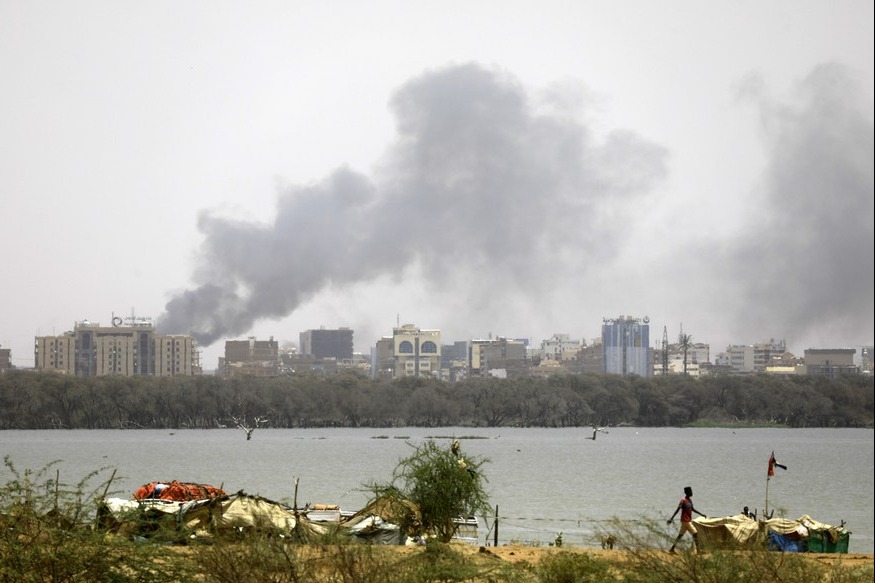
    Three years after Sudan’s brutal civil conflict first erupted, a newly released United Nations investigation has uncovered a cross-border network that funnels foreign fighters, weaponry, and critical supplies to the Rapid Support Forces (RSF), the paramilitary group fighting Sudan’s official government military, with an armed faction in Libya acting as a key facilitator.

    The findings, published Sunday by the UN Panel of Experts on Libya, cover the monitoring period from October 2024 to February 2026, and detail how Libya’s Subul al-Salam Battalion has coordinated the movement of recruits—including a contingent of former Colombian military personnel turned mercenaries—along with weapons and fuel across the Libya-Sudan border to bolster RSF operations. The battalion is an integrated component of the self-declared Libyan National Army (LNA), led by influential commander Gen. Khalifa Hifter, who holds de facto control over eastern and southern territories of war-battered Libya.

    UN experts confirm the battalion’s operations are concentrated in the southern Libyan border town of Kufra, a strategic hub that shares boundaries with Sudan, Chad, and Egypt. Kufra’s key infrastructure, including a local airport that falls under the battalion’s full control, has allowed the group to smoothly transfer fighters and military cargo from Libya into RSF-held territory in Sudan. The investigation further mapped out the tangible benefits the RSF has gained from this Libyan support network: the paramilitary now operates a permanent rear base approximately 75 kilometers, or 46.6 miles, southwest of Kufra, and leverages the town’s existing airbase as a transit hub for incoming Colombian fighters and a modification site for military vehicles imported into Sudan via Libyan smuggling routes.

    According to the report’s documentation, the battalion’s direct operational support extended to RSF battlefield advances in June 2025. Facilitation included deploying local ground units, providing armed escorts for foreign fighters traversing Libyan territory, and securing steady supplies of fuel and vehicle spare parts. This backing directly enabled the RSF’s seizure of the Uwaynat border region, a strategically critical tri-point where the territories of Sudan, Egypt, and Libya converge. At the same time, the UN notes that the cross-border activity has severely eroded what remains of border security in southern Libya, creating new instability in an already fragile region.

    As of publication, neither the Subul al-Salam Battalion nor RSF spokespersons have responded to requests for comment on the report’s findings. The RSF previously announced it had taken full control of the Uwaynat triangle in June, shortly after Sudan’s national military confirmed it had evacuated the area as part of what it described as defensive restructuring to repel ongoing RSF offensives. Sudan’s military has long leveled accusations that Hifter’s LNA is directly complicit in aiding RSF attacks—a claim Hifter has repeatedly denied.

    International human rights organizations have previously documented that both Hifter’s Libyan forces and the RSF receive covert military and financial support from the United Arab Emirates, an allegation Abu Dhabi has continuously rejected. In recent months, Sudan’s national military has moved to disrupt the Libya-based RSF supply line, launching targeted airstrikes in November against convoys of vehicles and groups of foreign fighters assembled inside Libyan territory ahead of deployment to Sudan, the UN report confirms.

    The cross-border mercenary network is the latest development in a Sudanese conflict that has already spiraled into one of the world’s worst humanitarian catastrophes. The war erupted on April 15, 2023, when long-simmering power tensions between Sudan’s military leadership and the RSF boiled over into open combat, first breaking out in the capital Khartoum before spreading across the vast country. The conflict has pushed millions of Sudanese into famine, displaced millions more, and created the largest single humanitarian crisis on the globe. According to data from the Armed Conflict Location & Event Data Project, a U.S.-based independent conflict monitoring organization, the war has killed no fewer than 59,000 people to date. The organization stresses that this official toll is almost certainly a significant undercount, given widespread reporting restrictions and access constraints across war zones.

    Already, the United States has imposed targeted economic sanctions on Colombian companies and private individuals linked to the scheme of recruiting and deploying former Colombian military officers to fight alongside the RSF in Sudan.