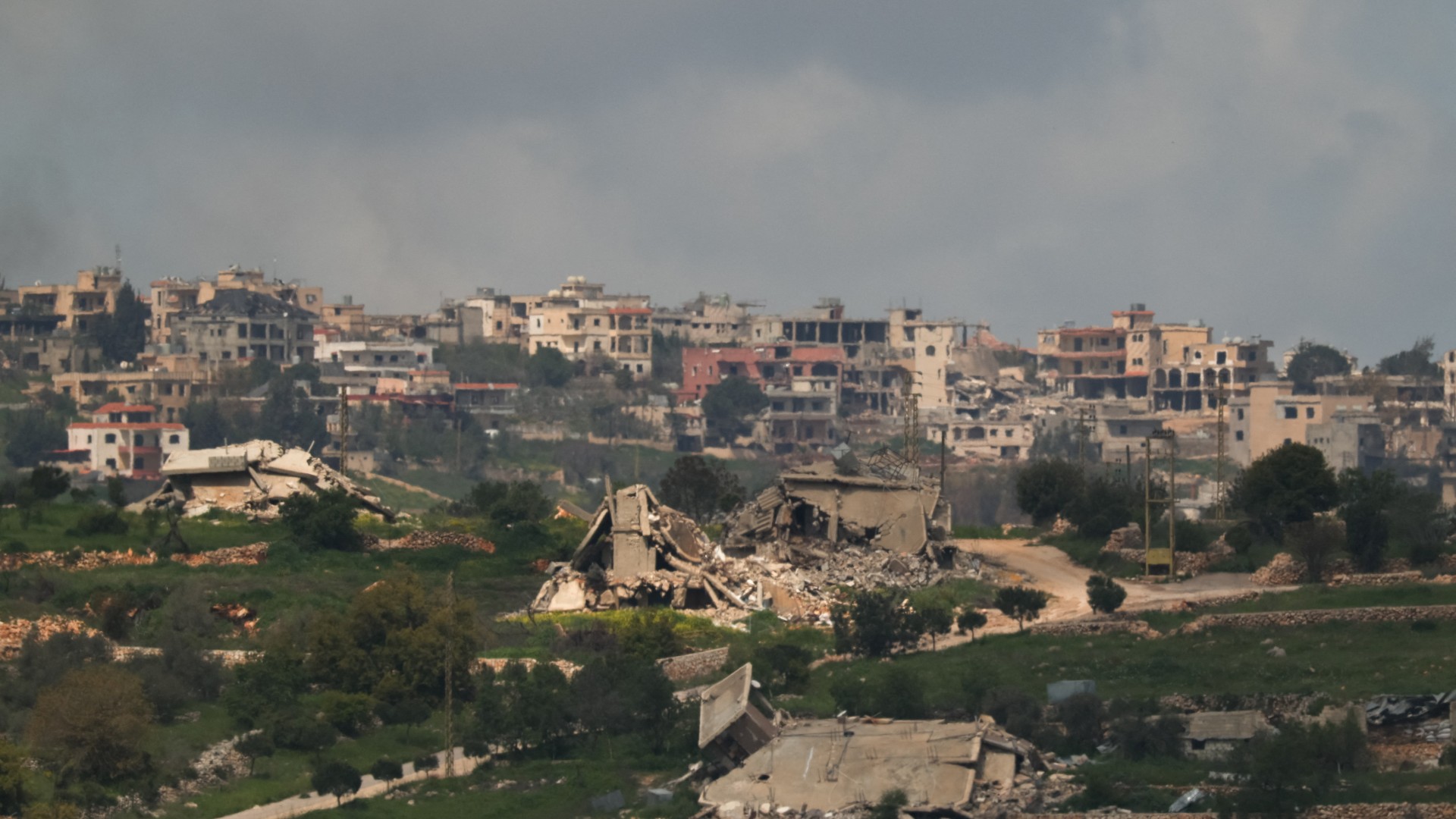
For weeks, Israeli military forces carried out sustained bombardment on two southern Lebanese towns, Bint Jbeil and Khiam, launching repeated attempts to encircle the heavily symbolic and strategically critical settlements. As of the post-ceasefire assessment, neither town has fully fallen under Israeli occupation, a development that lays bare the distinct limitations of Israeli firepower in southern Lebanon and the inherent advantages that local terrain delivers to defensive forces, according to three sources close to Hezbollah speaking to Middle East Eye. One of the three sources has direct, firsthand knowledge of frontline combat operations in the region.
The sources explain that Israeli ground advances were stalled not only by fierce organized armed resistance from Hezbollah, but also by the challenging physical landscape of southern Lebanon, the unique difficulties of urban combat, and the outsized political and military significance Israel itself assigned to these two targets. For Israeli military planners, the core objective was never simply to advance into the towns: it was to fully secure Bint Jbeil, Khiam and the surrounding areas to solidify control over Israel’s northern border with Lebanon. This failure to achieve that core goal raises major questions about the viability of any long-term Israeli military presence in southern Lebanon, and it also explains why Israel has continued to demolish civilian structures in areas it partially controls even after the April 15 ceasefire took effect, with the military actively broadcasting footage of this destruction across social media platforms.
For Israeli leadership, Bint Jbeil has loomed as a particularly charged objective for decades. “At every round of fighting, there has always been the question of Bint Jbeil for the Israelis,” one Hezbollah-aligned source explained. “The city has haunted the Israelis and created some sort of PTSD.” This outsized symbolism dates back to May 2000, when Hezbollah’s late secretary-general Hassan Nasrallah delivered his iconic speech in Bint Jbeil immediately after Israel withdrew from southern Lebanon, famously describing Israel as “weaker than a spider’s web”. The town was already a decisive battleground in the 2006 Israel-Lebanon war, where Hezbollah secured a widely recognized victory, making it a top priority target in the 2026 offensive.
In this latest conflict, Israeli operational objectives shifted significantly from the 2006 war. Initially, military planners set a broad goal: to isolate the entire Bint Jbeil district by seizing control of all key access routes, cutting off the town from surrounding settlements including Qawzah, Wadi al-Oyoun, Haddatha, Aitaroun, Wadi al-Skikiyyeh and Wadi al-Slouqi. Had this plan succeeded, it would have fully cut Bint Jbeil off from reinforcements and laid the groundwork for a long-term Israeli occupation of the area. But every Israeli attempt to achieve this encirclement failed, in large part because Hezbollah had studied Israeli tactics used in the Gaza Strip and prepared comprehensive countermeasures, the sources confirmed. Faced with this setback, Israeli commanders narrowed their operational scope, scaling back ambitions from isolating an entire district to besieging the core town of Bint Jbeil alone – a shift that represented a clear downgrading of strategic goals, moving from controlling open terrain to targeting a dense urban center that could be framed as a visible public relations victory.
For Hezbollah, the failure of Israel’s initial encirclement plan counts as a major battlefield success. “Everything the Israelis claimed about enforcing a total siege on the town was inaccurate,” a second source noted. “There was pressure from several directions, yes, but even in the final moments, supplies and ammunition were still reaching us through the surrounding axes. Bint Jbeil remained an operations hub from which attacks were launched into other areas. No force in the world can impose a total siege on our terrain in this area.”
Geographically, Bint Jbeil sits at the core of a strategic puzzle Israeli forces could not solve. The current conflict expanded to Lebanon in early March, after Hezbollah launched rocket fire in response to the killing of Ayatollah Ali Khamenei, pre-empting an Israeli invasion the group assessed was imminent. Israeli forces advanced into southern Lebanon from both eastern and western axes, pushing roughly 10 kilometers into Lebanese territory. To establish a continuous, stable controlled zone along the border, Israeli forces needed to link these two advance axes horizontally – a maneuver that required full control of Bint Jbeil. Without the town, the eastern and western sectors of the advance remain disconnected, leaving Israeli troops vulnerable as isolated pockets rather than forming a coherent defensive strip along the border.
After the failure of the district-wide encirclement, Israeli forces launched a four-pronged advance on the town itself, moving in from Ain Ebel, Saf al-Hawa, Yaroun and Maroun al-Ras. Even then, Israeli forces never managed to secure full control of the urban center. According to the sources, the Israeli advance relied on limited, incremental incursions, booby-trapping abandoned buildings and burning structures on the town’s outskirts. The military also deployed remotely operated unmanned trucks packed with explosives, a tactic first honed in Gaza City, designed to draw Hezbollah fighters into open combat before detonating to destroy entire neighborhoods. This cautious approach, the sources argue, reflects a deliberate Israeli choice to avoid the heavy casualties that would come from direct close-quarters combat.
To date, Israeli forces have failed to establish permanent, secured positions inside the town core. Key symbolic landmarks, including the “spider’s web” stadium where Nasrallah delivered his 2000 victory speech, the central grand mosque, and major religious compounds, all remain under Hezbollah control. Israeli troops never reached the town center, nor have they been able to eliminate Hezbollah’s fighting presence inside the settlement. The sources attribute this defensive success to years of intensive pre-conflict battlefield preparation by Hezbollah. “To illustrate the level of preparation with which the party fought in Bint Jbeil, the Hezbollah units inside the city twice attempted to kill the Israeli commander of the 52nd Battalion of the 401st Brigade by targeting his tank,” the second source said. “He survived both times by a miracle and is now in intensive care.” The fact that Hezbollah was able to identify the specific battalion and its commanding officer in advance demonstrates how thoroughly the group had studied Israeli order of battle ahead of the offensive, the source added.
The sources also detailed one incident in Bint Jbeil’s al-Awini neighbourhood where the Israeli military activated the Hannibal Directive, a policy that orders heavy bombardment of an area where soldiers are at risk of capture to prevent them being taken alive. “After it lost contact with its soldiers, it began shelling within roughly 20 metres of their position, before eventually managing to retrieve them,” the source recalled. “We knew that any attempt to capture them would prompt it to shell both its own soldiers and ours.” Middle East Eye has requested comment from the Israeli military on the claims outlined in this report.
The narrative of Israeli strategic failure holds equally true for Khiam, the second key southern Lebanese town. While Bint Jbeil serves as the critical link connecting Israel’s eastern and western advance axes, Khiam functions as a strategic gateway to inland Lebanese territory. Like Bint Jbeil, Khiam carries deep symbolic weight: it was the site of a notorious Israeli-backed prison during the 1982-2000 occupation, where hundreds of detainees faced systematic abuse and torture. To date, Israeli forces have failed to bypass Khiam, fully encircle the town, or seize control of its northern side. Hezbollah’s supply lines from the western Bekaa Valley have remained fully operational throughout the offensive, blocking Israeli forces from pushing further inland and derailing all plans to establish a stable controlled buffer zone along the border.
The three Hezbollah-aligned sources argue that Israel’s repeated failures to seize full control of Bint Jbeil and Khiam point to broader strategic challenges: even a shallow buffer zone of less than 10 kilometers in southern Lebanon will be extremely difficult for Israel to sustain. Without full control of these two key settlements, Israeli advances into Lebanon are capped in depth, leaving Israeli troops with disconnected, vulnerable outposts, unsecured urban areas behind their lines, and intact Hezbollah supply routes that keep resistance forces supplied and reinforced.
The sources acknowledge that Israel has made limited territorial gains during the offensive and has killed a large number of Hezbollah fighters, but they argue these gains have not added up to the sustainable, cohesive area of control Israel set out to achieve. The second source noted that Israel intentionally inflated the strategic importance of the battle for Bint Jbeil ahead of the offensive, a public relations gambit to frame any seizure of the town as a transformative victory. “The Israelis deliberately inflated the importance of this battle so that, if they succeeded in taking the city, it could be presented as proof of achievement,” he explained.
As evidence that Hezbollah’s defensive capabilities remain intact, the source pointed to an ambush carried out by the group’s elite Radwan force against Israel’s Battalion 101, carried out shortly before the April 15 ceasefire took effect. “Within minutes, three Hezbollah fighters managed to hit 10 paratroopers, leaving them dead or wounded,” he said. The incident underscores Hezbollah’s approach to the conflict: it is not merely a static defense of fixed territory, but a sustained contest of endurance, mobility, and preventing Israel from securing the decisive symbolic victory it sought to cement its strategic goals.