分类: politics

  • ‘Britain at the heart of Europe’: How Starmer’s plans are going down in the EU

    ‘Britain at the heart of Europe’: How Starmer’s plans are going down in the EU

    As the 10th anniversary of the Brexit referendum approaches this June, UK Prime Minister Keir Starmer has reignited debate over Britain’s post-Brexit relationship with the European Union, launching a high-profile push to rebuild tighter ties just one week after his Labour Party suffered a devastating defeat in local elections.

    In a widely anticipated defiant address, Starmer framed closer alignment with the EU as a core priority for his government, promising to lay the groundwork for deeper collaboration ahead of this summer’s EU-UK summit. “This Labour government will be defined by rebuilding our relationship with Europe, by putting Britain at the heart of Europe, so that we are stronger on the economy, stronger on trade, stronger on defence,” he told the audience. Starmer also argued that incremental changes are insufficient to address the UK’s current challenges in growth, energy and security, calling for a bolder approach to EU engagement than what his administration outlined after taking power in 2024.

    However, the speech has drawn widespread criticism for its lack of concrete new policies. Jill Rutter, a former British civil servant and senior research fellow at the UK in a Changing Europe think tank, dismissed Starmer’s announcement as “a damp squib”, noting it failed to deliver a single tangible new proposal. Reactions from across the Channel are deeply divided, split along the lines of defence and security versus economic and trade cooperation.

    On defence and global security, European leaders view the UK as a reliable and critical ally. With the EU focused on pressing threats including the ongoing Russia-Ukraine conflict, rising tensions with Iran, and shifting transatlantic relations under Donald Trump’s second U.S. administration, Brussels sees consistent UK cooperation as a strategic asset. This stable dynamic is not expected to change regardless of Starmer’s political future: EU officials widely believe UK foreign policy will remain consistent, including continued support for Ukraine and plans to assemble an international maritime force to protect shipping in the Strait of Hormuz, even if Starmer is ousted by internal leadership rivals.

    The mood shifts dramatically when it comes to economic ties, where Brussels holds a stance of weary cynicism. While the EU has repeatedly stated it welcomes closer relations if the UK commits to that path, the sector-specific talks Starmer’s government has pursued so far remain extremely limited. The only active negotiations focus on three areas: a food and drink safety agreement (known as SPS), a carbon emissions trading pact, and a youth mobility scheme that Starmer now touts as a major initiative for underprivileged British youth. Even that proposal, however, was originally an EU demand led by Germany that the Labour government initially rejected. Analysts widely agree that none of these limited deals will deliver meaningful, broad-based growth to the UK economy, even if expanded to other small sectors such as electricity market integration.

    The policy measures that could actually move the needle economically – joining the EU single market or forming a full customs union to eliminate most trade barriers – remain off the table for now, bound by Starmer’s pre-election “red lines” that rule out accepting free movement of workers, a non-negotiable requirement for full single market access. When pressed by journalists on whether these red lines might be dropped ahead of the next general election scheduled for 2029, Starmer declined to give a direct answer, sparking speculation of a potential policy shift. But the long timeline to the next election has left Brussels frustrated with the government’s vague positioning.

    One senior EU diplomat from a traditionally UK-friendly member state summed up the widespread European view: “For the last two years since Labour won power, we have heard the same thing: we want a ‘reset’ with the EU after Brexit. But what is this famous reset? The words from UK ministers sound increasingly enthusiastic but the actual steps they take are baby steps. Probably because they know the closer you get back to us, the more we ask from you in return. Do their voters know that?”

    To date, even modest steps toward closer cooperation have required the UK to accept EU terms, including the “pay to play” model for participation in EU programs. Rejoining the Horizon science research program, agreed by the previous Conservative government, costs the UK £2.2 billion annually, though proponents note British researchers have emerged as leading beneficiaries after two years of membership. In the ongoing sectoral talks, Starmer’s government has also had to agree to align with current and future EU regulations on relevant issues – a compromise that has already drawn fire from eurosceptic opponents. Nigel Farage’s Reform Party, which saw strong gains in last week’s local elections, has accused Labour of quietly reversing Brexit through incremental regulatory alignment. This alignment also complicates the UK’s long-held goal of reaching a comprehensive free trade agreement with the United States, as closer alignment with EU rules narrows the room for negotiating a separate deal that meets U.S. demands.

    Reform’s strong performance in last week’s local elections has not gone unnoticed in Brussels. Farage, who spent more than 20 years as a Member of the European Parliament campaigning for Brexit, is a well-known and controversial figure across the EU. While the EU will continue negotiating with the current Labour government, insiders say the European Commission is considering adding penalty clauses to future agreements, which would require the UK to pay compensation if a future eurosceptic government withdraws from existing cooperation deals.

    UK Minister for EU Relations Nick Thomas-Symonds has defended the government’s approach, saying Labour is pursuing a “ruthlessly pragmatic” and “ambitious” strategy that will never accept deals that conflict with UK national interests. But with the public increasingly divided over Brexit a decade on, and a rising eurosceptic opposition gaining traction, Starmer’s push to reset relations with the EU remains mired in vagueness – leaving both British voters and European leaders waiting for concrete action.

  • ‘Total lack of respect’: Macron interrupts speaker to ask for silence

    ‘Total lack of respect’: Macron interrupts speaker to ask for silence

    During an official conference held on Kenyan soil, French President Emmanuel Macron took an unexpected step to restore order, rising from his seat and interrupting the ongoing speaking program to demand that disruptive audience members stop talking.

    The incident unfolded as persistent noise from parts of the audience made it difficult for the scheduled speaker to be heard by attendees. Frustrated by the continued commotion and what he framed as a failure to extend basic courtesy to the person at the podium, Macron publicly called out the disruption, stating that the lack of quiet amounted to a complete disregard for the speaker and the event itself. He emphasized that it was simply impossible for a speaker to deliver their remarks effectively when the audience was not willing to maintain a respectful level of silence.

    The conference, which formed part of Macron’s official visit to Kenya, was focused on deepening bilateral cooperation between France and the East African nation, covering issues ranging from development partnership to climate action. The unexpected interruption drew immediate attention from other attendees and observers, highlighting the friction that can arise between diplomatic protocol and on-the-ground event dynamics during high-profile international visits.

  • South Africa to establish impeachment committee after president’s cash scandal is revived

    South Africa to establish impeachment committee after president’s cash scandal is revived

    Four years after a secret cash theft at President Cyril Ramaphosa’s private game ranch sparked allegations of serious presidential misconduct, South Africa’s national legislature has moved forward to launch a formal impeachment inquiry, complying with a landmark ruling from the country’s highest court that upends a 2021 attempt to shut down the investigation.

    On Monday, parliament announced it would establish a multi-party committee to reexamine the long-running scandal, which centers on claims that Ramaphosa concealed the 2020 theft of more than $580,000 in undeclared cash stashed in a sofa at his farm, failed to report the incident to law enforcement properly, and orchestrated a secret off-the-books effort to recover the stolen funds.

    The move comes in direct response to a Constitutional Court judgment issued last Friday, which struck down a 2022 parliamentary vote that blocked impeachment proceedings against the incumbent president as unconstitutional. At the time of that 2022 vote, Ramaphosa’s long-ruling African National Congress (ANC) held an outright majority in the 400-seat national legislature, allowing the party to quash the inquiry despite findings from an independent investigative panel that uncovered credible evidence of potential presidential wrongdoing. The top court ruled last week that procedural rules required the independent panel’s 2022 report to be referred to a dedicated impeachment committee for full review, rather than being dismissed outright by a plenary vote.

    The scandal first erupted in 2022, when the former head of South Africa’s State Security Agency filed a formal police complaint accusing Ramaphosa of money laundering and multiple other offenses tied to the hidden cash. The theft itself had been kept secret for two years before the allegations became public. Ramaphosa has repeatedly denied any misconduct, asserting the cash was generated from the legitimate sale of buffalo to international buyers from his game ranch. But the independent 2022 report cast significant doubt on this explanation, noting evidence that the total amount of stolen cash may have been larger than the $580,000 Ramaphosa acknowledged, and documenting that the president used members of his official presidential protection unit to secretly track down the theft suspects without following official law enforcement protocols.

    Under South Africa’s constitution, removing a sitting president via impeachment requires the support of at least two-thirds of the 400 sitting members of parliament. The political landscape has shifted dramatically since the 2022 vote: in the landmark 2024 general election, the ANC lost its decades-long parliamentary majority, and now governs as the largest partner in a 10-party national unity coalition. While Ramaphosa remains in a position to survive an impeachment vote if his ANC caucus unites behind him and secures backing from coalition partners, the new inquiry creates significant political uncertainty for his presidency.

    In a statement issued shortly after last week’s Constitutional Court ruling, Ramaphosa’s office reaffirmed the president’s commitment to the rule of law, saying, “President Ramaphosa maintains that no person is above the law and that any allegations should be subjected to due process without fear, favor or prejudice.”

    Parliament has not yet released a formal timeline for the impeachment committee’s investigation, which must complete its work before any full impeachment vote can be scheduled. For Ramaphosa, who campaigned for office in 2018 on a promise to root out widespread government corruption that flourished during the tenure of his predecessor Jacob Zuma, the renewed inquiry represents one of the most significant challenges to his political career, and has already badly dented the anti-corruption reputation he built upon entering office.

  • Washington dinner shooting suspect pleads not guilty

    Washington dinner shooting suspect pleads not guilty

    A 31-year-old man charged in connection with a violent attempted breach at last month’s high-profile White House Correspondents’ Dinner in Washington D.C. has entered a formal not guilty plea to federal charges that include firearms violations and a plot to assassinate former and current U.S. President Donald Trump.

    Cole Tomas Allen, the defendant named in the indictment, faces two separate federal gun charges on top of the attempted assassination count: illegal use of a firearm during a violent criminal act, and interstate transportation of a firearm with the explicit intent to carry out a felony offense. The case stems from an April incident that unfolded at the Washington Hilton hotel, where the annual media gathering was set to welcome Trump, top administration officials, and hundreds of working journalists.

    According to court documents and reporting from CBS News, the BBC’s U.S. partner, Allen made his first in-person court appearance on Monday before U.S. District Judge Trevor McFadden, who will oversee all future proceedings in the case. During the hearing, held in federal court in Washington, Allen appeared in a standard-issue orange inmate jumpsuit, with shackles secured to both his wrists and ankles.

    Prosecutors’ official account of the incident lays out a premeditated plan: Authorities say Allen departed his Torrance, California, home near Los Angeles on April 21, traveling cross-country by train via Chicago before arriving in the nation’s capital. Hours before the dinner was scheduled to begin, prosecutors allege Allen documented his preparations in photos taken in his local hotel room around 8:03 p.m. EST. The images, included in a U.S. government court memorandum, show Allen wearing formal attire alongside a shoulder holster, pliers, wire cutters, multiple strapped weapons including a sheathed knife, and a bag loaded with ammunition, posing in front of a mirror. Over the next 30 minutes, prosecutors say Allen accessed multiple websites to pull up live streams of the White House Correspondents’ Dinner to confirm the event’s timeline before leaving his hotel.

    When Allen reached the Washington Hilton, prosecutors allege he attempted to rush through an outer security checkpoint, sprinting through a metal detector while holding a loaded shotgun in a raised, ready position with both hands. In the ensuing confrontation, Allen exchanged gunfire with a U.S. Secret Service agent, striking the agent who was ultimately protected from serious injury or death by his bulletproof vest. Law enforcement agents tackled Allen just a few feet short of a staircase leading directly to the ballroom where the dinner was just getting underway, with Trump, Vice President JD Vance, cabinet members, and dozens of senior White House officials already inside the venue. Immediately after shots were fired, the president, vice president, and other senior officials were urgently evacuated from the ballroom as a security precaution.

    A key development unfolded during Monday’s initial hearing: Allen’s defense team has formally requested that Judge McFadden disqualify the entire Washington office of U.S. attorneys, including D.C. U.S. Attorney Jeanine Pirro, from participating in the prosecution. The defense is also pushing to remove Attorney General Todd Blanche from any role in the case. Eugene Ohm, lead defense counsel for Allen, argued that both Pirro and Blanche have publicly positioned themselves as victims of the April attack, making it improper for them to lead the prosecution against his client. Judge McFadden has ordered the U.S. Department of Justice to file a formal response to the disqualification request by June 22.

  • EU sanctions Hamas leaders and Israeli settlers, but shelves stronger economic pressure

    EU sanctions Hamas leaders and Israeli settlers, but shelves stronger economic pressure

    BRUSSELS — After years of gridlock and mounting public anger fueled by the ongoing humanitarian catastrophe in Gaza, the 27-member European Union has struck a historic unanimous political deal to impose fresh sanctions on senior Hamas leaders and extremist actors within the Israeli settler movement, top EU diplomatic officials confirmed Monday.

    The breakthrough came during a meeting of EU foreign ministers in the Belgian capital, where EU High Representative for Foreign Affairs and Security Policy Kaja Kallas hailed the agreement as a long-overdue shift from stalemate to action. “Extremism and violence should carry consequences,” Kallas wrote in a social media statement following the vote. “It was high time we move from deadlock to delivery.”

    While the bloc ultimately rejected bolder penalties pushed by a cohort of progressive European governments and has not yet published the full text of the new sanctions framework, French Foreign Minister Jean-Noël Barrot outlined the scope of the agreed measures: sanctions will target top Hamas commanders, as well as leading figures and key organizations tied to the Israeli settler movement operating in the occupied West Bank.

    “The European Union is sanctioning today the main Israeli organizations guilty of supporting the extremist and violent colonization of the West Bank, as well as their leaders,” Barrot wrote in his own social media post Monday. “These most serious and intolerable acts must cease without delay.”

    Addressing the targeting of Hamas leaders, Barrot added: “It is sanctioning the main leaders of Hamas, responsible for the worst antisemitic massacre in our history since the Shoah during which 51 French people lost their lives, a terrorist movement that must imperatively be disarmed and excluded from any participation in the future of Palestine.”

    The push for new sanctions against West Bank settler groups comes amid growing international alarm over a sharp surge in settler violence against Palestinian communities in the occupied territory. Palestinian authorities, human rights organizations and international monitors have repeatedly warned that routine attacks by settlers — including arson, property vandalism, the displacement of agricultural communities, and lethal violence against civilians — are worsening at an alarming rate. Data from the United Nations Office for the Coordination of Humanitarian Affairs shows that at least 40 Palestinians have been killed in the West Bank since the start of 2026, with a record 11 of those deaths at the hands of Israeli settlers — two more fatalities than were recorded in all of 2025.

    Diplomatic analysts widely attribute the sudden breakthrough on sanctions to the recent electoral ouster of former Hungarian Prime Minister Viktor Orbán, who stepped down last month after 16 consecutive years in power. A steadfast ally of Israeli Prime Minister Benjamin Netanyahu, Orbán had single-handedly blocked all previous EU attempts to impose sanctions on Israeli settlers for years, leaving the bloc unable to act despite widespread support among other member states.

    Orbán was defeated in April’s general election by opposition leader Péter Magyar, who was sworn in as Hungary’s new prime minister just days before Monday’s vote. Martin Konečný, head of the Brussels-based European Middle East Project, noted that the successful approval of the sanctions package confirms long-held assessments that Orbán was the sole barrier to action. “This validates the notion that Orbán was blocking them single-handedly,” Konečný said.

    Many foreign policy observers say the new sanctions could mark a pivotal shift in the EU’s long-standing approach to Israel. For months, a growing bloc of European governments led by Spain, Ireland and the Netherlands has pushed for punitive measures over the Israeli government’s military campaign in Gaza, as well as its expanding settlement activity and rising violence in the West Bank, and escalating cross-border conflicts in Lebanon, Syria and Iran.

    Ahead of Monday’s meeting, Luxembourg Foreign Minister Xavier Bettel summed up the growing pressure to act: “You can’t just turn a blind eye.”

    Even with the historic agreement, the EU fell short of adopting the more sweeping measures that many activists and progressive governments had called for. Diplomats failed to reach consensus on harsher economic measures, such as a bloc-wide ban on goods produced in Israeli settlements in the West Bank or the suspension of a key bilateral trade agreement between the EU and Israel.

    Hugh Lovatt, a senior fellow at the European Council on Foreign Relations, criticized the bloc’s limited scope of action. “There’s so much that you can and should be doing, and so to get stuck in this question of adding a few more settlers is missing the big picture,” Lovatt said. “The EU’s narrowed the scope of action now to individuals and to a few entities, and in doing that it’s ignoring the far more systemic issues at play.”

    Claudio Francavilla, associate EU director at Human Rights Watch, called the sanctions a tentative step forward but said far more action is required to bring the bloc into compliance with international law. The measures are “a step in the right direction, but so many more needed for the EU to comply with international law,” Francavilla said.

    Italy, one of the more prominent EU member states skeptical of harsher measures, has already signaled it is not ready to back a French-Swedish proposal that would cut West Bank settlers off from EU markets. Ahead of Monday’s meeting, Italian Foreign Minister Antonio Tajani said his government needed additional time to review the plan, withholding its support despite growing public pressure across the continent for tougher action.

    Dutch Foreign Minister Tom Berendsen noted that individual EU member states retain the right to implement national bans on settlement goods if bloc-wide negotiations stall in Brussels. The next meeting of the EU Foreign Affairs Council, scheduled for later this May, will focus specifically on trade policy related to the region.

    Spanish Foreign Minister José Manuel Albares Bueno pushed for swift action on broader measures in comments to reporters in Brussels Monday. “We have been talking about measures for too long,” he said. “Let’s move on to a vote and stop saying that there is no qualified majority for it. Let’s see how many of us are in agreement and who is not.”

  • Bosnia’s powerful peace envoy quits, with questions over role’s future

    Bosnia’s powerful peace envoy quits, with questions over role’s future

    After more than three years in one of the most contentious positions in Balkan politics, Christian Schmidt, the international High Representative for Bosnia and Herzegovina, has formally announced he will step down from his role, ending a tenure marked by persistent confrontation with ethno-separatist leaders and growing geopolitical friction.

    Schmidt, who took up the post in 2021, leaves behind a role that has been central to Bosnia’s post-conflict stability since the 1995 Dayton Peace Agreement. That landmark accord, which brought an end to three years of devastating ethnic conflict that tore the country apart, established the Office of the High Representative (OHR) as a UN-mandated watchdog tasked with upholding the terms of the peace deal. Endowed with sweeping executive authority known as the Bonn Powers, the post holder can intervene to override domestic legislation and remove fractious ethno-political leaders from office to preserve the country’s territorial integrity.

    Early high-profile office holders like Paddy Ashdown, who held the role in the early 2000s, embraced these expansive powers, famously removing 60 Bosnian-Serb officials from office in a single 2004 day over their refusal to cooperate with the UN’s war crimes tribunal for the former Yugoslavia. The move earned Ashdown the unflattering moniker the “Viceroy of Bosnia”, and later office holders adopted a far more restrained approach, pushing for Bosnian leaders to take ownership of domestic affairs. This hands-off strategy ultimately yielded limited progress, however, paving the way for Schmidt to take a far more activist approach when he assumed the role.

    Schmidt’s tenure was defined almost entirely by his standoff with Milorad Dodik, the powerful Bosnian-Serb leader who has long pushed for separatist secession from Bosnia and Herzegovina. Schmidt repeatedly used his Bonn Powers to block laws advanced by Dodik that would have advanced separatist goals, a confrontation that ultimately resulted in a one-year prison sentence and six-year ban from public office for Dodik. But the conflict ultimately eroded Schmidt’s own position: after Dodik spent heavily on high-powered Washington lobbying, the U.S. reversed its long-standing sanctions on the Bosnian-Serb leader. Observers have linked this policy shift to Dodik’s decision to award a major trans-Balkan gas pipeline contract to a little-known U.S. firm with close ties to former President Donald Trump’s family, a project that Schmidt openly opposed.

    Beyond his standoff with Dodik, Schmidt’s appointment was never formally recognized by Russia from the start. With the loss of U.S. backing, his position became untenable, leading to his personal decision to end his service supporting peace implementation in Bosnia, as confirmed by his office.

    Schmidt has confirmed he will remain in post until a successor is appointed, but the future of the OHR itself is now in serious question. Russia has long aligned with Dodik in calls to shut down the office entirely. If the U.S. now joins Russia in supporting closure, Bosnia will lose the only international check on ethno-nationalist separatist ambitions, leaving the country’s future stability and territorial integrity deeply uncertain.

  • Pentagon will review Senator Mark Kelly’s comments about US weapon stockpiles, Hegseth says

    Pentagon will review Senator Mark Kelly’s comments about US weapon stockpiles, Hegseth says

    A fresh high-profile political clash has erupted between U.S. Defense Secretary Pete Hegseth and Democratic Senator Mark Kelly, centered on claims that the Arizona lawmaker disclosed classified information during a public television interview regarding depleted American weapons stockpiles in the wake of the recent conflict with Iran.

    Appearing on CBS News’ flagship public affairs program *Face the Nation* on Sunday, Kelly, a former U.S. Navy captain, raised urgent alarms about the state of America’s munition reserves following military operations against Iran. He told interviewers that it was “shocking how deep we have gone into these magazines,” referencing details he received during an official briefing from Pentagon officials on specific stockpile levels.

    Within hours of the interview airing, Hegseth took to social media platform X to publicly accuse Kelly of irresponsible disclosure, claiming the senator had inappropriately shared details from a classified Pentagon briefing. “Did he violate his oath…again?” Hegseth wrote, announcing he had directed the Pentagon to launch a formal review of Kelly’s comments to assess whether any security protocols were broken.

    Kelly immediately pushed back against the defense secretary’s accusations, denying he had revealed any sensitive or classified material. The senator countered that the remarks he made on *Face the Nation* had already been discussed openly during a public Senate hearing held just one week prior. To back up his claim, he shared a video clip of a previous hearing featuring both he and Hegseth, pointing out that his assessment that it would take “years” to replenish key depleted stockpiles was actually a direct quote from Hegseth himself.

    In his response, Kelly also seized the opportunity to criticize the Trump administration’s handling of the Iran conflict, noting that the war has exacted a severe toll on U.S. military resources while the president and his defense team have still failed to outline clear strategic goals for the operation to the American public.

    The latest dispute is only the newest chapter in a bitter ongoing legal and political battle between the Trump administration and Kelly. Just days before Hegseth’s call for the review, a federal appeals court indicated it was likely to reject the Pentagon’s bid to punish Kelly over separate remarks where he urged U.S. service members to refuse unlawful orders.

    The conflict dates back to November, when Kelly and five other House and Senate lawmakers published a public video encouraging active-duty troops to disobey any orders they judged to be illegal. The Pentagon moved to discipline Kelly over the remarks, prompting the senator to file a lawsuit against the federal government in January. In his court filing, Kelly alleged that Hegseth had attempted to illegally demote him from the Navy Reserve as retaliation for his public criticism of the Trump administration.

    In February, a U.S. district judge granted a temporary injunction blocking the proposed demotion while the legal proceeding moves forward. The Pentagon appealed that ruling to the federal circuit court, where arguments were recently held. A rejection of the Pentagon’s appeal would represent another major legal setback for the administration in its conflict with Kelly.

    The BBC has reached out to Kelly’s office requesting additional comment on the latest dispute, while the Pentagon, when asked to confirm whether a formal investigation into Kelly’s comments is underway, declined to issue any new statement and instead referred reporters back to Hegseth’s original social media post.

  • Former Polish justice minister who faces prosecution at home says he’s traveled from Hungary to US

    Former Polish justice minister who faces prosecution at home says he’s traveled from Hungary to US

    In a dramatic development that has triggered a cross-border legal probe and raised questions of potential diplomatic friction, former Polish Justice Minister Zbigniew Ziobro — a top figure in Poland’s nationalist conservative Law and Justice (PiS) government that ruled from 2015 to 2023 — has announced he traveled from Hungary, where he held asylum, to the United States. Polish prosecutors confirmed Monday they are now probing whether any third parties helped Ziobro evade the criminal charges he faces in his home country.

    Ziobro, a central architect of the PiS administration’s controversial overhaul of Poland’s judiciary, has been wanted by Polish authorities since last year for allegations of abuse of power. Under his leadership, the PiS government installed ideologically aligned judges to secure political control over Poland’s highest courts, and targeted judicial critics with disciplinary punishments and unwanted geographic reassignments, moves that drew widespread international criticism over democratic backsliding.

    In January, Ziobro confirmed he had been granted political asylum in Hungary, then led by long-time nationalist Prime Minister Viktor Orbán, a close ideological ally of the PiS movement. His unexpected move to the U.S. was made public on Sunday, in an interview with Polish right-wing media outlet Republika — timed on the exact same day that Orbán’s elected successor, Péter Magyar, was sworn into office in Budapest following an upset election victory last month that ended Orbán’s 16-year tenure. According to Polish state news agency PAP, Ziobro stated he used travel documentation issued to him as part of his asylum status in Hungary to enter the U.S.

    The charges against Ziobro date back to October 2023, when Polish prosecutors requested that his parliamentary immunity be stripped to allow formal charges to proceed. Prosecutors accuse Ziobro of misappropriating funds from a public state fund established for victims of violence, including diverting money to purchase Israeli Pegasus spyware. Tusk’s governing Civic Coalition has repeatedly accused the former PiS administration of using Pegasus to conduct illegal surveillance on political opponents ahead of the 2020 parliamentary election. Ziobro has consistently denied all wrongdoing, maintaining every action he took was fully legal under Polish law.

    Poland’s new pro-European Union government, led by Prime Minister Donald Tusk, took office in late 2023 on a pledge to roll back the judicial overhaul implemented by the PiS and restore the rule of law. To date, however, those efforts have been blocked by two consecutive Polish presidents affiliated with the nationalist right, leaving the reform process deadlocked.

    On Monday, Poland’s national prosecutor’s office announced via social media that it has opened a new investigation into Ziobro’s sudden departure, focused on identifying any individuals who may have aided his flight and helped him avoid standing trial on existing charges, which would constitute obstruction of the ongoing inquiry into the management of the national justice fund.

    Current Polish Justice Minister Waldemar Żurek confirmed via a post on X Sunday evening that Polish authorities had already invalidated all of Ziobro’s Polish-issued travel documents, including his diplomatic passport, before his international travel. He added that Poland will formally request clarification from both the U.S. and Hungary on the legal basis that allowed Ziobro to exit Hungarian territory and enter the United States.

    The cross-border movement has opened the door to potential political tension between Warsaw and Washington, but Polish officials have moved quickly to downplay that risk. “We don’t want this issue to become political,” Polish Foreign Ministry spokesperson Maciej Wewiór told the Associated Press in an interview. “Our relationship with the U.S. goes much deeper than what happens with Ziobro. But we do want our citizen to eventually return to Poland and face justice.”

  • Trump-Xi meet more about US uncertainty than China ambition

    Trump-Xi meet more about US uncertainty than China ambition

    As U.S. President Donald Trump prepares to touch down in Beijing this week for high-stakes talks with Chinese President Xi Jinping, the choreographed opening moments of the summit are already predictable: firm, photographed handshakes, sweeping rhetorical claims, carefully staged symbolic gestures, and mutual declarations of unlocking new “historic” economic cooperation. But behind this carefully curated diplomatic spectacle lies a far more consequential shift reshaping the geopolitical future of the Indo-Pacific.

    Donald Trump’s second term in office has not delivered a cohesive new U.S. doctrine for the Indo-Pacific. Instead, it has amplified longstanding American strategic anxieties into a louder, purely transactional approach that departs sharply from the frameworks built by his two immediate predecessors. For more than a decade, successive U.S. administrations have framed the Indo-Pacific as the global center of geopolitical gravity. Barack Obama’s “pivot to Asia” was designed to reassure regional allies that Washington recognized the region’s growing strategic weight. Joe Biden built on that foundation, expanding the framework through minilateral security pacts, technology alliances, and targeted diplomatic engagement crafted to balance China’s rise without triggering open conflict.

    Trump’s second term marks a clear break from this trajectory. While the current administration has retained most of Washington’s hard-line rhetoric toward Beijing, it has abandoned the broader diplomatic and institutional architecture that once sustained U.S. credibility across the region. Instead, the Trump 2.0 approach relies heavily on economic nationalism, repeated tariff threats, and demands for increased defense burden-sharing from allies already navigating mounting geopolitical and financial volatility. Despite the administration’s claims of strategic renewal, this strategy largely repackages long-running U.S. anxieties about China into a more confrontational doctrine centered on trade escalation, economic coercion, and increasingly inflammatory rhetoric around global great-power competition.

    This shift has left regional governments viewing Washington through an increasingly transactional lens. U.S. allies and partners face repeated calls to decouple their supply chains from China, even as they confront new American tariffs, industrial policy disputes, and growing uncertainty about the durability of long-term U.S. commitments to the region.

    This ambiguity matters deeply, because most middle powers in Asia have no interest in being forced to choose between Washington and Beijing. The vast majority of regional governments seek to retain strategic flexibility, diversified trade relationships, and stable security arrangements that avoid dividing the region into rigid, opposing blocs. Vietnam offers a clear illustration of this common regional dilemma. Over the past decade, Hanoi emerged as one of the biggest beneficiaries of global supply chain diversification, as manufacturers shifted production out of China amid escalating U.S.-China tensions. American firms were major drivers of this shift. Yet today, Washington increasingly frames Vietnam’s export growth through a narrative of “overcapacity” and industrial imbalance, even though most of Vietnam’s manufacturing sector is powered by multinational investment, not state-directed dumping. This contradiction has not been lost on regional capitals, nor has the growing gap between Washington’s military posture and its diplomatic messaging.

    The U.S. continues to carry out freedom of navigation operations in the South China Sea, deepen defense ties with regional allies, and strengthen deterrence frameworks around Taiwan. But military posturing alone does not add up to a cohesive regional strategy. Diplomatic engagement, economic integration, and institutional trust remain equally critical pillars of influence in Asia. That power vacuum is an opening Beijing has been quick to exploit. China’s leadership understands that regional influence today depends not just on naval power, but on infrastructure financing, deep trade relationships, development assistance, and increasingly, environmental diplomacy and ocean governance.

    Beijing’s bid to host the secretariat for the new UN High Seas Treaty is a perfect example of this broader strategy. China has positioned itself as a responsible steward of the global maritime commons, pledging financial support for marine conservation projects while expanding its diplomatic footprint across developing coastal states. To be sure, many regional governments remain deeply cautious of China’s strategic intentions, particularly in the South China Sea, where gray zone tactics, maritime coercion, and unresolved territorial disputes continue to erode trust. But Beijing does not need to be fully consistent in its own policies to displace American influence; it only needs to capitalize on growing perceptions of inconsistency in U.S. policy. Trump’s return to the White House has only amplified these perceptions. The administration’s focus on tariffs and economic confrontation risks undermining the very partnerships Washington needs to sustain long-term strategic competition with China.

    Regional leaders hear constant demands to align with Washington against Beijing, even as they watch the U.S. withdraw from many of the multilateral trade frameworks and regional agreements that once anchored American economic leadership in Asia. At the same time, Xi Jinping enters the upcoming summit with key advantages that extend far beyond diplomatic positioning. While China’s economy is experiencing slower growth, Beijing retains enormous leverage across regional supply chains, manufacturing networks, and infrastructure financing. It can restrict exports of critical rare earth minerals, which are essential for defense systems, electric vehicles, and a wide range of everyday modern products. It continues to invest heavily in advanced technologies, maritime capabilities, and strategic industries that will define future great-power competition.

    Xi has projected consistent policy continuity in Asia, anchored by long-term planning and institutional discipline – qualities that many regional governments value greatly, even when they remain wary of Beijing’s long-term ambitions. For instance, the Belt and Road Initiative, for all the criticism it has drawn, projects permanence through ports, railways, energy projects, and long-term financing commitments that unfold over decades. Chinese diplomacy also prioritizes patience and gradualism. Even when Beijing acts assertively in the South China Sea or the Taiwan Strait, it typically frames those actions within a broader narrative of historical continuity and national rejuvenation. This consistency holds unique weight in Asia, where political stability and policy predictability are often valued as much as ideological alignment. While many regional governments still do not fully trust Beijing, a growing number are questioning whether U.S. policy can remain durable beyond U.S. electoral cycles and the shifting priorities of individual political leaders.

    Against this backdrop, Trump’s Beijing visit carries significance that stretches far beyond bilateral U.S.-China relations. The summit will serve as a critical test of whether Washington can still articulate a broad, cohesive Indo-Pacific vision that goes beyond tariffs, confrontation, and occasional displays of military strength. It will also reveal whether the U.S. still understands that regional influence depends not just on containing China, but on offering regional partners a credible, stable, and economically attractive alternative to Beijing’s model. The core risk for Washington is not that Asia will suddenly align fully with China. It is that the region will gradually adapt to a new order where U.S. policy appears unpredictable, excessively transactional, and increasingly disconnected from the long-term economic and political realities shaping the Indo-Pacific. This kind of strategic drift would benefit Beijing far more than any joint summit communique or carefully staged diplomatic performance.

    Trump will arrive in Beijing seeking to project American strength. But most regional observers will be watching for a far more critical marker: whether the U.S. still possesses the strategic patience and political coherence required to sustain leadership in the Indo-Pacific. Right now, the answer to that question remains deeply uncertain. This analysis is contributed by James Borton, editor-in-chief of the South China Sea NewsWire, co-author of the recently released SCSNW Indo-Pacific Report, with contributions from managing editor David Hessen.

  • Russia and Ukraine trade blame for continued fighting as US-brokered ceasefire nears its end

    Russia and Ukraine trade blame for continued fighting as US-brokered ceasefire nears its end

    The 72-hour ceasefire between Russia and Ukraine negotiated by the United States expired on Monday amid mutual accusations of breaches, leaving Western powers scrambling to map out a path toward new diplomatic negotiations to end the more than four-year-old conflict. This truce, announced by former U.S. President Donald Trump late last week, was framed as a gesture to mark Russia’s Victory Day holiday commemorating the defeat of Nazi Germany in World War II, and was also paired with a proposed prisoner swap of 1,000 detainees from each side. Trump had even hailed the temporary pause in fighting as the potential “beginning of the end” of the full-scale invasion that began in 2022.

    Even before the truce reached its expiration deadline, both warring parties had already levied widespread claims of violations against one another. Ukrainian officials confirmed on Monday that Russian strikes using drones, aerial bombs and heavy artillery hit populated civilian areas in northeastern Kharkiv and southern Kherson, leaving at least two civilians dead and seven more injured. For its part, Russia’s Defense Ministry released a claim Sunday that Kyiv had violated the truce more than 1,000 times, according to Russian state media reports.

    Independent analysis from the Washington-based Institute for the Study of War (ISW), which draws on NASA satellite observation data, found that while large-scale military activity dropped slightly after the ceasefire took effect, fighting never fully halted across the front line. In an assessment published late Sunday, the think tank cautioned that ceasefires lack durability without three core components: clear enforcement rules, independent credible monitoring systems, and formal structured processes to resolve disputes. This collapse follows a pattern of similar temporary truces that have failed to end sustained fighting since Russia’s full-scale invasion, as well as a year of U.S.-led diplomatic efforts that have yielded no tangible progress toward a lasting peace.

    Despite the tentative prisoner swap plans announced alongside the ceasefire, neither side has shown any willingness to compromise on their core negotiating demands. Russian President Vladimir Putin continues to insist on full Russian control of Ukraine’s Donbas region, the country’s major industrial heartland that Russian forces have yet to fully capture, a non-negotiable demand that Ukrainian President Volodymyr Zelenskyy has repeatedly rejected outright. While Zelenskyy has offered to hold direct face-to-face peace talks with Putin, the Russian leader has refused to meet until a final negotiated settlement is nearly complete, creating a stalemate that has persisted for months.

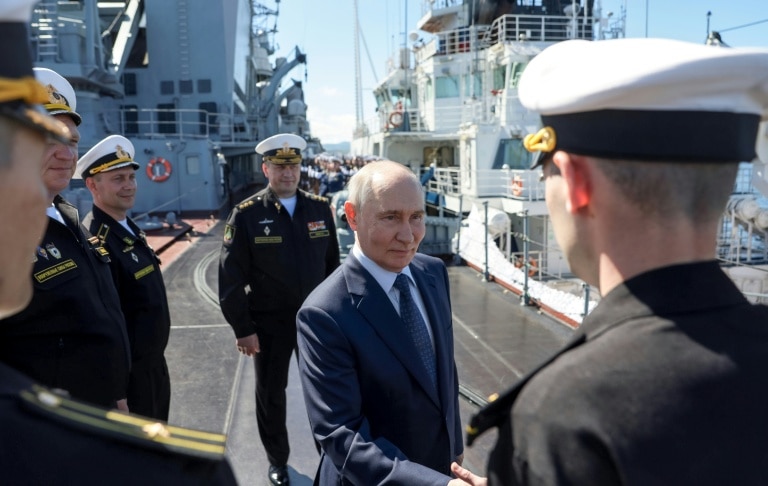
    Over the weekend, Putin floated the idea of former German Chancellor Gerhard Schröder—who has long-standing close business ties to Russia—serving as an independent mediator, but the proposal was immediately dismissed by German and European officials. The move comes as European Union officials acknowledge that their own peace efforts have been largely sidelined by U.S. leadership over the past year, but the bloc is now moving to take a more prominent role in diplomatic processes. EU foreign policy chief Kaja Kallas emphasized that the bloc must first align on its core objectives before entering any formal discussions with the Kremlin, telling reporters in Brussels that “Before we discuss with Russia, we should discuss amongst ourselves what we want to talk to them about.”

    Ukrainian Foreign Minister Andrii Sybiha joined EU foreign ministers for their Brussels meeting, and backed a continued dual-track approach to diplomacy. “We have mainstream peace talks under the leadership of the U.S., and we need this track and we need U.S. leadership. But Europe could play also its role,” he said. Sybiha also highlighted shifting battlefield dynamics, noting that Ukraine has strengthened its position in recent months, slowing Russia’s gradual advance into Ukrainian territory to a costly, slow-moving campaign across the 1,250-kilometer front line. Ukraine has also leveraged domestically produced long-range drones and missiles to strike military targets deep inside Russian territory, he added, saying “We have a new reality on the battlefield … Ukraine became stronger after the most difficult winter.”

    On the sidelines of diplomatic talks, a separate incident linked to the war has sparked political upheaval in the Baltic state of Latvia. Investigations into recent stray drone incidents on Latvian territory concluded that Russian electronic warfare systems deliberately diverted Ukrainian drones that had been targeting sites inside Russia, pulling them off course into Latvian airspace. On Sunday, Latvian Prime Minister Evika Silina ordered Defense Minister Andris Sprūds to resign over the incident, saying he had lost her trust after the incident “clearly demonstrated that the political leadership of the defense sector has failed to fulfill its promise of safe skies over our country.” Sprūds complied with the order, framing the ouster as an internal domestic political dispute.

    Sybiha confirmed he had spoken with Latvian Foreign Minister Baiba Braže about the incident, and reaffirmed Ukraine’s commitment to collaborating with Baltic states and Finland to prevent similar stray drone incursions in the future. He offered to deploy Ukrainian technical specialists directly to assist with prevention efforts. Latvia is not the only European country to report such incidents in recent weeks; Estonia, Poland and Romania have all also documented stray drones landing on their territory in recent months.

    German Defense Minister Boris Pistorius became the latest senior European official to visit Kyiv on Monday, arriving for an unannounced trip focused on expanding bilateral defense cooperation between Germany and Ukraine. Western leaders have continued to reiterate their commitment to supporting Ukraine’s military capabilities amid the ongoing stalemate on the front lines.