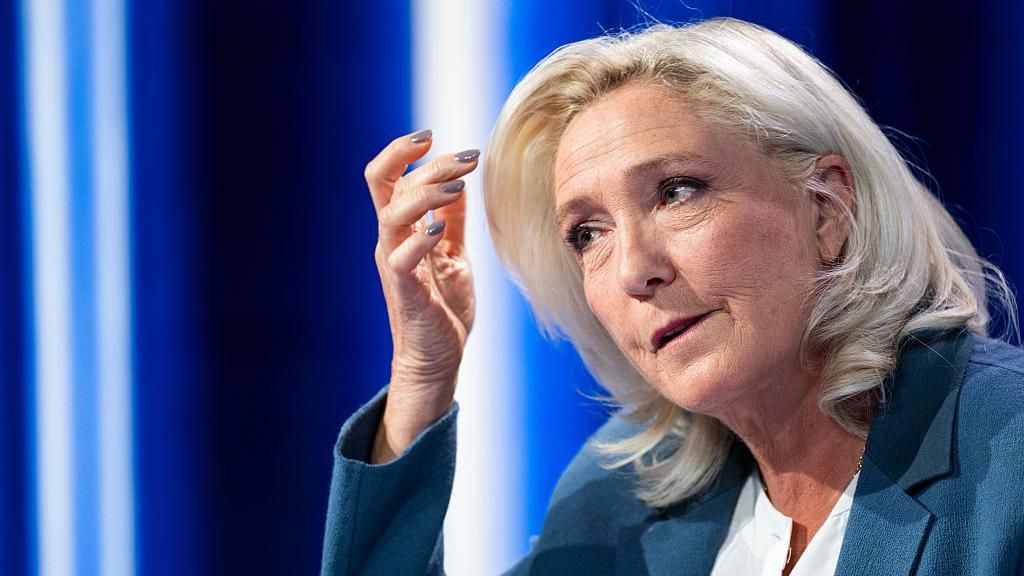
As France prepares for the 2027 presidential election, all eyes turn to Paris on Tuesday, where a high-stakes appeal court ruling will shape the trajectory of one of the nation’s most influential political figures: Marine Le Pen, leader of the far-right National Rally (RN). Scheduled to hand down its decision at 13:30 local time (11:30 GMT), the court will determine whether to uphold a 2025 embezzlement conviction that currently bars Le Pen from running for the country’s highest office.
At 57, Le Pen is no stranger to presidential campaigns, having already stood three times and finished second behind incumbent Emmanuel Macron in both the 2017 and 2022 races. With less than 10 months remaining before the first round of voting on April 18, 2027, she currently holds a lead in national opinion polls. Should the court confirm her ineligibility, 30-year-old RN chairman Jordan Bardella — Le Pen’s handpicked political protégé — will step in as the party’s candidate, making Tuesday’s outcome one with far-reaching consequences for the future of French politics. Political analysts broadly agree the verdict will effectively fire the official starting gun for what is already shaping up to be a deeply divisive presidential race.
The conviction at the center of the appeal dates back to March 2025, when a lower court found Le Pen guilty of diverting €1.4 million (£1.2 million) in European Parliament public funds between 2004 and 2016. Le Pen served as a Member of the European Parliament (MEP) from 2004 to 2017, and prosecutors alleged the funds were illegally used to pay party staffers rather than legitimate parliamentary assistants. The original ruling handed down a five-year ban from public office, a four-year prison sentence with two years suspended and two years to be served at home under electronic monitoring. Judges concluded Le Pen either explicitly approved or tolerated the fake employment scheme, automatically disqualifying her from the 2027 election.
During appeal hearings held earlier this year in January and February, Le Pen stopped short of denying wrongdoing entirely, but rejected claims she organized the fraudulent scheme. She did acknowledge making “a mistake” that allowed some parliamentary aides to work “for the benefit of the party.” Prosecutors have asked the appeal court to retain the original five-year public office ban, while modifying the prison sentence to one year of electronically monitored home detention and three suspended years. Le Pen has already publicly noted that even if she were technically eligible to run, being required to wear an electronic monitoring tag would make a successful campaign impossible, as it would restrict her ability to travel for rallies, public meetings and voter outreach.
The original trial judges left no room for ambiguity about Le Pen’s role in the scheme, concluding she was “at the heart” of the fake jobs system first established by her father, Jean-Marie Le Pen, founder of the party previously named the National Front. Marine Le Pen took control of the party from her father in 2011 on a promise to “detoxify” its far-right brand, ultimately cutting ties completely with him in 2015 over his controversial statements about the Holocaust. She rebranded the organization as the National Rally in 2018, and despite two presidential defeats against Macron, led the party to its best-ever legislative showing in 2024, when a hard-right RN alliance won 143 seats in the 577-seat National Assembly.
Le Pen has framed the legal proceedings against her as political persecution, claiming she faces “differential treatment” compared to other party leaders who have been found guilty of similar fraud offenses. A number of different outcomes are possible from Tuesday’s ruling, each with distinct political ramifications. An outright acquittal — which most political observers consider an unlikely result — would clear Le Pen to run with her political reputation fully intact. If the court upholds her conviction and retains a public office ban of more than two years (dated from the original conviction in March 2025), she will remain disqualified from running. However, a guilty verdict with a reduced ban of two years or less would allow her to appear on the 2027 ballot.
If the court follows prosecutors’ sentencing recommendations, Le Pen would still face one year of electronic monitoring. She has already emphasized that this would effectively end her presidential bid, saying, “When you are a presidential candidate you must be completely free to move about… I can’t rely on a judge to allow me to hold a rally or go to a market.” Should the verdict go against her, Le Pen technically has the right to launch a further appeal to France’s highest court, the Court of Cassation, within 10 days. But she has indicated she will not pursue this route, as the process would take several months and derail any coordinated campaign planning. Prosecutors could also launch their own appeal to the top court even if Le Pen is acquitted.
Ahead of the ruling, Le Pen has struck a defiant tone, saying she does not feel fear and remains calm regardless of the outcome. She has acknowledged that being barred from running would “undoubtedly be painful,” but added, “Whatever happens I won’t be dead, whatever happens I’ll continue to fight for my ideas.” If barred, she would step back from the presidential race to remain an activist for the party’s platform. Immediately after the verdict is released Tuesday, Le Pen will address the nation in a prime-time interview on France’s main 20:00 news broadcast to outline her next steps.
Bardella, who has been part of Le Pen’s inner circle since joining her 2017 presidential campaign as a 20-something, has served as RN party chairman since 2022. After Le Pen’s 2025 conviction, he was formally named her stand-in candidate, cementing the party’s contingency plan. Over the weekend, Bardella reaffirmed his unwavering loyalty to Le Pen, telling supporters, “I want to reiterate my total support, my total friendship, and that I’m committed to her in politics, to see her elected president of the republic.” Le Pen has said if she is elected president, Bardella will serve as her prime minister, and she would throw her full support behind him if she is forced to cede the top of the ticket to him.
The RN has projected an image of unified leadership regardless of the outcome, and recent polling shows the contingency plan has done little to damage the party’s standing: Bardella currently polls marginally better than Le Pen in first-round voting projections, with both candidates polling above 30%. Political opponents have questioned whether Le Pen would truly cede power to Bardella if she is barred, and have argued that Le Pen remains a far more threatening general election candidate than her young protégé, due to his relative lack of national political experience. Conservative Republicans candidate Bruno Retailleau previously joked that while French voters elected 40-year-old Macron, they would be hard-pressed to embrace a 30-year-old president.
Le Pen is not the only RN figure involved in the case. Of the 25 original party defendants tried in 2025, 12 were convicted and 12 have also launched appeals against their convictions. The list includes high-ranking RN officials such as Vice President and Perpignan Mayor Louis Aliot, former National Front Secretary General Nicolas Bay, veteran figure Bruno Gollnisch, former Le Pen aide Catherine Griset, and former party treasurer Wallerand de Saint-Just, all of whom received various combinations of prison time and public office bans in the original ruling.