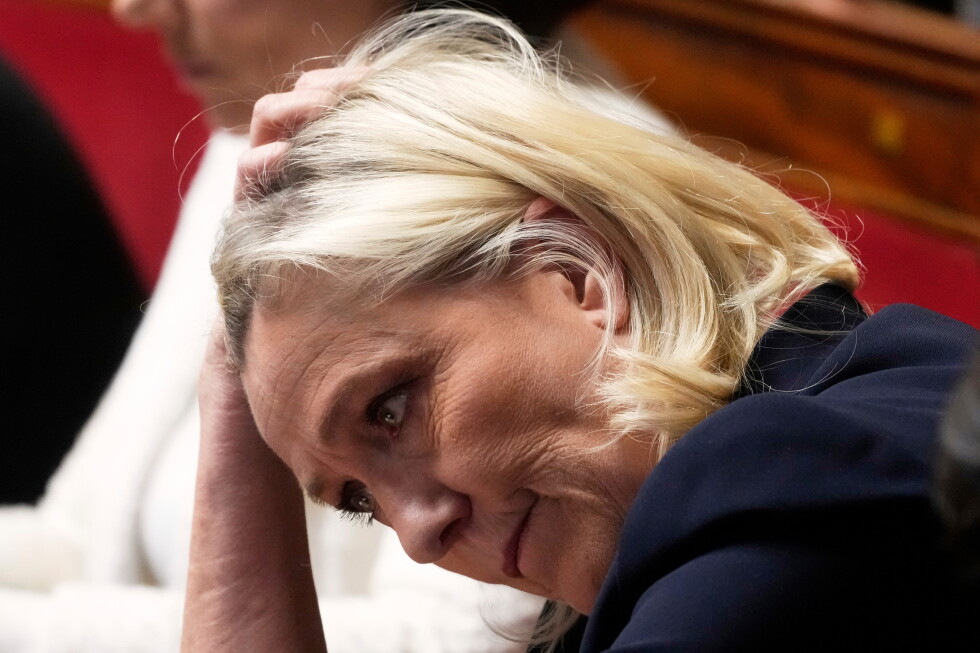
PARIS (AP) — A high-stakes ruling from Paris’ appellate court is scheduled for Tuesday in the long-running embezzlement case against far-right French leader Marine Le Pen, a decision that carries the power to upend the lineup for France’s 2027 presidential election and determine if one of the country’s top presidential hopefuls will appear on the ballot.
Le Pen, 57, was first convicted in March 2025 alongside other senior members of her National Rally (formerly the National Front) party. The lower court found the group guilty of systematically misappropriating European Parliament funds between 2004 and 2016, using money earmarked for EU parliamentary assistants to pay full-time party staff. The initial conviction handed Le Pen a suspended prison sentence and an immediate five-year ban from holding public office — a penalty that has been in effect since March 31, 2025. Le Pen has consistently denied any intentional wrongdoing and is pushing for the appeals court to overturn her conviction, clearing the way for her fourth presidential bid. If she is barred from running, her 30-year-old long-time protégé Jordan Bardella is widely expected to step in as the National Rally’s nominee, a shakeup that would fundamentally rearrange the race to succeed outgoing President Emmanuel Macron.
For Le Pen, the most favorable outcome is a full acquittal. During her five-week appeal trial held earlier this year, the presidential contender admitted to what she called “a mistake,” acknowledging that some employees compensated through EU assistant funds did carry out work for the party. But she stressed that she honestly believed this arrangement complied with existing rules and never made any attempt to conceal the hiring structure. She also faulted European Parliament officials for failing to flag the practice as problematic at the time it was occurring.
Le Pen’s lead defense attorney Rodolphe Bosselut framed the stakes clearly to the three-judge appellate panel, telling the court that his client had placed her entire political career in their hands, asking: “is the work of her life going to end here, or can it be rebuilt?” Even if Le Pen secures an acquittal, prosecutors retain the right to challenge the ruling by bringing the case to France’s highest judicial body, the Court of Cassation.
A second plausible outcome sees the appeals court uphold Le Pen’s conviction but reduce the public office ban to two years or less — or eliminate the ban entirely. Because the ban has already been in effect since March 2025, a penalty of two years or less would expire before the first round of the 2027 presidential election, scheduled for April. That said, Le Pen’s path to the ballot would not automatically clear even in this scenario. Any remaining prison sentence, electronic monitoring requirement, or other judicial restrictions would create crippling barriers to a national campaign. Le Pen herself has already indicated she would choose not to run under such circumstances.
“If I’m allowed to be a candidate but am effectively prevented from campaigning freely, then you understand that wouldn’t be possible,” Le Pen explained in a recent interview with French broadcaster LCI. “I can’t be dependent on a judge to authorize me to go hold a campaign rally or to visit a market.”
In the harshest likely outcome, the appeals court could side with prosecutors, who have requested a four-year prison sentence (three of which would be suspended) and reimpose the five-year ban on holding public office. Though prosecutors did not explicitly ask for the ban to take immediate effect as the lower court did, the appellate court retains the authority to order that. Le Pen could still appeal the ruling to the Court of Cassation, but it remains uncertain whether the high court would suspend the sentence while it reviews the case. The Court of Cassation has previously stated that if it takes up the appeal, it will aim to issue a ruling before the 2027 election, but timing remains a critical concern for Le Pen.
The presidential hopeful has stressed that she cannot delay her decision to run, noting that presidential campaigns require months of advance preparation. France’s election process is already set to begin formal organization in September, with campaigning accelerating in early 2026. Candidates are also required to collect endorsements from 500 elected officials to qualify for the ballot, a requirement that makes last-minute candidate replacements extremely difficult.
Le Pen argued that prolonged legal uncertainty, even if she ultimately wins a ruling in her favor at the Court of Cassation, would sink her campaign. “If I’m prevented from running but the Court of Cassation rules in my favor three or four months later, it will be too late to conduct a proper presidential campaign,” Le Pen told RTL radio last year, explaining that she would not risk damaging her party’s chances by delaying a decision.