分类: politics

  • UK police investigate after officers left guns outside mayor’s home

    UK police investigate after officers left guns outside mayor’s home

    A major security blunder has shaken London’s law enforcement community after armed protection officers assigned to guard Mayor Sadiq Khan accidentally left a cache of loaded weapons unsecured on a public street in the capital’s south end, triggering an urgent internal investigation. As of this week, five serving officers have been reassigned away from frontline protection duties while the probe into the incident moves forward, Metropolitan Police officials confirmed in an official statement released late Friday.

    The stockpile of weapons, which British tabloid newspaper The Sun has reported includes a Heckler & Koch MP5 semiautomatic carbine, a Glock service pistol, a Taser conducted energy weapon and a quantity of live ammunition, was discovered completely unattended by a local civilian couple earlier this Tuesday. The pair stumbled on the unmarked bag left along the curb before alerting police to the dangerous oversight.

    Jordan Griffiths, a scaffolder who was with his girlfriend when the bag was found, told reporters he was utterly stunned when he opened the bag and realized what it held. “I could not believe my eyes,” Griffiths said in an interview with The Sun. “I took some pictures as proof of what we had found, then I called the police right away and told them what I had. They turned up within a few minutes to collect the guns.”

    The Metropolitan Police’s Directorate of Professional Standards, the unit tasked with overseeing officer conduct and investigating procedural errors, is leading the review into how such a critical lapse in security protocol occurred. In the unit’s public statement, leaders acknowledged the public alarm the incident is likely to spark. “We are urgently reviewing the circumstances of this incident and recognize the concern it may cause,” the statement read. “At this stage it is believed the bag was misplaced by on-duty officers a short time before the member of the public located it.”

    A representative for Mayor Sadiq Khan said that while the incident does not pose an ongoing threat to the mayor, law enforcement leadership must take every possible measure to prevent similar dangerous oversights from happening in the future. “The police must now take all steps to ensure an incident like this never occurs again,” the spokesperson said.

  • Defenses not ‘annihilated,’ Iran reportedly downs two US planes

    Defenses not ‘annihilated,’ Iran reportedly downs two US planes

    Just 48 hours after former President Donald Trump asserted that Iran no longer posed a military threat and that the country’s entire air defense network had been completely destroyed, Iranian military forces carried out a stunning strike that downed two manned U.S. military aircraft on Friday, multiple international news outlets have confirmed.

    Citing an Israeli government official and a second anonymous source with direct knowledge of the incident, Axios first broke the news Friday afternoon that an F-15E Strike Eagle, one of the U.S. Air Force’s primary fighter-attack jets, was hit by Iranian anti-aircraft fire, forcing both crew members to eject over Iranian territory. This strike marks the first documented incident of a manned U.S. aircraft being shot down inside Iranian borders since the U.S.-Israeli military campaign against Iran launched on February 28.

    As of Friday evening, one of the F-15E crew members had been recovered by U.S. special operations forces, though The Washington Post reports that details of his medical condition remain undisclosed. Search operations are still intensifying across the region to locate the second missing crew member.

    Shortly after Axios’ initial report, The Intercept published confirmation that a second U.S. aircraft, an A-10 Warthog ground-attack jet, crashed near the strategic Strait of Hormuz around the same time as the F-15E incident. Matching the pattern of the first crash, one crew member from the A-10 has been recovered, while the second remains unaccounted for.

    Al Jazeera later added that a U.S. Black Hawk search-and-rescue helicopter was also struck by an Iranian projectile while participating in the operation to locate missing pilots. The helicopter was able to exit Iranian airspace before making a safe landing outside Iranian territory, with no reported casualties on board.

    Iran has officially claimed responsibility for downing the F-15E, with Tasnim News Agency — the semiofficial media outlet of the Islamic Revolutionary Guard Corps (IRGC) — releasing a formal statement confirming the strike. U.S. Central Command (CENTCOM) has a history of rejecting previous Iranian claims of downing U.S. aircraft, including a separate claim made near the Strait of Hormuz just one day prior on Thursday. However, CENTCOM has not issued any denial regarding Friday’s incidents, and has publicly confirmed that the F-15E was indeed lost.

    Friday’s development directly contradicts sweeping claims Trump made during a national televised address just this past Wednesday. During the speech, Trump declared that five weeks of intense U.S. bombing campaigns had “eviscerated” Iran’s military capabilities, and that the country was “essentially really no longer a threat” to regional or American interests. He went further to claim that Iran’s entire air defense infrastructure had been wiped out, saying, “They have no anti-aircraft equipment. Their radar is 100% annihilated. We are unstoppable.”

    Just one week prior, Trump claimed that Iran’s leadership was desperate to negotiate a peace deal because it “can’t do a thing” to defend itself against U.S. airstrikes. U.S. Defense Secretary Pete Hegseth echoed this narrative, repeatedly touting unchallenged U.S. “air superiority” over the region.

    Even before Friday’s downing of the two jets, these rosy assessments from the White House were already called into question. A Thursday report from CNN cited internal U.S. intelligence findings that roughly half of Iran’s missile launchers remain fully operational, and that the country still retains around 50% of its drone fleet. One senior source told CNN that Iran remains “very much poised to wreak absolute havoc throughout the entire region.”

    Military analysts have warned that any missing crew members captured by Iranian forces could become critical bargaining chips for Tehran in future negotiations with Washington. Iranian officials have already seized on the incident to mock the Trump administration’s claims. Mohammad Ghalibaf, speaker of Iran’s Parliament, posted a scathing rebuke on social media following news of the downing. “After defeating Iran 37 times in a row,” Ghalibaf wrote, “this brilliant no-strategy war they started has now been downgraded from ‘regime change’ to ‘Hey! Can anyone find our pilots? Please?’”

    The incident also comes amid growing controversy over casualty transparency in the conflict. An analysis published by The Intercept earlier this week found that at least 15 American troops have been killed in the region since the campaign began, with more than 520 others injured. CENTCOM has been accused of covering up the true scope of U.S. casualties after the command released incomplete, outdated casualty figures to reporters and repeatedly declined to share full, updated totals.

  • Senegal limits foreign trips for officials as the fallout from Iran war deepens

    Senegal limits foreign trips for officials as the fallout from Iran war deepens

    DAKAR, SENEGAL — Facing mounting economic pressure from a global energy crisis spurred by the Iran conflict, the Senegalese government has implemented strict new rules barring cabinet ministers from all foreign travel except for trips deemed absolutely critical to state affairs, as part of sweeping cost-cutting initiatives to stabilize public finances.

    Like most sub-Saharan African nations, Senegal relies almost entirely on imports to meet its domestic petroleum product demand. this heavy dependence leaves the country’s already fragile economy extremely exposed to global supply chain disruptions, most notably the tensions around the Strait of Hormuz — a key global oil chokepoint. Ongoing conflict linked to the Iran war has driven dramatic, sustained increases in global crude prices, squeezing both public budgets and household finances across the country.

    Speaking publicly Friday, Prime Minister Ousmane Sonko outlined the scope of the new austerity measures, noting that the national government’s initial 202X budget was built around a projected crude oil price of just $62 per barrel. In the wake of market volatility tied to the Iran conflict, current crude prices have surged to nearly twice that forecast, creating a massive unplanned budget shortfall that requires urgent action.

    “I have implemented a series of drastic measures to rein in all unnecessary government spending, starting with the full cancellation of all non-essential international missions,” Sonko stated in comments carried by state-owned national newspaper Le Soleil. The prime minister confirmed he had already scrapped multiple of his own planned trips to regional and European destinations, including Niger, Spain, and France.

    Going forward, Sonko emphasized, “No minister in my government will be permitted to leave the country except for missions that are absolutely essential.”

    The energy-driven price shock has extended far beyond government balance sheets, worsening daily hardship for millions of low-income Senegalese and other Africans who already struggled with poverty. For many households across the region, soaring fuel prices have made daily commutes to work unaffordable and put regular meals out of reach for vulnerable families.

  • Trump seeks $152m to reopen notorious Alcatraz prison

    Trump seeks $152m to reopen notorious Alcatraz prison

    A controversial new provision in the Trump administration’s 2027 fiscal budget request has sparked fierce political debate across California, as the White House seeks $152 million to restart operations at one of America’s most infamous correctional facilities: Alcatraz Island.

    Perched just off the coast of San Francisco, within view of the iconic Golden Gate Bridge, Alcatraz—widely nicknamed “The Rock”—has held a unique place in American popular culture for decades. First built as a coastal naval defense fort in the 1800s, the site was converted first into a military prison, then into a maximum-security federal prison in the 1930s under the U.S. Department of Justice. For nearly 30 years, it held some of the nation’s most notorious criminals, including gang kingpin Al Capone, organized crime leader Mickey Cohen, and Prohibition-era outlaw George “Machine Gun” Kelly. The site’s remote location and brutal conditions made it nearly impossible to escape, cementing its reputation as the most feared prison in the country.

    Alcatraz’s operational costs far outpaced those of other federal facilities, however. By 1963, the Bureau of Prisons confirmed running the island prison cost three times more than any comparable mainland facility, in large part due to the lack of natural infrastructure: the island has no native running water or permanent sewage system, meaning all supplies and waste must be shipped in and out by boat. It was permanently decommissioned as a prison that year, and turned over to the National Park Service to operate as part of the Golden Gate National Recreation Area. Today, it is one of San Francisco’s most popular tourist landmarks, drawing millions of visitors each year and generating roughly $60 million in annual tourism revenue for the region. It has also been featured in dozens of major Hollywood films, including *Escape from Alcatraz* starring Clint Eastwood and *The Rock* starring Sean Connery and Nicolas Cage.

    The Trump administration’s proposal would reverse that decades-long status. The $152 million request would cover the first year of construction costs to “rebuild Alcatraz as a state-of-the-art secure prison facility,” and is part of a broader $1.7 billion investment package for the Bureau of Prisons. President Trump first announced the plan on his social media platform Truth Social last year, stating he was directing the Bureau of Prisons, Department of Justice, FBI, and Department of Homeland Security to collaborate on a “substantially enlarged and rebuilt ALCATRAZ” that would “house America’s most ruthless and violent offenders.”

    The proposal has faced immediate, fierce pushback from Democratic politicians in California, who have raised a host of practical, financial, and cultural objections to the plan. House Democratic leader and longtime California representative Nancy Pelosi called the proposal “absurd on its face and should be rejected outright.” In a statement, Pelosi argued that “rebuilding Alcatraz into a modern prison is a stupid notion that would be nothing more than a waste of taxpayer dollars and an insult to the intelligence of the American people.” Pelosi and other local politicians also warned that converting the island back into an active prison would permanently eliminate one of the Bay Area’s most iconic tourist landmarks, cutting off millions in annual economic revenue.

    Beyond the loss of tourism, critics point to long-standing structural challenges that led to Alcatraz’s original closure 62 years ago, which remain unresolved. The island still lacks any natural source of running water or a permanent, modern sewage system, requiring all infrastructure for the facility to be built from scratch at massive extra cost. Unlike the 1960s, modern environmental regulations would also add billions in unaccounted-for costs to the project, critics say, making the final price tag far higher than the Trump administration’s initial estimate. Even if construction is completed, ongoing operational costs will still dwarf those of any mainland federal prison, as all food, fuel, staff, and supplies must be ferried to the island daily.

    Before the plan can move forward, it must first receive full approval from the U.S. Congress, where Democratic leaders have already signaled they intend to block the provision. While the proposal is popular with some conservative voters who frame Alcatraz as a symbol of harsh justice for violent crime, it remains deeply unpopular with California voters, local leaders, and the tourism industry that relies on the landmark for thousands of local jobs.

  • White House seeks $1.5 trillion in defense spending in 2027 budget proposal

    White House seeks $1.5 trillion in defense spending in 2027 budget proposal

    WASHINGTON D.C. – In a move that lays bare the core governing priorities of the current presidential administration, the White House Office of Management and Budget formally released its 2027 fiscal year budget proposal on Friday, April 4, 2026. The proposal’s centerpiece is a 44 percent jump in national defense spending, bringing the total defense topline to a historic $1.5 trillion.

    White House Budget Director Russell Vought framed the massive defense allocation as a deliberate expansion of the administration’s previous defense investment strategy, noting the plan builds on the prior $1 trillion historic defense spending cap to deliver the much larger figure for 2027. Alongside the dramatic increase in military funding, the proposal advances the president’s stated policy agenda by imposing strict constraints on non-defense federal spending, calling for an overall 10 percent cut to domestic program budgets compared to 2026 spending levels.

    Speaking at a White House event earlier that week, President Donald Trump emphasized that boosting defense outlays is a top priority for his administration, arguing that many domestic responsibilities – including public health and social support programs – should be transferred to individual state governments. “We’re fighting wars. We can’t take care of day care. You got to let a state take care of day care, and they should pay for it too,” Trump stated during the gathering.

    The proposed cuts reach across a wide range of domestic policy areas. Beyond reductions to public health programs, the budget would slash funding for refugee resettlement initiatives, renewable energy development projects, federal university research grants, and affordable housing assistance programs, among other domestic services.

    Policy analysts widely note that a presidential annual budget functions primarily as a policy blueprint that outlines the administration’s governing priorities, rather than a binding final plan. Ultimate authority over all federal spending rests with the U.S. Congress, which will review the proposal, amend its provisions, and pass its own appropriations bills to set final government spending levels for the 2027 fiscal year.

  • Conflict fuels price fears, deepens political rifts in US

    Conflict fuels price fears, deepens political rifts in US

    Weeks after the United States and Israel launched joint military strikes against Iran on February 28, American households across the country are already confronting the steep economic and political fallout of the conflict, as surging consumer prices deepen public discontent and widen long-simmering divides within the U.S. political landscape.

    At a Costco gas station in Houston’s Bunker Hill neighborhood on March 28, Roselyn, a clinic nurse filling up her vehicle, recorded a striking marker of inflation pressure: premium gasoline was selling for $4.27 per gallon, a $1 per gallon jump from the day the strikes began. That increase marks a 32% rise from the pre-conflict baseline of roughly $3.23 per gallon. For Roselyn, who identifies as politically independent and opposes the war, the price hike has compounded existing financial stress for working households.

    She questioned why the federal government is funneling billions into the conflict even as millions of American families struggle to make ends meet, adding that many of her patients have reported skyrocketing medical costs. Out-of-pocket healthcare expenses for these patients have doubled or even quadrupled in recent weeks, she said. The strain is not limited to fuel and healthcare costs, either. Retired former teacher Miller, who lives in the Houston area, told reporters that he and his wife have already noticed gradual price increases for grocery staples, and a prolonged conflict is expected to push costs even higher. In response to rising travel prices, the couple is now weighing whether to cancel their fall cruise vacation.

    Roselyn and Miller are far from outliers in their anxiety and opposition. Recent independent polling confirms broad national disapproval of both the war and the Biden (Trump) administration’s handling of the conflict. A late-March survey conducted by the Pew Research Center found that 61% of respondents disapprove of President Trump’s management of the Iran conflict, with just 37% voicing approval. Nearly 60% of respondents said launching military action against Iran was the wrong policy decision, compared to only 38% who called it the right choice. Forty percent of those polled said they believe the war will leave the United States less safe over the long term, while just 22% expect it to improve national security.

    A separate mid-March poll conducted by CBS and YouGov, which surveyed 3,300 U.S. adults, found that 68% of respondents said the administration has failed to clearly articulate the core goals of the Iran strikes. A majority of respondents also said they do not view Iran as an imminent threat to the United States, and do not see regime change in Iran as a priority that serves U.S. national interests.

    The conflict has also sharpened already stark partisan divides across the political spectrum. Among self-identified Republican voters, 79% approve of the administration’s handling of the war, while 92% of Democratic voters express disapproval. The support is even more solid among Trump’s most loyal base: roughly 90% of MAGA Republicans back the ongoing military action.

    Beyond partisan divides, the conflict has exposed a growing generational rift even within Trump’s own conservative coalition. Older Republican voters overwhelmingly back the president’s decision, but many younger conservative activists say they feel betrayed by a move that contradicts the “America First” foreign policy Trump campaigned on.

    The split was on full display at the recent Conservative Political Action Conference held in Texas, the Associated Press reported. Younger attendees told reporters they felt “disappointment and even betrayal” over the strikes, while older conservative attendees defended the action as a pragmatic response to long-standing threats to U.S. national security.

    “We did not want to see more wars,” Benjamin Williams, a 25-year-old marketing specialist with Young Americans for Liberty based in Austin, Texas, told the AP. “We wanted actual America-first policies, and Trump was very explicit about that” during his election campaign.

    With near-unified Democratic opposition already well established, growing public fractures among prominent Republican and conservative officials and policy experts have drawn increased national attention. On March 17, Joe Kent, the former director of the National Counterterrorism Center and a one-time loyalist to Trump, resigned from his post in protest of the conflict.

    “I cannot in good conscience support the ongoing war in Iran,” Kent wrote in a social media post announcing his departure. “Iran posed no imminent threat to our nation, and it is clear that we started this war due to pressure from Israel and its powerful American lobby.”

    The divide over the war also extends to foreign policy elites and academic experts. Proponents of the strikes argue that a weakened Iranian regime will deliver substantial long-term benefits to U.S. national security and economic interests. Saeed Ghasseminejad, a senior Iran and financial economics adviser at the Foundation for Defense of Democracies, argued that building a strategic partnership with a post-conflict democratic Iran could generate more than $1 trillion in revenue for U.S. companies over the next decade, with the energy sector alone producing $300 billion in non-ownership revenue for American firms.

    Critics, however, have widely questioned the legal and strategic rationale for the conflict, with many labeling it an unnecessary “war of choice.” Tom Ginsburg, an international law scholar at the University of Chicago, told the university’s newspaper in mid-March that there is no credible evidence Iran was preparing an imminent attack on Israel or U.S. military installations in the Middle East.

    “I have not seen any legal justification for the war. That’s not surprising, but it should be disturbing,” Ginsburg said. “It suggests that there is no conception of any restraint in using force abroad.”

    Panelists at a recent University of Chicago foreign policy discussion reached a broad consensus that the U.S. failed to consult key European and Gulf allies before launching the strikes, a misstep that has left many major allies unwilling to offer full backing for the U.S. effort. Paul Poast, an associate professor of political science at the university, noted that instead of building a broad international coalition to support the action, the unilateral U.S. approach has fostered hesitation and even open distrust among traditional partners. Many U.S. allies, particularly those that host American military bases and have faced past Iranian aggression, are now questioning Washington’s reliability and decision-making process, Poast added.

    Critics have also pointed to the administration’s mixed messaging as evidence that it lacks a clear endgame for the conflict. President Trump has sent contradictory signals in recent weeks, floating the possibility of deploying U.S. ground troops into Iran one day before suggesting American forces would withdraw from the region very soon.

    The cost of the conflict is already mounting at a staggering rate: Pentagon officials told members of Congress during a recent closed-door briefing that the first six days of strikes cost U.S. taxpayers more than $11.3 billion. Independent analyses from groups including the Center for American Progress estimate that by late March, the ongoing conflict was costing between $25 billion and $30 billion in federal spending every month.

  • Democratic states sue to block Trump’s mail-in ballot restrictions

    Democratic states sue to block Trump’s mail-in ballot restrictions

    A legal showdown over election administration has erupted in the United States, as the top leaders of 23 states governed by the Democratic Party have filed a federal lawsuit aiming to halt newly imposed restrictions on mail-in voting unveiled by President Donald Trump via executive order earlier this week.

    The core of the plaintiffs’ legal argument centers on constitutional authority: the lawsuit contends that the president lacks any constitutional mandate to interfere in the administration of U.S. elections, a power explicitly reserved for individual state governments. According to the court filing, the new executive rules “transgress Plaintiff States’ constitutional power to prescribe the time, place, and manner of federal elections” and amount to an unlawful attempt to “amend and dictate election law by fiat based on the President’s whims.”

    The U.S. Constitution clearly outlines the division of election oversight authority: individual state legislatures hold the power to set the rules for federal elections, while Congress retains the right to modify those regulations at the national level. This framework puts Trump’s unilateral action directly at odds with long-standing constitutional separation of powers, the suit argues.

    Trump has spent months pushing unsubstantiated claims that widespread voter fraud is inherent to mail-in voting, a narrative he has repeated even as members of his own household have taken advantage of the voting method. The president himself recently cast a mail-in ballot in Florida, citing his status as sitting president, and both his wife Melania and son Donald Trump Jr. have used mail-in voting in recent electoral cycles.

    The executive order, signed by Trump this past Tuesday, includes two key provisions. First, it orders the federal government to build and maintain a national database of all U.S. citizens eligible to vote. Second, it directs the U.S. Postal Service to only deliver mail-in and absentee ballots to voters who appear on a state-maintained Mail-in and Absentee Participation List, a requirement designed to restrict ballot access to only those formally registered to vote by mail.

    New York Attorney General Letitia James, a leading figure in the coalition of plaintiffs, emphasized the stakes of the legal challenge in a public statement following the filing. “Free and fair elections are the cornerstone of our democracy, and no president has the power to rewrite the rules on his own,” James said.

    Independent legal experts have echoed the plaintiffs’ skepticism, noting that there is little precedent or constitutional support for the president unilaterally overhauling state-run election procedures. Most analysts agree that the new restrictions are extremely unlikely to go into effect ahead of November’s midterm elections, which will determine which party controls the majority in both chambers of the U.S. Congress.

    This is not the first time the courts have pushed back against Trump’s election-related executive actions. Judges have already blocked a separate executive order that would have withheld federal election funding from states that refused to comply with Trump’s preferred voting rules.

    The latest executive order comes as Trump continues to pressure congressional Republicans to pass the SAVE America Act, a sweeping voting reform proposal that would require all prospective voters to provide proof of U.S. citizenship in order to cast a ballot, a measure that voting rights advocates argue would disenfranchise millions of eligible voters.

  • How Canada’s largest gun control effort in decades is missing the mark

    How Canada’s largest gun control effort in decades is missing the mark

    For more than 35 years, gun control advocate Heidi Rathjen has pushed for sweeping restrictions on assault-style weapons, a fight born from unspeakable tragedy. In 1989, a gunman opened fire on her campus at Montreal’s École Polytechnique, killing 14 women and wounding more than a dozen others. The massacre marked a defining shift in Canada’s approach to gun violence, but it would take another 31 years—and a second mass killing that left 22 dead in Nova Scotia in 2020—for the federal government to finally act, rolling out a national ban on roughly 2,500 models of assault-style firearms paired with a voluntary buyback program to remove existing weapons from civilian circulation.

    Three years on, what was meant to be a landmark public safety win has devolved into a fragmented, widely criticized effort facing pushback at every turn, from provincial governments and law enforcement to legal gun owners and even the country’s own public safety minister. Experts and advocates warn the program is at high risk of falling far short of its goals, plagued by poor communication, inconsistent policy design, and political division.

    Rathjen, who now serves as a spokesperson for gun control group PolySeSouviene, acknowledges the 2020 ban represents a step forward for public safety, but argues it is fatally flawed by its narrow scope. Key models of semi-automatic weapons, including the widely owned SKS rifle, remain excluded from the ban, leaving thousands of high-powered firearms still in circulation. “Without a comprehensive ban on assault weapons, there is no ban… and the money will be wasted,” she said, warning that the federal government’s $215 million CAD investment in the program risks delivering little meaningful improvement to community safety if the scope of the ban is not expanded.

    Even Public Safety Minister Gary Anandasangaree publicly expressed confusion over the policy’s logic, in a private conversation leaked to the *Toronto Star* late last year. Pressed on the program’s value, given that the vast majority of gun crime in Canada is committed with unregistered, illegal firearms, he told a Toronto resident, “Don’t ask me to explain the logic to you on this.” Anandasangaree later walked back the comments, calling them “misguided” and reaffirming his support for the initiative, but the leak amplified public doubts about the policy’s coherence.

    The challenges facing Canada stand in stark contrast to the widely celebrated success of similar programs implemented after mass shootings in Australia and New Zealand. After the 1996 Port Arthur massacre that left 35 dead, Australia implemented a national ban and buyback that removed more than 650,000 firearms from circulation, while New Zealand collected roughly 56,000 weapons after the 2019 Christchurch mosque shooting that killed 51 people. Joel Negin, a public health professor at the University of Sydney, said Australia’s success stemmed from two key choices that Canada failed to replicate: a rapid, coordinated rollout of a broad suite of gun control measures immediately after the tragedy, and sustainable, dedicated funding from a temporary national tax levy. In Canada, by contrast, the buyback has been rolled out slowly, disconnected from complementary interventions targeting illegal gun trafficking, and lacks the coordinated intergovernmental alignment that made Australia’s program work. “The situation in Canada is that the gun buy-back has been proposed, but it’s not necessarily linked closely to other interventions,” Negin explained, noting the rollout of all post-2020 gun laws has been deeply fragmented.

    Confusion over which firearms fall under the ban is pervasive among legal gun owners, according to Frank Nardi, a gun shop owner based in Montreal. Nardi, who opposes the ban, argues it unfairly targets law-abiding hunters and sport shooters while failing to address the root causes of gun violence in Canada, most notably gaps in the mental health system and rampant cross-border smuggling of illegal guns from the United States. He told the BBC many of his regular clients have approached him with questions about the program, unable to determine whether their own firearms are prohibited under the current rules. Pointing to two nearly identical semi-automatic rifles with the same caliber and ammunition type, he noted one is classified as prohibited while the other remains legal, a seemingly arbitrary distinction that has eroded trust in the policy among gun owners. “Let’s concentrate on that before slapping all these regulations and confiscations on all these legal firearm owners, who have always supported safety and followed the protocols,” he said.

    Political division has further gridlocked the rollout: two conservative-leaning western provinces, Alberta and Saskatchewan, have refused to participate in the federal program. Alberta will not enforce the ban, while Saskatchewan has passed legislation shielding gun owners from criminal liability until the province secures a guarantee of what it calls fair compensation for surrendered weapons. Blaine Beaven, Saskatchewan’s newly appointed firearms commissioner, framed the province’s opposition as a defense of legal gun owners, calling the ban “an ideological mandate that’s being put out there that has limited to no discernible benefit to public safety.” Multiple Canadian police forces have also declined to assist with the program, describing it as a “significant operational burden” that diverts resources away from their top priority: cracking down on illegal gun smuggling.

    This widespread pushback comes even as polling shows most Canadians support stronger gun control: a 2020 survey found 82% of respondents backed a ban on military-style assault weapons, and a majority say the country’s current gun laws are either appropriate or not strict enough. Canada already has far more stringent regulations than its neighbor the United States, requiring all gun buyers to pass a safety course and complete rigorous background checks to obtain a firearms license. But lax gun laws in the U.S. have fueled a steady flow of illegal weapons across the border: 2024 data from Ontario, Canada’s most populous province, shows roughly 91% of handguns seized in criminal investigations originate from the United States.

    While most gun crime in Canada involves unregistered illegal handguns, high-profile mass shootings that have shaken the country over the past three decades have almost exclusively involved long guns, from the 1989 École Polytechnique attack to the 2020 Nova Scotia rampage. Most recently, in February 2024, an 18-year-old gunman killed eight people, including multiple schoolchildren, in the small British Columbia town of Tumbler Ridge, using at least one unregistered modified rifle before dying of a self-inflicted wound.

    Despite the widespread criticism, the federal government says it remains committed to moving forward with the buyback. As of the initial declaration deadline this spring, more than 37,000 gun owners have voluntarily declared more than 67,000 prohibited firearms for buyback, just half of the 136,000 total weapons the government set aside funding to purchase. An amnesty period for gun owners to surrender their weapons without facing criminal charges has already been extended multiple times, and the new deadline for destruction is set for 30 October. It remains unclear whether that deadline will hold, however.

    The Supreme Court of Canada recently agreed to hear a legal challenge to the 2020 ban brought by the Canadian Coalition of Firearm Rights, after two lower courts upheld the policy. The court’s decision is not expected for several months, and the gun rights group is already advising owners who have declared their weapons to withdraw their applications pending the ruling. Group founder Tracey Wilson told the BBC the coalition is prepared to file its own request to extend the amnesty deadline if the federal government does not act first. “We’re not going to wait for them to do the right thing by Canadians,” she said.

    For Rathjen, who has spent more than half her life fighting for stronger gun laws, the current impasse is a devastating disappointment. With time running out to expand the ban to include all assault-style models, she warns the federal government has invested hundreds of millions of dollars and massive political capital into a program that is already heading for failure. “It’s just unbelievable that the government has invested so much in this controversial and difficult file, so much money, so much political capital, and yet they’re heading for failure,” she said.

  • ‘We want a voice in our land’ – the people evicted to build Nigeria’s capital

    ‘We want a voice in our land’ – the people evicted to build Nigeria’s capital

    Fifty years after Nigeria established its Federal Capital Territory (FCT) to house the new capital city of Abuja, indigenous communities that gave up their ancestral lands still battle for the compensation, basic services, and political representation promised to them decades ago. For Lami Ezekiel, an 80-something elder who still carries vivid memories of the late 1980s, the arrival of heavy construction machinery marked the end of life as she knew it. “We just watched big trucks and bulldozers flatten our farms,” she recounts. Ezekiel and thousands of other original inhabitants of the land that became Abuja have waited generations for the compensation pledged when their communities were cleared for government buildings, foreign embassies, and luxury developments.

    The push for a new Nigerian capital began in the 1960s, driven by growing concerns that the former capital, Lagos, was too vulnerable to attack due to its coastal location and politically divisive as a major hub of the Yoruba ethnic group in a country balancing deep ethnic rivalries. In February 1976, the military government under Murtala Muhammed carved out the 7,315-square-kilometer FCT from parts of three existing states: Niger, Plateau, and Kaduna. The government officially branded the territory “neutral, no man’s land” — a phrase that still stings for the at least 10 indigenous groups, including the Gbagyi people, who have called this land home for millennia.

    Daniel Aliyu Kwali, president of the FCT Stakeholders’ Assembly, points out that archaeological and historical records confirm indigenous communities have inhabited the region for more than 6,000 years. “The FCT is only 50 years old; I am 70 years old. We are far older than the capital territory itself,” Kwali notes.

    Isaac David, born in 1982 in the FCT’s Kabusa community, grew up playing in clean streams and helping his family tend crops on land that had sustained his ancestors for generations. Today, the streams that once watered his community are gone, replaced by the five-star Transcorp Hilton Abuja. Former farmland now hosts the United Nations headquarters, the U.S. Embassy, and Nigeria’s seat of power, the Aso Rock Presidential Villa — built on what was once a sacred community shrine. Today David owns farms in neighboring Niger state, because indigenous residents who want to farm now must purchase land far outside Abuja’s city limits.

    Initially, the Nigerian government planned to relocate all “few local inhabitants” outside the FCT boundaries, but scrapped the plan over the high cost of mass resettlement. “Due to the high cost of resettlement, the government allowed residents who wished to stay in the FCT to remain,” explained Nasiru Suleiman, director of resettlement and compensation at the Federal Capital Development Authority (FCDA). Under the adjusted policy, residents of what would become central Abuja were relocated to planned resettlement communities like Kubwa, about 30 minutes from their original homes.

    For many families, the forced removal was a traumatic experience. John Ngbako, who served as Maitama community secretary at the time, recalls asking authorities why original inhabitants could not stay alongside the new arrivals moving into the capital. Community leaders say they were promised new farmland, housing, and fully installed water and electricity infrastructure at the Kubwa relocation site. But before negotiations over the terms of resettlement could be finalized, security forces moved in. Families were loaded onto open tipper trucks and dropped off in Kubwa, where none of the promised amenities existed, and tensions quickly flared with Kubwa’s original inhabitants.

    Laraba Adamu, who was newly married when she was relocated, remembers open hostility when she went to the local river to fetch water. “People would see us coming and shout, ‘The government cows have arrived,’” she says. Today, Ezekiel lives in a small two-room home in Kubwa where she has to cook outdoors. “When we were moved, they promised us all the social amenities,” she says. “None of them have been fulfilled. We pay for our drinking water, we pay for our electricity, and we have no farmland at all.” The displaced Maitama community named their new settlement Maitama-Kubwa, clinging to the identity of the neighborhood they were forced to leave. Esu Bulus Yerima Pada, who became chief of Maitama-Kubwa in 2001 as a descendant of the community’s traditional ruling line, says the government also promised to issue formal land titles confirming residents’ ownership of their new plots. “To this day, they have never done it,” he says. Community leaders still bring younger generations to visit the upscale Maitama district of central Abuja to show them the land their ancestors tended, where even the banana trees planted by previous generations still stand.

    Tensions over land and forced demolitions have not faded — they continue to erupt today. In March 2025, bulldozers moved into Gishiri, another indigenous community that predates the FCT, to demolish dozens of homes. Princess Juliet Jombo, a 32-year-old schoolteacher, lost all the properties her late father, a traditional ruler, had built and left for her family. “Everything my father worked for his whole life and left to us — it was all destroyed,” she says. Her one-bedroom flat was originally valued at just 260,000 naira ($170), and even after public protests the valuation only doubled to 520,000 naira — far too little to buy alternative housing in Abuja’s rising market. The demolition also destroyed the community primary school, leaving nearly 500 students out of classes for months.

    Suleiman of the FCDA insists the resettlement process is conducted through consultation with affected communities, and that compensation is either paid directly to recipient bank accounts or provided as newly built housing. But community activists and leaders say support and resettlement always come after forced demolitions, never before. “By law, the government must first hold dialogue with the people, who have the right to choose a place where they feel safe,” David says. “Then the government should build new housing, and only then relocate people to the new site.” David, who has become one of the most visible advocates for FCT indigenous rights earning him the nickname “Commander,” entered political activism in the mid-2000s after learning about the FCT’s unique constitutional status.

    For indigenous communities, the fight goes far beyond unfulfilled compensation promises — it is also a battle against systemic political exclusion. Unlike any of Nigeria’s 36 states, the FCT has no elected governor. Instead, the country’s president appoints a minister from anywhere in Nigeria to exercise powers equivalent to a state governor. “As an indigene of Niger state, I could run for governor of Niger state,” Kwali says. “But here in the FCT, my home, I have no constitutional right to elect a governor, and I cannot run for the position myself. Any other Nigerian can become FCT minister, but I never can.”

    The exclusion extends to local office: unlike other regions of Nigeria that reserve local elected positions for people with indigenous family origins in the area, any Abuja resident can run for local office regardless of their birthplace. Many FCT elected representatives come from other parts of Nigeria, a situation that strikes indigenous residents as deeply unfair. “I could never go to your home village and run for local office and expect to win,” said Methuselah Jeji, a 32-year-old new father who worries about the barriers his child will face growing up in the FCT. “My child can never be governor. That is very sad — it is not that I am unable, it is just that this is the land where God placed me.”

    David argues that the lack of indigenous political representation directly explains why most FCT indigenous communities remain mired in underdevelopment, even as central Abuja sees massive state investment. While central Abuja boasts wide, paved boulevards, gleaming foreign embassies, and luxury high-rise apartments, most indigenous settlements on the capital’s outskirts have potholed dirt roads, overcrowded classrooms, understaffed clinics, unreliable electricity, and no formal secure land ownership for residents. “When we had one of our own in the Senate, we saw real change,” David says, referring to Philip Aduda, the only FCT indigenous person ever elected to the Nigerian Senate, who lost his seat in 2023 to a candidate originally from Kano state.

    Danladi Jeji, Methuselah’s father, warns that the decades of unresolved grievances and stalled court cases have created a tinderbox. With many legal challenges languishing in the court system for years, many indigenous residents feel their concerns are completely ignored by the government. He fears that the younger, more politically aware generation of indigenous FCT residents will grow tired of peaceful advocacy and turn to confrontation: “This is a bomb waiting to explode.”

    Despite decades of disappointment, activists still prioritize non-violent action to advance their demands. “We can demand our rights peacefully,” David says. “We want representation. We want to have a voice in our own land.” For her part, Ezekiel still holds out hope that the government will finally keep its promises, and that she will get farmland to work before she dies. “If I could be given land to farm today, land where I and my children can work, I would be truly grateful,” she says. “I am still strong.”

  • China aims to show global leadership with Iran war diplomacy. US appears uninterested

    China aims to show global leadership with Iran war diplomacy. US appears uninterested

    As the Iran war enters its fifth week marked by sharp military escalation, China has emerged as an increasingly active diplomatic player in the Middle East, launching a coordinated push to position itself as a responsible mediator while facing widespread skepticism from the United States over the substance of its peace efforts.

    Beijing’s latest diplomatic gambit centers on a joint five-point peace proposal drafted alongside Pakistan, which it has spent weeks rallying regional and global powers to support. The framework calls for an immediate end to hostilities and the reopening of the strategically critical Strait of Hormuz, where Iran’s control over shipping traffic has sent global energy prices skyrocketing. China has also openly opposed a revised United Nations resolution put forward by Bahrain that would authorize defensive military action to secure the waterway, arguing that any Security Council action must de-escalate tensions rather than inflame them further.

    Since the outbreak of the war, Chinese Foreign Minister Wang Yi has conducted a flurry of diplomatic outreach: holding more than 20 phone calls with foreign ministers across the Middle East and major global powers, hosting his Pakistani counterpart in Beijing to finalize the joint proposal, and dispatching a special envoy to the region to hold face-to-face talks on de-escalation. Wang has courted support from Gulf nations and European Union officials, framing the five-point plan as a reflection of broad international consensus that prioritizes peace. China and Russia have lobbied against the Bahrain UN proposal, warning that outside powers could exploit a UN mandate to expand the conflict; to avoid a likely veto, Bahrain has significantly watered down the text and delayed a vote until next week.

    Analysts and U.S. officials frame China’s heightened diplomacy as a calculated bid to expand its global influence at the United States’ expense. Sun Yun, director of the China program at the Washington-based Stimson Center, noted that the ongoing crisis presents a rare, high-profile opportunity for Beijing to demonstrate its diplomatic leadership on a pressing global issue. “The war with Iran is the priority of all countries in and outside the region,” Sun explained. “It is an opportunity China will not miss to demonstrate its leadership and diplomatic initiative.”

    Former senior U.S. diplomat Danny Russel, now a distinguished fellow at the Asia Society Policy Institute, drew a direct parallel between the current five-point proposal and China’s 2023 12-point peace plan for Ukraine, arguing that both efforts amount to empty rhetoric rather than actionable mediation. “What we are seeing from China is messaging, not mediation,” Russel said. “Its narrative is that while Washington is reckless, aggressive and heedless of the cost to others, China is a principled and responsible champion of peace.” Liu Pengyu, spokesperson for the Chinese Embassy in Washington, has pushed back against this characterization, asserting that China has worked “tirelessly for peace” since the war began.

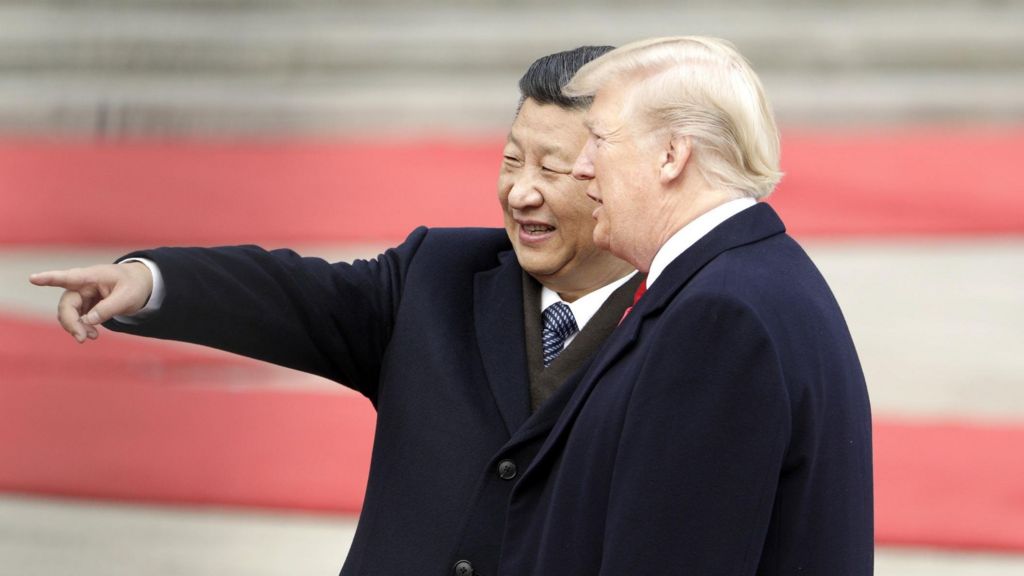
    The Trump administration has made clear it has little enthusiasm for China’s mediation efforts. Three U.S. officials, speaking on condition of anonymity, told the Associated Press that Washington has grown skeptical of third-party mediation in the conflict, and has no interest in boosting China’s international standing or granting it a victory in the Middle East. The administration currently describes its position on the Chinese-Pakistani proposal as “agnostic” — neither endorsing nor rejecting it — but officials note this posture could shift ahead of President Donald Trump’s planned summit with Chinese President Xi Jinping, currently scheduled for mid-May. Trump initially postponed the meeting from its original late March date citing the demands of the war, and analysts say Beijing has a clear incentive to de-escalate tensions before the summit to avoid another delay.

    In terms of core national interests, China is better insulated from the economic fallout of the Strait of Hormuz closure than many other major economies, thanks to years of energy supply diversification, reduced fossil fuel dependence, and a large strategic petroleum reserve. Only around 13% of China’s oil imports come from Iran, and Beijing has secured agreements with Tehran to allow Chinese-flagged vessels safe passage through the waterway. Still, analysts warn that a protracted conflict would eventually harm China’s export-driven economy: prolonged energy price shocks and global shipping disruptions would raise input costs and weaken global demand, dragging on Chinese growth.

    Ali Wyne, senior research and advocacy adviser on U.S.-China relations at the International Crisis Group, added that Beijing is eager to highlight the perceived failures of U.S. policy in the region. “China welcomes the opportunity to suggest that it is helping mitigate a crisis of America’s making, especially as the Trump administration’s lack of a considered strategy for containing the fallout becomes more apparent,” Wyne said.

    The conflict took a major turn for the worse last Friday, when Iran shot down two U.S. military aircraft — the first such escalation in the five weeks since the war began. Days after claiming in a national address that the U.S. had “beaten and completely decimated Iran,” Trump told NBC News that the downing would not impact potential negotiations with the Iranian government.