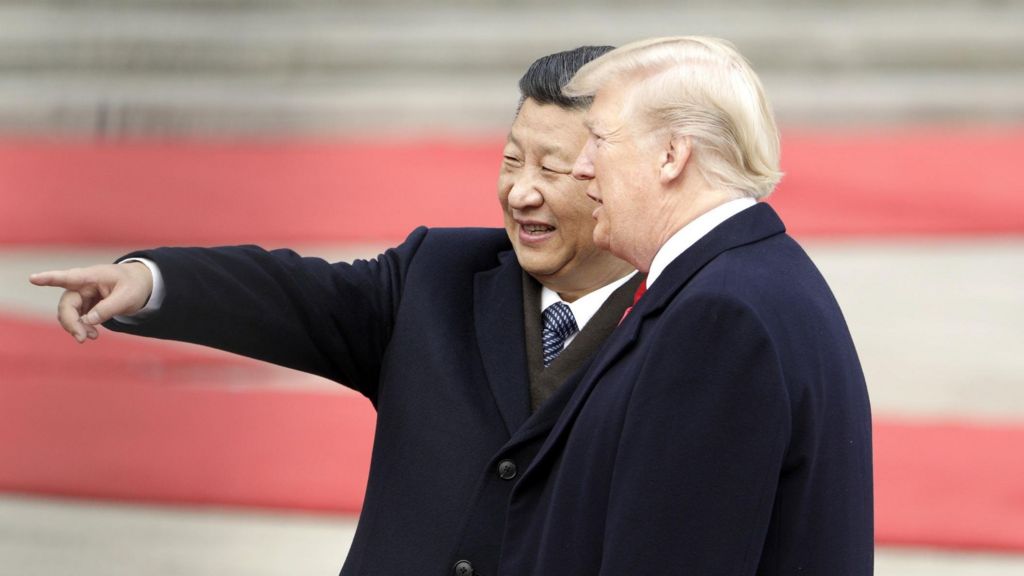
Eight years after Donald Trump’s 2017 state visit to Beijing, the U.S. president is back at the Chinese capital this week for high-stakes talks with Chinese leader Xi Jinping, arriving to a changed China that stands far more confident and globally assertive than it did during his first trip. Back in 2017, Beijing rolled out an unprecedented honor for Trump, hosting a formal dinner inside the Forbidden City — a gesture no sitting U.S. president had received before. This year’s reception promises equal grandeur, with a scheduled stop at Zhongnanhai, the closed compound that houses China’s top political leadership. But while the hospitality is warm, the summit agenda remains fraught: alongside longstanding sticking points of trade, technology competition and the Taiwan issue, rising tensions over Iran have added a new layer of geopolitical friction to the talks.
To understand the scale of China’s transformation since Trump’s last visit, one need only look beyond Beijing’s historic central districts to the megacity of Chongqing, tucked into the mountainous southwest of the country. Where Trump’s 2017 visit saw Beijing pour extensive diplomatic effort into proving it stood as a geopolitical equal to the U.S., that effort is no longer necessary today, according to Ali Wyne, senior research and advocacy adviser for US-China relations at the International Crisis Group. Washington now openly recognizes China as a “near-peer” competitor, Wyne notes — arguably the most formidable rival the United States has faced in its entire history.
Chongqing, once a gritty, overlooked manufacturing hub, has been remade by billions in state investment into a symbol of China’s new economic and global ambitions. Its dramatic, vertically stacked skyline, where subways cut through residential skyscrapers and winding roads cling to steep hillsides above the Yangtze River, has earned it the viral nickname of the world’s “cyberpunk capital,” drawing two million international visitors annually after China expanded visa-free travel to boost its soft power. It is also at the forefront of Xi Jinping’s push to develop “new productive forces,” with massive state investment pouring into renewable energy, robotics, artificial intelligence and electric vehicle manufacturing. Chongqing now leads China in automobile production, underpinning China’s status as the world’s largest car exporter, and is positioning itself to become the Silicon Valley of western China. This year alone, China plans to invest roughly $400 billion in the robotics sector, where it already operates more industrial robots than any other country.
Yet behind Chongqing’s futuristic skyline and viral social media trends such as the “Chongqing train eating” challenge that draws tourists and locals alike to snap viral photos, the city also exposes the challenges China currently faces. Years of large-scale urban construction have left the local government, which serves a population of more than 30 million, heavily indebted, alongside broader national headwinds: a sluggish property sector, falling home prices, rising youth unemployment and persistently low domestic consumption. U.S. tariffs first implemented under Trump’s first term and economic spillover from the ongoing Iran conflict have only amplified these pressures. In older working-class neighborhoods of Chongqing, many daily-wage workers and small vendors still struggle to make ends meet, and ordinary residents expressed a range of views on the approaching summit and the U.S. president.
Many ordinary Chinese credit Trump’s “America First” agenda and divisive trade policies with weakening U.S. global standing and accelerating China’s rise, even as they criticize his unilateral approach. “He doesn’t care about the consequences at all. He should know that we share the same world — it is a global village. He should not always put America first,” one unnamed tourist told reporters. Still, for many young Chinese people, the U.S. remains a symbol of opportunity and creative freedom, even as strained bilateral relations have made studying abroad a more uncertain dream. That uncertainty, however, has also pushed Chinese engineers and innovators to accelerate domestic technological development, visible in Chongqing’s new innovation hubs, where school children now interact with domestically developed humanoid and aquatic robots.
One major sticking point in this week’s talks is expected to be access to advanced semiconductors, the core component powering AI and robotics innovation. While the previous Biden administration imposed tight restrictions on sales of cutting-edge chips to China to slow the country’s technological progress, President Trump has relaxed some of those rules, allowing U.S. chip giant Nvidia to sell certain mid-tier advanced chips to China, while keeping bans on the most high-end models. For global analysts, the growing competition over AI also creates a shared risk: both powers must set aside great power rivalry to address common threats, from cyberattacks on critical infrastructure to the risk of malicious actors misusing AI to access sensitive nuclear or medical systems.
Trade remains the most closely watched issue on the summit agenda. Since 2017, China has deliberately reduced its reliance on the U.S. market, reorienting its trade toward Southeast Asia and the European Union; U.S.-bound Chinese exports have dropped by roughly 20%, pushing the U.S. to third place among China’s largest trade partners. When Trump began threatening new tariffs ahead of the 2024 election, Beijing prepared for the outcome, and did not back down when the tariffs took effect last year. Today, Beijing is far more economically resilient, with new trade routes such as the China-Europe rail link through Central Asia helping domestic manufacturers like Chongqing’s electric vehicle makers reach new global customers. The Iran crisis has also boosted demand for EVs as global gasoline prices rise, strengthening the sector’s outlook. “I’m quite optimistic about the future development of Chongqing’s EV industry,” says Lucia Chen, an EV sales executive at a local Chongqing firm. “My family and friends have all made the switch from fuel cars to EV. Because of the Iran war, petrol prices have risen a lot and many buyers are considering an EV for the first time.”
Beyond trade and technology, Trump is also arriving in Beijing seeking China’s diplomatic help to de-escalate the ongoing Iran conflict, a shift that underscores Beijing’s growing central role in global geopolitics. For Trump, a successful summit would be marked by a tangible win, such as an agreement for China to increase purchases of American goods. For Xi, any outcome that delivers a smooth, orderly visit is already a win: it reinforces his core message that China remains open to business and open to the world, after years of isolation during the COVID-19 pandemic.
Today, as Beijing rolls out the red carpet for Trump, the contrast between the two leaders could not be clearer: Xi is positioning China as a beacon of global stability, against a backdrop of the unpredictable, mercurial Trump whose foreign policy has scrambled traditional global alliances. Since Trump returned to the White House, his on-again off-again approach to trade and diplomacy has left U.S. allies reeling, while Beijing has steadily built ties with Western leaders from across the globe. To be sure, challenges remain beneath the polished image China presents to visiting leaders: strict state control over media and public discourse, pervasive surveillance, and zero tolerance for political dissent. Still, Chongqing’s transformation offers a clear preview of the future China is working to build: a future where it stands as a fully equal global power to the United States, leading in key emerging technologies and projecting growing influence across every region of the world. Whether that transformation is seen as a success story or a cautionary sign, it is impossible to ignore: the China that greets Donald Trump in 2025 is vastly different from the one he visited in 2017.