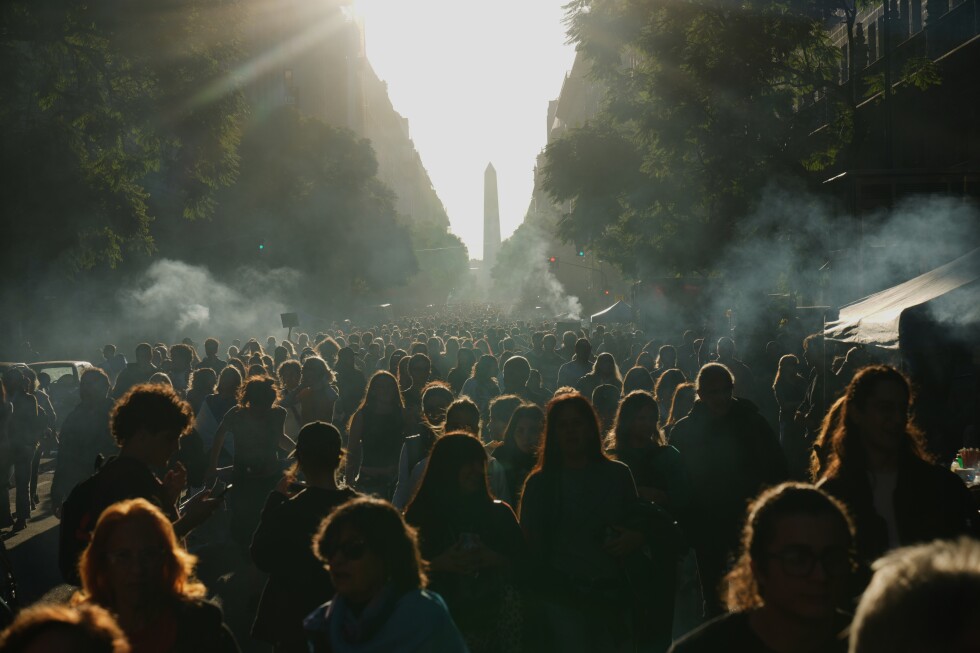
BUENOS AIRES, Argentina – Mass mobilization swept across major Argentine cities on Tuesday, as tens of thousands of demonstrators filled public streets to push back against sweeping funding cuts to the nation’s beloved public university system enacted by libertarian President Javier Milei.
Marches originating from multiple points in central Buenos Aires converged on the Casa Rosada, the Argentine government’s executive headquarters, where protesters voiced fierce opposition to chronic budget shortfalls that are steadily eroding the financial backbone of the country’s public higher education network. For nearly 75 years, Argentina’s public university system has stood as a cornerstone of national identity: tuition-free since 1949, it has cultivated a highly skilled national workforce deeply valued by the country’s large middle class, and counted five Nobel Prize winners among its alumni. Last year, Argentina’s Congress passed bipartisan legislation mandating that the government adjust university operating budgets and professor salaries to match the country’s sky-high persistent inflation. But rather than enacting the law, the Milei administration has instead challenged its constitutionality in the courts, leaving the system starved of needed funding.
Milei’s ideological framing of the cuts aligns closely with that of his prominent American ally and backer, former U.S. President Donald Trump: the president has repeatedly painted public university campuses as hotbeds of progressive “woke” indoctrination. The funding slashes form a core part of his controversial austerity agenda, which leans on dramatic cuts to overall public spending to correct what he frames as decades of fiscally irresponsible spending and entrenched corruption under prior left-leaning administrations.
Tuesday’s cross-sectional protest drew participants of all age groups and political affiliations, unfolding as Milei’s national approval ratings have plummeted in recent months amid a steep economic downturn. The country has struggled with contracting economic output, eroding real wages, and rapidly rising unemployment under his watch. A growing wave of corruption scandals has also fueled public anger, most notably an ongoing investigation into unexplained lavish spending by Milei’s close confidant and Cabinet Chief Manuel Adorni, whose lifestyle appears far out of step with his modest public salary and officially declared assets. Protesters carried placards calling out the discrepancy, with one common sign reading “How much does Adorni cost us?”
Alejandro Álvarez, Milei’s appointed undersecretary for university policies, dismissed the mass demonstration as a purely partisan political action. He claimed the government has already provided increased funding to offset rising operating costs, but university unions and faculty organizations have uniformly rejected these marginal adjustments as woefully inadequate to address the system’s needs.
In its legal challenge to last year’s congressionally approved funding law, the Milei administration argues the legislation does not identify specific revenue streams to cover the mandated funding increases amid the country’s ongoing harsh fiscal austerity program. The case is currently on track to be decided by Argentina’s Supreme Court, and protesters on Tuesday issued a direct public call for the nation’s highest judicial body to heed the widespread public outcry across the country’s public squares.
Data from Argentina’s largest national faculty federation shows that since Milei took office in late 2023, the real inflation-adjusted value of university professors’ salaries has dropped by roughly 33 percent. Ricardo Gelpi, rector of the nationally prestigious University of Buenos Aires, warned that the dramatic erosion of purchasing power has already pushed more than 580 research faculty in engineering and hard science departments to leave the public system for higher-paying positions at private institutions or other sectors.
Speaking from the march in Buenos Aires, 24-year-old University of Buenos Aires law student Sol Muñíz summed up the widespread public sentiment around the cuts. “It’s very clear this government is determined to defund public education,” she said. “University is a source of pride for us. It is the best thing we have.”