分类: politics

  • ‘Every drop of water counts’: Fear for the future of Argentina’s glaciers

    ‘Every drop of water counts’: Fear for the future of Argentina’s glaciers

    Nestled in the shadow of the snow-capped Andes, Virginia de Valle walks through her family’s 16-hectare Bodega Gieco vineyard in Argentina’s renowned wine hub Mendoza, gesturing to the rows of grapevines that produce 100,000 litres of premium wine annually. Her opening remark carries unshakable gravity: “Without water, there would be no wine.” For Mendoza’s winemaking community, every drop of irrigation water traces back to the Andes’ winter snowpack and ancient glaciers – natural reserves that now sit at the center of a fierce national debate following recent parliamentary approval of sweeping reforms to Argentina’s landmark 2010 glacial protection law.

    For generations, Mendoza’s identity has been tied to its glacial water supply. Residents call the region “the daughter of the Andes’ water,” and as droughts grow more frequent and severe across the semi-arid province, glacial melt has become a critical buffer that keeps vineyards productive and household taps running. De Valle’s fear is shared by millions across the country: the rolled-back protections will open vulnerable glacial ecosystems to destructive large-scale mining, putting vital water sources at irreversible risk. “Every drop of water counts,” she emphasizes, a warning that resonates far beyond Mendoza’s vine rows.

    Argentina was a global pioneer in glacial conservation when it passed the 2010 Glacier Law, the first national legislation in the world dedicated specifically to protecting these critical frozen water reserves. The original law designated all glaciers and surrounding periglacial environments – including permafrost that traps billions of liters of frozen water – as strategic national reserves, banning any commercial activity that would damage them, and required a full national inventory maintained by the country’s leading glacial research body, the Argentine Institute of Snow Research, Glaciology and Environmental Sciences (Ianigla).

    The new reforms shift all decision-making power to provincial governments, which will now determine which glaciers within their borders qualify as “strategic” – defined as reserves that provide water for consumption, agriculture, biodiversity, scientific research or tourism. Glaciers deemed non-strategic can be removed from the national protected inventory, stripping them of all legal environmental safeguards. Proponents of the changes, led by President Javier Milei’s libertarian administration La Libertad Avanza, frame the original 2010 law as an unnecessary regulatory barrier that has blocked Argentina from unlocking its vast mineral wealth. They argue that opening glacial regions to copper and lithium mining will catalyze regional economic growth and accelerate the global transition to clean energy, which depends heavily on both minerals. Milei, who has campaigned on cutting red tape to attract foreign investment, has pointed to neighboring Chile, which shares the Andes mountain range and exports $20 billion worth of copper annually, while Argentina currently exports no copper at all. According to Bloomberg reporting, major global mining firms including Glencore, Lundin and BHP Group have already met with Milei, with plans to invest roughly $40 billion into Argentina’s untapped copper reserves if regulations are loosened.

    Opposition to the reforms has erupted across the country, from Mendoza’s wine valleys to Patagonia’s popular hiking destination El Chaltén, with the rallying cry “Los glaciares no se tocan” (Hands off our glaciers) painted on walls and sidewalks nationwide. More than 100,000 people registered to participate in a public hearing on the reforms in March, though fewer than 400 were able to speak during the two-day session. Agostina Rossi Serra, a biologist with environmental advocacy group Greenpeace, argues that widespread public opposition demonstrates this is not just an environmentalist cause – it is a fight for public water security. “It made clear that it’s not just environmental organisations who were asking for this law not to be amended; it was the people, the public, who were asking for water to continue to be protected,” she says.

    Many of the provincial governments pushing for the reforms, including Mendoza and neighboring San Juan, are located in arid and semi-arid regions where water is already a scarce, highly contested resource. Serra accuses these regional governments of prioritizing mining revenue over the long-term well-being of local ecosystems and communities: “They are provinces that believe mining development is far more important than ecosystems and the communities themselves.”

    Leading glaciologists have also pushed back on the core justifications for the reform, calling its central claims fundamentally flawed. Lucas Ruiz, an independent glaciologist researcher at Ianigla, explains that the argument that some glaciers do not contribute to river systems is scientifically baseless. “The most false part of it all is the claim that there are glaciers that do not contribute to rivers. If it’s a glacier, it has ice and contributes water. It’s very basic,” he says. Ruiz adds that the reform’s vague language creates massive uncertainty: “We are left not knowing what criteria will be used, not knowing which technical bodies will be involved, and clearly, any glacier and any periglacial environment could be at risk.”

    Ruiz also acknowledges a painful paradox at the heart of the debate that complicates the scientific community’s position: glacial melt is accelerating globally due to climate change, driven by fossil fuel emissions. Avoiding the worst-case scenarios requires a rapid global energy transition to renewables – a transition that depends entirely on large-scale extraction of copper and lithium for batteries, transmission infrastructure and clean energy technology. “It is a stark paradox, hard to accept, but it is the reality. Because the message from science is that energy transition is necessary,” he says. The solution, he argues, is not to roll back protections entirely, but to require rigorous environmental impact assessments for any mining project that would affect glacial ecosystems, and ensure all development is conducted responsibly.

    Greenpeace remains deeply concerned that the profit motive will push provinces to weaken protections to attract investment. “If I have an international company looking for a place to develop a project, I’ll probably choose the province with the fewest environmental restrictions. That’s the concern we’re going to face,” Serra says.

    Supporters of the reform argue that provincial control is the most fair and effective governance structure. Federico Palavecino, a Buenos Aires-based lawyer who advises mining projects on glacial regulation, says that since provincial communities will bear the consequences of any mismanagement, they should have the right to set their own rules. “Why should we tell them how to live?” he asks, arguing that removing regulatory barriers will bring much-needed economic investment to struggling rural communities.

    Back in her Mendoza vineyard, De Valle is working to educate visitors about the potential consequences of the reform, framing the fight as one that affects all Argentines, not just winemakers. “It will affect wineries, but first, it will affect life,” she says. With more than 16,900 glaciers across Argentina feeding 36 river basins that supply water to seven million people across 12 provinces, the outcome of this debate will shape the country’s water security, economic future and environmental legacy for generations to come.

  • Trump administration unveils 250-foot ‘Triumphal Arch’ design

    Trump administration unveils 250-foot ‘Triumphal Arch’ design

    A new controversial urban and memorial proposal has moved into the formal review stage in the United States’ capital, as former President Donald Trump’s administration has unveiled detailed architectural renderings for a 76-meter-tall triumphal arch monument, a project that has already sparked debate over its scope, cost, and place in Washington D.C.’s existing monument landscape.

    In a post shared to his social platform Truth Social on Friday, Trump lavished praise on the proposed structure, which has been nicknamed the “Arc de Trump” by observers. He claimed it would become “the GREATEST and MOST BEAUTIFUL Triumphal Arch, anywhere in the World”, adding that it would stand as a lasting, positive addition to the capital for generations of American visitors to enjoy.

    Administration officials confirmed this week that formal planning documents have been submitted to the U.S. Commission of Fine Arts, the federal body tasked with reviewing federal projects and public art in the nation’s capital. Notably, the commission is currently staffed with several appointees aligned with Trump, and the panel is scheduled to vote on the proposal during its upcoming meeting next week.

    If approved and constructed, the monument would surpass two of Washington D.C.’s most iconic landmarks in height: the United States Capitol Building and the Lincoln Memorial. Preliminary renderings released by the White House reveal a gold-accented design: prominent gold lettering reading “One Nation Under God” will adorn the main arch, the structure will be crowned by two golden eagles framing a gilded winged statue of Lady Liberty, and four golden lion statues will stand guard at the monument’s base.

    In a formal statement, White House press secretary Davis Ingle framed the project as a tribute to American service members and national history. He argued that the arch will improve the visitor experience for guests arriving at Arlington National Cemetery, serving as a permanent visual reminder of the sacrifices made by American service members over the nation’s 250-year history, sacrifices that have allowed current generations to enjoy the country’s freedoms.

    Planned to be sited along the approach to Washington D.C. from Arlington National Cemetery, welcoming visitors crossing Memorial Bridge into the capital, the arch is modeled after Paris’ famous Arc de Triomphe, a design influence Trump made public when he first announced the project last year. It is one of several high-profile initiatives Trump has pushed forward to reshape Washington D.C.’s public landscape to align with his personal vision. Another of these projects, a planned expansion of the White House ballroom, is currently tied up in ongoing litigation, putting that work on indefinite hold.

    One major unanswered question remains around the project: the Trump administration has not released any details about the total construction cost or a formal funding plan for the arch. Trump has previously suggested that unused funds allocated for his fully financed White House ballroom project could be diverted to cover the arch’s costs, but no concrete budget or funding timeline has been made public.

  • Trump aides caught with pants down as Iran war gooses inflation

    Trump aides caught with pants down as Iran war gooses inflation

    Fresh official inflation data from the U.S. Bureau of Labor Statistics has laid bare the severe economic fallout of the Trump administration’s military conflict with Iran, confirming a dramatic jump in consumer prices driven almost entirely by disrupted global energy markets. The BLS report, released in April 2026, shows the Consumer Price Index rose 0.9% month-over-month in March, outpacing most preliminary forecasts. Energy prices alone led the surge, climbing 10.9% from February, with retail gasoline costs skyrocketing 21.2% in a single month. On an annual basis, overall inflation hit 3.3% — the highest annual rate recorded since April 2024.

    The revelation that senior Treasury Department officials conducted zero pre-conflict planning for the expected economic and energy market disruptions has intensified bipartisan and public criticism of the administration’s approach to the conflict. In a public letter to Treasury Secretary Scott Bessent, Senate Finance Committee’s top Democrat Ron Wyden of Oregon disclosed bombshell details from closed-door discussions with Sriprakash Kothari, a senior advisor to Bessent and Trump’s nominee for Treasury assistant secretary for economic policy. Kothari reportedly told Wyden’s staff that he had not completed any analysis related to energy markets or potential economic fallout in the lead-up to the February 28 launch of military strikes, and that he was unaware of any other Treasury staff conducting such basic contingency planning. Kothari only began working on the conflict’s economic impacts after learning about the February strikes from mainstream news reports, Wyden added.

    Wyden emphasized that the current affordability crisis squeezing U.S. households, which has been sharply worsened by the Iran conflict, was entirely predictable before military action began. Intelligence agencies warned as early as March 2025 that Iran had the capability to disrupt global energy supplies through the Strait of Hormuz, a critical chokepoint for nearly 20% of the world’s daily oil trade. To date, the six-week-long conflict has already cost U.S. taxpayers more than $30 billion in direct military costs, and American drivers have paid over $8 billion extra for gasoline alone as global oil prices surged. A prior CNN report, citing anonymous sources familiar with internal planning, confirmed that the Trump administration significantly underestimated Iran’s willingness to disrupt Hormuz shipping, and that formal economic and energy analysis from the Treasury and Energy Departments — a core part of decision-making for previous administrations — was sidelined as secondary considerations in the planning process.

    Leading economists across the public and private sectors have warned that the March inflation spike is just the first visible wave of economic damage from the conflict. University of Michigan economist Justin Wolfers noted that the BLS data marks the first official confirmation of the war’s impact on U.S. consumer prices, and warned that larger increases are still to come. New York Times economics reporter Ben Casselman observed that the 3.3% annual rate is the fastest inflation recorded during Trump’s second term, with the entire increase traced directly to higher energy costs tied to the conflict. Heather Long, chief economist at Navy Federal Credit Union, highlighted that nominal annual wage growth of 3.5% is now almost entirely erased by 3.3% inflation, leaving most U.S. households with effectively no real income gains amid the price surge. “This is the squeeze many households are feeling,” Long explained. “Their pay can’t keep up with this level of inflation.”

    Elizabeth Pancotti, managing director for policy and advocacy at the progressive policy group Groundwork Collaborative, added that energy price spikes will soon spill over into other consumer sectors. “The toll of Trump’s war in Iran won’t stop at the pump,” she said. “Price hikes on summer vacations, groceries, and electronics are coming down the pike as his war stokes chaos in supply chains around the world. By pursuing this illegal war, the president has made it clear that he’s putting American families last.”

    The Republican Party has attempted to frame the inflation data as a policy win by focusing on core inflation, a measure that excludes volatile food and energy prices, which came in slightly lower than analysts projected. “Core inflation just came in LOWER than expected for the month of March! President Trump continues defying the ‘experts’ and beating expectations,” the GOP wrote in a social media post. But the message drew immediate pushback from social media users, who noted that core inflation is irrelevant for most households when gas prices hit a national average of $4.15 per gallon. Vox senior editor Benji Sarlin drew a parallel to the Biden administration’s failed attempts to calm public anxiety by highlighting core inflation during the 2021-2022 price surge, writing, “Congrats to all the Trump White House folks explaining the difference between topline inflation and core inflation during an oil shock today, I’m sure the Biden WH alums will be very sympathetic. People on social media also love it when you say inflation is actually pretty good if you just exclude gas, try it out.”

  • ‘Make or break’: What to know about US-Iran talks in Pakistan

    ‘Make or break’: What to know about US-Iran talks in Pakistan

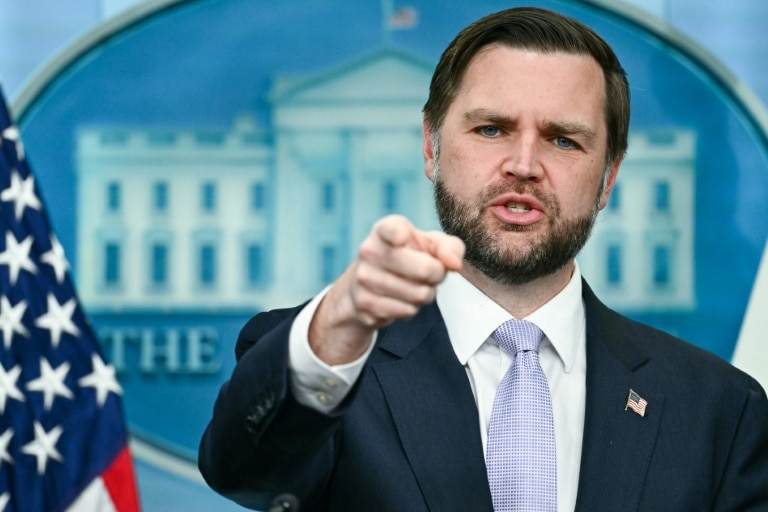
    On a Friday morning in Washington D.C., U.S. Vice President JD Vance departed for Pakistan’s capital of Islamabad, bringing a more optimistic and conciliatory tone to Saturday’s landmark ceasefire talks with Iran that sets him apart from his superior, President Donald Trump. Speaking to reporters ahead of the negotiations, which will be mediated by Pakistan, a country that maintains friendly diplomatic ties with both Washington and Tehran, Vance struck a measured hopeful note.

    “We’re looking forward to the negotiation. I think it’s going to be positive,” Vance said. Echoing comments previously made by President Trump, he added, “As the president of the United States said, if the Iranians are willing to negotiate in good faith, we’re certainly willing to extend the open hand. If they’re going to try to play us, then they’re going to find the negotiating team is not that receptive.”

    Trump, for his part, took a far more aggressive stance in a series of posts Friday on his Truth Social platform, claiming Iran “has no cards” to play in negotiations and arguing that Tehran’s public relations strategy is far stronger than its military capabilities. “The only reason they are alive today is to negotiate!” the president wrote.

    As both sides prepare for the critical discussions, Pakistani Prime Minister Shehbaz Sharif framed the talks as a defining turning point for the region, calling it a “make or break” moment in public comments Friday.

    For Iran, Vance’s appointment as head of the U.S. delegation is viewed as a welcome shift from the failed talks of the past, when the negotiation team was led by special peace envoy Steve Witkoff and Trump’s son-in-law Jared Kushner, both of whom faced intense criticism for their lack of technical diplomatic experience relative to seasoned Iranian negotiators like Foreign Minister Abbas Araghchi. Notably, Kushner holds no official role in the Trump administration but maintains extensive private financial interests across Israel and Gulf Arab states. Admiral Brad Cooper, head of U.S. Central Command, is also expected to join the talks; his appearance at previous diplomatic talks in Oman alongside Witkoff and Kushner in February was widely interpreted as a veiled show of military force to reinforce Trump’s willingness to use military power against Iran.

    Negar Mortazavi, a senior fellow at the Center for International Policy, called Vance’s leadership of the delegation a clear signal of Washington’s increased seriousness. “It shows a lot of seriousness. It’s a major step up,” Mortazavi told Middle East Eye Friday. She added that if Iran sends Parliament Speaker Mohammad Bagher Ghalibaf to lead its delegation, the two sides would be evenly matched. Ghalibaf will indeed join Foreign Minister Araghchi for the talks, but before departing Tehran Friday, he laid out a non-negotiable precondition: the U.S. must first unblock more than $100 billion in Iranian assets held in international bank accounts before formal discussions can begin. “Two of the measures mutually agreed upon between the parties have yet to be implemented: a ceasefire in Lebanon and the release of Iran’s blocked assets prior to the commencement of negotiations,” Ghalibaf wrote on X. “These two matters must be fulfilled before negotiations begin.”

    These talks mark a historic shift from U.S.-Iran negotiations of the past six years. Since the Trump administration unilaterally withdrew from the 2015 Iran Nuclear Deal in 2018, direct talks between the two countries have been nonexistent, and all discussions have been carried out through third-party mediators shuttling messages between separate delegations. This time around, the involvement of the U.S. vice president opens the door for potential direct face-to-face negotiations, a development that many analysts see as significant.

    Mortazavi noted that Vance’s selection also carries symbolic weight, as he is closely aligned with the anti-war wing of the Republican Party and the Make America Great Again movement. This stands in contrast to Secretary of State Marco Rubio, a longstanding hawk on Iran from the party’s traditional neoconservative wing, Mortazavi explained.

    Pakistan, the host and mediator of the talks, has adopted a flexible approach to the format of the discussions. Pakistani Ambassador to Washington Rizwan Saeed Sheikh told Al Jazeera English Friday that “all options are open” for how negotiations will be structured. “I believe it would not be good to have prerequisites or prejudgments or preemptions, but rather let the process flow in accordance with the comfort level of the two conflicting parties,” he said.

    Despite the opening for diplomacy, the shadow of military conflict looms large over the talks. In comments to The New York Post Friday, Trump repeated his open threat to resume military action against Iran if no deal is reached. “We’re loading up the ships with the best ammunition, the best weapons ever made – even better than what we did previously, and we blew them apart,” Trump said of U.S. naval deployments. “If we don’t have a deal, we will be using them, and we will be using them very effectively.”

    Iran, for its part, has placed the responsibility for a successful outcome firmly on Washington, demanding that the U.S. rein in its closest regional ally, Israel. Within hours of a preliminary ceasefire announcement Tuesday, Israel launched strikes in Lebanon that killed more than 350 people and wounded over 1,000 more. Lebanon’s Hezbollah movement, a key strategic partner of Iran, is widely viewed as the central sticking point in negotiations, as Israel has long held ambitions to reoccupy southern Lebanon.

    “The Iran-US Ceasefire terms are clear and explicit: the US must choose-ceasefire or continued war via Israel. It cannot have both,” Araghchi wrote on X Wednesday. “The world sees the massacres in Lebanon. The ball is in the US court, and the world is watching whether it will act on its commitments.”

    Israel will not have any official representation at Saturday’s talks in Islamabad, and holds no direct role in the ceasefire agreement reached earlier this week. Washington remains the only primary channel for diplomatic pressure on the Israeli government. Analysts note that U.S. and Israeli interests are currently misaligned on the outcome of the talks.

    “They’re not interested in this resolution,” Mortazavi told Middle East Eye of Israel. “And I think US and Israeli interests right now are diverging. Despite Iran saying that the regional cessation of hostilities was part of the agreed ceasefire, and Pakistan has reaffirmed that… this has been a pattern from Israel. Right before the ceasefire or right after the ceasefire, they do an escalation, sometimes essentially in the form of a trap, to push the other side to violate it.”

    In response to Israel’s post-ceasefire escalation, Iran has not followed through on its commitments under the preliminary ceasefire deal to change its posture at the Strait of Hormuz, a key global energy chokepoint that Trump has repeatedly demanded Iran open to full commercial traffic.

    Ryan Costello, policy director for the National Iranian American Council, warned Friday that the core regional tensions that pushed the two sides to the brink of full war remain unresolved, even as talks are set to open. “While the bombardment of Iran has paused for now, the underlying conditions that brought the region to the brink remain firmly in place,” Costello said in a statement. He added that expectations for a breakthrough should be “very low,” noting that “if diplomats succeed in meeting in Islamabad to begin discussions on a broader peace, they will do so in spite of President Trump’s efforts to walk back the terms.”

    For Pakistan, a country with little experience mediating high-level international conflicts between major powers, the bar for success is modest: simply getting the two sides to continue talking would mark a significant win. “Diplomacy is a gradual process,” Sheikh told Al Jazeera English. “For as long as we have to facilitate, we cherish, we value, and we are grateful for the trust reposed in us, and as a repository of that trust, we would be willing to go the whole distance.” The talks come as Pakistan’s own stance on the conflict has come under scrutiny: just two days before the talks opened, Pakistani Defense Minister Khawaja Muhammad Asif posted a since-deleted message on X calling Israel “cancerous” and “a curse for humanity.”

  • Event marks 55th anniversary of ‘ping-pong diplomacy’

    Event marks 55th anniversary of ‘ping-pong diplomacy’

    Fifty-five years after a seemingly small sports exchange reshaped the trajectory of China-US relations, stakeholders from both nations gathered in Beijing’s Capital Indoor Stadium on Friday to honor the legacy of the groundbreaking “ping-pong diplomacy” that first opened the door to normalized engagement between the two countries.

    The historic gathering brought together a diverse group of attendees, including surviving firsthand witnesses who participated in the original 1971 cross-border table tennis exchange, rising young table tennis talents from China and the United States, and delegates from a wide range of public and private sectors across both nations. During the event, young athletes from the two countries posed for commemorative photos, symbolizing the continued people-to-people connection that the original diplomacy initiative first built.

    Beyond honoring the 55-year milestone, the ceremony also served as the official launch pad for a full calendar of bilateral youth sports exchange programs set to take place across 2026. Organizers and attendees alike emphasized that by carrying forward the spirit of “ping-pong friendship” forged half a century ago, the younger generation of Chinese and Americans is breathing new, dynamic energy into the civil society ties that underpin broader bilateral relations, even amid periods of political tension between the two governments.

    The original ping-pong diplomacy, which grew from an accidental encounter between a US table tennis team member and Chinese athletes during the 1971 World Table Tennis Championships in Japan, paved the way for then-US President Richard Nixon’s historic visit to China the following year, ending decades of estrangement and establishing the foundation for modern China-US relations.

  • China’s state media turns to social media and AI to tell its story — and often mock the US

    China’s state media turns to social media and AI to tell its story — and often mock the US

    In a marked departure from its decades-long tradition of stiff, dogmatic political messaging, China’s government has embraced cutting-edge artificial intelligence and viral social media strategies to project its worldview onto the global stage — with the United States frequently serving as the central target of its sharp-edged content. This shift marks a new chapter in the intensifying global information war, where Washington has already begun ramping up countermeasures to push back against foreign anti-U.S. narratives that it says threaten its national security.

    The most prominent recent example of this new approach is a five-minute AI-generated animated short released by China’s state-run China Central Television, framed in the style of a classic martial arts film to deliver an allegorical take on the ongoing conflict in Iran. In the video, a well-dressed white eagle standing in for the United States cackles menacingly before launching an attack on a faction of black-cloaked Persian cats representing Iranians. After losing their leader, the cats vow to retaliate and block a key global trade chokepoint, weaving together themes of injustice, resistance and geopolitical power plays. This Iran-focused short is just one of multiple AI-powered satirical works produced by Chinese state media in recent months that cast the U.S. as a global bully, targeting former President Donald Trump’s provocative policies ranging from his open suggestion of annexing Greenland to his push for U.S. dominance in the Western Hemisphere.

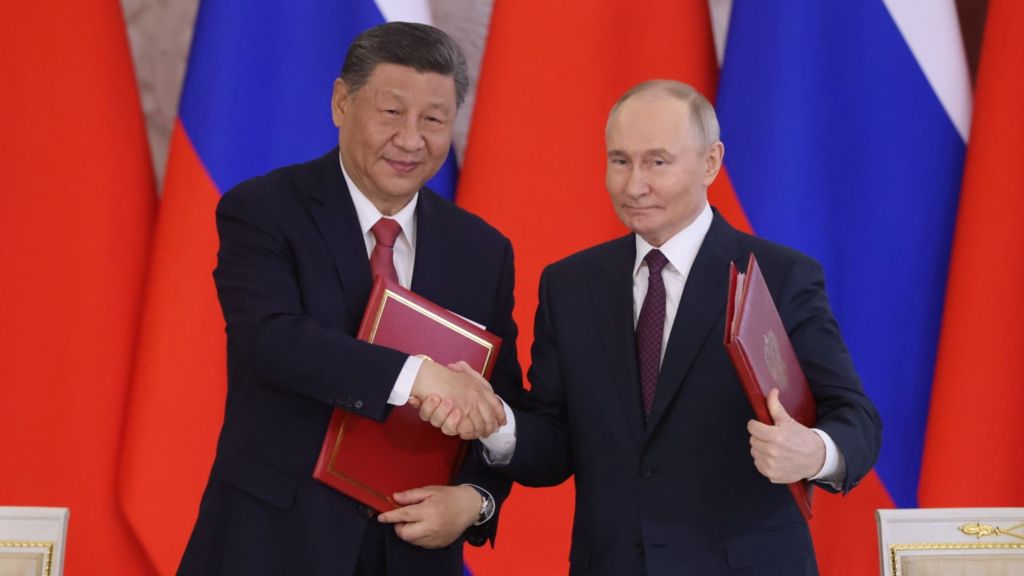
    This evolution of Chinese global messaging aligns with years of push from Chinese President Xi Jinping, who has prioritized expanding China’s global communication capacity, securing a louder voice in international affairs, and countering Western narratives that Beijing views as biased or hostile to its interests. It is not only Chinese state outlets deploying this tactic: pro-Iran factions have also turned to polished AI-generated memes to taunt the U.S. and its former leadership as part of broader information campaigns.

    Experts note that AI-infused “infotainment” distributed via social media represents a far more effective tool for winning over young global audiences than the dry, slogan-heavy propaganda of the past. “It is a new way for Chinese mainstream media to engage global Gen Z audience and social media users to understand Chinese standpoint and viewpoint of international affairs,” explained Shi Anbin, director of the Israel Epstein Center for Global Media and Communications at Tsinghua University. The Iran-themed animation, widely regarded as one of the most polished pieces of state media AI content to date, quickly went viral among Chinese domestic audiences after its release, earning praise for distilling a complex geopolitical crisis into an accessible, engaging narrative. After an X user translated and shared the subtitled clip to English-speaking audiences, it racked up more than 1 million views in just a few days. Andrew Chubb, a senior lecturer in global affairs at Lancaster University who studies political propaganda, noted that the work feels far removed from traditional overt propaganda: “It’s hardly even like propaganda — it almost seems more just a historical fiction dramatization of the situation.”

    This shift is a dramatic break from China’s communication past. For decades, Chinese official messaging relied on stiff, slogan-filled speeches in party-run newspapers, dry ideological study materials required for students and junior officials, and rigid, unapproachable rhetoric that failed to resonate with younger generations. As domestic audiences drifted away from this outdated tone, Beijing began a deliberate overhaul: it now embraces playful internet slang to retell party history, uses rap music to celebrate the ruling party’s achievements, recruits A-list pop stars and actors to star in blockbuster patriotic films that draw audiences through star power rather than mandatory attendance, and even turned anti-corruption dramas into hit television shows by prioritizing compelling plots and sharp writing.

    Urged to deliver messaging that is both engaging and persuasive, Chinese state media have rushed to experiment with non-traditional, digitally native formats, AI-generated content chief among them, according to Wang Zichen, deputy secretary-general of the Beijing-based Center for China & Globalization. “Whatever one thinks about the format, the message itself clearly resonates with increasingly larger audiences, which helps explain why such content gains traction online,” Wang said.

    Beijing has invested heavily in building a sprawling global communication ecosystem, constructing a vast “matrix” of social media accounts across major Western platforms including X and Facebook, managed by a mix of diplomats, state media outlets, influencers and automated bots. These outlets regularly seize on current events to push Beijing’s narrative. In February, for example, state-run Xinhua News Agency released an AI-generated music video mocking Trump’s suggestion to take over Greenland, featuring a military-uniformed bald eagle singing lyrics that brag “Anything I want, I’ll get it. One way or another, I’ll get it.” A month later, after Trump hosted the “Shield of the Americas” summit, Xinhua followed up with another short video, this one depicting a suited bald eagle trapping small birds in a cage under the pretext of national security, dryly noting “Sometimes, security comes with a little control.”

    The growing sophistication of these foreign messaging campaigns has already prompted pushback from Washington. Recent State Department diplomatic cables have warned that state-run foreign media campaigns on digital platforms “pose a direct threat to U.S. national security and fuel hostility toward American interests,” and the U.S. has pledged to ramp up its own efforts to counter these narratives in what has become an escalating global information conflict.

  • North Korean leader Kim backs China’s push for ‘multipolar world’ in talks with foreign minister

    North Korean leader Kim backs China’s push for ‘multipolar world’ in talks with foreign minister

    Diplomatic relations between North Korea and longtime ally China are entering a fresh period of deepened cooperation, following high-level talks in Pyongyang that saw North Korean leader Kim Jong Un publicly align with Beijing’s core policy priorities amid shifting global geopolitics, North Korea’s state-run Korean Central News Agency confirmed Saturday.

    During Friday’s closed-door meeting with visiting Chinese Foreign Minister Wang Yi, Kim made clear that Pyongyang unreservedly supports China’s efforts to safeguard its territorial integrity under the long-held one-China principle — Beijing’s formal stance that Taiwan is an inalienable part of Chinese territory. The North Korean leader also laid out Pyongyang’s positions on a range of unspecified regional and global issues of shared concern, stressing that steady, expanded development of bilateral ties has grown far more critical in today’s tense geopolitical climate, KCNA reported.

    Wang, who is wrapping up a two-day official trip to North Korea, noted that the bilateral relationship has advanced to a “new phase” following the 2023 summit between Kim and Chinese President Xi Jinping. This visit marks Wang’s first trip to Pyongyang in seven years, and he held preliminary in-depth discussions with North Korean Foreign Minister Choe Sun Hui on Thursday focused on expanding cooperation, rebuilding people-to-people exchanges, and aligning views on key global affairs. Neither North Korean nor Chinese state media have publicly disclosed whether talks covered U.S. policy or the ongoing conflict in the Middle East.

    The high-profile engagement aligns with Kim’s long-running diplomatic strategy: by embracing the vision of a multipolar global order and rejecting what he frames as U.S.-led unipolar hegemony, the North Korean leader has worked to break years of international isolation by strengthening ties with major powers at odds with Washington. While Russia has emerged as Kim’s top foreign policy priority in recent years — with Pyongyang supplying thousands of troops and large stockpiles of weapons to support Moscow’s invasion of Ukraine — Kim has simultaneously moved to rebuild closeness with China, the North’s historical primary ally and most important economic lifeline.

    Last September, Kim joined Chinese President Xi and Russian President Vladimir Putin for a World War II commemoration in Beijing, where he held his first summit with Xi in six years, a move designed to frame Pyongyang as a core member of a unified bloc countering U.S. influence. Just last month, the two Asian neighbors completed the first stage of restoring cross-border travel connectivity, resuming direct flights and passenger train services that had been completely suspended at the start of the COVID-19 pandemic in 2020.

    Wang’s trip to Pyongyang comes ahead of a widely anticipated rescheduled summit between U.S. President Donald Trump and Xi Jinping, set to take place in Beijing in May. Some South Korean officials have expressed cautious hope that the U.S.-China talks could open a new diplomatic pathway to engage Pyongyang. Kim has cut off all substantive dialogue with Washington and Seoul since the 2019 collapse of his nuclear diplomacy with Trump during the U.S. leader’s first term. In the years since, Kim has adopted an uncompromising hard-line stance toward South Korea — which he now labels North Korea’s “most hostile” adversary — and has repeatedly rejected U.S. offers to restart talks, demanding that Washington drop its requirement for North Korean denuclearization as a precondition for any negotiation.

  • Trump has handed JD Vance his most difficult mission yet

    Trump has handed JD Vance his most difficult mission yet

    Against the backdrop of a six-week Iran war that has roiled the Middle East and sent shockwaves through the global economy, U.S. Vice President JD Vance finds himself at the center of the most high-stakes diplomatic challenge of his tenure, leading American peace talks with Tehran in Islamabad, Pakistan. What has made his already difficult mission even more complex? A lighthearted off-script joke from President Donald Trump during a White House Easter lunch that laid bare the vice president’s awkward, high-risk predicament.

    “If the deal doesn’t go through, I’m blaming JD Vance,” Trump quipped to the room of senior administration officials, including Vice President (then Secretary of State) Marco Rubio and Defense Secretary Pete Hegseth, drawing laughter. Then he added the punchline that underscored Vance’s no-win starting position: “If it does happen, I’m taking full credit.”

    The mission Vance now leads is nothing short of a political minefield. To reach a lasting end to the conflict that erupted in late February, Vance must reconcile the competing demands of mutually distrustful stakeholders spanning three continents. At the top of the list is Trump himself, a mercurial commander-in-chief who has flip-flopped between calling for rapid peace and threatening to wipe out Iran’s entire civilization. Just days before the current temporary ceasefire, Trump demonstrated his volatile negotiating style: he gave Iran a 24-hour deadline to reach a deal, took to Truth Social to warn that “a whole civilization will die” if Tehran refused, and then announced the ceasefire less than two hours before his escalation deadline expired. Even Vance openly described the current truce as “fragile,” a framing that diverged from the president’s more upbeat messaging.

    Beyond Trump, Vance must win buy-in from a weakened but still defiant Iranian regime that retains critical leverage through its control of the Strait of Hormuz, a key global energy chokepoint. He also has to assuage Israeli concerns over a regional ceasefire, convince war-weary European allies that have refused to assist in reopening the strait to back the deal, and keep the hawkish wing of Trump’s Make America Great Again base satisfied – all while positioning himself for a potential 2028 presidential run.

    What makes this assignment particularly tricky for Vance is that it cuts directly against his long-stated foreign policy positions. A former Iraq War Marine, Vance has long opposed endless U.S. military entanglements abroad. As recently as the eve of the Iran war, he told The Washington Post that Trump would never allow the U.S. to be dragged into another permanent Middle East conflict, and he reportedly voiced deep private skepticism about launching strikes on Iran before the war began. “Vance has signaled a desire for restraint in American foreign policy. That’s pretty hard to square with the American war against Iran,” explained Jeff Rathke, president of the Washington-based American-German Institute.

    Despite these public and private misgivings, Trump hand-picked Vance to lead the delegation, which also includes veteran special envoy Steve Witkoff and Trump’s son-in-law Jared Kushner, who led preliminary indirect talks before the ceasefire. Some observers have questioned whether the choice was intentional, handing Vance a potentially unwinnable assignment that would damage his political future if talks collapse. But a senior anonymous U.S. official countered that Vance was selected to signal the administration’s seriousness about reaching a durable deal, a framing that has been welcomed by regional allies. “It shows that America is seriously coming to the table,” noted Assaf Orion, a retired Israeli brigadier general.

    Vance has been actively positioning himself as a core loyalist and key enforcer of Trump’s “America First” foreign policy agenda since taking office. He made international headlines with a blistering takedown of European immigration and free speech policies at the 2025 Munich Security Conference, and he instigated a high-profile shouting match with Ukrainian President Volodymyr Zelenskyy in the Oval Office over U.S. aid. Just this week, he made an unprecedented appearance in Hungary to campaign for re-election for Trump ally Prime Minister Viktor Orbán, cementing his reputation as a sharp-elbowed global proxy for the president.

    Still, at 41 years old and just a few years removed from his entry into national politics as a U.S. Senator, Vance remains a relative newcomer to high-level international diplomacy. Unlike Witkoff and Kushner, he was not involved in the detailed preliminary talks between the U.S. and Iran, and Orion notes that the pair’s workload across simultaneous negotiations over Ukraine, Iran and Gaza raises questions about technical expertise on the ground in Islamabad.

    Before departing Washington for Pakistan, Vance sought to tamp down overblown expectations, telling reporters: “If the Iranians are willing to negotiate in good faith, we are certainly willing to extend an open hand.” He added that Trump had provided the negotiating team with “some pretty clear guidelines,” though the president’s well-documented tendency to reverse course leaves Vance exposed: if Trump accepts a deal only to backtrack later, the vice president will likely shoulder the blame.

    As U.S. allies around the world watch closely to see if Vance can deliver, the question hanging over the Islamabad talks remains open: can Vance pull off a deal that satisfies all competing parties, or will he become the fall guy if negotiations collapse? For Vance, the outcome will not only shape the future of the Middle East and the global economy, but also his own prospects of leading the country in 2028. As Trump put it shortly before Vance departed: “He’s got a big thing. We’ll see how it all turns out.”

  • Final push for votes as challenger to Hungary’s Orbán scents victory

    Final push for votes as challenger to Hungary’s Orbán scents victory

    On the eve of Hungary’s most consequential national election in a generation, the country’s two leading political forces are pushing their campaigns to the final 24-hour stretch, as challenger Péter Magyar mounts a historic bid to unseat Viktor Orbán’s ruling Fidesz party, which has held uninterrupted power for 16 years.

    Addressing thousands of energized supporters ahead of voting, Magyar declared his movement was on the cusp of securing a two-thirds parliamentary majority, urging his base to put in a final push before heading into the voting booths. Following his speech, the opposition leader worked the crowd, posing for selfies with voters in a display of grassroots connection that has become a hallmark of his campaign. His final campaign stop will be in Debrecen, Hungary’s second-largest city located in the country’s northeast, while Orbán—who trails Magyar in most independent opinion polls—will close out his campaign with a major rally in the capital, Budapest.

    The momentum of the anti-Fidesz movement was on full display Friday night, when tens of thousands of Hungarians packed Budapest’s Heroes’ Square and the adjacent streets for a united anti-incumbent concert, one of the largest public opposition gatherings in the country in decades. For first-time voter Fanni, who traveled two hours from her southern village to attend the event with her mother, the election represents a once-in-a-generation opening for change. “I don’t think I’d support Magyar in an ideal world, but this is our only shot to turn things around,” she said, adding that she could feel a palpable shift across the country.

    Orbán’s greatest vulnerability heading into the vote is the broad, cross-sectional public anger that has coalesced around Magyar’s opposition movement. A former Fidesz insider who broke with the party over its corruption and authoritarian turn, Magyar has built his new grassroots political party, Tisza, into a unifying force for disparate anti-Orbán groups across the political spectrum.

    The incumbent prime minister has received high-profile backing from prominent American conservative figures in the final days of the campaign: U.S. Vice President JD Vance completed a two-day campaign swing in support of Fidesz, and former President Donald Trump pledged late Friday that he would leverage “the full economic might of the United States to strengthen Hungary’s economy” if Orbán secures another term.

    Though Hungary is a small landlocked Central European nation with just 9.6 million residents, Orbán has positioned himself as a pivotal global player over his tenure. A close ally of both Trump and Russian President Vladimir Putin, he has emerged as a leading disruptive force within the European Union, consistently blocking Brussels’ policy initiatives on Ukraine and alienating his EU allies while maintaining close economic and political ties to the Kremlin.

    While pro-Fidesz pollsters still argue the incumbent holds a narrow edge—pointing to the large share of undecided “shy Fidesz voters” who do not share their voting intentions with pollsters—Orbán’s campaign has lacked the energy and momentum that has defined Magyar’s challenge. Orbán’s core message to voters has been a warning that the opposition could eliminate all the economic and political progress his government has built over 16 years, and he has called for national unity amid global uncertainty. His strategy of framing the EU and Ukrainian President Volodymyr Zelensky as the primary threats to Hungarian sovereignty has failed to close the gap: most independent polls show Magyar holding a steady 10-point lead over Fidesz.

    Magyar, a centre-right conservative who spent years in senior roles within Fidesz before breaking away, has run a grueling national campaign, delivering as many as seven public speeches a day across villages, towns and cities across the country. Speaking to supporters in the small northwestern town of Mosonmagyaróvár, he framed the election as a historic opportunity for regime change to reverse Orbán’s authoritarian turn.

    Tisza’s coalition has drawn support from across the ideological spectrum, but its greatest strength is among young Hungarians, many of whom have never known any government other than Fidesz. “Right now, there’s no future for young people in this country,” said Laura, a first-time voter who attended a Magyar rally with her friend Napsugár.

    Political analyst Zsuzsanna Végh, a researcher with the German Marshall Fund of the United States, confirmed that a clear generational shift is underway: opinion polls put Fidesz’s support among voters aged 18 to 29 at less than 10 percent. She also noted that the opposition has made significant inroads in small towns and even rural villages, long considered Fidesz strongholds. “While large rally crowds don’t guarantee election outcomes, the scale of engagement and mobilization that Magyar has achieved is unprecedented in Hungary,” Végh said.

    A Magyar victory would end 16 years of Orbán rule and roll back many of the incumbent’s controversial policies, but to dismantle the pro-Fidesz institutional infrastructure that has been built in the judiciary and state bodies over the past 16 years, Magyar needs to win a two-thirds parliamentary majority. That will require flipping control of many long-held Fidesz municipal seats, including in Székesfehérvár, Hungary’s medieval “city of kings” located an hour south of Budapest. Orbán visited the city on Friday, reminding supporters that it has long been a safe Fidesz seat; losing the city would be a major humiliation for the party.

    One local stallholder in Székesfehérvár’s covered market estimated that 90 percent of local residents still back Fidesz. For Agota, a retired pensioner, the opposition’s pro-EU and pro-Ukraine stance poses a clear risk to Hungary. “I’m genuinely afraid they will drag Hungary into the war,” she said.

    Anti-EU and anti-Ukraine rhetoric has been the centerpiece of Orbán’s campaign, repeated nonstop on pro-Fidesz television networks and news websites, and featured on campaign posters that pair Zelensky and Magyar under the slogan “They are dangerous!”

    But György Wáberer, one of Hungary’s wealthiest businessmen, has accused Fidesz of deliberate fear-mongering over the EU and Ukraine to distract from its corruption and close alignment with the Kremlin. “April 12 is a fateful date: you will decide whether Hungary belongs to Europe or to Russia,” Wáberer said, drawing a fierce rebuke from a senior Orbán administration official who labeled Wáberer a traitor who sold out his country.

    Notably, Magyar has allowed Russian state propaganda television crews to cover his rallies, telling them they are witnessing authentic regime change in action, while his supporters have repeatedly chanted “Russians go home” — a clear reflection of growing public frustration with Orbán’s close ties to Putin. The same chant has even broken out at Orbán rallies, where protesters have disrupted the prime minister’s speeches.

    Orbán’s alignment with Putin has delivered cheap Russian fuel to Hungarian consumers throughout the full-scale invasion of Ukraine, but the chant “Russians go home” carries deep historical resonance in Hungary, dating back to the 1956 revolution against Soviet occupation.

    Even in loyal Fidesz territory like Székesfehérvár, opinions are deeply divided. At a local flower stall, 73-year-old Eva said she believes it is long past time for a change, while her daughter-in-law Andrea argues that Magyar is arrogant and dismissive of the progress Fidesz has delivered. “Fidesz has to go, they have stolen so much and the country is dying,” Eva said. Andrea pushed back, noting that Fidesz has renovated six local schools and built new hospital facilities in the city. Eva countered that much of the public funding for those projects was siphoned off by corrupt insiders close to Orbán.

    Widespread allegations of corruption and cronyism have pushed millions of former Fidesz voters away from the ruling party at both the local and national level. Over 16 years in power, big public infrastructure contracts have consistently been awarded to members of Orbán’s inner circle, while independent media outlets have been systematically bought up by allies of the prime minister. After nearly two decades in uninterrupted control, Fidesz may finally be facing its moment of reckoning at the ballot box.

  • US immigration appeals board decides Mahmoud Khalil can be deported

    US immigration appeals board decides Mahmoud Khalil can be deported

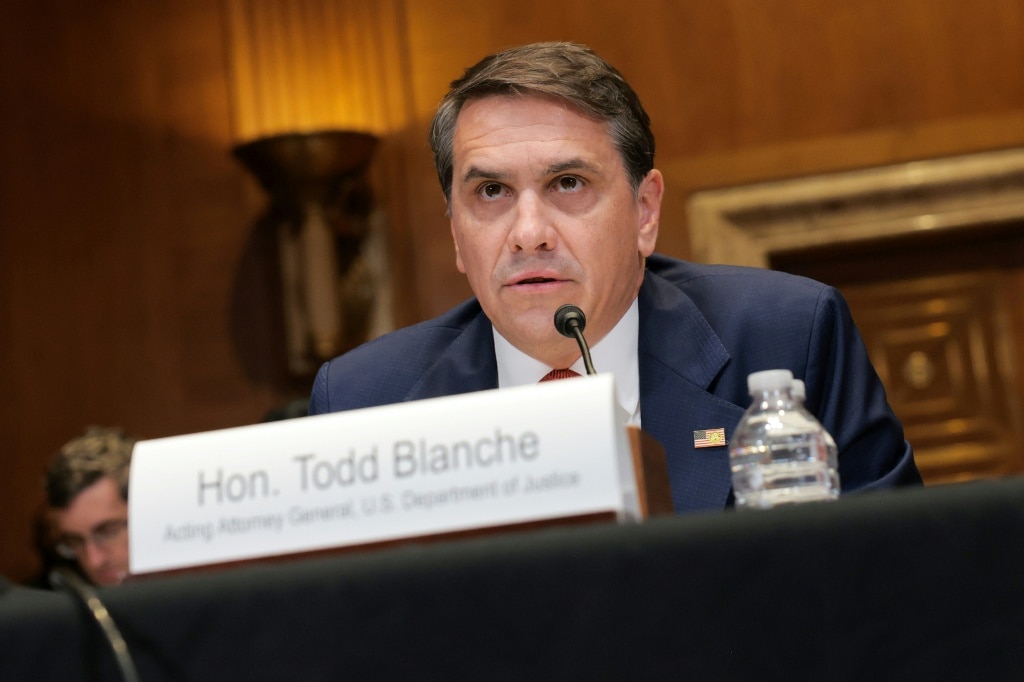
    A decades-long legal permanent resident of the United States and prominent Palestinian rights activist has moved one step closer to forced removal from the country, after the federal Board of Immigration Appeals (BIA) issued a final deportation order in his case Thursday. The outcome has reignited fierce debate over the erosion of free speech protections and the politicization of U.S. immigration institutions under the second Trump administration.

    Unlike the independent federal judiciary that oversees most U.S. legal proceedings, the BIA operates as an entity under the executive branch, falling directly within the oversight of the Department of Justice alongside the nation’s entire immigration court system. This structural dependency has long drawn criticism from civil liberties advocates, who argue it leaves immigration rulings vulnerable to political pressure from the sitting White House.

    Khalil’s legal team, which includes counsel from the American Civil Liberties Union (ACLU), has unequivocally framed the BIA’s final order as unlawful retaliation for the activist’s peaceful, public advocacy for Palestinian human rights. In response to Thursday’s ruling, attorneys confirmed they will pursue further appeal to challenge the decision.

    A separate federal civil case remains ongoing, in which Khalil alleges U.S. authorities violated his constitutional rights by targeting his activism. A critical court order from this ongoing litigation currently blocks Immigration and Customs Enforcement (ICE) from arresting Khalil or carrying out his deportation until the civil case reaches a conclusion.

    “The only thing standing between the government and its unconstitutional goals is the intervention of a federal district court last summer,” explained Brett Max Kaufman, an ACLU attorney working on Khalil’s defense. “Without the protection of a habeas court, the government could target anyone for this kind of retaliation. That makes today’s ruling a stark reminder of what is at stake in Mahmoud’s case. We will continue to use every available legal avenue to protect our client and defend First Amendment protections against this cruel, unrelenting campaign.”

    Habeas corpus, the legal principle at the center of the case, traces its origins to 13th-century England, where it was established to prevent the monarchy from detaining people arbitrarily without due process. Today, the protection applies to all people present on U.S. territory, regardless of whether they hold U.S. citizenship.

    Now 31, Khalil holds U.S. legal permanent resident status, a designation granted to Green Card holders that carries most of the same rights and obligations as citizenship short of voting. Back in June 2024, a federal court ordered Khalil’s release from ICE detention, with Judge Michael Farbiarz noting there was credible evidence that immigration charges had been brought specifically to punish Khalil for his speech — a finding that would violate constitutional protections.

    But the case has shifted steadily against the activist this year. In January 2025, the U.S. Court of Appeals ruled that Judge Farbiarz lacked legal jurisdiction to intervene in the deportation proceedings. That ruling cleared the way for potential re-arrest of Khalil, handing a major victory to the Trump administration in a high-profile case that tests the boundaries of free speech for non-citizen activists, including international students and legal permanent residents.

    Khalil has rejected the BIA’s ruling and said the outcome came as no surprise. “I have committed no crime. I have broken no law. The only thing I am guilty of is speaking out against the genocide in Palestine — and this administration has weaponized the immigration system to punish me for it,” Khalil said in a public statement. “My family is here. My life is here. I reject any attempt to intimidate me out of my home based on lies and ideological attacks. This is not justice. This is just another attempt to retaliate against me.”

    Khalil rose to prominence as a lead negotiator for pro-Palestinian student demonstrators during the 2024 Gaza solidarity encampment at Columbia University, where he was a graduate student. The campus protest was organized to oppose Israel’s military campaign in Gaza, which the Gaza health ministry reports has killed more than 72,000 Palestinians as of 2025.

    The Trump administration, which has repeatedly framed pro-Palestinian campus activism as equivalent to antisemitism, launched a targeted crackdown on student organizers earlier this year. ICE plainclothes agents arrested Khalil outside his Columbia University campus apartment in March 2025. Agents initially claimed they had revoked Khalil’s student visa, but when Khalil’s wife presented agents with his Green Card proving permanent resident status, agents stated that status had also been revoked.

    Without notifying Khalil’s legal team or his family, authorities transferred Khalil to an immigration detention center in central Louisiana, even though his habeas case was pending in New York and he had previously been held in detention in nearby New Jersey. Khalil was one of the first high-profile activists affiliated with an elite U.S. university to be detained as part of the administration’s crackdown.

    He ultimately spent 104 days in ICE custody, forcing him to miss two milestone life events: the birth of his first child and his own graduation ceremony from Columbia University.