分类: politics

  • Philippines accuses Chinese fishermen of dumping cyanide in South China Sea

    Philippines accuses Chinese fishermen of dumping cyanide in South China Sea

    Long-running territorial friction in the South China Sea has entered a new phase of escalation after Manila formally accused Chinese fishermen of deliberately dumping cyanide in waters around the Spratly Islands, a contested archipelago at the heart of competing regional sovereignty claims.

    In an official press briefing Monday, Philippine National Security Council (NSC) Assistant Director-General Cornelio Valencia framed the alleged activity as a deliberate act of sabotage targeting Filipino military personnel stationed at Second Thomas Shoal. According to Valencia, the cyanide poisoning first began last year, with the explicit goal of wiping out local fish populations to cut off a critical food supply for troops based in the area. Beyond threatening food access, he added, the toxic contamination poses direct health risks to military personnel and could damage the coral reef ecosystems that provide structural support to the BRP Sierra Madre, the World War II-era vessel intentionally grounded at the shoal in 1999 to assert the Philippines’ territorial claim.

    Philippine Navy Spokesperson Rear Admiral Roy Vincent Trinidad laid out what Manila says is evidence backing the accusation: Filipino forces seized 10 bottles of cyanide from small sampan boats linked to larger Chinese fishing vessels in three separate incidents across February, July, and October 2024. He also confirmed that last month, troops observed another sampan crew dumping substances near the shoal, and follow-up laboratory testing of water samples confirmed the presence of cyanide.

    Cyanide fishing is a banned practice across most of Southeast Asia, including under Philippine law. The technique, historically used to stun fish for the lucrative live reef trade, causes irreversible harm to coral reefs and marine ecosystems, making it illegal in most international and regional fishing frameworks.

    China has immediately and forcefully rejected the accusation, dismissing it as a baseless fabrication. Chinese Foreign Ministry spokesperson Guo Jiakin called the claim “completely unbelievable and not even worth refuting”, countering that the Philippines has a long record of illegal harassment against Chinese vessels engaged in legitimate, routine fishing activity in the area.

    Valencia confirmed that Philippine officials raised the allegation during a recent diplomatic meeting with Beijing but have yet to receive a formal response. The NSC is preparing a full report for the Philippine Department of Foreign Affairs, which could serve as the foundation for an official diplomatic protest. In the meantime, the Philippine Navy and Coast Guard have been ordered to ramp up patrols across the disputed Second Thomas Shoal region.

    The latest exchange of accusations comes amid years of steadily escalating tensions between the two countries in the South China Sea, a strategically critical waterway that holds some of the world’s richest fishing grounds and untapped offshore energy reserves. More than half of the world’s global fishing fleet operates in the South China Sea, and the waterway carries an estimated $3 trillion in annual international trade. Sovereignty over the sea is disputed by six parties: China, the Philippines, Vietnam, Malaysia, Brunei, and Taiwan. China claims nearly the entirety of the South China Sea as its sovereign territory, a claim that was ruled to have no legal basis under international law by a 2016 tribunal ruling under the United Nations Convention on the Law of the Sea (UNCLOS) — a decision Beijing has repeatedly refused to recognize.

    Tensions around Second Thomas Shoal, in particular, have spiked repeatedly in recent years. China’s coast guard has made repeated attempts to block Philippine resupply missions to the small outpost on the BRP Sierra Madre, and a violent confrontation in June 2024 saw Chinese coast guard personnel armed with melee weapons board Philippine navy vessels near the shoal, leaving multiple Filipino sailors injured.

    In recent months, the Philippines has deepened military cooperation with extra-regional powers in response to growing tensions with Beijing. Last week, Manila held joint maritime exercises with the United States and Australia in the disputed South China Sea, leading into the annual Balikatan military exercises, which will include Japan as a full participating member for the first time this year. Beijing has repeatedly condemned these multinational drills, arguing they unnecessarily raise geopolitical tensions in the region. In a further sign of expanding defense ties, the Philippines signed a military agreement with France in March that will see a 15 to 20-person French contingent deploy to participate in the upcoming April 20 Balikatan exercises.

  • US blockade of Iranian ports explained in two minutes

    US blockade of Iranian ports explained in two minutes

    In a recent, accessible explainer delivered by the British Broadcasting Corporation’s veteran security correspondent Frank Gardner, the mechanics of the newly implemented United States blockade on Iranian ports have been broken down for global audiences in a concise two-minute analysis. The move, which marks a sharp escalation in long-running tensions between Washington and Tehran, targets maritime trade flowing through key Iranian port facilities that serve as critical economic arteries for the Islamic Republic.

    Gardner’s breakdown unpacks the strategic logic behind the blockade, detailing how U.S. naval assets and enforcement mechanisms will be deployed to intercept incoming and outgoing commercial vessels connected to Iranian trade networks. The correspondent’s analysis also contextualizes the measure within the broader framework of U.S. foreign policy aimed at pressuring Iran over its nuclear program and regional military activities, addressing both the intended impacts of the restriction and potential unintended consequences that could ripple across global energy markets and Middle Eastern security.

    The short-format explainer was designed to demystify the complex geopolitical move for the general public, cutting through jargon to clarify what the blockade means for shipping companies, regional actors, and the global economy. It comes at a time of heightened volatility in the Persian Gulf, where clashes between commercial shipping and regional militant groups have already raised international concerns over the security of one of the world’s busiest energy transit chokepoints.

  • Israel could act against Syria after Iran war, Turkish foreign minister says

    Israel could act against Syria after Iran war, Turkish foreign minister says

    In a recent live interview with Turkey’s Anadolu Agency, Turkish Foreign Minister Hakan Fidan has outlined his analysis of shifting regional dynamics in Syria, warning that Israel is likely to launch military action against Damascus once regional conditions align. The top Turkish diplomat’s comments come amid a period of fragile calm on the Israel-Syria frontier, following months of gradual political and territorial shifts across war-torn Syria.

    Fidan emphasized that the Syrian government has already taken a pragmatic and strategically sound diplomatic approach by opening direct engagement with both the United States and Israeli government to shore up its security. Beyond diplomacy, he argued that long-term stability in Syria depends on building inclusive, resilient national governance. “It needs to have a structure that embraces all segments of society,” Fidan stated, noting that broad public buy-in is a non-negotiable foundation for any lasting political order in the country.

    On the domestic front, Fidan acknowledged that Damascus is navigating multiple ongoing challenges, most notably the massive task of national reconstruction after more than 12 years of brutal civil war. He pointed to positive progress on one key internal security file: the integration of the Syrian Democratic Forces (SDF), the dominant Syrian Kurdish armed group that controls large swathes of northeastern Syria. Earlier this year, the SDF transferred control of significant territories back to the Damascus government, a step Fidan confirmed remains on track for broader institutional integration.

    Fidan also flagged the unresolved uncertainty surrounding the Druze community in southern Syria as a persistent flashpoint that could escalate tensions. This issue has long drawn Israeli intervention: Israel carried out repeated strikes on Syrian government positions last year, claiming it was acting to prevent alleged sectarian targeting of the Druze minority. That cycle of attacks largely halted after an intelligence-sharing agreement was reached between Israel and Damascus in January 2025.

    “Israel’s desire and practice of exploiting this issue are obvious,” Fidan told reporters. He warned that Israel’s current pause in action, driven by its focus on the ongoing conflict in Iran, does not mean permanent disengagement from aggressive policy toward Syria. “Because of the ongoing war in Iran, it is not doing certain things right now, but that does not mean it will never do them,” Fidan added. “Israel’s desire and practice of exploiting this issue are obvious. Because of the ongoing war in Iran, it is not doing certain things right now, but that does not mean it will never do them.”

    Fidan stressed that Syria is not currently a top strategic priority for the Israeli government, but that “later, when the time comes, it may want to act.” Despite that risk, he noted that the Syrian government’s ongoing diplomatic outreach to Washington and Jerusalem has been largely effective, with Damascus facing no major setbacks in advancing its positions. He added that Turkey, which considers Syria a core national security interest, has adjusted its own preparations based on the clear stance articulated by Israeli Prime Minister Benjamin Netanyahu and his administration. “For us, Syria is a vital area of interest and security. We need to be prepared for every possible scenario there,” Fidan said.

    The remarks also addressed widespread speculation following a high-profile regional visit earlier this month: Ukrainian President Volodymyr Zelensky traveled to Damascus on a Turkish government plane alongside Fidan for a meeting with Syrian President Ahmed al-Sharaa. The trip sparked rumors that Ankara, Kyiv and Damascus were working to launch a new trilateral security framework. While Fidan acknowledged the visit held strategic importance, he pushed back against claims it would develop into a formal, permanent trilateral security doctrine.

    This independent reporting on Middle Eastern regional dynamics comes from Middle East Eye, a outlet focused on unrivaled, independent coverage of the Middle East, North Africa and surrounding global affairs.

  • Trump deletes controversial Truth Social post where he appears Jesus-like

    Trump deletes controversial Truth Social post where he appears Jesus-like

    A firestorm of bipartisan condemnation has forced former and current U.S. President Donald Trump to take down a controversial AI-created post on his Truth Social platform that depicted him in a Jesus-like healing role, capping a chaotic 24 hours that also saw an escalating public verbal clash with Pope Leo XIV over the ongoing military conflict in Iran.

    The removed image, generated entirely through artificial intelligence, showed Trump dressed in a flowing white robe pressing a glowing hand to the forehead of a patient lying in a hospital bed, a composition intentionally echoing classic religious art depicting Jesus Christ healing the sick. The graphic layered in overtly patriotic American imagery as well: the Statue of Liberty stood in the background, a large American flag billowed beside it, fighter jets and a bald eagle were included, alongside a uniformed soldier, a praying woman, and a hospital nurse.

    Criticism of the inflammatory post broke out within minutes of it going live, with condemnation coming even from corners of the conservative and faith-based movements that have been core supporters of Trump. Christian activist Sean Feucht, who is currently organizing a national series of faith-centered events to celebrate the 250th anniversary of U.S. independence, publicly called for the image’s immediate removal, stating that there was no conceivable context in which the content could be considered appropriate.

    Prominent conservative commentator and transgender rights critic Riley Gaines also pushed back against the post, invoking a biblical phrase by writing “God shall not be mocked.” Leading faith-based American media outlets joined the rebuke as well. David Brody, a senior journalist with the Christian Broadcasting Network, argued that the image crossed a clear red line, noting that even loyal backers of Trump’s policy agenda could reject the inappropriate content.

    The ill-fated image was posted less than 60 minutes after Trump published a lengthy, scathing attack on Pope Leo XIV, the first American to hold the papacy, who has emerged as one of the most high-profile global critics of U.S. and Israeli military operations in Iran. In his original criticism, Trump branded the Pope “weak on crime” and “terrible for foreign policy.”

    Pope Leo responded to Trump’s attack earlier on Monday, pushing back firmly against the president’s criticism. He stated that he has no fear of the Trump administration, and that his only commitment is to speaking openly about the core message of the Gospel, which he views as the central purpose of his role as pontiff. The Pope has repeatedly described the violence of the Iran war as “absurd and inhuman” in his public remarks.

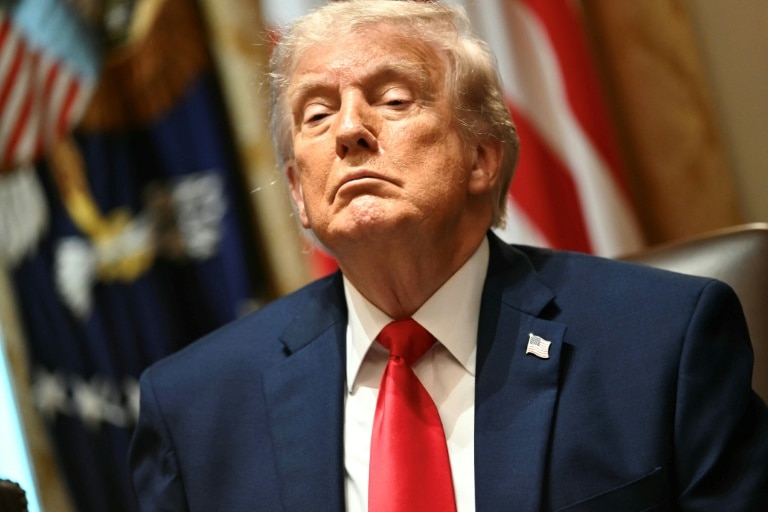
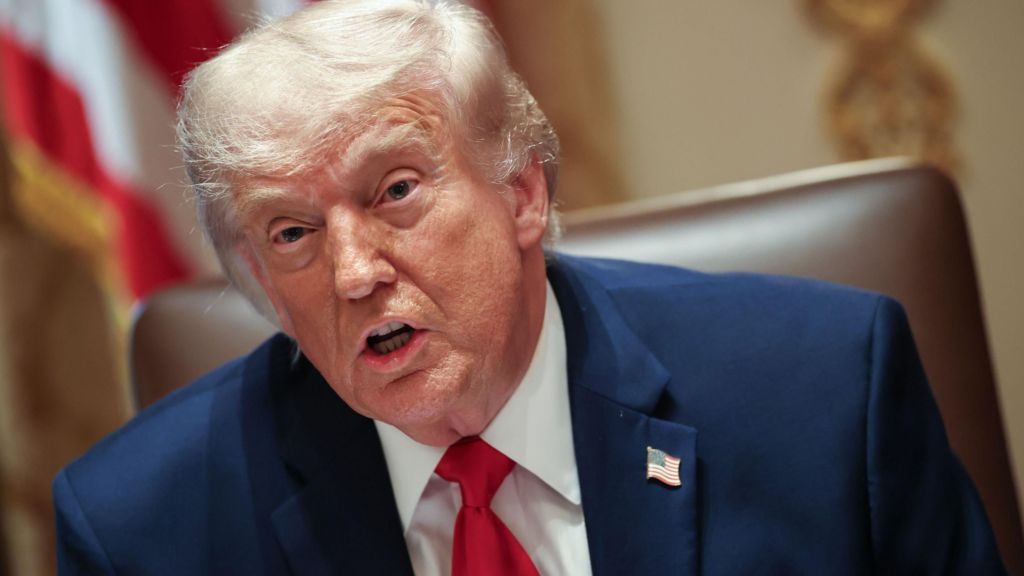
    Speaking to reporters at the White House on Monday, Trump refused to issue any apology for either the attack on the Pope or the controversial image. He insisted that Pope Leo had taken the wrong position on the conflict, arguing that a nuclear-armed Iran cannot be tolerated, and claimed the Pope would ultimately be unsatisfied with the end result of the current military campaign.

    The BBC has reached out to the White House to request official clarification on the specific circumstances that led to the image’s removal, and has not yet received a response. This incident is far from the first time that content posted to Trump’s Truth Social account has sparked major national controversy. Back in February, a racist edited video that depicted former President Barack Obama and former First Lady Michelle Obama as apes was posted to the account before being removed. Initially, the White House defended the clip as a harmless “internet meme” and told critics to drop what it called “fake outrage,” but after sustained backlash from multiple Republican senators, the post was pulled, and a senior White House official claimed a junior staffer had published the clip “erroneously.”

  • Iran’s FM blames Islamabad talks’ failure on US maximalist demands, blockade threats

    Iran’s FM blames Islamabad talks’ failure on US maximalist demands, blockade threats

    High-stakes negotiations between Iran and the United States aimed at de-escalating Middle East tensions ended in a disappointing breakdown in Islamabad over the weekend, with Iran’s top diplomat placing full blame on Washington’s inflexible demands and hostile threats against the Islamic Republic.

    Iranian Foreign Minister Seyed Abbas Araghchi announced the collapse of the talks in a social media post to X early Monday, revealing that the two long-standing adversaries had come surprisingly close to a historic agreement after days of closed-door negotiations. This round of diplomacy marked the highest-level direct engagement between Tehran and Washington in nearly half a century, a period defined by broken diplomatic ties and repeated cycles of open conflict.

    Araghchi emphasized that Iran entered the discussions with sincere, good-faith intentions to end the ongoing regional war and reach a mutually acceptable understanding. “In intensive talks at highest level in 47 years, Iran engaged with US in good faith to end war. But when just inches away from the ‘Islamabad MoU,’ we encountered maximalism, shifting goalposts, and blockade,” he wrote in his post. He added a warning that reciprocity defines relations between the two nations: “Zero lessons earned. Good will beget good will. Enmity begets enmity.”

    Within 24 hours of the talks collapsing, former U.S. President Donald Trump responded to the failed diplomacy with a sharp escalation of his own, announcing in a post on Truth Social that the U.S. Navy would implement a full naval blockade blocking all commercial and military vessels attempting to transit in and out of the Persian Gulf through the Strait of Hormuz, one of the world’s most critical energy chokepoints.

    Iranian military leaders swiftly dismissed Trump’s threat as empty posturing. Iranian Navy Commander Shahram Irani called the proposed blockade “very ridiculous and laughable” in comments reported by Iran’s semi-official Tasnim News Agency, confirming that Iranian naval forces maintain full surveillance over all U.S. military movements across the region.

    The Islamic Revolution Guards Corps (IRGC), Iran’s elite revolutionary military force, issued a stark warning of its own Sunday, making clear that any foreign military vessel that attempts to approach the Strait of Hormuz under any pretext following the threat will be treated as a deliberate violation of ceasefire agreements and met with severe, immediate retaliation.

    The breakdown of the Islamabad talks has raised fresh fears of a rapid escalation of hostilities in the already volatile Middle East, putting global energy markets at risk of major disruption as tensions between the two nations surge once again after a brief window of diplomatic progress.

  • Ex-Nigerian oil minister denies taking bribes

    Ex-Nigerian oil minister denies taking bribes

    At London’s Southwark Crown Court this week, 65-year-old former Nigerian oil minister Diezani Alison-Madueke has issued a categorical denial of all bribery charges against her, pushing back against prosecution claims that she accepted luxury gifts and funded stays in high-end UK properties in exchange for awarding lucrative government oil contracts.

    Prosecutors allege that a group of Nigerian businessmen covered millions of pounds in lavish spending for Alison-Madueke, including more than £2 million in purchases at London’s iconic luxury department store Harrods, and £4.6 million in renovation works for multiple upscale properties across London and Buckinghamshire. The charges outline that the ex-minister gained access to a grand countryside estate in Buckinghamshire, a £2.8 million private residence in central London’s Marylebone, and multiple multi-million-pound properties overlooking Regent’s Park, all funded by business figures seeking favorable contract decisions from her office.

    But in her testimony to the court on Monday, Alison-Madueke said that all costs incurred during her official stays in the UK were ultimately reimbursed by Nigeria’s state-owned national oil corporation, the Nigerian National Petroleum Company (NNPC). She explained that NNPC’s disjointed financial system prompted the creation of a dedicated London-based service firm to handle logistics for her official work in the UK, covering routine costs such as hotel accommodation and chauffeured transport.

    “I can state categorically that at no point did I ask for, take or receive a bribe of any sort from these persons and did not abuse my office,” Alison-Madueke told the court. “I always sought to act impartially.”

    The court heard context for Alison-Madueke’s stays in UK properties: one 2011 Christmas stay at a Gerrards Cross, Buckinghamshire home was arranged after her ex-husband required emergency hospital treatment that prevented the pair from flying back to Nigeria, and the ex-minister said she played no role in booking the accommodation. A second two-week stay at the same property was for a work project: Alison-Madueke and 10 to 12 other Nigerian officials gathered there to compile a book highlighting the Nigerian president’s work advancing women’s issues in the country. She added that the Regent’s Park property was repurposed for confidential official meetings, while another property cited in the charges was fully gutted for renovations and uninhabitable when she visited it.

    Regarding past stays at two St John’s Wood apartments, where rent was covered by Nigerian businessman Kolawole Aluko (one of the business figures linked to the case who is not standing trial), Alison-Madueke noted that the arrangement was far more cost-effective than continuing to book £2,000-per-night suites at luxury London hotels such as The Savoy and The Dorchester. She also told the court she had no knowledge at the time that one of her chauffeurs had delivered £100,000 in cash to an address linked to her, stressing the sum was unrelated to her work or personal affairs.

    The trial also heard details of Alison-Madueke’s early career, which saw her rise quickly through the ranks at oil giant Shell to become the first female senior executive in the company’s Nigerian operation. She told the court she had originally been reluctant to join Shell, after her father — a senior company employee and tribal leader — launched an unsuccessful legal case against the multinational over what he described as apartheid-style employment practices in West Africa. Alison-Madueke added that even when she took on the role, she remained critical of Shell’s response to devastating oil spills in her home region of the Niger Delta, saying the company had failed to adequately repair the environmental damage it caused.

    Alison-Madueke also outlined the extreme personal risks she faced as a woman leading Nigeria’s oil sector in what she described as a deeply patriarchal society. She told the court she faced constant credible kidnap threats, and that members of her own family had already been abducted by extremist groups. Beyond her role as Nigerian oil minister, Alison-Madueke made history in 2015 when she became the first woman elected to lead the Organization of the Petroleum Exporting Countries (OPEC), the global cartel that coordinates crude oil production levels to influence global energy markets.

    Alison-Madueke currently faces five counts of accepting bribes and one count of conspiracy to commit bribery, all of which she denies. Two other defendants are also on trial alongside her: 54-year-old oil industry executive Olatimbo Ayinde, who denies one count of bribery and one count of bribing a foreign public official, and 69-year-old Doye Agama, Alison-Madueke’s brother and a former archbishop, who denies a single charge of conspiracy to commit bribery. The trial is ongoing at Southwark Crown Court.

  • Spanish PM calls for a multipolar world in Tsinghua speech

    Spanish PM calls for a multipolar world in Tsinghua speech

    On April 13, 2026, during the second day of his five-day official visit to China — his fourth trip to the country since taking office — Spanish Prime Minister Pedro Sanchez delivered a landmark address to faculty, students and university administrators at Beijing’s Tsinghua University, where he laid out a clear call for global leaders to embrace an emerging multipolar world order and reject outdated, dangerous zero-sum geopolitical thinking.

    Opening his argument with a centuries-old historical lesson, Sanchez drew on the experience of 16th-century Jesuit missionary Matteo Ricci, who arrived in China in 1583 carrying a European-produced world map that placed Europe at the center of the globe and pushed Asia to its geographic periphery. When Chinese cartographers questioned the lopsided framing that placed China on the margins, Ricci redrew the map with the Pacific Ocean at its center, a reworking that Sanchez framed as a timeless lesson for modern geopolitics.

    “Four hundred years have passed, but unfortunately, there are still people who see the world through that original, distorted map,” Sanchez told the Tsinghua audience. “That view is not only wrong, but very dangerous. It traps us in the past and limits our imagination of possibilities.”

    Sanchez emphasized that the current global shift is not a simple transfer of hegemonic power from one bloc to another, but a broad expansion of global multipolarity that touches both geopolitical influence and shared prosperity. Today, he noted, dynamic progress is unfolding simultaneously across regions with distinct cultural traditions and political systems — from China to Africa to Latin America — without requiring validation or permission from any single dominant power.

    “A multipolar world is not an assumption or an ideal, but a new reality. We cannot change it; we can only deny it or embrace it,” Sanchez said, confirming that Spain has made the deliberate choice to embrace this new reality with realism, a sense of shared responsibility, and optimistic hope for the future. He added that if Spain, China and Europe built shared prosperity in past decades, there is no reason the three actors cannot replicate that success in the modern era.

    Acknowledging that differences and healthy competition exist between nations, Sanchez stressed that lasting human progress stems from building common ground rather than deepening existing divides. He outlined that Spain seeks a bilateral relationship with China rooted in unwavering mutual respect: cooperating on shared global priorities whenever possible, competing constructively when necessary, and managing unavoidable differences through deliberate, respectful dialogue.

    To help a multipolar world order function effectively and equitably, Sanchez proposed three core actionable priorities for global leaders. First, he called for a fundamental reshaping of modern multilateralism, advocating for comprehensive United Nations reform that would expand the authority of the UN General Assembly, increase the representativeness of the UN Security Council, and build a more inclusive, democratic global decision-making mechanism.

    Second, Sanchez highlighted the urgent need to build fair, reciprocal global trade relations, expressing hope that China would continue expanding market access to help address existing trade imbalances across global markets. Third, he stressed that major global powers bear a greater responsibility to address shared transnational challenges, including climate change mitigation, global public health, artificial intelligence governance, nuclear nonproliferation and safety, and global poverty eradication. He noted that global investment in these critical areas has fallen by 23% since the start of 2026, a trend that puts all nations at risk.

    Sanchez also underscored the critical role of a unified European Union in maintaining global stability, noting that “Without a united EU, there will be no stable global order, just as without China’s participation, the world cannot achieve true stability and prosperity.”

    Closing his address, Sanchez invoked a recent image of four NASA astronauts observing Earth from outer space: a single, borderless blue planet that is unique and irreplaceable. “Humanity itself is a miracle, the only miracle in the world. Our responsibility is to make this miracle continue through mutual understanding and cooperation,” he said.

  • The US blockade of Iran is a gamble. Will it work?

    The US blockade of Iran is a gamble. Will it work?

    Against the backdrop of ongoing conflict between Iran, the United States, and Israel, Washington has advanced a new strategic gambit: a targeted naval blockade on maritime traffic moving in and out of Iranian ports in the Persian Gulf region. The proposal, which has been debated heavily among defense and policy circles, raises critical questions about military feasibility, strategic outcomes, and the potential ripple effects across global energy markets.

    Retired U.S. Rear Admiral Mark Montgomery affirmed to the BBC that the blockade operation is militarily achievable, arguing it carries far less risk than more aggressive alternative options floated by former President Donald Trump in recent weeks. Options including seizing Iran’s Kharg Island or running permanent military escorted convoys through the narrow Strait of Hormuz would put U.S. personnel in far greater danger, Montgomery noted. In the confined waters of the strait, U.S. forces would be directly exposed to retaliatory strikes from Iranian missiles, attack drones, and fast attack craft, with the added threat of naval mines complicating any large-scale movement.

    In contrast, a blockade positioned further offshore in the Gulf of Oman allows U.S. warships to maintain a safer operating distance while still tracking and intercepting vessels departing or heading to Iranian ports at will. The U.S. Navy already possesses all necessary capabilities for this mission, from special operations teams and maritime helicopters to fast interception craft. Past U.S. blockades on Venezuela and Cuba already demonstrate Washington’s long-standing ability to enforce such measures, and the January seizure of the Russian oil tanker *Marinera* in the North Atlantic proved that interdiction operations can be executed effectively almost anywhere on the globe.

    U.S. Central Command (Centcom) has stated the blockade will be “enforced impartially against vessels of all nations” entering or leaving Iranian ports and coastal areas, though vessels calling at non-Iranian terminals will not be detained. Ships carrying humanitarian aid will be allowed passage, but will be subject to mandatory inspection, the command confirmed.

    While the strategic logic of the move is clear, its long-term success remains far from guaranteed. Since the outbreak of the wider regional war, Iran has maintained steady exports of its own petrochemical products through the Gulf, earning billions of dollars in critical revenue while also disrupting hydrocarbon exports from other Gulf nations. A fully effective blockade would cut off that income stream, further weakening Iran’s already strained economy and pressuring its leadership to make concessions. But Iran has already demonstrated significant resilience after more than a month of coordinated U.S. and Israeli attacks, and many analysts believe the country is prepared to endure the added pressure of a blockade.

    Compounding this, a prolonged blockade will almost certainly push global oil prices even higher than current elevated levels. David Satterfield, a former U.S. special envoy for Middle East humanitarian affairs, told the BBC that Iranian leadership is confident it can outlast the pressure. “They believe they can outweigh this,” Satterfield explained. “Iran thinks the U.S. will face economic pain from spiking oil prices, and Gulf states will ultimately pressure Washington to reopen the strait to traffic.” He added that Washington has underestimated Iran’s long-term determination: “The Iranians believe that they can absorb more pain for a longer period than their opponents can.”

    Maritime industry observers have already begun tracking immediate shifts in shipping traffic around the strait following the announcement of the blockade. In the 48 hours after Trump’s initial announcement, the strait saw its highest volume of traffic since the war began in late February, with roughly 30 identifiable vessels (those with active automatic identification systems) passing through. Lloyd’s List editor-in-chief Richard Meade described the surge as “a flurry of vessels trying to get out” before the blockade took full effect, and several vessels already made U-turns to return to safer ports after the policy was announced. Maritime intelligence analyst Michelle Wiese Bockmann, who is closely monitoring current traffic, noted that “If I was a seafarer, I’d be very worried” about operating in the region now.

    For now, with a temporary ceasefire holding, the conflict has morphed into a standoff of competing blockades, with the global economy caught directly in the crossfire. U.S. officials are reportedly hoping that the new blockade will push China, the world’s largest importer of Iranian crude oil, to increase diplomatic pressure on Tehran to make concessions. Despite holding large strategic petroleum reserves, China cannot absorb a prolonged disruption to its Iranian oil supply without significant economic fallout.

    At this early stage, Donald Trump’s latest regional move remains a high-stakes gamble. The full economic and geopolitical impacts of the blockade are set to unfold in the coming weeks, with consequences that will be felt far beyond the Persian Gulf.

  • French lawmakers set to push bill criminalising speech on Israel

    French lawmakers set to push bill criminalising speech on Israel

    A deeply divisive bill that would impose sweeping new criminal penalties on a wide range of speech related to Israel is currently moving through France’s national parliament, triggering fierce public backlash and reigniting long-simmering debates over the boundaries of political expression in the country.

    The legislation, scheduled for its first reading in the National Assembly on April 16, has already earned unusual cross-party support, with backing even from far-right political factions. But the broad political consensus behind the bill has not quelled public opposition: more than 500,000 people have signed a public petition demanding the legislation be scrapped, and organized protests against the measure have spread across multiple French cities as critics warn it poses an unprecedented threat to core free speech protections.

    The proposal is the brainchild of sitting French MP Caroline Yadan, a prominent lawmaker who publicly identifies as an “unconditional” supporter of Israel. Yadan represents the 8th constituency for French citizens living overseas, a district where Israeli residents make up a substantial share of the voting electorate, and she has centered her entire political tenure on advancing policies that defend Israeli actions and interests. She has already openly broken with French President Emmanuel Macron over his official recognition of the Palestinian people’s right to statehood, and publicly condemned Macron in October 2024 after the president called for a halt to French weapons deliveries to Israel amid Israel’s ongoing military campaign in Gaza. Yadan, who is Jewish, has defended the bill with an unsubstantiated claim that “For fifteen years, Jews have been killed in France ‘in the name of Gaza.’”

    If enacted, the bill would introduce a series of far-reaching new criminal offenses. It would make it a crime to deny Israel’s right to exist, and explicitly criminalize comparisons between the Israeli state and Nazi Germany — a legal protection that is not extended to France itself. The legislation also expands existing terrorism-related statutes to cover what the text labels “implicit” provocation, broadening the definition of “apology for terrorism” to include the “minimising or trivialising” of terror attacks.

    Under the bill’s first article, anyone found guilty of speech interpreted as justifying or reframing acts designated as terrorism could face up to five years in prison and substantial financial fines. This broad language could even criminalize framing such acts as “resistance,” or providing contextual background that courts deem insufficiently condemnatory. Critics note the new wording would allow courts to treat attempts to explain the political root causes of violence as criminal acts, opening the door to widespread prosecution of dissenting political speech.

    Marc Trevidic, a former French anti-terrorism judge, has issued a sharp public warning about the dangerous implications of the bill’s vague wording. “Implicit provocation to terrorism: do you realize what that means? Becoming a censor of other people’s thoughts, trying to guess what a person really meant,” Trevidic said.

    One high-profile provision expands existing French laws on crimes against humanity, explicitly classifying any comparison between Israel and Nazi Germany as “outrageous trivialization” of the Holocaust, a criminal offense under the new legislation. The bill’s preamble makes its core intent unambiguous: it explicitly states that framing the Israeli state as equivalent to the Nazi regime must be treated as a criminal act, effectively shielding Israel from one of the most politically charged forms of criticism directed at the country’s policies.

    The legislation builds on France’s already strict existing speech regulations, which have criminalized Holocaust denial under the 1990 Gayssot Act for decades. But legal experts and free speech advocates note the new measures go far beyond existing prohibitions, extending criminal liability into a broad swathe of mainstream political expression. As the first parliamentary vote approaches, the clash between the bill’s cross-party backers and mass public opposition has put France’s commitment to free expression under unprecedented national scrutiny.

  • Pope Leo responds to Trump, saying he will continue to ‘speak out’

    Pope Leo responds to Trump, saying he will continue to ‘speak out’

    A growing diplomatic and religious rift has emerged between U.S. former President Donald Trump and Pope Leo XIV, the first American-born pontiff in Roman Catholic history, after the pontiff’s public rebuke of Trump’s threats against Iran triggered a sharp personal attack from the former president.

    The conflict began when Pope Leo XIV publicly pushed back against aggressive rhetoric from Trump targeting the Islamic Republic of Iran, warning that escalatory threats risked sparking broader regional instability and endangering civilian lives across the Middle East. That condemnation quickly prompted a retaliatory attack from Trump, who took aim at the pontiff’s leadership and his unprecedented role as the first U.S. citizen to lead the global Catholic Church.

    In a recent public statement responding to Trump’s criticism, Pope Leo XIV made clear that his commitment to advocating for peace and global justice would not be silenced. The pontiff reaffirmed that the Catholic Church has long played a role in speaking out against aggression and promoting diplomatic solutions to global conflict, and that his position on Iran was rooted in that longstanding tradition, rather than political alignment.

    Observers note that the exchange marks a rare high-profile clash between a sitting (and future prospective) U.S. political leader and the head of the Catholic Church, particularly given the historic context of Pope Leo XIV’s ascension as the first American pope. The disagreement also highlights the growing intersection of religious leadership and global political discourse, as the pontiff continues to weigh in on pressing international security issues that impact millions of people worldwide.