分类: politics

  • Xinjiang raises human rights protections

    Xinjiang raises human rights protections

    URUMQI — A new academic publication offering a data-driven, on-the-ground account of advancing human rights protections under the rule of law in the Xinjiang Uygur autonomous region has been officially launched, earning acclaim from scholars for its rigorous, firsthand approach to documenting the region’s development. Titled *Report on the Legal Protection for Human Rights in Xinjiang (2024)*, this second volume of an annual blue book series was jointly compiled by researchers from Xinjiang University and the Southwest University of Political Science and Law, based in Chongqing. The series made its debut in 2023, building a growing body of independent academic research on the region’s human rights progress.

    Dai Bin, Party secretary of Xinjiang University, described the new blue book as a landmark academic contribution to advancing understanding of Xinjiang’s human rights work. Unlike many secondhand accounts circulated by international commentators, the publication draws on objective quantitative data, detailed on-the-record case studies, and extensive on-site materials to map out tangible progress made across the region in recent years.

    “As an educator and researcher who has built my career here in Xinjiang, I have seen with my own eyes how the fundamental rights to subsistence and development are fully protected for people of all ethnic groups across this region,” Dai said at the launch event. He highlighted universal access to compulsory education, expanded job security, targeted investment in cultural heritage preservation, rising household living standards, and consistent legal safeguards for all residents as the most tangible proof of China’s consistent human rights progress in Xinjiang.

    Zhang Jianjiang, Party secretary of Xinjiang University’s Law School, explained that the report is the product of years of systematic grassroots research by scholars who have lived and worked in Xinjiang long-term. The research team traveled extensively across both northern and southern Xinjiang, collecting firsthand data and reviewing typical court cases directly from villages, urban communities, local factories, and primary and secondary schools across the region.

    The final report offers structured analysis of legal safeguards across seven key domains that touch residents’ daily lives: labor rights, access to education, religious freedom, public health services, environmental protection, and the preservation of Xinjiang’s diverse traditional cultural heritage. “Our core goal is straightforward: we want to present the global community with a truthful, complete picture of how human rights are protected under the rule of law in Xinjiang,” Zhang said.

    Remina Xiaokaiti, deputy dean of Xinjiang University’s School of Marxism, added that Xinjiang has built a comprehensive, all-encompassing legal framework to protect the religious freedom of all residents. “Under the framework of the rule of law, the right to religious freedom for people of all ethnic groups in Xinjiang now has solid, tangible guarantees,” she said.

    Over the past five years, Remina noted, the central and regional governments have increased allocated funding for the protection and renovation of religious sites across Xinjiang, with investments focused on preserving cultural relics hosted at these sites, upgrading public safety infrastructure, and improving overall site facilities. “By focusing both on upgrading site facilities and standardizing religious practices in accordance with law, we have made religious activities safer and more orderly, which gives worshippers greater peace of mind and clarity,” she said.

    Scholars in attendance at the launch emphasized that the evidence-based approach of the blue book fills a gap in international discourse around Xinjiang human rights, offering independent, on-the-ground research that counters misinformation spread by foreign critics.

  • US, China contrast sharply on climate

    US, China contrast sharply on climate

    Global climate action has entered a new phase of stark geopolitical and strategic divergence, as the United States has undertaken sweeping reversals of decades-old climate policy while China doubles down on low-carbon development as a core driver of national modernization. What began as incremental rollbacks of environmental rules in the U.S. has evolved into a fundamental reorientation of economic priorities, with far-reaching implications for global competitiveness, investment flows, and climate risk distribution.

    The first major shift came in February 2026, when the U.S. Environmental Protection Agency formally revoked the 2009 Endangerment Finding, the longstanding legal bedrock that allowed federal regulation of greenhouse gas emissions under the Clean Air Act. Far from a minor technical tweak, the move reopened a debate that policymakers and climate experts had considered settled for nearly 17 years: whether the federal government has any role to play in governing climate-related risk at all.

    By March, the policy shift expanded beyond regulatory rollback into direct capital reallocation. Multiple reports confirm that the current U.S. administration has arranged compensation for French energy firm TotalEnergies to exit two large-scale offshore wind projects, with the planned investment redirected back to fossil fuel development. This step is unprecedented: while past administrations have rolled back clean energy incentives, actively diverting capital away from renewable energy and back to carbon-intensive infrastructure marks a new, more fundamental departure from global decarbonization trends.

    Supporters of the changes argue that the Endangerment Finding granted federal regulators unwarranted, sweeping power that touched everything from automobile emissions standards to utility and industrial operations. They frame the revocation as a necessary correction to rein in regulatory overreach and rebalance authority between the federal government, states, and private industry.

    But critics warn the move removes a critical stabilizing pillar for both policy and markets. Climate policy is not merely a set of restrictive rules; it provides the predictable policy framework that underpins decades-long investments in energy infrastructure, low-carbon technology, and grid modernization. When core regulatory signals are suddenly reversed, uncertainty ripples through every corner of the energy market, leaving investors and industry leaders unable to plan for the long term.

    More deeply, the policy reversal represents a conceptual shift: the U.S. has moved from debating how to cut greenhouse gas emissions to debating whether it should regulate emissions at all. Once that foundational question is reopened, climate policy stops being a technical, solution-focused exercise and becomes a battle over the scope of governance itself.

    Even for observers skeptical of broad federal regulation, one unavoidable truth remains: eliminating the federal regulatory framework does not make climate risk disappear—it only shifts that risk to other actors. Risk now falls to individual U.S. states that choose to maintain their own emissions standards, which will face increased legal and economic pressure. It shifts to the courts, where years of protracted legal battles over climate authority will play out. It shifts to insurance providers, which are already forced to absorb the growing costs of climate-fueled extreme weather events. Ultimately, that risk lands on American households, in the form of higher energy and insurance costs, and greater exposure to climate harm.

    Unlike political policy shifts, climate risk does not pause to accommodate election cycles. It continues to accumulate regardless of changes in Washington.

    While the U.S. steps back from decarbonization, China is moving aggressively in the opposite direction, with a clear and consistent long-term strategy embedded in its national development planning. The newly adopted 15th Five-Year Plan (2026-2030) places clean energy development, broad economy-wide electrification, and low-carbon industrial transformation at the very center of national economic strategy. For Chinese policymakers, climate action is not treated as a drag on growth; it is framed as a core engine of modernization and global competitiveness.

    China’s approach to climate action relies on integrated co-control, which ties long-term greenhouse gas mitigation to immediate, tangible improvements in public health through concurrent reduction of traditional air pollution. Policy measures that cut coal consumption, expand electric transportation, boost industrial energy efficiency, and scale up renewable energy deliver two sets of benefits at once: lower carbon emissions and much cleaner air for urban and rural communities.

    This policy integration is strategically significant. Cleaner air delivers immediate, visible public gains: fewer respiratory hospitalizations, better quality of life, and broader sustained public support for climate action. What is often framed as an abstract, long-term environmental goal becomes politically grounded when tied to these everyday improvements for ordinary people.

    The contrast between the two major powers could not be more clear. The U.S. now frames climate action as an unnecessary economic burden and a case of regulatory overreach, while actively renewing government support for fossil fuel production. By comparison, China frames environmental and climate policy as a clear pathway to industrial upgrading, global technological leadership, and long-term economic competitiveness.

    U.S. climate policy has long been vulnerable to whiplash from political cycles, with new administrations often reversing the climate actions of their predecessors. What makes the current shift unique is that this instability is no longer limited to regulatory policy—it has now spread to core investment signals, reshaping how capital flows across the energy sector.

    When national governments signal a retreat from clean energy development, markets respond accordingly. Capital flows toward the sectors that have explicit government support, clear scalability, and predictable policy frameworks. Innovation follows deployment, and deployment follows the direction set by government policy. For large-scale capital projects, consistent policy is not a luxury—it is an absolute requirement. Sectors from electrification and battery manufacturing to grid expansion and clean hydrogen require decades of sustained investment to mature, and they cannot adapt quickly to sudden policy reversals. When core regulatory foundations are upended and governments actively encourage a return to fossil fuel development, investment risk surges and new projects slow to a crawl.

    China, by contrast, has long aligned its environmental governance goals with its national industrial strategy. Over time, this consistent alignment has allowed it to build global dominance in solar panel manufacturing, take a leading position in electric battery production, and develop the world’s most competitive and extensive electric vehicle supply chains. For China, strong environmental governance has become a tool to gain competitive positioning in the industries that will define 21st century economic growth. If the U.S. continues to deprioritize clean energy and reembrace fossil fuels, it risks losing significant momentum in these strategically critical sectors that will shape global economic competition for decades.

    The diverging paths of the two largest economies carry immediate implications for the entire world. Most other major economies have already made clear their commitment to continued decarbonization: Japan is advancing large-scale hydrogen development, South Korea is pouring investment into next-generation battery technology, and countries across Southeast Asia, South Asia, and Africa are rapidly scaling up renewable energy capacity. European economies have maintained their long-term commitment to clean energy transition. The global debate is no longer over whether to act on climate—it is over how to structure that action to drive long-term growth.

    The lesson drawn from this sharp divergence between the U.S. and China is unambiguous: climate policy is no longer a peripheral environmental issue. It is a central pillar of modern national economic strategy. Economies that successfully integrate air quality improvement, carbon reduction, and industrial modernization will not only deliver cleaner, healthier environments for their people—they will also drive sustained inclusive economic growth and shape the structure of global industry for generations. That is the high stake at the core of the U.S.’s historic climate policy U-turn.

    This analysis comes from Christine Loh, chief development strategist at the Institute for the Environment at the Hong Kong University of Science and Technology and former undersecretary for the environment in Hong Kong. The views expressed do not necessarily reflect those of China Daily.

  • Sánchez returns to China as Spain seeks deeper ties amid Iran war tensions

    Sánchez returns to China as Spain seeks deeper ties amid Iran war tensions

    MADRID – Spanish Prime Minister Pedro Sánchez has returned to China for his fourth visit in as many years, a high-profile diplomatic trip aimed at forging stronger political and economic bonds between Madrid and Beijing, the world’s second-largest economy. The visit unfolds against a fraught global geopolitical backdrop, as European leaders scramble to push for a diplomatic end to the U.S.-Israeli military conflict in Iran – a conflict Sánchez has emerged as one of Europe’s most outspoken critics of, a stance that has severely strained Madrid’s relations with Washington.

    Ahead of his scheduled bilateral meeting with Chinese President Xi Jinping, Sánchez delivered a policy address at Beijing’s prestigious Tsinghua University on Monday, where he called on China to step into a more prominent leadership role in the emerging multipolar global order. “This means, for example, demanding that international law be upheld, and that an immediate ceasefire be reached in all active conflicts: Lebanon, Iran, Gaza, the West Bank, and Ukraine,” Sánchez stated during the speech.

    The core objective of Sánchez’s visit aligns with Spain’s long-stated policy of diversifying its diplomatic and economic partnerships with major global powers. Spanish government officials have made clear that Madrid aims to attract greater Chinese direct investment and expand Spanish export volumes to the Chinese market, even though all EU trade negotiations – including those for Spain, one of the bloc’s 27 member states – are handled at the union level.

    Like many other European nations undergoing a urgent energy transition away from fossil fuels, Spain – which already generates over half of its domestic electricity from renewable sources – relies on access to Chinese critical raw materials, photovoltaic solar panels, and other green technology that are central to its decarbonization goals.

    In recent weeks, Spain has taken an unusually bold stance among European nations against U.S. and Israeli military operations in the Middle East. The Sánchez government has already closed Spanish airspace to U.S. military aircraft deployed to the Iran conflict, and denied Washington access to jointly operated military bases located in southern Spain. This public break with U.S. policy has given added strategic weight to Sánchez’s annual trip to China, according to regional policy experts.

    “Against the backdrop of growing friction with the U.S. administration, these yearly high-level meetings have taken on increased geopolitical significance,” explained Eric Sigmon, a Madrid-based political analyst and former U.S. national security adviser.

    Sánchez’s three-day visit, running from April 13 to 15, includes scheduled talks with not only President Xi, but also Chinese Premier Li Qiang and Zhao Leji, Chairman of the Standing Committee of the National People’s Congress and the third-ranking leader of the Communist Party of China.

    Unlike many other major European Union economies, Spain has maintained a far less adversarial approach to China in recent years. As the fourth-largest economy in the eurozone, Spain has actively worked to rebalance its bilateral trade relationship with Beijing: China currently runs a substantial trade surplus with Spain, a dynamic that reflects the gap between the two nations’ economic scale – 49 million people for Spain versus more than 1.4 billion for China.

    Data from the American Enterprise Institute’s China Global Investment Tracker shows that while Chinese foreign direct investment into other major EU economies including France and Germany has declined over the past five years, Chinese investment in Spain has actually grown consistently since 2019, even though total volumes still remain lower than in several other Western European countries.

    As a mid-sized global political power, Spain has framed its foreign policy under Sánchez as one that pursues stronger independent bilateral ties with all of the world’s major economies – including China, a growing India, and the United States – rather than aligning strictly with any single bloc. The country’s long-term commitment to deepening relations with Beijing was underscored last November, when King Felipe VI carried out an official state visit to China, the first by a Spanish monarch in 18 years.

    Sigmon noted that the economic and commercial dimension of the relationship remains the central priority for Madrid. “Spain needs foreign capital and new investment, and it clearly views China as a promising source of that funding,” he said. For China, meanwhile, Spain acts as a uniquely cooperative and open partner within Western Europe, he added. Still, Sigmon cautioned that the inherent asymmetry in the size and scope of the two economies means Spain may struggle to secure major concessions from Chinese negotiators in key areas of interest, including advanced technology access and market access openings for Spanish exporters.

  • Katya Adler: Jubilation in Budapest will be felt in Europe but leaves Moscow cold

    Katya Adler: Jubilation in Budapest will be felt in Europe but leaves Moscow cold

    For decades, Budapest’s iconic Chain Bridge has stood as a quiet architectural centerpiece, connecting the rolling hills of historic Buda to the bustling, energetic streets of central Pest across the Danube River. By night, its string of glowing lights reflect off the river’s surface, dancing like scattered tiny moons in the dark water, drawing thousands of tourists each year who crowd its walkways to snap selfies against the postcard-perfect backdrop. But on election Sunday this year, the bridge served a far different, far more historic purpose: draped in the green, white, and red of the Hungarian flag, it became the gathering ground for a nation celebrating the end of an era.

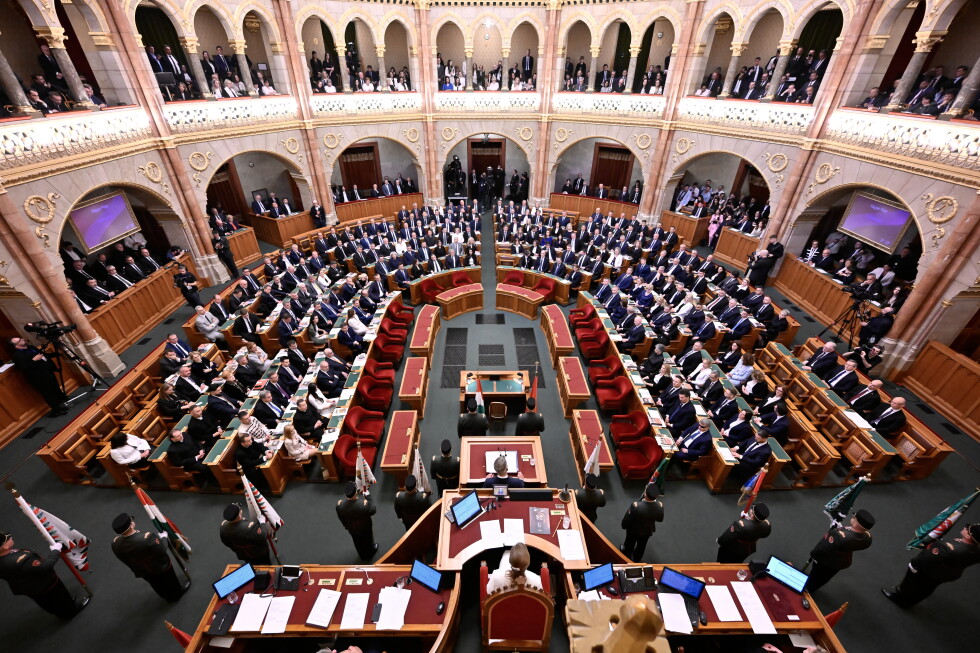
    After 16 consecutive years in power, Hungarian Prime Minister Viktor Orbán and his long-ruling Fidesz party were ousted from government in a historic election upset that has sent ripples across Europe and beyond. The victory went to opposition leader Péter Magyar and his Tisza party, whose supporters flooded the Chain Bridge that night, their chants and cheers echoing across the river as they celebrated what they described as the liberation of their homeland. In his triumphant victory speech to the crowd, Magyar doubled down on that shared feeling of renewal: “We did it,” he told the roaring gathering. “We brought down the Orbán regime — together we liberated Hungary. We took back our homeland! Thank you! Thank you all!”

    The result capped a seismic shift in Hungarian politics, achieved against all odds. Orbán had spent years consolidating power, building what he openly called an “illiberal democracy” marked by tight control of state media, electoral rule changes designed to favor his party, and deep influence over key government and industry positions held by his allies and family members. Even with these structural advantages, he suffered a decisive defeat at the polls, driven by a record-breaking voter turnout that saw millions of Hungarians turn out to oust his government.

    By the early hours of Monday morning, crowds of first-time voters danced through Budapest’s side streets, giddy with a heady mix of hope and disbelief. “I cried when I put the X on my ballot paper,” 20-something voter Zofia told reporters on the ground. “I still can’t quite believe we did it. But we did!” As she spoke, her group of friends chanted a phrase with deep roots in Hungarian history: “Russians Go home!”

    That slogan carries a sharp, ironic weight for Orbán, who first rose to national prominence back in 1989, as communist rule in Hungary collapsed. At that historic moment, he made his name with a fiery speech demanding Soviet troops withdraw from Hungarian soil, echoing the same rallying cry that first emerged during the 1956 anti-communist uprising. But over his decades in power, Orbán shifted dramatically, moving steadily to the authoritarian right and building a close, cozy relationship with Russian President Vladimir Putin. On the campaign trail, his own 1989 slogan was thrown back in his face by critics angered by his proximity to Moscow.

    Orbán’s removal from power marks a significant strategic blow to Putin, who relied on his loyal ally within the European Union to undermine Western efforts to hold Russia accountable for its full-scale invasion of Ukraine. Over the course of the war, Orbán repeatedly delayed EU sanctions packages against Moscow and has blocked a critical €90 billion EU support loan that Kyiv says it needs to maintain its economic and military stability. For Ukraine, the election result is a clear win: President Volodymyr Zelenskyy was quick to congratulate Magyar on his victory, writing on social media that he looked forward to “constructive work” between the two nations.

    Magyar has already signaled he will not fully reverse Orbán’s policy of refusing direct military aid to Kyiv, a cautious move designed to avoid alienating the large share of Hungarian voters who remain wary of being drawn into the conflict — a fear Orbán deliberately stoked throughout the campaign, warning that an opposition win would bring the war across Hungary’s border. But the new leader has pledged to end the block on the €90 billion EU loan to Kyiv, a major shift that will remove one of the biggest obstacles to European support for Ukraine.

    Across the EU, Orbán’s departure has been widely welcomed. For years, the Hungarian leader was nicknamed “the Obstructor” in Brussels, widely seen as a persistent fracture in the European union’s unified front against threats from Russia, China, and other global rivals. UK Prime Minister Keir Starmer called the result “an historic moment for European democracy,” while European Commission President Ursula von der Leyen said simply that “Hungary has chosen Europe.”

    The upset is far less welcome in Washington, where US President Donald Trump has lost his closest European ideological ally. Trump repeatedly endorsed Orbán during the campaign, even sending Vice President JD Vance to Budapest to speak at a pro-Orbán rally mid-campaign. Both Trump and his former chief strategist Steve Bannon, a key backer of populist nationalist movements across Europe, have long held Orbán up as a hero of their anti-globalist, Christian nationalist political project. Bannon once described Orbán as a trailblazer for the global right-wing movement Trump leads.

    Some political analysts have framed Orbán’s defeat as evidence that the wave of populist nationalism that swept across Europe over the past 15 years has reached a turning point, and entered a period of decline. But this narrative overlooks the unique set of factors that led to Orbán’s ouster, and ignores that recent setbacks for other right-wing populist leaders — from Marine Le Pen’s underperformance in recent French local elections to Italian Prime Minister Giorgia Meloni’s recent referendum defeat — are rooted in country-specific political dynamics that don’t add up to a broader regional trend.

    In Orbán’s case, his downfall was driven by a combination of long-simmering discontent across multiple segments of Hungarian society, and a final collapse of support even among his traditional base. For years, he alienated liberal and left-leaning Hungarians, as well as LGBTQ+ Hungarians and many women who saw their rights eroded under his socially conservative “pro-family” agenda that rigidly enforced traditional gender roles. But in the end, even long-time Orbán voters abandoned him in droves, driven by economic discontent and growing anger at corruption.

    A visit to Orbán’s home village of Felcsút, the day before the election, laid bare that anger. Once a humble boy from the village, Orbán poured public and private investment into the community, building a local football stadium and youth football academy. But his family’s growing wealth has become a flashpoint for anger: his son-in-law is linked to a luxury local golf course, while his father is currently rebuilding a nearby private estate estimated to cost around $30 million. Orbán has consistently denied all corruption allegations, and for years when the Hungarian economy was strong, many locals were willing to overlook the accumulation of wealth among his inner circle. But in recent years, soaring inflation and plummeting living standards have turned that tolerance to anger, even among his onetime supporters.

    “He failed us. He failed his country. He hoodwinked us,” Gyárfás Oláh, a former Orbán supporter and one-time local mayor, told reporters wearily. A large share of Magyar’s vote came from Hungarians who voted against Orbán, not necessarily for the new leader — who remains untested in national government. So what can we expect from the new prime minister?

    At 45, Magyar is an energetic, telegenic, and shrewd politician who was once a member of Orbán’s own Fidesz party. Like Orbán, he identifies as a conservative nationalist, and often carries a Hungarian flag to every campaign event. Political analysts note that Hungarian voters, who largely lean socially conservative, needed a center-right candidate to unify around to defeat Orbán — and it is likely that many of Orbán’s existing policies, including his hardline anti-immigration stance, will continue under the new government. Where Magyar has promised dramatic change is in institutional reform: he has pledged sweeping changes to “roll back the Orbán regime,” distance Hungary from Russia, and repair the fractured relationship with the European Union.

    For most Hungarians, the top priorities remain domestic: rebuilding the struggling economy, fixing underfunded public services, bringing down inflation, and lowering the sky-high cost of living that drove so many to abandon Orbán. There is a long to-do list for the new government, and Magyar has made clear he is ready to get to work. “Tonight we celebrate,” he told jubilant supporters late on Sunday night, grinning as he stood surrounded by cheering supporters. “Tomorrow, we get to work!”

    Magyar will not officially take office as prime minister until Hungary’s president formally asks him to form a new government, a step expected to take place within roughly a month.

  • Labor maintains two-party lead, buoyed by women: poll

    Labor maintains two-party lead, buoyed by women: poll

    Fresh national polling from Australia’s leading independent research firm Roy Morgan has delivered clear evidence that the center-left Albanese Labor government maintains a commanding two-party preferred advantage over the center-right Coalition opposition, with growing momentum among female voters emerging as the key pillar of its lead. Data collected between April 6 and 12, released publicly on Monday, puts Labor at 56% of the two-party preferred vote, a result that would hand the party a comfortable parliamentary majority if a federal election were held today. The entire shift in momentum toward the current government can be traced to rapidly rising support among women voters: a striking 61% of female respondents now back Labor on a two-party preferred basis, a 3.5 percentage point jump from previous polling. By contrast, less than 40% of women surveyed said they would support the Coalition, leaving the opposition trailing badly among this key demographic. The narrative shifts sharply when breaking down results by male voters, however. Among men, Labor’s two-party preferred support fell 4 percentage points to 50%, leaving the two major parties deadlocked in a tie. On the primary vote, Labor’s support among men dipped 1 point, while far-right party One Nation saw a 2.5 percentage point increase in primary support among male respondents. Across all demographic groups, One Nation’s overall primary support rose 3 percentage points to hit 24.5%, marking a notable recent surge for Pauline Hanson’s populist party. Even with this rightward shift among a subset of the electorate, poll analysts confirm that Labor’s lead among women is large enough to offset losses among men, leaving the party on track to retain power with a clear majority if an election were called in the immediate term.

  • Carney on verge of Liberal majority government as votes cast in three by-elections

    Carney on verge of Liberal majority government as votes cast in three by-elections

    One year after Mark Carney took office as Canada’s prime minister, his Liberal Party stands on the cusp of securing a narrow working majority in the House of Commons, with the outcome of three upcoming by-elections set to reshape the country’s federal political landscape for years to come.

    Voters head to the polls on Monday for three vacant ridings: two in the Greater Toronto Area, Scarborough Southwest and University-Rosedale, and a third competitive race in the Montreal suburb of Terrebonne. Currently, the Liberals hold 171 of 343 total seats in the Commons – just one seat short of the 172 needed for a formal majority. If the party claims victory in even two of the three contests, Carney will secure his narrow majority, allowing his government to pass legislation without relying on opposition support and pushing the next mandatory federal election back to 2029.

    Political observers note the projected shift in parliamentary control has been accelerated by an unusual wave of cross-party defections, with five sitting opposition lawmakers – four former Conservatives and one New Democratic Party member – already joining the Liberal caucus since Carney took power. Canadian media reports indicate the party is also courting several additional sitting MPs to switch allegiances in the coming weeks.

    The two Toronto seats up for grabs were vacated by high-profile former Liberal lawmakers who accepted new roles: Scarborough Southwest was previously held by ex-defence minister Bill Blair, who now serves as Canada’s ambassador to the United Kingdom, while University-Rosedale was the seat of former deputy prime minister Chrystia Freeland, now a senior policy adviser to the Ukrainian government. Political analysts widely predict the Liberals will hold both ridings, putting Carney’s majority within reach regardless of the outcome in Terrebonne.

    The race in Terrebonne remains one of Canada’s most closely watched by-election contests in recent decades. The Liberal candidate won the riding by just a single ballot in the 2025 April federal election, but Canada’s Supreme Court nullified the final result in February after uncovering an administrative error by Elections Canada involving mailed-in postal ballots. The contest is once again rated as a pure toss-up between the Liberals and the sovereigntist Bloc Quebecois. To bolster his candidate Tatiana Auguste, Carney personally campaigned in the riding ahead of polling day.

    University of Toronto political science professor Semra Sevi described the recent pace of party-switching as extraordinary, even for Canada’s fluid parliamentary system. “Carney has built a big tent, attracting members of parliament who would not normally be associated with the Liberal party,” Sevi explained in an interview. “The complication, however, is that the tent may now be so big that there isn’t a lot of ideological coherence in it.”

    That ideological tension flared up after the most recent defection of former Conservative MP Marilyn Gladu, a socially conservative lawmaker who has publicly described herself as personally pro-life. Gladu has committed to voting in line with Liberal caucus policy on abortion access, and Carney has defended his decision to welcome her, stressing that the party’s core values remain unchanged. Under Carney’s leadership, the Liberals have shifted toward the political centre-right, a marked departure from the more progressive agenda of former prime minister Justin Trudeau. Carney has rolled back several of Trudeau’s signature policies, including the national consumer carbon tax, and has prioritized positioning Canada as a global “energy superpower” while cutting public sector staffing levels – policy shifts that have proven appealing to disaffected centre-right Conservative MPs.

    The wave of defections has triggered fierce backlash from Conservative leader Pierre Poilievre, who has branded the floor-crossings undemocratic and accused Carney’s government of striking corrupt backroom deals to seize power. “By poaching MPs from other parties, Carney is telling those who elected them that ‘your vote does not count’,” Poilievre has argued.

    At the same time, analysts note the defections reflect deep-seated discontent within the Conservative caucus. Just over a year ago, Poilievre was widely seen as the likely next prime minister, but Carney surged in polling amid widespread voter concerns about cross-border trade and diplomatic relations with the United States under the second Trump administration. Today, many Conservative MPs fear the party has little chance of forming government under Poilievre’s leadership, with growing discontent over his approach to caucus management.

    Recent national polling puts the Liberals 10 to 15 percentage points ahead of the Conservatives, with Carney maintaining high personal approval ratings among Canadian voters. Closing out a Liberal party convention in Montreal over the weekend, Carney used his keynote address to frame his big-tent approach as a strength for a country facing overlapping national crises. “Canada’s founding insight is that unity does not require uniformity,” he told party members.

  • Pope Leo kicks off African tour under shadow of Trump’s ire

    Pope Leo kicks off African tour under shadow of Trump’s ire

    Pope Leo XIV departed Rome’s Fiumicino Airport on Monday, kicking off a landmark 11-day tour across four African nations that stands as one of his most high-profile international outings since his election to the papacy in May 2025. But the historic journey faces an early shadow, cast by harsh public criticism from former U.S. President Donald Trump launched just hours before the pontiff’s departure.

    The first stop of the 18,000-kilometer voyage is Algeria, a majority-Muslim nation that has never before welcomed a sitting pope. According to Algiers Archbishop Jean-Paul Vesco, the core goal of the Algerian leg of the trip is to foster interfaith connection: to help “build bridges between the Christian and Muslim worlds.”

    Roughly seven hours before Pope Leo departed Rome, Trump launched an unexpected public attack against the pontiff, centered on Leo’s repeated calls for an end to ongoing violent conflict in the Iran war. Speaking to reporters, Trump stated plainly, “I’m not a big fan of Pope Leo,” and accused the pontiff of “toying with a country (Iran) that wants a nuclear weapon.”

    Trump went further, suggesting that college of cardinals only elected Leo to the papacy earlier this year because of his American citizenship, framing the selection as an attempt to curry favor with Washington. The attack concluded with Trump sharing an AI-generated image that bizarrely depicted him in the likeness of Jesus Christ.

    This public rebuke is not out of the blue. Pope Leo had already publicly decried Trump’s threats against Iranian civilians as “unacceptable” — a critique that did not name Trump but left little ambiguity about its target. The pontiff has also previously condemned the Trump administration’s “inhuman” approach to migrant policy.

    In a surprising show of solidarity even from a political ally of Trump, Italian Prime Minister Giorgia Meloni, a far-right leader with well-documented close ties to Trump, released a public statement Monday morning wishing the pope a successful trip across Algeria, Cameroon, Angola and Equatorial Guinea. “May the Holy Father’s ministry foster the resolution of conflicts and the return of peace, both internally and between nations, following the path traced by his predecessors, and provide support and comfort to the Christian communities he will encounter during his journey,” Meloni wrote.

    Beyond its global diplomatic and interfaith goals, the tour carries deep personal meaning for Pope Leo. Algeria is the birthplace of Saint Augustine, the 4th and 5th-century Christian theologian whose spiritual thinking has shaped the entire course of Leo’s ministry. Augustine founded the theological tradition that underpins the Augustinian Order, the monastic community Pope Leo has belonged to for decades; he even served as head of the order before his election to the papacy, and has visited Algeria twice previously in that role. In his inaugural address as pope, Leo introduced himself as a “son” of Augustine, and regularly cites the theologian’s writings in his public messages.

    Ahead of the pope’s arrival in Algiers, the capital has been abuzz with festive preparation: city walls have been repainted, road surfaces refreshed, and public green spaces decorated with fresh plants and flower arrangements to welcome the historic visit. After meeting with Algerian President Abdelmadjid Tebboune, addressing the diplomatic corps, and paying respects to those killed in Algeria’s 1954-1962 war of independence against France, Pope Leo will travel Tuesday to Annaba, the modern city built atop the ancient Roman town of Hippo Regius where Saint Augustine lived and worked for much of his career. There, he will celebrate mass at the Saint Augustine Basilica.

    Father Fred Wekesa, rector of the Annaba basilica, noted that the visit will be a powerful moment of encouragement for Algeria’s small Christian community, bringing “a message of encouragement and solidarity.”

    Monday’s itinerary in Algiers also includes stops at the iconic Great Mosque of Algiers, home to the world’s tallest minaret, and the Basilica of Our Lady of Africa, which overlooks the city’s bay. The pontiff will also hold a private prayer service in a chapel honoring 19 priests and nuns who were killed during Algeria’s brutal 1992-2002 civil war, an internal conflict that claimed an estimated 200,000 lives. Notably, he will not visit the Tibhirine monastery, where seven monks were kidnapped and murdered in 1996, a killing whose full context remains unresolved decades later.

    Wekesa pointed out that while many global observers still see Algeria through the lens of its “dark years” of civil conflict, Pope Leo’s visit will give the world a chance to see the nation differently. “We are capable of living together in peace,” he said, noting the visit will highlight “the hospitality and generosity of the Algerian people.”

    Even so, human rights organizations have raised ongoing concerns about religious freedom in Algeria. While the country’s constitution enshrines formal guarantees of freedom of worship, multiple groups say repression of religious minority communities remains a persistent issue. Last week, three major human rights organizations publicly called on Pope Leo to raise these concerns during his meetings with Algerian leadership.

  • Trump attacks Pope over criticism of Iran war

    Trump attacks Pope over criticism of Iran war

    In a stunning break from decades of diplomatic precedent between U.S. leaders and the Vatican, former and current U.S. President Donald Trump has delivered an extraordinary, scathing rebuke of Pope Leo, opening a high-profile rift between the White House and the Catholic Church over two polarizing global issues: the ongoing war in Iran and Trump’s hardline immigration agenda.

    The verbal assault began with a post Sunday on Trump’s Truth Social platform, where the president unleashed a series of harsh accusations against the pontiff. He labeled Pope Leo “WEAK on Crime and terrible for Foreign Policy,” and doubled down on his criticism during a subsequent press briefing, telling reporters bluntly, “I’m not a big fan [of Pope Leo].”

    The conflict stems from long-running public opposition Pope Leo has leveled against two of Trump’s signature policies. On the Iran conflict, the pontiff has emerged as one of the most high-profile global critics of the U.S.-led war against Tehran, a conflict justified by the U.S. and Israel over Iran’s pursuit of nuclear capabilities. When Trump issued a stark threat to “destroy Iranian civilisation” earlier this year, Pope Leo dismissed the statement as “unacceptable” and has repeatedly called on the Trump administration to pursue a diplomatic “off-ramp” to end the bloody conflict. The pope has used multiple public platforms, including his recent Easter address, to press for de-escalation across the Middle East, urging global leaders with the power to end war to choose peace. In that Easter speech, he lamented that global populations have grown desensitized to violence and indifferent to the thousands of civilian deaths from ongoing conflicts, without naming specific nations directly.

    Beyond the Iran war, Pope Leo has also publicly questioned whether Trump’s restrictive immigration agenda aligns with the Catholic Church’s longstanding pro-life and pro-human dignity teachings, putting him at direct ideological odds with the White House.

    Trump’s criticism came as Pope Leo embarked on an 11-day pastoral trip to Africa, his second major international journey since his election to the papacy one year ago. In his social media post, Trump went beyond policy criticism, repeating a claim that the pontiff’s election was orchestrated specifically to counter his presidency. “He was elected because he was American, and they thought that would be the best way to deal with President Donald J Trump,” Trump wrote. “If I wasn’t in the White House, Leo wouldn’t be in the Vatican.”

    Pushed by reporters to elaborate on his claims, Trump doubled down on his unorthodox attacks, arguing “I don’t think he’s doing a very good job, he likes crime, I guess.” He added: “He’s a very liberal person, and he’s a man who doesn’t believe in stopping crime, he’s a man who doesn’t believe we should be toying with a country that wants a nuclear weapon so they can blow up the world.” His reference to Pope Leo being “weak on nuclear weapons” referred to the pontiff’s calls for diplomatic negotiation rather than military escalation around Iran’s nuclear program.

    Trump’s unprecedented public attack drew immediate, fierce backlash from Catholic leaders and religious scholars across the globe. Massimo Faggioli, a prominent Vatican and church history expert, told Reuters that the scope and bluntness of Trump’s criticism was unmatched even in periods of deep conflict between secular leaders and the papacy. “Not even Hitler or Mussolini attacked the Pope so directly and publicly,” Faggioli said, highlighting how extraordinary the current rift is. The conflict has sparked widespread debate over the separation of church and state, as well as the role of the papacy in shaping global policy on war and migration.

  • 10 measures aim to advance cross-Strait ties

    10 measures aim to advance cross-Strait ties

    As a high-profile delegation led by Chinese Kuomintang Chairwoman Cheng Li-wun wrapped up its six-day visit to the Chinese mainland, the mainland on Sunday announced a comprehensive 10-measure policy package designed to advance peaceful cross-Strait relations and lift the well-being of residents on both sides of the Taiwan Strait. This announcement comes on the heels of a historic Friday meeting between Xi Jinping, General Secretary of the Communist Party of China Central Committee, and Cheng — the first top-level dialogue between the two cross-Strait political parties in a decade.

    During the meeting, General Secretary Xi emphasized that the core goal of advancing cross-Strait relations is to deliver a higher quality of life for people on both sides. With the mainland kicking off its 15th Five-Year Plan (2026-2030), Xi extended an open invitation to Taiwan compatriots to share in the mainland’s development opportunities and progress, calling for joint efforts to strengthen the broader Chinese national economy. He also made clear that high-quality products from Taiwan, including agricultural and fishery goods, are welcome to gain greater access to consumer markets across the mainland.

    The 10 new initiatives, released by the Taiwan Work Office of the CPC Central Committee, span a wide range of key areas including party-to-party communication, youth exchanges, infrastructure connectivity, cross-Strait transportation, trade facilitation, and cultural cooperation. A centerpiece of the package is a proposal to explore the establishment of a regular communication mechanism between the CPC and the KMT, built on the shared foundation of upholding the 1992 Consensus and opposing “Taiwan independence”. The 1992 Consensus, which enshrines the one-China principle, was first reached in 1992 by the cross-Strait authorized bodies the Association for Relations Across the Taiwan Strait and the Straits Exchange Foundation.

    Other key measures include expanding youth exchanges through long-term institutional programs and arranging annual cross-Strait delegation visits. The package prioritizes advancing utility interconnection and cross-connection bridge projects between Fujian Province and the Taiwan-controlled Jinmen and Matsu islands. It also lays out plans to promote the normalization of direct cross-Strait passenger air services and restore suspended routes connecting Taiwan with multiple mainland cities.

    To boost economic ties, the measures streamline approval and purchase processes for qualified Taiwan agricultural and fishery products, expand market access support for Taiwan-based businesses, and improve port and service conditions for Taiwan fishing vessels operating in cross-Strait waters. In the cultural and media sector, the mainland will open its market to more Taiwan-produced content, encourage collaborative media production projects, and support the innovative development of shared Chinese culture. Additionally, the package outlines steps to resume individual tour travel from Shanghai and Fujian residents to Taiwan; currently, only group tours are permitted for residents of these two regions, though individual travel to Jinmen and Matsu from Fujian resumed in the second half of 2024.

    KMT Vice Chairman Chang Jung-kung, a member of the visiting delegation, framed the 10-point package as a goodwill “gift” from the mainland delivered to the Taiwanese people through Cheng’s visit, noting that the measures directly advance Taiwanese public welfare. He highlighted that the package demonstrates the mainland’s sincere goodwill and delivers tangible, practical benefits to Taiwan.

    Cheng’s six-day trip, which ran from April 8 to April 13, marked the first visit to the mainland by a KMT chairperson in 10 years, and included stops in Jiangsu Province, Shanghai and Beijing. This year marks the 160th birth anniversary of Sun Yat-sen, the founding figure of the KMT, so the itinerary included traditional stops for KMT leaders: the delegation paid respects to Sun at his mausoleum in Nanjing and the Sun Yat-sen Memorial Hall at Biyun Temple in Beijing’s Xiangshan.

    Beyond traditional exchanges, the trip included multiple stops showcasing the mainland’s cutting-edge technological progress. On the final day of the tour, the delegation visited Xiaomi’s electric vehicle hyperfactory in Beijing, where members learned about the mainland’s breakthroughs in electric vehicle research and manufacturing. A day earlier, the group toured the Zhongguancun National Innovation Demonstration Zone Exhibition Center in Beijing, where they viewed the latest developments in artificial intelligence, embodied intelligence, and high-end medical devices.

    Speaking after the Zhongguancun visit, Cheng noted that Taiwan’s service sector and traditional manufacturing industries face growing headwinds, and said, “I found answers for Taiwan’s future here.” She expressed deep admiration for how the mainland has integrated AI and technological innovation across every economic sector, calling the trip “highly rewarding.” “Without political barriers across the Strait, the two sides could make significant contributions to humanity,” she said, calling for deeper cross-Strait cooperation that leverages the unique strengths of both sides. She added that collaborative work to narrow differences and reduce confrontation is ultimately aimed at delivering better lives for all people across the Strait.

    Li Peng, dean of the Taiwan Research Institute at Xiamen University, noted that Cheng’s visit reaffirms the shared commitment of both sides to pursue peaceful cross-Strait development, uphold the 1992 Consensus, oppose “Taiwan independence”, and work to improve public well-being on both sides. He pointed out that mainstream public opinion in Taiwan supports restarting and expanding people-to-people cross-Strait exchanges, with many Taiwan residents eager to access the benefits of the mainland’s robust development. “Cheng’s trip has achieved these core objectives,” Li said, adding that the new 10-measure package delivers tangible benefits to Taiwan compatriots and stands as a landmark, productive outcome of the visit.

  • In their words: How leaders reacted to Viktor Orbán’s defeat in Hungary’s election

    In their words: How leaders reacted to Viktor Orbán’s defeat in Hungary’s election

    BUDAPEST, Hungary — After 16 years of dominating Hungarian politics and carving out an outsize role in global conservative movements, Viktor Orbán’s tenure as prime minister has come to an abrupt end following a crushing landslide defeat in Sunday’s national election. The political shakeup, which saw opposition challenger Péter Magyar secure an overwhelming mandate from Hungarian voters, is sending ripples across Europe and beyond, as leaders from Kyiv to Brussels react to the end of an era defined by Orbán’s controversial illiberal agenda.

    During his four consecutive terms in office, Orbán built a global following among right-wing populists, who replicated his political playbook: systematically restructuring state institutions to consolidate ruling party power, rolling back protections for minority groups, narrowing the space for independent media, and positioning himself as a fiery champion of national sovereignty against what he framed as the overreach of globalization and uncontrolled migration. To his critics across the European continent, however, Orbán represented a direct threat to European democracy, eroding the bloc’s core shared commitments to human rights, the rule of law, and institutional accountability.

    Ultimately, Hungarian voters delivered a clear verdict that it was time for political change, handing Magyar a decisive victory that has reshaped the European political landscape. The outcome carries particularly profound stakes for Ukraine, as Orbán maintained the closest ties to the Kremlin of any European Union leader, repeatedly blocking bloc-wide aid packages to Kyiv amid Russia’s full-scale invasion.

    Within hours of the election results being confirmed, Ukrainian President Volodymyr Zelenskyy extended an olive branch to the new Hungarian administration, emphasizing Kyiv’s longstanding goal of building constructive, good-neighborly relations across the continent. “It is important when constructive approach prevails. Ukraine has always sought good-neighbourly relations with everyone in Europe and we are ready to advance our cooperation with Hungary,” Zelenskyy wrote on social media. “We are ready for meetings and joint constructive work for the benefit of both nations, as well as peace, security, and stability in Europe.”

    For the European Union, Orbán’s defeat has been met with widespread relief, ending years of diplomatic gridlock and public friction between Budapest and Brussels. Despite Hungary receiving billions of euros in structural development funding from the bloc, Orbán consistently attacked EU institutions and its policy agenda, often deriding top EU leaders in public remarks.

    Minutes after Orbán delivered his concession speech, European Commission President Ursula von der Leyen — a frequent target of Orbán’s criticism — issued a celebratory message on X: “Europe’s heart is beating stronger in Hungary tonight.”

    Top leaders from Europe’s largest major powers quickly echoed the sentiment. British Prime Minister Keir Starmer called the election outcome “an historic moment, not only for Hungary, but for European democracy. I look forward to working with you for the security and prosperity of both our countries.” German Chancellor Friedrich Merz extended warm congratulations to Magyar, writing “Let’s join forces for a strong, secure and, above all, united Europe. Gratulálok, kedves Magyar Péter!” French President Emmanuel Macron added that “France welcomes the victory of democratic participation, the Hungarian people’s commitment to the values of the European Union, and Hungary’s commitment to Europe.”

    Meanwhile, populist leaders and far-right parties that counted Orbán as a close ideological ally have reacted with measured, careful rhetoric following his defeat. Italian Prime Minister Giorgia Meloni, who aligned closely with Orbán on a range of EU policy issues, thanked her “friend Viktor Orbán” for their past collaboration, noting “I know that even from the opposition he will continue to serve his Nation.”

    In France, the far-right National Rally — which is gearing up for a 2025 presidential run to unseat Macron and long supported Orbán’s agenda — struck a cautious tone. Party leader Jordan Bardella wrote that “This result, respectfully welcomed by Viktor Orbán, shows that the incessant accusations by European institutions in recent years against Hungarian democracy were unfounded.”

    The election result marks one of the most significant political shifts in Europe in recent years, with implications for EU policy, Ukraine’s war effort, and the future of global populist politics. As Magyar prepares to take office, leaders across the continent are waiting to see how his new administration will reshape Hungary’s place in Europe.