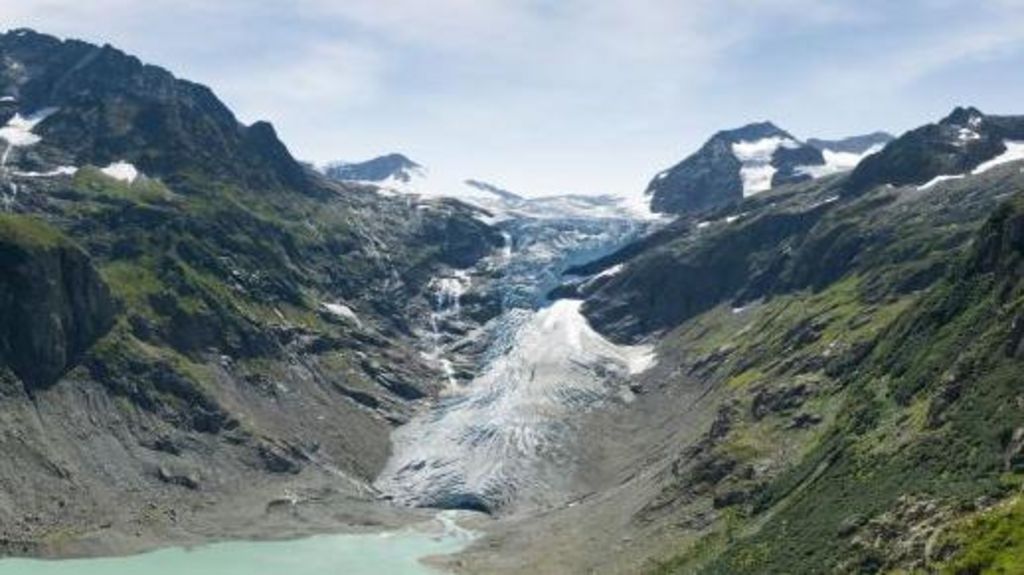
Decades after two Belgian climbers vanished while exploring the Swiss Alps, the accelerating melt of one of the region’s most well-known glaciers has finally solved a 34-year-old missing persons case. Local law enforcement confirmed this week that DNA testing has positively identified two bodies found by a passing hiker on the Trift Glacier, located south of Lucerne, as the 39-year-old and 41-year-old mountaineers who disappeared near Weissmies Mountain back in 1992.
The hiker first stumbled on the remains on July 26, after rising temperatures drove enough glacial ice melt to expose the bodies that had been entombed for more than three decades. Valais regional police launched an immediate recovery mission shortly after the discovery, moving the remains to a cantonal hospital in Sion for formal forensic identification.
Weissmies Mountain, a 4,000-meter-plus peak in the popular Saas Valley mountaineering region, has long drawn climbing enthusiasts from across the globe. Regional authorities maintain a centralized missing persons database stretching back to 1925, and officials note that the majority of open cases involve people who disappeared while traversing the Alps’ icy terrain, or in nearby rivers and alpine waterways.
This latest discovery is far from an isolated incident. Police confirmed that glacial melt driven by rising temperatures has repeatedly uncovered the remains of long-missing people in recent years. In 2023, for example, remains found on a glacier near the iconic Matterhorn were confirmed to belong to a German climber who had been missing since 1986.
The unearthing of the 1992 climbers shines a stark new light on the dramatic pace of glacial retreat across the European Alps, a trend scientists overwhelmingly tie to human-caused climate change. Data from Glacier Monitoring in Switzerland (Glamos) shows that Swiss glaciers have lost 25% of their total ice volume over the 10-year period ending in 2025, after already seeing record-breaking ice loss in 2022 and 2023. Glamos recorded an additional 3% reduction in glacial coverage across Switzerland in 2025 alone.
Global monitoring data backs up this alarming trend. Copernicus, the European Commission’s climate monitoring service, reports that glacial shrinkage has accelerated worldwide since the 1990s, with an even steeper rate of loss starting in 2000. Switzerland has experienced some of the most dramatic melt on the continent.
Beyond revealing long-buried remains, the steady loss of glacial ice and reduced winter snowpack linked to rising global average temperatures has created widespread disruption for Switzerland. Unseasonably warm conditions at high altitudes have threatened the future of many alpine ski resorts and forced the cancellation of multiple high-profile winter competitions in recent years.