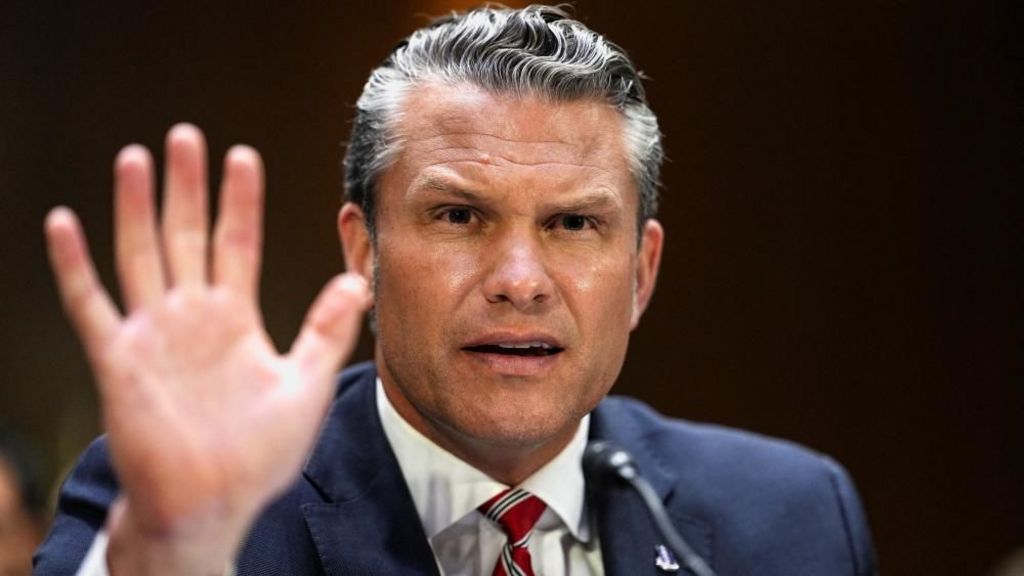
A controversial social media post from U.S. Defense Secretary Pete Hegseth has ignited widespread outrage across Canada, deepening already strained bilateral relations that are roiled by an escalating trade dispute between the two North American allies. Hegseth shared an image pulled from a local Canadian cadet training program’s social media account, which shows a young female cadet accepting an achievement award from her female instructor. To the post, he added a Canadian flag emoji and the caption “this is real”, a comment widely interpreted as a deliberate attempt to disparage Canada’s entire military establishment by mocking the physical appearance of the two women in the photo.
Canadian Defense Minister David McGuinty was among the first senior officials to condemn the action, stating Tuesday that Hegseth’s social media jab fell far below the standard of dignity expected for a cabinet-level defense secretary. The controversy comes at a moment when U.S.-Canada relations are already at a multi-decade low: the two nations are locked in a bitter trade dispute that has repeatedly devolved into personal insults and public taunts, and the Trump administration has spent years arguing that Canada unfairly relies on U.S. military power for its national defense while failing to meet its own alliance spending commitments.
Canadian Prime Minister Mark Carney made clear Tuesday that there will be no resumption of stalled trade negotiations until the Trump administration ends its pattern of provocative public attacks. “Any trade discussions will only begin again when the Americans stop doing memes, stop throwing shade, stop trying to be tough and start being serious about having those discussions,” Carney told reporters.
When pressed for comment on Hegseth’s post, the Pentagon offered only a terse response, saying the content “speaks for itself” and declining further clarification. Canada’s national cadet program, which falls under military oversight, provides leadership development and practical skills training to young Canadians between the ages of 12 and 18, making the mockery of teen participants particularly inflammatory for Canadian audiences.
The Army Cadet League of Canada, a civilian non-profit that supports the national program, issued an official statement strongly condemning the attack. The organization emphasized that “directing derogatory commentary toward youth who are actively working to better themselves and serve their communities is unacceptable,” and added that it rejects any form of online harassment or mockery of cadets’ hard-earned achievements.
Canada’s Chief of the Defence Staff, General Jennie Carignan, told public broadcaster CBC that military officials have already reached out directly to the two cadets involved in the incident to offer support and align on next steps. “We are consulting with them on how they want to go about doing this,” Carignan said, confirming that the cadets’ preferences will guide any official response from the Canadian Armed Forces.
Multiple Canadian lawmakers from across the political spectrum have joined the condemnation, including Scott Anderson, a Conservative Member of Parliament from Vernon and a former military reservist. In a public post directed at Hegseth, Anderson argued that the U.S. defense secretary had failed to uphold the basic “responsibility and decorum” that comes with his high office. “You have chosen to set both aside and insult two female Canadian non-combatants, and to intentionally shame them before millions. You should be ashamed,” Anderson wrote. He added that while the U.S. and Canada are deeply connected through shared economies, integrated continental defense systems and intertwined cultural ties, the two remain sovereign nations, and Hegseth’s behavior crosses a fundamental line of respect. “Our economies, our continental defence and our cultures are irretrievably intertwined and yet we are two distinct nations. Canadians and Americans should have no problem with each other, but I have a problem with you,” Anderson added.
The current tensions between the two nations trace back to last month, when planned bilateral trade talks collapsed after both sides traded accusations of last-minute demands that derailed a tentative preliminary agreement. In the immediate aftermath of the breakdown, the U.S. imposed 50% tariffs on roughly $20 billion worth of Canadian imports, and Canada has announced matching retaliatory tariffs set to take effect next week. The exchange of tariffs has been accompanied by a steady stream of personal and political insults: Ontario Premier Doug Ford publicly called U.S. President Donald Trump a “loser”, Trump has made the outlandish proposal to rename Lake Ontario to “Lake America”, and U.S. Transportation Secretary Sean Duffy went so far as to falsely claim Canada “doesn’t have a military”.
Despite the current downward spiral in relations, the U.S. and Canada have a decades-long history as close defense partners, including Canada’s long-standing deployment of troops alongside U.S. forces in the War in Afghanistan. In recent months, Canada has also significantly ramped up its defense spending after years of falling short of NATO’s mandatory spending targets, a move that was intended in part to address long-standing U.S. criticism of Canada’s defense contribution.
For Hegseth, the international backlash adds to a growing list of domestic challenges he currently faces. A veteran himself, Hegseth has already been under significant pressure in Washington following a string of high-profile departures of senior military leaders from the Pentagon, and growing public criticism of the Trump administration’s handling of the ongoing war with Iran. He has also built his public profile around pushing for strict standards for the appearance and physical fitness of U.S. troops, framing his agenda as a push to restore what he calls the military’s “warrior ethos.”