作者: admin

  • From terror suspects to clothing designers: Aussies listed on Interpol’s red list revealed as James Dalamangas arrested

    From terror suspects to clothing designers: Aussies listed on Interpol’s red list revealed as James Dalamangas arrested

    For nearly three decades, James Dalamangas avoided the long arm of international law, until Greek law enforcement officers detained the 55-year-old Australian earlier this week at a property in Aigialeia, central Greece. His arrest closes one of the longest-running fugitive cases in recent Australian history, tying back to the 1999 fatal stabbing of Sydney man George Giannopoulous at a nightclub in Belmore.

    Dalamangas’ 27-year evasion raises two pressing questions: who are the other Australian-linked fugitives still at large overseas, and what strategies allow suspects to remain undetected for decades? Criminology associate professor Xanthe Weston from Central Queensland University told reporters that low-profile behavior and identity fraud were the core pillars of Dalamangas’ long run from authorities. “Over 27 years, he must have secured a new identity and deliberately avoided drawing any attention to himself,” Weston explained. Successful long-term hiding relies on blending into local communities, establishing a quiet routine, and never standing out enough to trigger suspicion from residents or officials, she added.

    What may surprise many is that out of more than 3,000 suspects listed on Interpol’s global Red Notice – the organization’s official wanted person alert – only five have Australian citizenship or direct links to Australia. Weston says this tiny proportion is entirely expected, given Australia’s unique geographic and demographic profile. The country’s large landmass and sparse population, particularly in remote inland regions, make it an attractive hiding spot for fugitives fleeing other countries, rather than a place that produces large numbers of people fleeing overseas. “If you want to vanish, settling in a small outback village in Australia makes it surprisingly easy,” Weston noted. She added that while modern technological advances and the rise of social media have made long-term hiding far harder than it was in the 1990s, it remains possible for disciplined, low-profile suspects to stay off law enforcement radars indefinitely.

    The five Australian-linked fugitives currently on Interpol’s Red Notice list cover a wide range of serious charges, from terrorism to drug smuggling and fraud:

    The first is 45-year-old Meliad Farah, a Kogarah-born Australian who has been wanted for over 12 years for his alleged role in a 2012 suicide bombing in Burgas, Bulgaria. The attack targeted a bus carrying Israeli tourists departing Burgas Airport, killing five Israeli travelers and a Bulgarian bus driver, while injuring 32 more civilians. Farah, who also uses the alias Hussein Hussein, is accused of participating in planning the atrocity. Bulgarian authorities released his photograph in 2013 alongside co-accused Canadian Hassan al-Haj, and he is widely believed to be a Hezbollah operative.

    Next is 44-year-old Melbourne-based fashion designer Qui Shan Lian, who counts some of the world’s most high-profile celebrities among her past professional connections. She has been wanted since 2017 on drug smuggling charges, after Chinese authorities requested Interpol issue a Red Notice for her arrest.

    Third is 56-year-old Thi Hoa Trung Trinh, a Vietnamese national with confirmed ties to Australia who was added to the list four years ago. Limited public details are available about her case, but she is suspected of property misappropriation through breach of trust, and is wanted by Vietnamese law enforcement. She is described as 155cm tall, with black hair and dark brown eyes.

    Fourth is 55-year-old Abdulzagir Medjidov, a dual Australian-Russian citizen born in Russia’s Dagestan republic. He has been wanted for 13 years, with an initial arrest warrant issued in 2013 on charges of attempted murder and criminal preparation. He is fluent in both English and Russian, and is wanted by Russian authorities.

    The final fugitive is 65-year-old Australian national Thi Minh Phung Duong, who was born in Vietnam and has evaded capture for more than 12 years. Added to Interpol’s Red Notice list in 2011, she is wanted for fraud and property misappropriation through swindling, alleged to have committed her offenses in Vietnam. Few additional details about her case have been released publicly.

    Dalamangas’ recent arrest after 27 years on the run underscores what Weston emphasized: even for the most careful fugitives, it is impossible to hide forever.

  • Disaster drills helped prevent more deaths when powerful quake hit the southern Philippines

    Disaster drills helped prevent more deaths when powerful quake hit the southern Philippines

    Five days after a 7.8 magnitude offshore earthquake — one of the most powerful seismic events to hit the Philippines in 50 years — struck the country’s southern region, local officials are crediting regular, long-running disaster preparedness drills with preventing a far worse human toll. As of Friday, official counts put the death toll at 55, with 31 people still unaccounted for, nearly 1,120 injured, and more than 45,000 residents displaced from their homes. Half of those displaced remain in temporary emergency shelters, after the quake damaged over 12,600 residential structures across rural farming communities and urban centers alike.

    Weeks of ongoing strong aftershocks have left many survivors too traumatized to return to their damaged properties, even after initial safety inspections. In the days following the quake, user-generated footage posted to social media has captured the chaos of the shaking, showing horrified crowds watching small structures crumble, and public flag-raising ceremonies thrown into disarray as the ground shifted. The quake struck on the first school day after the summer holiday break, putting student responses to the emergency in the spotlight.

    Multiple videos show students screaming in panic as the ground shook, but many remained orderly outside school buildings, following long-practiced emergency protocols: some stood still, others crouched and covered their heads with their hands, as teachers worked to calm panicked groups and guide responses. One video posted to Facebook has gone viral, racking up millions of views; it shows dozens of elementary students crying and screaming while seated in an open, tree-lined school yard, where the visible swaying of the ground threw the children off balance. A nearby tin storage shed collapsed moments after the shaking started with a loud crash, sending a handful of students running, though teachers quickly guided them back to their assigned safe positions. Remarkably, the Malita-based grade school in Davao Occidental province where the footage was recorded reported zero injuries from the quake.

    “This incident serves as a reminder of the importance of earthquake preparedness and the value of regular disaster response drills,” the Mahayahay Elementary School said in an official statement following the event.

    Teresito Bacolcol, director of the Philippine Institute of Volcanology and Seismology (PHIVOLCS), confirmed Friday that consistent public education and regular emergency drills over many years helped communities across the affected region anticipate and respond correctly to the extreme seismic event, a rare powerful quake for the archipelago in modern history. He added that additional good fortune played a role: the quake struck at 7:37 a.m. local time, just minutes before most workers and students were set to enter indoor offices and classrooms, when people would have been at higher risk of injury from falling debris or structural collapse.

    “It’s good that our efforts to educate people on what to do when earthquakes hit somehow paid off,” Bacolcol told the Associated Press. However, he also raised urgent concerns about the structural failures of several buildings that he said should have withstood the quake’s force if national building code construction standards had been properly followed during construction.

    Ednar Dayanghirang, regional director of the Philippines’ Office of Civil Defense for the 5 million-person affected region, noted that preparedness measures reduced fatalities in multiple critical ways, most notably by preventing deadly crowd stampedes that often occur during mass public emergencies. “We required all school principals to take one-day courses on incident management, then they appointed disaster-response teams among teachers to deal with earthquakes, tsunamis,” Dayanghircsang said. “They listened and they learned.”

    Located along the Pacific Ring of Fire, a horseshoe-shaped arc of active seismic faults that circles the Pacific Ocean basin, the Philippines ranks among the most disaster-prone nations on Earth, regularly facing major earthquakes, volcanic eruptions and tropical storms. Years of repeated disaster events have pushed the national government to invest heavily in public disaster preparedness training, a choice that officials now confirm saved hundreds if not thousands of lives during this month’s powerful quake.

  • The migration pact: What’s in the EU’s landmark asylum reform?

    The migration pact: What’s in the EU’s landmark asylum reform?

    On June 12, a sweeping overhaul of European Union migration and asylum rules formally comes into force, marking the first time the bloc has established a unified, bloc-wide framework for managing irregular migration and border processes. According to EU Migration Commissioner Magnus Brunner, the reform is designed to give individual member states greater control over cross-border population movements, ending years of fragmented national policies that have strained regional cooperation.

    The new system introduces sweeping changes to how the EU processes people crossing its external borders illegally. Under the updated rules, all irregular arrivals will undergo mandatory identity and security screenings completed within a seven-day window. Biometric data, including facial scans and fingerprints, alongside basic identity documentation, will be stored in a centralized EU database. The primary goal of this screening is to triage applicants: sorting those eligible for standard or accelerated asylum processing from those who will be ordered deported to their country of origin or a prior transit country. Human rights organizations have already raised red flags, warning that the process will effectively result in widespread detention for most migrants, including unaccompanied minors, for the full duration of screening.

    A core component of the reform is a new fast-track rejection pathway for applicants deemed to have low protection prospects or pose potential security risks. This includes nationals from countries such as Morocco and Bangladesh, where at least 80 percent of asylum applications are typically rejected by EU member states. These cases will be processed entirely in dedicated facilities located near the EU’s external borders—encompassing land frontiers, maritime ports and international airports—with a maximum processing timeline of 12 weeks. Rights advocates argue this compressed timeline will lead to rushed, flawed asylum decisions and extend detention periods for vulnerable people, while applicants from regions with higher approval rates will still follow the bloc’s existing standard asylum procedures.

    For years, the EU’s original migration rules placed full responsibility for processing asylum claims on the member state where an irregular migrant first arrived. This system placed disproportionate burden on southern EU states including Italy, Greece and Malta, which have received the vast majority of sea and land arrivals over the past decade. To address this imbalance, the reform introduces a mandatory solidarity mechanism that requires all member states to contribute to sharing the burden. States can either agree to relocate a set number of asylum seekers from frontline border states, or opt to pay a contribution of 20,000 euros (equivalent to roughly $23,000) per asylum seeker to the receiving frontline country. The mechanism is designed to relocate at least 30,000 asylum seekers annually, though early negotiations have already hit major stumbling blocks: a first round of talks held last year saw multiple member states refuse to accept any relocation assignments.

    The overhaul also includes a dedicated emergency response framework to address sudden, large-scale migration surges, similar to the 2015-2016 crisis that saw more than two million asylum seekers, most fleeing conflict in Syria and Afghanistan, enter the bloc. Under surge conditions, member states will be permitted to roll back standard asylum protections and hold migrants in external border detention centers for longer periods than the rules normally allow. The framework also applies to what the EU calls “instrumentalization of migration,” a practice the bloc has repeatedly accused Belarus and Russia of engaging in, claiming the two countries push irregular migrants across EU borders to destabilize the 27-nation bloc.

    Despite the formal entry into force, major implementation challenges remain. A dozen member states have not yet completed necessary preparations, including building the border infrastructure required to carry out the new mandatory screenings. Other countries have already reported technical issues with integrating national systems into the new centralized biometric database. Public opinion across much of the bloc has hardened further on migration since the pact was agreed, pushing national governments to demand even stricter measures. Currently, an additional legislative package focused on expanding deportations of asylum seekers whose claims have been rejected is moving rapidly through the EU’s lawmaking process.

    These developments have amplified concerns from human rights groups that European policymakers are prioritizing political expediency over basic humanitarian protections. Judith Sunderland, associate Europe and Central Asia director at Human Rights Watch, criticized the incoming rules, saying “The Pact takes a sledgehammer to the right to asylum at a time when the world needs Europe more than ever to champion human rights.”

  • ‘I was employee number one’: SpaceX co-founder reacts to firm’s market debut

    ‘I was employee number one’: SpaceX co-founder reacts to firm’s market debut

    Twenty-two years after stepping away from a legacy aerospace career to help launch a radical new space venture, Tom Mueller, SpaceX’s very first hire and co-founder alongside tech entrepreneur Elon Musk, has opened up about his experiences as the company prepares for a high-stakes public market debut. In an exclusive interview with BBC correspondent Michelle Fleury, Mueller, who built the company’s first rocket engines from scratch in a cramped Los Angeles warehouse, recalled the early days of the startup when few industry insiders believed a private company could challenge established government-led space programs.

    As the driving force behind SpaceX’s groundbreaking Merlin and Raptor rocket engine designs, Mueller witnessed every milestone of the company’s transformation: from the early failed launch attempts that nearly sank the venture to the historic first reusable rocket landings that revolutionized space access. Now, as the company moves toward its public listing that is projected to value SpaceX at well over $100 billion, Mueller shared his perspective on how the small team of passionate engineers grew into the world’s leading commercial space enterprise. The long-awaited market debut is expected to reshape the private space industry, unlocking billions in new capital for SpaceX’s ambitious projects including the Starlink satellite internet constellation and the NASA-led Artemis program’s lunar landing mission. Mueller’s reflections offer a rare insider look at the origins of a company that has redefined what private enterprise can achieve in space exploration.

  • ‘Best Canada team ever’ bid to shine at home World Cup

    ‘Best Canada team ever’ bid to shine at home World Cup

    As the 2026 FIFA World Cup kicks off, much of the global spotlight has fallen on political shifts in the United States and ongoing infrastructure and scheduling controversies in co-host Mexico. But few have turned their attention to the tournament’s third, often underrepresented host nation: Canada. For Canadian football observers, this quiet invisibility is nothing new. “Canada is often overlooked, and we are comfortable with that,” veteran Canadian football journalist Har Johal told BBC Sport in an exclusive interview. “We will smile, be polite, and let our co-hosts to the south dominate the headlines. But that does not mean we do not have big ambitions of our own.”

    Beneath the widely held stereotype of Canadian politeness lies a steely, growing confidence: this iteration of the men’s national team is widely considered the most talented in the country’s history, and they are poised to deliver a breakout performance on home soil this summer, starting with their tournament opener against Bosnia-Herzegovina in Toronto on Friday at 20:00 BST.

    ### Off the Pitch: Hosting Success, With Some Growing Pains
    Unlike several proposed U.S. host venues that have drawn criticism for exorbitant travel costs and remote locations, Canada has avoided major off-pitch controversy. Both of its host cities – Vancouver and Toronto – boast centrally located, accessible stadiums that eliminate the need for long-distance commutes for fans. That said, the nation is not immune to the cost-of-living strains hitting the 2026 tournament overall.

    FIFA’s standardized ticketing pricing structure has left many local fans facing similarly expensive seat costs to their counterparts in the U.S. and Mexico, and hotel prices have skyrocketed to unprecedented levels. Downtown Vancouver hotels currently charge more than $1,000 per night during the tournament, with some peak match-night rates exceeding $2,000. When Vancouver hosted the 2010 Winter Olympics, the average downtown hotel rate sat at just $359 per night. Compared to standard 2025 off-tournament rates, prices have surged by more than 300% in some blocks.

    ### A History of Waiting, and Growing Talent on the Pitch
    This 2026 tournament marks just Canada’s third appearance at the men’s World Cup finals, following debut runs in 1986 and 2022. The nation’s World Cup record is far from intimidating: across six total matches, Canada has yet to earn a win, scoring only two goals while conceding 12. At the 2022 Qatar World Cup, Canada entered the tournament labeled a potential dark horse after a stunning qualification campaign, but was outclassed in a brutal group that featured eventual semi-finalists Croatia and Morocco, alongside Belgium.

    Four years later, with four additional years of top-flight international experience and the undeniable energy boost of a home crowd, expectations around the team have shifted dramatically. Johal notes that momentum for Canadian football has been building for decades, as more young Canadian talent earn spots at top European clubs. “The timing is fantastic, but it has been building for Canada – we have seen more players in top European leagues, the talent is there,” she explained. “At Qatar, expectations were already high, and they are just as high again this year. People are getting excited, momentum is slowly building. The whole country is really behind Team Canada, and excitement ramps up every single day. This is a great generation, the best Canadian team we have ever had.”

    On paper, Canada’s 2026 group is far more manageable than their 2022 draw. They will face Switzerland, Qatar, and Bosnia-Herzegovina – the latter of which upset powerhouse Italy on penalties to qualify for the tournament. “People are saying there is no reason Canada cannot top this group, especially after Italy choked,” Johal said. “Now maybe the Swiss are our biggest rivals.”

    That confidence has yet to fully translate to recent match results. Canada were eliminated from the 2025 Concacaf Gold Cup quarter-finals by underdog Guatemala on penalties, and their recent friendly form has been inconsistent. The March 2026 international break brought two consecutive draws against Iceland and Tunisia on home soil in Toronto, and goals have been hard to come by: the team has failed to score in four of their last nine outings, leaving manager Jesse Marsch with work to do to meet lofty home expectations.

    ### The Golden Generation Led By a Talisman Returning From Injury
    While Marsch works to solidify his starting eleven, the entire nation is holding its breath for star talisman Alphonso Davies, who is set to miss the opening Bosnia-Herzegovina match through injury but hopes to return later in the tournament. The 25-year-old Bayern Munich winger, now Canada’s captain, made history at the 2022 World Cup as the first Canadian man to score a World Cup goal, even as the team bowed out in the group stage. Now the undisputed face of Canadian football, Davies has missed 15 club matches this season through a series of injury setbacks, including a hamstring strain that kept him out of the March 2026 international window. If the winger can return to full fitness, it would be a transformational boost for the host side.

    “We saw Davies come back and score for Bayern recently, he is an integral part,” Johal said. “Davies is 100% the face of the team, it’s just we have not seen that face so often with the injuries.”

    Davies anchors what is widely called Canada’s golden generation, alongside Juventus striker Jonathan David and Villarreal midfielder Tajon Buchanan. If all three can reach peak form for the tournament, analysts agree Canada has the quality to compete with any side in their group.

    Toronto-based national team midfielder Jonathan Osorio credits the rising quality of Canadian football to decades of growing popularity and investment in the sport at all levels. “The exposure to other leagues around the world being shown on TV here was also a factor,” Osorio told BBC World Service. “I think Canadian club teams in MLS being successful helped, and all those things helped that next generation really believe and dream big, and believe that it is possible to one day help Canada reach a high level. Our grassroots began to improve. Everything began to improve as far as the sport in our country and that’s what led us to finally getting over that hump and qualifying for multiple World Cups. I think this team represents Canada more than any other national team in any sport. We really show how diverse Canada is.”

    ### Ambition Meets Expectation: A First Win Awaits
    For a nation that has never won a World Cup match, the bar for success is clear. “Success has to be getting out of the group, or even topping the group,” Johal said. “There is no reason why they can’t, they are strong all over the field. Yes, we have never won a game, but as hosts it is a good time to do that now. If they don’t get out the group, heads will roll.”

    The first head expected to be on the chopping block if Canada underperforms is manager Marsch, a former Leeds United boss appointed in May 2024 specifically to lead the host side into the home tournament. While Marsch’s time in England ended in sacking and Leeds relegation in the 2022-23 season, he has built strong support in Canada for his straightforward style and experience coaching at the top club level. Osorio argues Marsch’s tactical approach is a perfect fit for this Canadian side.

    “His football is very intense and physical, which suits our strengths as a team,” Osorio said. “But at the same time, it doesn’t take away from playing attractive, confident football. It’s been a perfect match honestly, and his experience coaching at the highest level has already had a huge impact on a lot of players in terms of their development and growth. It’s probably the best squad we’ve ever had in our history, and the player pool is deeper than it’s ever been.”

    Marsch, an American, has already dismissed off-field speculation about him leaving the Canadian job to take the vacant U.S. national team role in 2024, and has publicly pushed back on U.S. President Donald Trump’s controversial comments calling for the annexation of Canada, calling the remarks “ridiculous”. Johal says Canadian fans appreciate Marsch’s no-nonsense, transparent approach, and do not take issue with an American leading their national side.

    “People like Marsch, they like his no-nonsense approach,” Johal said. “He is an open book and gives long answers at media conferences – what you see is what you get. People just want the best results.”

    As for the style of play fans can expect from the 2026 hosts, Johal says it matches the country’s beloved national sport of ice hockey: high-tempo, physical, and aggressive, with no willingness to back down from opposition. “Canada are aggressive, they get on the ball and want to take the game to the opposition. It is similar to hockey – physical play and high pace. Players are not afraid to get stuck in. I would not be surprised to see a few cards – they do not want to be pushed around.”

    So for fans expecting the stereotypical quiet Canadian politeness on the pitch this World Cup: think again.

    Fans across the UK can watch Canada’s opening match against Bosnia-Herzegovina on BBC One, BBC iPlayer, and the BBC Sport website and app from 19:00 BST on Friday, with full live commentary on BBC Radio 5 Live and BBC Sounds.

  • Gavin Preston murder: Contract killer has kind compassionate nature, his mum tells court

    Gavin Preston murder: Contract killer has kind compassionate nature, his mum tells court

    On May 8, a Victorian court reached a guilty verdict in one of Australia’s most shocking recent contract killing cases: 25-year-old Jaeden Tito and 26-year-old Rabii Zahabe were convicted of the brutal murder of underworld figure Gavin Preston and the attempted murder of his companion Abbas Maghnie. As the sentencing phase of the trial gets underway, the case has drawn new attention for the heart-wrenching testimony from Tito’s mother, whose public conflict over her son’s actions lays bare the human fallout of gang-related violence.

    The murder itself unfolded in broad daylight on September 9, 2023, at a popular suburban cafe called Sweet Lulu’s in Keilor, Melbourne. Preston, 50, was sitting outdoors eating breakfast with Maghnie when two masked gunmen, who had lain in wait for hours, opened fire. Preston was killed instantly in a hail of bullets, while Maghnie suffered life-threatening wounds. Investigators later confirmed Maghnie survived only by chance: one of the assassins’ weapons jammed mid-attack, stopping them from firing the fatal shot that would have killed him. To date, Maghnie has refused to cooperate with police investigations into the shooting. Both Tito and Zahabe have maintained their innocence throughout the trial, despite the jury’s guilty verdict.

    In an emotional letter to the court — drafted with assistance from ChatGPT — Levi Tito, Jaeden’s mother, opened up about the devastating impact of her son’s conviction on her family. One of six children, Jaeden grew up as a protective older brother to his siblings and a constant source of joy for the household, she told the court. “I do not write this letter to excuse his behaviour but rather to share with this court the person I have known,” she wrote. “Your Honour, I understand my son’s actions have had devastating consequences … I continue to see kindness, compassion and humanity within him.”

    She added that even in custody, her son has kept in close contact with the family, sending regular letters and cards and taking up quiet hobbies like reading and colouring. These small acts, she said, confirm that the caring son and brother she raised has not disappeared entirely. “When we learned of his arrest … Our world changed completely,” she said. “We deeply long for the day he can come home to us but we understand that day is not near.” As Levi Tito spoke, Preston’s fiancee Lauran Howe, who was in attendance at the court, sat with her head in her hands, confronting the pain of losing her partner.

    Prosecutors, led by senior counsel Kristie Churchill, are pushing for the harshest possible sentence: life imprisonment for both men, arguing that the pre-planned, public nature of the killing demands the maximum penalty. “We say this was a murder that was extensively planned, it was sophisticated,” Churchill told the court. “This was a public execution that exposed many members of the public going about their lawful business to the execution.”

    Defense lawyers for both hitmen have pushed back against life sentences, noting that while the pair were convicted, there is no evidence they were the masterminds behind the plot. Paul Smallwood, representing Zahabe, argued that his client’s young age and the harsh conditions of his pre-sentencing custody should be taken into account. Daniel Sala, Tito’s attorney, echoed that point, emphasizing that the two men were nothing more than small parts of a larger criminal operation. “They are not the driving force behind it,” Sala said.

    The court has heard that both men are currently being held in protective custody due to the underworld connections of the victim, which puts them at significant risk of attack from other inmates. While the identity of the person or group that ordered the hit has not been confirmed, prosecutors acknowledged during the trial that Preston had a long criminal history and no shortage of enemies who may have wanted him dead.

    Justice Michael O’Connell, presiding over the case, noted that even if the pair were not the main organizers, they were fully aware of every detail of the plot. “Your clients seemed to know about all that planning and take advantage of it to make a getaway which enables them to get to Sydney within a couple of hours,” he said. The pair will return to court at a later date for their final sentencing, after the justice has considered all arguments from both the prosecution and defense.

  • ‘Pressure cooker’: Crown alleges affair discovery led to Priscilla Brooten’s death

    ‘Pressure cooker’: Crown alleges affair discovery led to Priscilla Brooten’s death

    After seven days of dramatic evidence presentation in a high-profile Brisbane Supreme Court murder trial, both prosecution and defence have wrapped their cases, leaving the future of accused killer Mark Sheridan Waden in the hands of a 12-person jury set to begin deliberations Monday. Waden has entered a firm not guilty plea to the 2018 murder of Priscilla Brooten, a US citizen who disappeared without a trace from the Bracken Ridge home the pair shared, with her body never located despite years of investigation.

    Crown prosecutors laid out a damning circumstantial case arguing the killing followed a volatile relationship that erupted into a fatal argument on July 5, 2018. Prosecutor Andrew Walklate told jurors Brooten discovered private Facebook messages showing Waden was carrying on a secret relationship with a younger female colleague, triggering a day of tense exchanges between the pair. Phone records, diary entries, and counselling documents obtained by the prosecution paint a picture of a relationship mired in crisis, described by Walklate as a “pressure cooker scenario” that had been building long before that fateful July day. Brooten’s own notebook, left behind at the home after her disappearance, contained a chilling entry: she wrote she had threatened to ruin Waden’s life by exposing his unlicensed marijuana business and publishing details of a prior assault where he had nearly killed her.

    Walklate outlined that only four plausible explanations exist for Brooten’s complete disappearance: her former boyfriend Steven Thompson killed her, she remains alive in hiding, she died by suicide, or Waden killed her. He stressed that all available evidence points exclusively to the fourth scenario, adding that all evidence points to a deliberate killing rather than an accidental death. Notably, both the prosecution and defence have ruled out Thompson as a suspect, with Walklate describing him as a kind man who remained close to Brooten after their relationship ended and cared deeply for her well-being. Thompson was the one who first reported Brooten missing when all contact abruptly stopped, and spent months independently searching for clues about her fate.

    Key pieces of the Crown’s case include the suspicious timing of a 4-metre trench Waden arranged to be excavated at his property just 24 hours after Brooten vanished. Walklate said the urgent excavation, booked through the gig work platform Airtasker, was intended to hide Brooten’s body, the murder weapon, or other evidence tying Waden to the crime. Prosecutors also point to a series of text messages sent from Brooten’s phone to Thompson the day after she was allegedly killed, which contained text saying Brooten was leaving and that Thompson should not attempt to find her. Walklate argued the messages were a fabrication sent by Waden to create the false impression Brooten had left the country voluntarily.

    Further suspicious evidence cited by the Crown includes varying explanations Waden gave to friends and acquaintances for Brooten’s sudden absence – he claimed she had fled Australia over debt with dangerous criminal groups, that she had unresolved immigration issues, and that she had chosen to cut off contact. Prosecutors say these conflicting stories were part of a deliberate campaign to divert attention from the killing. They also point to a mysterious 2018 phone call to the US Consulate made by a man claiming to be Thompson, which alleged Brooten was being held against her will in the non-existent location of “Winchester, Maryland”. Thompson has denied making the call, and Walklate argued it was another false trail planted by Waden to confuse investigators.

    Since July 2018, there has been no confirmed trace of Brooten: no banking transactions, social media activity, border crossings, hospital admissions, or credible sightings have been recorded. Walklate noted the complete lack of contact is especially notable because Brooten did not reach out even after her own mother died, an absence that would be unthinkable if she were still alive. Brooten left all of her personal possessions – including clothing, makeup, and identification documents – at the shared home, further undermining any claim she left voluntarily.

    For the defence, barrister James Godbolt urged the jury to acquit Waden, arguing the entire case against his client is based entirely on circumstantial evidence that fails to meet the legal standard of proof beyond a reasonable doubt. Godbolt reminded jurors that even if they suspect Waden may have killed Brooten, or think it is probable he did so, that standard is not sufficient for a guilty verdict. “If you don’t get to beyond reasonable doubt, Mark Waden should be acquitted of murder,” Godbolt told the court.

    Godbolt pushed back against every key part of the Crown’s narrative, starting with the trench excavation: he said the work was part of a long-planned front-yard landscaping project, pointing out the illogic of burying a body in a front yard along a busy road when a private backyard was available. Testing of soil from the trench turned up no trace of human remains, and no forensic evidence linking Waden to Brooten’s death has ever been found, he added.

    The defence laid out alternative explanations for Brooten’s disappearance, noting the US citizen had a long history of severe depression and self-harm, with expert assessment placing her in the severe to extreme range of the condition. Godbolt argued suicide remains a plausible outcome, or alternatively that Brooten – who had been living unlawfully in Australia using multiple aliases – chose to disappear and live off the grid to avoid authorities. He also heavily criticized the police investigation into Brooten’s disappearance, calling it “inadequate to the extreme” for failing to thoroughly explore alternative leads and the possibility she remains alive.

    Justice Peter Callaghan is scheduled to deliver his final instructions to the jury on Monday, after which jurors will retire to decide whether the prosecution has proven its case beyond reasonable doubt.

  • ‘Natural leaders’: Jake and Tom Trbojevic to serve as co-captains as Kieran Foran continues to make changes at Manly

    ‘Natural leaders’: Jake and Tom Trbojevic to serve as co-captains as Kieran Foran continues to make changes at Manly

    The Manly Sea Eagles, one of the National Rugby League’s most storied franchises, have announced a major off-field shakeup to their leadership group, with head coach Kieran Foran confirming that club fan favorite Jake Trbojevic will step into a permanent co-captaincy role alongside his younger brother Tom.

    Tom Trbojevic was named the club’s sole captain earlier this year, taking over from club legend Daly Cherry-Evans who departed for the Sydney Roosters at the end of the 2024 season. The star fullback has been sidelined in recent weeks with a hamstring injury, but is on track to make his return to the field next Thursday when Manly faces off against the Canterbury-Bankstown Bulldogs.

    The 2025 NRL season got off to a disastrous start for Manly: the club dropped its first three consecutive matches, resulting in the immediate dismissal of former head coach Anthony Seibold. Foran, who originally joined the club’s staff as an assistant coach, stepped into the interim head coaching role and quickly turned the team’s on-field fortunes around. Impressed by his rapid turnaround of the squad, Manly’s front office signed Foran to a three-year permanent head coaching contract just weeks into his interim tenure.

    During Tom Trbojevic’s injury absence, Jake Trbojevic stepped up to lead the side with remarkable composure and results. That strong performance laid the groundwork for Foran’s decision to share the captaincy between the two brothers, a move that aligns with the team’s current chemistry.

    In addition to the co-captaincy appointment, powerful back-rower Haumole Olakau’atu has been named the club’s sole vice-captain. The appointment comes at a pivotal moment for Olakau’atu, who was recently dropped from the New South Wales Blues State of Origin side and will be eager to prove his selection worth against the Bulldogs next week.

    Speaking on the leadership changes, Foran emphasized that the move was a natural fit for the evolving squad. “Tom and Jake are the natural leaders of this group, and it makes sense to have them as co-captains,” Foran told reporters. “Jake has done an amazing job in Tom’s absence and we knew he would. He stepped up when the team needed him. That’s what leaders do. Haumole has also been wonderful this year, not only in his performances but also in the leadership he brings to the group.

    Right now, what’s best for the team is to have both Tom and Jake sharing the captaincy, supported by Haumole as vice-captain. It’s a pretty straightforward decision to be honest. We are lucky as a group to have two legends of the club leading the way.”

    For Jake Trbojevic, the new role caps off a positive stretch that has cleared up uncertainty around his future in the NRL. Earlier this year, widespread speculation suggested 2025 would be his final season in top-flight rugby league, but the forward has confirmed he will remain with Manly through the 2027 season. A long-time fan favorite and one-club man, Trbojevic said he was eager to take on the new responsibility.

    “I’ve just loved the past few months, and I’ll do whatever is best for the team,” he said. “If Foz (Foran) and Tom want this, then I’m all in. Leading this amazing group of players and playing for this great club is a privilege.”

  • Ahead of G7, Carney softens tone toward Trump with trade talks at stake

    Ahead of G7, Carney softens tone toward Trump with trade talks at stake

    OTTAWA, Ontario — Just months after catapulting to international fame as a leading voice of middle power resistance to great power coercion, Canadian Prime Minister Mark Carney is poised to adopt a far more restrained tone when confronting U.S. President Donald Trump at the upcoming Group of Seven (G7) summit in France, according to political analysts and trade observers.

    Carney’s January appearance at the World Economic Forum in Davos, Switzerland, cemented his status as a rising global political star. In a widely celebrated keynote address, he declared the long-standing global rules-based order effectively defunct and delivered a sharp rebuke of large nations using coercion to pressure smaller states. The speech drew global acclaim, overshadowing Trump’s own remarks at the annual gathering and turning Carney into a symbol of pushback against great power overreach.

    But the geopolitical calculus has shifted dramatically as the G7 summit, set to open Monday in Évian-les-Bains, arrives just weeks before a mandatory July 1 review of the U.S.-Mexico-Canada Agreement (USMCA). The updated trilateral trade pact, which replaced the original North American Free Trade Agreement in 2020, has interconnected the three North American economies for more than three decades, and its future hangs in the balance ahead of the review. This week, Trump reignited fears by suggesting he may opt not to renew the landmark agreement.

    For Canada, the stakes could not be higher. More than 70 percent of the country’s total exports flow across its southern border into the United States, making the preservation of the preferential trade deal an existential economic priority for Ottawa. Canadian historian Robert Bothwell notes that Carney faces far greater risks from Trump’s trade policy than any other G7 leader, explaining “we are more exposed to the United States than anybody else.”

    The strained dynamic between the two leaders comes as bilateral tensions have escalated sharply in recent weeks, eroding what has long been one of the world’s most enduring and amicable cross-border alliances. The decades-long partnership, forged by shared geography, common cultural heritage, and centuries of aligned interests, has fractured under repeated friction between the two administrations.

    In one recent sign of the souring relations, a planned reception for Ontario Premier Doug Ford — leader of Canada’s most populous province — hosted by the U.S. Chamber of Commerce in Washington was abruptly canceled at the last minute earlier this month. While the reason for the cancellation was not officially confirmed, one senior Ford cabinet minister, Vic Fedeli, struck a defiant tone, saying if Trump pressured the chamber to scrap the event, “Ford should be wearing that as a badge of honor.”

    Just this week, Trump doubled down on his dismissive rhetoric toward Canada, claiming the U.S. “doesn’t need anything that Canada has.” In response, Carney has doubled down on his policy of trade diversification, setting a national goal to double Canadian exports to non-U.S. markets over the next 10 years, and citing Trump’s protracted trade war as a major barrier to cross-border investment confidence.

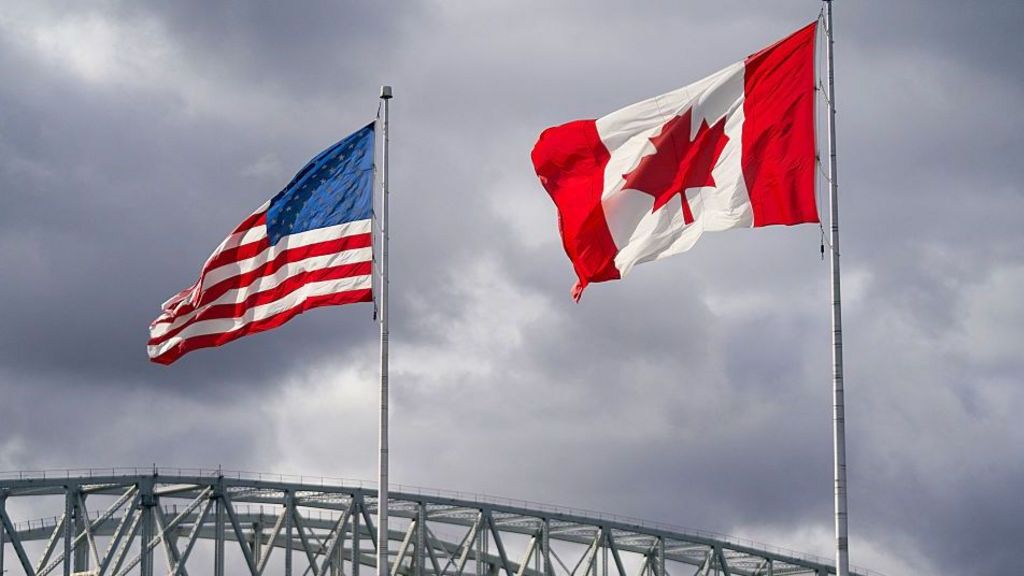
    Additional friction emerged this week when the long-planned opening of a major new cross-border bridge spanning the Detroit River — a project Trump previously threatened to block entirely — was pushed back indefinitely, with developers citing unresolved logistical and regulatory issues.

    Trump’s confrontational approach to Canada, from launching the 2018 bilateral trade war to his joking (and often repeated) suggestion that Canada should become the 51st U.S. state, has deeply angered Canadian voters. That public backlash directly created the political conditions that allowed Carney to win the 2025 prime ministerial election, after he campaigned on a promise to aggressively confront Trump’s trade aggression.

    Yet despite his campaign rhetoric and high-profile Davos rebuke, political observers say Carney has steadily moderated his tone toward the Trump administration in recent months, in a deliberate bid to avoid further damaging bilateral relations ahead of the USMCA review. U.S. Trade Representative Jamieson Greer has repeatedly highlighted that Canada was one of only two countries (alongside China) that retaliated against U.S. trade tariffs during the trade war, labeling those retaliatory measures a major sticking point in ongoing renewal negotiations.

    Daniel Béland, a professor of political science at Montreal’s McGill University, points to a clear contradiction between Carney’s global rhetoric and his practical trade priorities. “There is a clear tension between what Prime Minister Carney said in his Davos speech about middle powers standing up to hegemons and his attempt to nudge the U.S. administration ‘in the right direction’ with regard to the USMCA review and trade policy more generally,” Béland explained.

    Carney has already downplayed Trump’s recent 51st state comments, framing them as meaningless provocation rather than a serious policy proposal. Canada and Mexico are jointly pushing for a 16-year renewal of the current agreement, while Trump has openly mused about withdrawing from the pact entirely. The most likely outcome, trade insiders say, is a compromise that would replace the fixed renewal with annual reviews over the next decade.

    Ahead of the G7 gathering, Carney has embarked on a series of pre-summit diplomatic stops across Europe. He is set to meet French President Emmanuel Macron in Paris on Friday, before traveling to Ireland over the weekend to hold talks with his Irish counterpart — part of his ongoing push to expand Canada’s trade ties beyond the North American market. This trip marks Carney’s ninth visit to Europe in the 15 months since he took office in March 2025.

    Even as Carney pursues trade diversification, analysts note that the U.S. will remain Canada’s largest trading partner for the foreseeable future, an unavoidable reality that shapes every step of Carney’s current trade strategy. “That is an inescapable reality that Carney must keep front of mind even as he seeks to make Canada somewhat less dependent on trade with the U.S.,” Béland added.

  • A blind Ukrainian veteran turns pottery into a business and mentors others

    A blind Ukrainian veteran turns pottery into a business and mentors others

    In a sunlit apartment workshop in central Ukraine’s Vinnytsia, two broad-shouldered men stand focused before a spinning pottery wheel, their hands woven together deep in soft, malleable clay. For both men, connection and direction come not through sight, but through the quiet pressure of touch. One is Ivan Shostak, a 37-year-old combat veteran who lost his vision on Ukraine’s front lines, and now devotes himself to guiding other visually impaired veterans through the healing craft that remade his own life.

    Shostak’s journey to the pottery wheel began long before he lost his sight. A veteran of the 2014 Donbas conflict, he chose to delay reenlistment when Russia launched its full-scale invasion in 2022, waiting to welcome his second son into the world before returning to duty. Just a few months into his second tour, in March 2023, a rocket-propelled grenade detonated inches above his head during the brutal, months-long Battle of Bakhmut. The blast robbing him permanently of his vision, and left him with a concussion, traumatic brain injury, and damaged neck vertebrae.

    The physical pain was overwhelming, but the hardest trials came after Shostak returned home. Unable to cope with the weight of his injury, his then-wife left, leaving him to navigate his new darkness alone. “There was a family, and after the injury there was no family,” Shostak reflected. Only his parents remained close, standing by him through the darkest days. For six months, he was confined to bed, numbing physical agony with medication, but no drug could ease the crippling despair that settled over him.

    A turning point came when a fellow soldier on home leave stepped in, bringing Shostak to a local rehabilitation center for visually impaired people. In just four weeks, center staff taught him to navigate daily life: how to use a smartphone, how to move with a cane, how to reclaim small acts of independence. It was there that Shostak first learned a life-changing truth: “It turned out you could live even in total darkness.”

    A group visit to a local pottery workshop would spark the new path that would redefine Shostak’s life. As he shaped his first simple plate on the wheel, a long-lost feeling rushed back: the thrill of creating something tangible, of proving he could still contribute, still build. “After that came the thrill that I could still do something,” he recalled.

    Shostak began attending classes regularly, slowly honing his craft, and eventually started selling his handcrafted pieces—everything from mugs and plates to candle holders. When the UN Development Program and Swedish supporters launched the “Pottery in the Dark” rehabilitation project in Vinnytsia, designed to support war veterans who lost their sight in combat, Shostak stepped into the role of instructor. What began as a personal rehabilitation exercise has since grown into a thriving small business and a peer support network for other traumatized veterans.

    Today, Shostak works from a small workshop his older brother—also a serving soldier—built for him in his apartment, running his business with a small team of three who help market and sell his work primarily through his Instagram page. He keeps no rigid schedule, noting that pottery demands emotional alignment: “Clay is that kind of material, and pottery is that kind of work, where if you feel bad, there’s nothing to do here. It won’t come out at all. Everything breaks, comes out crooked. Only when you feel good, you sit down, you work, and it all turns out great.” While firing and glazing are completed at a separate offsite studio, Shostak personally selects every glaze color, guided by his sense of touch and imagination. Every piece he creates bears the emblem of the air assault forces he served in: a dome, wings, and a sword, alongside the unit’s motto “Nobody but us” and Shostak’s name.

    For Shostak, the work is about more than making a living to support his two children—it’s about setting an example. “I have two kids I have to help through life and show by my own example that you have to fight for your life,” he said.

    The project has already transformed lives beyond Shostak’s. Roman Shtohryn, director of the Podillia rehabilitation center hosting the program, reports that six of the 11 veterans who completed the training now earn a steady income from their pottery work. Shtohryn explains that pottery serves unique therapeutic roles for traumatized veterans: it pulls creators into a meditative state of flow, drawing focus away from pain and trauma, and delivers an immediate, tangible reward for their effort—a finished piece they can hold and sell.

    On a recent workday, Shostak guided 47-year-old fellow veteran Viacheslav Sadovskyi, who was injured when a drone exploded near him in 2024, leaving him blind after five reconstructive surgeries. Laughing as he checked in, Shostak reached for Sadovskyi’s hands, guiding them to the spinning clay, walking him through how much pressure to apply, which angles to use, his hands never leaving Sadovskyi’s the whole time. “There, I can feel it,” Sadovskyi said.

    For program leaders, the peer-to-peer model is what makes the work so powerful. “It matters that a veteran teaches a veteran,” Shtohryn said. “We’re equals. We understand and support each other.” To date, Shostak has created more than 1,000 one-of-a-kind pottery pieces—none of which he has ever seen, but every one of which carries the mark of his resilience, and helps build a new future for other veterans walking the same path.