作者: admin

  • Xi takes part in deliberation at annual national legislative session

    Xi takes part in deliberation at annual national legislative session

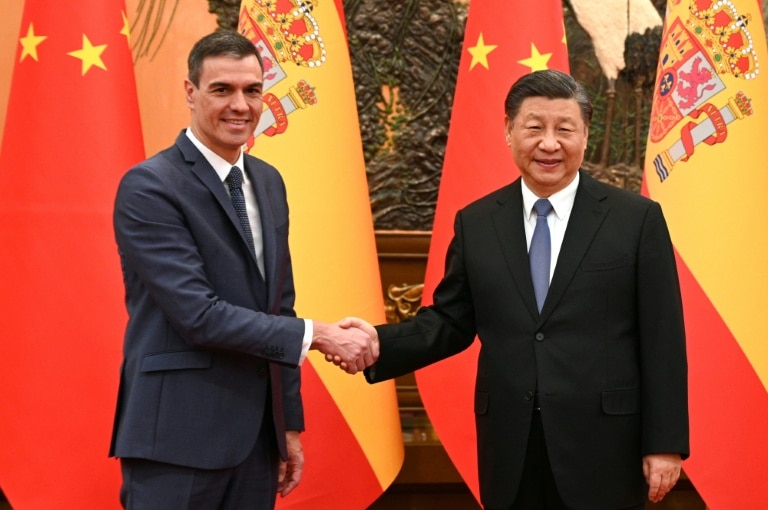
    President Xi Jinping participated in a crucial deliberation session on Thursday with deputies from Jiangsu province during the ongoing Fourth Session of the 14th National People’s Congress (NPC), China’s supreme legislative body. The engagement marks a significant moment in the annual parliamentary gathering that sets the nation’s policy direction.

    During the deliberation at the Great Hall of the People, President Xi, who also serves as General Secretary of the Communist Party of China Central Committee and Chairman of the Central Military Commission, listened attentively to representatives’ insights and contributed to discussions concerning regional development strategies. The Jiangsu delegation, representing one of China’s most economically dynamic provinces, presented reports on their implementation of national policies and regional development achievements.

    This participation underscores the leadership’s commitment to understanding grassroots realities and incorporating local perspectives into national policymaking. The deliberation focused on multiple dimensions of modernization, with particular emphasis on high-quality development models that balance economic growth with environmental sustainability.

    President Xi’s engagement with provincial delegations during NPC sessions has become a established practice that demonstrates the hierarchical yet interconnected nature of China’s governance structure. These interactions facilitate direct communication between central leadership and local implementers, ensuring policy coherence across administrative levels.

    The current NPC session, convened annually in Beijing, brings together nearly 3,000 deputies from across China to review government work reports, approve budget allocations, and deliberate on legislative matters that shape the nation’s developmental trajectory through the coming year.

  • Thousands of students rally after woman’s explicit images circulated

    Thousands of students rally after woman’s explicit images circulated

    A massive demonstration engulfed the campus of University College Dublin (UCD) as thousands of students mobilized in a powerful display of solidarity with victims of sexual violence. The protest was triggered by the malicious circulation of a sexually explicit image of a fellow student, which was disseminated to a vast network of university staff emails and a large student WhatsApp group.

    The university’s Students’ Union orchestrated the rally, condemning both the horrific act and what they perceive as UCD’s inadequate institutional response. Protestors marched across campus, voicing demands for the university to enact stronger measures against sexual violence and to provide more robust support systems for affected students.

    At the heart of the case is a student, pseudonymously identified as Caitlyn, who revealed she is the individual depicted in the circulated image. In a deeply personal account, Caitlyn disclosed that the image was taken without her knowledge or consent following an alleged rape three years ago, an incident she initially did not report to Irish police (Gardaí) for fear of not being believed.

    Her world shattered two years later when Gardaí informed her that the image had been anonymously sent to over 170 UCD staff email accounts from a ProtonMail account, an encrypted service that complicates tracing the sender. The emails contained abusive language, derogatory comments about her appearance, and suggestions that she should take her own life.

    The case escalated months later when the same image was redistributed to a WhatsApp group of 300 UCD students, including Caitlyn herself. This repeated violation has intensified criticism of the university’s handling of the situation, with the Students’ Union accusing UCD of a delayed and insufficiently strong condemnation.

    In response to mounting pressure, UCD issued statements emphasizing its full cooperation with the Gardaí in this ‘extremely distressing and complex’ case. The university outlined that it ‘acted immediately’ upon discovery, contacting authorities and attempting to delete the emails pre-emptively. It also implemented systems to block future emails from the specific accounts used in the attack.

    Further complicating the narrative, it was revealed that prior to these incidents, Caitlyn had engaged in a legal battle with UCD regarding her academic progression after missing exams, which she attributed to the trauma of the alleged rape. The High Court ultimately ruled in the university’s favor, noting UCD’s efforts to find a solution while affirming its autonomy in academic decisions.

    Despite the immense personal trauma and institutional challenges, Caitlyn remains resolute in her ambition to become a doctor. By speaking out, she aims to foster change and prevent similar atrocities from befalling others. UCD has reiterated an open invitation for her to meet with the Dean of Medicine to discuss her future options and has pledged to work closely with the Students’ Union, adopting a ‘victim-centred approach’ to combat image-based sexual abuse (IBSA) within its community.

  • Pentagon prepares for Israeli-US war on Iran that could last until September: Report

    Pentagon prepares for Israeli-US war on Iran that could last until September: Report

    The United States Department of Defense is accelerating efforts to bolster its intelligence capabilities as the nation braces for an extended military engagement with Iran, conducted in coordination with Israel. Current military strategizing now projects operations continuing deep into the autumn season, indicating a significant escalation beyond initial forecasts.

    According to a recent Politico report, U.S. Central Command has formally requested the Pentagon dispatch additional military intelligence officers to its Tampa, Florida headquarters. These personnel reinforcements are slated to support ongoing operations targeting Iran for a minimum duration of 100 days, with potential extensions through September.

    This deployment initiative represents the Trump administration’s first documented measure to augment intelligence assets for the conflict, strongly suggesting Washington anticipates a substantially prolonged campaign compared to initial public statements. President Donald Trump had previously suggested military actions might conclude within four to five weeks, while cautiously acknowledging the possibility of a longer engagement.

    The urgent mobilization of personnel and resources simultaneously reveals Washington’s apparent lack of preparedness for the scale of hostilities initiated alongside Israel. Military operations of this magnitude typically require months of advance planning, yet the current scramble within Pentagon corridors indicates officials gravely miscalculated the potential repercussions of striking Iran.

    Earlier reporting revealed senior Trump administration advisers preferred allowing Israel to initiate hostilities before commencing U.S. military actions. This sequence ultimately transpired, directly drawing Washington into active combat operations. Collaborative Israeli-U.S. attacks have resulted in significant casualties, with the Iranian Red Crescent Society reporting at least 700 fatalities and hundreds wounded, including over 165 children killed in a devastating elementary school strike.

    The conflict now threatens to define Trump’s presidential legacy while exacerbating fractures within his political base, where substantial opposition exists toward fighting another Middle Eastern war on Israel’s behalf. Secretary of State Marco Rubio openly acknowledged that Israeli actions compelled Washington’s involvement, stating administration officials anticipated Israeli operations would precipitate attacks against American forces.

    Israeli Prime Minister Benjamin Netanyahu publicly celebrated the second joint military campaign against Iran within twelve months, explicitly crediting President Trump and U.S. military support while framing the conflict as the realization of a four-decade personal objective.

  • Hegseth urges Latin American allies to go on offense against drug cartels

    Hegseth urges Latin American allies to go on offense against drug cartels

    MIAMI — U.S. Defense Secretary Pete Hegseth issued a stark warning to Latin American nations on Thursday, demanding more forceful measures against drug cartels that threaten regional security. Speaking at the inaugural Americas Counter Cartel Conference at U.S. Southern Command headquarters, Hegseth declared that Washington stands ready to take unilateral action if allied governments fail to adequately combat these criminal organizations.

    “America is prepared to take on these threats and go on the offense alone if necessary,” Hegseth told defense officials from more than a dozen conservative governments closely aligned with President Donald Trump, including Argentina, Honduras, and the Dominican Republic. The conference served as a precursor to a scheduled weekend summit between regional leaders and Trump at his Florida golf club.

    Hegseth framed the security challenge as a civilizational struggle, emphasizing the shared Christian heritage of the Americas that he claimed was endangered by decades of inadequate responses to organized crime. He explicitly rejected continuation of previous policies, stating “business as usual will not stand,” while pledging U.S. support to combat cartels and “make the Americas great again.”

    The defense secretary’s hardline position was reinforced by Deputy White House Chief of Staff Stephen Miller, who compared Western Hemisphere cartels to global terrorist organizations. “Cartels that operate in this hemisphere are the ISIS and al-Qaida of this hemisphere and must be treated just as ruthlessly,” Miller asserted, advocating for “hard power” and lethal force rather than criminal justice approaches.

    This conference occurs within the context of the Trump administration’s strategic reorientation toward Latin America, described in national security documents as the “Trump Corollary” to the 19th-century Monroe Doctrine. Since taking office in January 2025, Trump has designated Mexican and Venezuelan cartels as foreign terrorist organizations and declared the United States to be in “armed conflict” with these groups.

    The administration’s assertive stance has already translated into military action, including 44 naval strikes against suspected drug smugglers resulting in at least 150 deaths. A substantial naval deployment—the largest in Latin America since the Cold War—facilitated the January operation that captured Venezuela’s former president Nicolas Maduro, now facing drug charges in New York.

    While the approach has gained support from conservative regional leaders like El Salvador’s Nayib Bukele and recently enabled joint U.S.-Ecuador operations against criminal groups, experts caution about the risks of militarizing law enforcement in regions with historically weak institutions and problematic military legacies.

    Rebecca Bill Chavez, president of the Inter-American Dialogue and former deputy assistant defense secretary, warned: “Without strong rule-of-law institutions and civilian oversight, militarizing the fight against cartels can weaken the very institutions needed to defeat them.”

  • Panic in Beirut as Israel warns people to evacuate from the city’s southern suburbs

    Panic in Beirut as Israel warns people to evacuate from the city’s southern suburbs

    BEIRUT — Panic engulfed Lebanon’s capital Thursday as unprecedented traffic gridlock paralyzed the city following Israel’s military directive ordering the complete evacuation of all southern Beirut suburbs. The emergency warning advised residents to “save your lives and evacuate your homes immediately” through specified routes toward central Beirut and northern areas.

    This blanket evacuation order for the Dahiyeh district—a known Hezbollah stronghold—signals an anticipated major Israeli bombardment operation. While Israel had previously issued warnings for areas south of the Litani River, this marks the first comprehensive evacuation mandate for Beirut’s southern suburbs since hostilities reignited between Israel and Hezbollah.

    The escalation follows Monday’s missile and drone attacks by Hezbollah into Israel—the first such assault in over a year—which came in response to recent U.S. and Israeli strikes on Iran. Israeli retaliation has included sustained bombardment of southern Lebanon and Beirut’s outskirts.

    According to updated figures, the conflict has already claimed 102 lives and displaced over 83,000 Lebanese citizens prior to Thursday’s evacuation order. The directive prompted urgent diplomatic intervention, with Lebanese President Joseph Aoun urgently contacting French counterpart Emmanuel Macron seeking intervention to prevent widespread strikes.

    Macron issued a statement demanding immediate de-escalation, calling for Hezbollah to cease fire toward Israel while urging Israel to refrain from ground interventions or large-scale operations in Lebanese territory. The French president confirmed communications with U.S. President Donald Trump, Israeli Prime Minister Benjamin Netanyahu, and Lebanese leadership, while announcing Paris would send humanitarian aid to Lebanon.

    Residents expressed both fear and frustration while fleeing. “We don’t put anything past them (Israel), they will strike us no matter where we go,” said Hadi Kaakour, a Dahiyeh resident. Another evacuee, Yousef Nabulsi, lamented: “We got sucked into a mess that we have nothing to do with. People have been displaced and are now staying on the streets, and this is wrong.”

    UNIFIL peacekeepers confirmed the first ground combat observations west of Kfar Kila near the Israeli border, including weapon fire and aerial attacks. This development follows Israel’s Tuesday announcement of additional troops moving into southern Lebanon, where Israeli forces have maintained presence since the November 2024 ceasefire.

    The Lebanese army has withdrawn from border areas as Israeli troops advanced, while Hezbollah has published statements and video evidence of attacks on Israeli forces, including missile strikes against tanks. The Israeli army confirmed two soldiers wounded by anti-tank fire in Lebanon on Wednesday.

  • Irish economy grew strongly in 2025

    Irish economy grew strongly in 2025

    Ireland’s economy demonstrated remarkable resilience in 2025 with official data revealing nearly 5% growth in domestic economic activity. The measurement of modified domestic demand (MDD), which provides a more accurate picture of Ireland’s economic performance by excluding multinational corporate distortions, indicates robust expansion despite global economic challenges.

    Finance Minister Simon Harris highlighted that the figures confirm strong domestic growth despite external pressures. While acknowledging that headline growth figures might slightly overstate underlying economic strength, Harris emphasized two critical positive indicators: rising real incomes and record-breaking employment levels reaching unprecedented numbers.

    Ireland’s economic performance appears even more impressive when considering the context of potential trade disruptions. Initial concerns about significant impact from U.S. tariff policies have largely not materialized, primarily because pharmaceutical exports—Ireland’s main export to the American market—have generally remained exempt from these trade measures.

    The nation’s fiscal position has been further strengthened by sustained corporation tax revenues, creating a substantial financial buffer. This has enabled the establishment of a national wealth fund for long-term investment while simultaneously supporting increased government spending that contributes to economic growth.

    Looking forward, the government has committed to major infrastructure development, including Dublin’s inaugural underground railway system, signaling continued investment in the nation’s economic future.

    However, this strong macroeconomic performance contrasts with microeconomic challenges faced by many citizens. Despite overall economic prosperity, younger demographics particularly report not feeling the benefits due to persistently high housing costs. While the job market remains healthy, soaring rental expenses consume disproportionate portions of income for young workers. The government maintains that housing construction initiatives are progressing, though recent polling suggests many voters remain skeptical about these claims.

  • Meet Pedro Sánchez, Europe’s most vocal critic of Trump’s attacks on Iran

    Meet Pedro Sánchez, Europe’s most vocal critic of Trump’s attacks on Iran

    In a striking demonstration of diplomatic independence, Spanish Prime Minister Pedro Sánchez has positioned himself as Europe’s most persistent critic of U.S. President Donald Trump, triggering a heated exchange over military cooperation. The confrontation escalated when Trump threatened to sever all trade relations with Spain after Sánchez refused to permit American military operations against Iran from Spanish bases.

    The White House claimed Spain had received Trump’s message ‘loud and clear’ and was cooperating, but Spanish Foreign Minister directly contradicted this assertion, highlighting the deepening rift. Sánchez, while condemning Tehran’s repressive regime, stated unequivocally that Spain would not participate in what he deemed an unjustified military assault.

    ‘We refuse to be complicit in actions detrimental to global stability and contrary to our values merely from fear of retaliation,’ Sánchez declared, adopting the slogan ‘No to the war’ during a recent address.

    This military base dispute represents merely the latest chapter in broader ideological conflict between the two leaders. Since assuming power in 2018, Sánchez has championed progressive policies including feminism, authorized immigration, human rights, and climate action—all frequent targets of Trump’s MAGA movement and European far-right parties.

    The Spanish leader has distinguished himself through several contentious positions: becoming one of Israel’s most vocal critics regarding Gaza military operations, which he labeled ‘extermination of a defenseless people’; securing a NATO exemption that limits Spain’s defense spending to 2.1% of GDP instead of the proposed 5%; implementing migrant regularization programs for approximately 500,000 foreigners; and proposing social media restrictions for users under 16—a move that prompted Elon Musk to accuse Sánchez of ‘fascist totalitarianism.’

    Despite these contemporary tensions, the historical context reveals decades of stable, friendly Madrid-Washington relations dating back to U.S. military base agreements during Francisco Franco’s dictatorship.

  • Wary Europeans pledge ‘defensive’ military aid in Mideast war

    Wary Europeans pledge ‘defensive’ military aid in Mideast war

    European powers are cautiously escalating military deployments to the Eastern Mediterranean as the Israel-Iran conflict expands regionally, with multiple nations emphasizing strictly defensive postures while avoiding direct combat involvement. The collective response follows recent attacks on Cyprus and Western interests in the Gulf, creating a complex security challenge for EU members.

    Britain has dispatched HMS Dragon, a warship equipped with rapid-fire Sea Viper missile systems, alongside Wildcat helicopters carrying anti-drone Martlet missiles. This deployment complements four Typhoon fighter jets sent to Qatar, though Prime Minister Keir Starmer initially resisted US requests to utilize British bases for offensive operations, drawing criticism from former President Donald Trump.

    France has committed its nuclear-powered aircraft carrier Charles de Gaulle, carrying 20 Rafale fighter jets and advanced radar aircraft, to the region. Additional air defense units are being deployed to Cyprus, building on previous successful engagements by frigate Languedoc against Huthi rebel drones in the Red Sea. Paris has permitted US support aircraft to use Istres air base with strict guarantees against offensive operations.

    Greece has contributed two frigates and four F-16 fighter jets to Cyprus while allowing US access to its Souda Bay base in Crete. Italy plans to send naval assets alongside France, the Netherlands and Spain, plus anti-drone and missile defense systems to Gulf partners. Defense Minister Guido Crosetto emphasized that US aircraft using Italian bases would be limited to logistical support under existing agreements.

    Portugal authorized conditional use of its Lajes base in the Azores for defensive or retaliatory operations exclusively targeting military objectives. Spain, despite Prime Minister Pedro Sanchez’s vocal opposition to the conflict and refusal to permit US base access, will deploy its advanced frigate Cristobal Colon to provide aerial defense and potential civilian evacuation support around Cyprus.

    The coordinated but carefully constrained European response reflects balancing act between supporting allies and avoiding direct entry into the escalating Middle East conflict, with all participating nations explicitly characterizing their contributions as defensive measures.

  • China to accelerate push for tech self-reliance in new five-year plan: minister

    China to accelerate push for tech self-reliance in new five-year plan: minister

    China has declared an accelerated push toward technological self-reliance as a cornerstone of its national development strategy. Science and Technology Minister Yin Hejun outlined a comprehensive roadmap for the 2026-2030 period following the opening session of the National People’s Congress, positioning scientific innovation as critical to China’s transformation into a global technology leader.

    The strategic blueprint emphasizes original and pioneering research across the entire innovation chain. Minister Yin highlighted intensified focus on strengthening basic research infrastructure while advancing cutting-edge domains including artificial intelligence, quantum technology, biomanufacturing, and nuclear fusion. The approach marks a significant shift from conventional research conversion models toward integrated planning of technological and industrial innovation.

    Technological advancement is positioned as the driving force behind new quality productive forces and modernized industrial systems. The ministry plans to enhance coordination across China’s national innovation ecosystem, particularly leveraging three major international science hubs: Beijing-Tianjin-Hebei, Yangtze River Delta, and Guangdong-Hong Kong-Macao Greater Bay Area. These regions will serve as primary innovation sources, industry leadership centers, and talent attraction clusters.

    Substantial infrastructure development accompanies the strategy, including construction of major scientific facilities, establishment of world-class academic journals and databases, and reforms to science evaluation systems. While emphasizing domestic capability building, the plan also commits to international scientific cooperation through leadership in major global research initiatives.

    The commitment follows demonstrated progress in China’s innovation capacity. The nation climbed to 10th position in the global innovation index, with 2025 research investment exceeding 3.92 trillion yuan ($570 billion). A landmark achievement saw basic research funding reach 7.08% of total R&D expenditure, surpassing the 7% threshold for the first time. These investments have yielded breakthroughs in open-source large models, semiconductor chips, and pharmaceutical innovations.

  • Two more candidates nominated for next UN secretary-general

    Two more candidates nominated for next UN secretary-general

    The campaign for the next United Nations Secretary-General has gained significant momentum with the formal nomination of two additional high-profile candidates. Official documents published on the website of the UN General Assembly President confirmed the new entrants to what is becoming a competitive international leadership contest.

    Burundi, representing the African Union in its current chair capacity, has nominated Macky Sall, the former President of Senegal. Simultaneously, Costa Rica has presented Rebeca Grynspan, an accomplished economist and former Vice President of the Central American nation, as its candidate for the prestigious position.

    These nominations expand the field to four declared candidates seeking to succeed the current Secretary-General. The previously announced contenders include Michelle Bachelet, former President of Chile nominated jointly by Chile, Brazil and Mexico, and Rafael Grossi, the sitting Director General of the International Atomic Energy Agency, who received Argentina’s endorsement.

    In a significant development, UN General Assembly President Annalena Baerbock has circulated a detailed communication to member states outlining the procedural framework for candidate assessments. The interactive dialogues with aspiring candidates are scheduled for the week of April 20, 2026, according to the official correspondence.

    The evaluation process will be structured around the three foundational pillars of the United Nations: international peace and security, human rights protection, and sustainable development. Each candidate will present their strategic vision for the organization’s future direction, followed by an extensive question-and-answer session with representatives from member states.

    The presidential letter additionally established a firm nomination deadline, requiring all candidacies to be formally submitted before the interactive dialogues commence, with April 1, 2026 serving as the absolute cutoff for eligibility participation in the evaluation process.