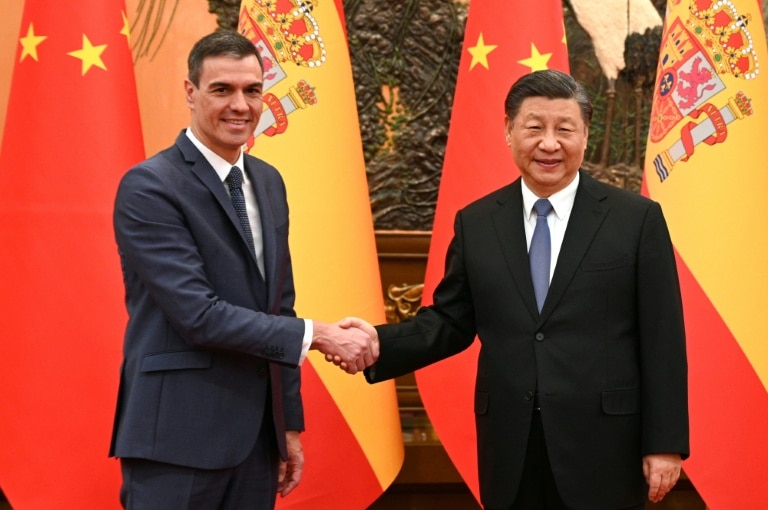
As geopolitical and trade tensions mount between Europe and the United States under the second Trump administration, Spanish Prime Minister Pedro Sanchez launched a high-stakes three-day official visit to China on Monday, with the explicit goal of deepening economic and diplomatic cooperation between Madrid and Beijing, and positioning Spain as a central connecting hub between China and the European bloc.
This trip marks Sanchez’s fourth visit to China in as many years, a frequency that underscores the Spanish government’s strategic priority of building stable, mutually beneficial relations with the world’s second-largest economy. The timing of the visit comes at a moment of growing friction between European allies and Washington, where Donald Trump’s aggressive tariff policies and erratic diplomatic approach have sparked widespread anxiety across the continent.
Tensions between Madrid and Washington escalated sharply last month, after Trump threatened to sever trade ties with Spain in retaliation for the Spanish government’s refusal to grant the U.S. military access to its bases for strikes against Iran—itself a major economic partner of China. This rift has further incentivized Spain to advance its independent diplomatic and trade agenda with Beijing, analysts say.
Sanchez is not the first Western leader to travel to Beijing in recent months: senior leaders from Britain, Canada, and Germany have already completed official visits this year, with Trump himself scheduled to travel to China for a summit in May.
According to senior Spanish government sources, the core priorities of Sanchez’s visit center on expanding market access for Spanish goods, boosting two-way investment, and opening new collaborative channels in emerging sectors. Specifically, Madrid is pushing for greater access to the Chinese market for its key agricultural and industrial exports, while exploring new joint technology partnerships with Chinese firms. Another key goal is attracting fresh Chinese foreign direct investment to Spain—the eurozone’s fourth-largest economy—and securing stable access to China’s supplies of critical raw materials that are essential to Spain’s industrial and energy transition.
On the first day of his trip, Sanchez traveled to the headquarters of Chinese consumer technology giant Xiaomi, before touring an innovation exhibition hosted by the Chinese Academy of Sciences. On Tuesday, he is scheduled to hold formal talks with China’s top leadership, including President Xi Jinping and Premier Li Qiang, before concluding his visit with a public press conference.
Bilateral trade between the two countries has expanded rapidly in recent years, but remains marked by a significant trade imbalance. Last year, Spain recorded a 42.3 billion euro ($49.1 billion) trade deficit with China, with Chinese exports to Spain far outpacing Spanish shipments to the Asian market. Even so, Spanish exports to China grew 6.8% in 2025, a gain that the Spanish government attributes to the steady deepening of bilateral ties. During Sanchez’s 2025 visit to Beijing, China agreed to open its market wider to a host of popular Spanish exports, including pork and cherries, a win that Madrid hopes to build on during this trip.
Claudio Feijoo, a leading China studies expert at the Technical University of Madrid, told Agence France-Presse that Spain holds unique strategic appeal for Chinese investors and policymakers. “Spain’s economy is growing faster than most other major European economies, and it maintains relatively low energy costs, which makes it an attractive base for Chinese companies looking to enter the European market,” Feijoo explained.
Beyond economic advantages, he noted that Beijing views Spain as a comparatively friendly, less confrontational partner in Europe, with a greater degree of policy independence from Washington than many other European allies. “China sees Spain as a more autonomous actor that can make its own decisions, which creates more space for mutually beneficial cooperation,” he said. “Spain is also perfectly positioned as a gateway to three key regions: Europe, Latin America, and North Africa. It can act as a central hub that gives Chinese companies access to multiple large markets from a single base.”
Feijoo added that Spanish agricultural products hold particularly strong growth potential in the Chinese market, as China cannot meet all of its own domestic demand for high-quality food products, while Spain is one of the world’s top producers of a wide range of premium agricultural goods.
Chinese Foreign Ministry spokesperson Mao Ning highlighted the positive trajectory of bilateral ties in a press briefing earlier this week, describing Spain as a “an important partner of China within the EU.” She added that Sanchez’s visit represents a key opportunity to “promote bilateral relations to an even higher level” for both sides.
The warming of relations between Madrid and Beijing has already been on display in recent months: last November, King Felipe VI and Queen Letizia completed a state visit to China, the first by a Spanish monarch in 18 years, a trip that widely was seen as a reflection of the growing closeness of ties between the two countries.
Sanchez, one of the few remaining left-wing heads of government in Europe, is traveling to China with his wife Begona Gomez and Foreign Minister Jose Manuel Albares.