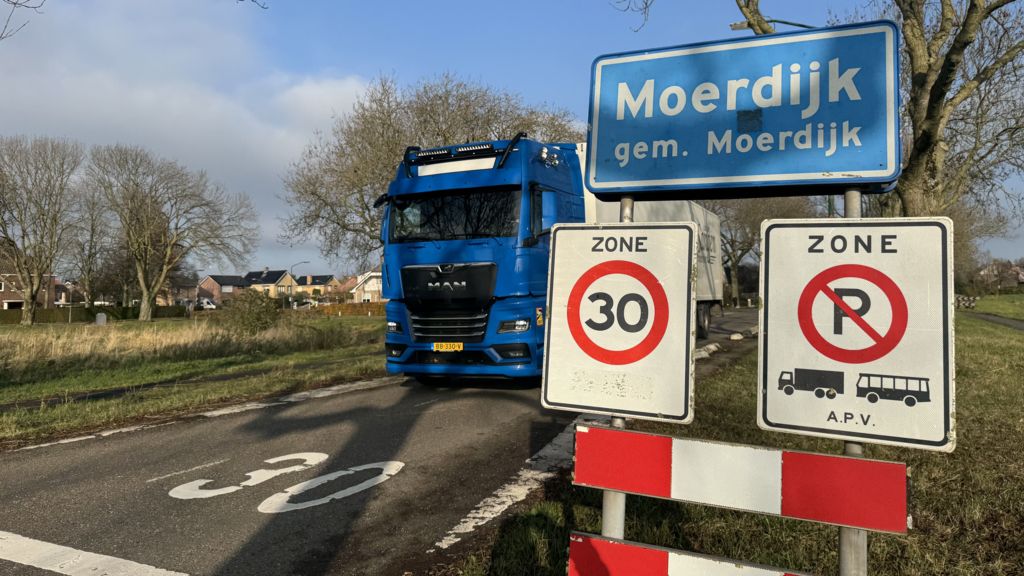
Tucked along the sun-dappled shores of the Hollands Diep estuary, 21 miles south of Rotterdam, Moerdijk has been a tight-knit fishing community for more than a century. Home to roughly 1,100 residents, generations of families have built their lives, livelihoods, and legacies here: third-generation fishmongers have trawled its waters since 1918, homeowners have built their houses with their own hands, and generations of ancestors rest in its quiet village cemetery. Today, however, this centuries-old settlement stands at the center of a national conflict that threatens to wipe it entirely off the map.
The Dutch government’s ambitious push to expand offshore wind energy has created an urgent need for large-scale high-voltage substations, facilities that connect power carried by undersea wind farm cables to the country’s national electricity grid. With the Netherlands being one of Europe’s most densely populated countries, available developable land is an extremely scarce resource. Government planners have identified Moerdijk as an ideal candidate for the site: its coastal position adjacent to existing ports, major motorways, and established power infrastructure aligns perfectly with the technical requirements of the substation project. If the plan moves forward, the entire village will be demolished within the next 10 years, its homes and community replaced by industrial energy infrastructure.
For residents who have rooted their lives in Moerdijk, the news has been devastating. Jaco Koman, a third-generation fishmonger whose family has operated in the village for more than a century, sees the proposal as an unnecessary sacrifice of a thriving community. His business, which supplies traditional smoked eel to high-end restaurants across the country, depends on the deep coastal waters and open land that drew planners to Moerdijk in the first place. “You go to bed with it and you wake up with it,” Koman said of the constant threat of displacement. While he does not oppose the country’s transition to clean energy, he argues that the burden of this transition should not fall on his community. “Why does our village have to disappear? We could connect these wind farms further out at sea, away from inhabited areas,” he asked.
The atmosphere of uncertainty hangs heavy over Moerdijk’s quiet streets. For-sale signs dot residential driveways, but few buyers are willing to invest in a community marked for demolition. Many residents have flown their flags at half-mast, a quiet act of mourning for a village that still stands, but is already considered lost by many who live here. For Andrea, owner of the local grocery store, the threat is deeply personal: her husband built the family home by hand, all three of her children were born within its walls, and her grandparents and in-laws are buried in the village cemetery. “I’m scared I’ll lose my house,” she said. “There’s so much life here. But in 10 years’ time it may be nothing.”
The conflict unfolding in Moerdijk is not an isolated incident; it lays bare a growing national dilemma across the Netherlands. For decades, the country has grappled with competing demands for its limited land: housing development, agricultural production, conservation, transportation networks, industrial development, and now the new infrastructure required to deliver large-scale renewable energy. The country’s existing electricity grid is already at maximum capacity, delaying new business and housing projects across the nation, while the government’s target to expand North Sea offshore wind will require massive new onshore infrastructure to bring that power to consumers.
Geerten Boogaard, a professor of local government at Leiden University, explained that the Moerdijk conflict exposes the core dynamics of Dutch governance. “In the end we are a centralist state,” Boogaard noted. When the national government labels a project a “vital national interest”, it holds the legal authority to push the project forward over local objections. While local councils can protest and residents can challenge the decision in court, the central government ultimately holds the power. Beyond the legal and planning issues, Boogaard frames the conflict as a larger clash of priorities: “It is a collision between two ways of life – that of a local, tightly knit community, and that of a country trying to transform its energy system in response to climate change, security concerns and pressure to phase out fossil fuels.”
For 71-year-old retired engineer Jacques, who built an eco-friendly home on the edge of Moerdijk in the 1990s, the transformation of the area has already been dramatic. When he moved in, the horizon was clear of industrial development; today, it overlooks one of Europe’s largest logistics hubs, and the constant rumble of passing trucks drowns out local birdsong. “This village will be demolished. That I know for sure,” he said.
The Dutch government has delayed a final decision on Moerdijk’s fate, but an announcement is expected later this year. Ministers declined to comment for this report. Aart Jan Moerkerke, mayor of the Moerdijk municipality, described the pressure on local leaders as immense. The central government is seeking roughly 450 hectares of land – an area equivalent to more than 700 full-size football pitches – to develop not just the substation, but also new hydrogen production facilities and major pipeline routes for transporting hydrogen and ammonia from the Port of Rotterdam to southeastern Netherlands.
In a painful compromise, the municipal council has already agreed in principle to accept the relocation of Moerdijk, choosing to sacrifice one small village to avoid major disruption and declining quality of life in four nearby settlements. The central government could still reverse course, opting instead to squeeze the new infrastructure around existing communities to save Moerdijk, but that alternative carries its own risks of wider disruption. The municipality is currently waiting for the national government to provide binding guarantees on compensation, relocation timelines, and development conditions before moving forward with any formal agreement. For Moerkerke, telling the residents of Moerdijk that their homes and community could be gone within a decade was “the hardest decision of my career”.
What is at stake in Moerdijk extends far beyond the future of this single small village. The decision will serve as a critical test of how nations balance the urgent need for green energy transition against the rights and lives of small local communities that stand in the way of that progress. For the 1,100 residents of Moerdijk, that abstract policy dilemma is a daily reality. For now, they live in limbo, never knowing whether the village they call home will exist in 10 years, or whether it will live on only as a memory and a line on an old map.