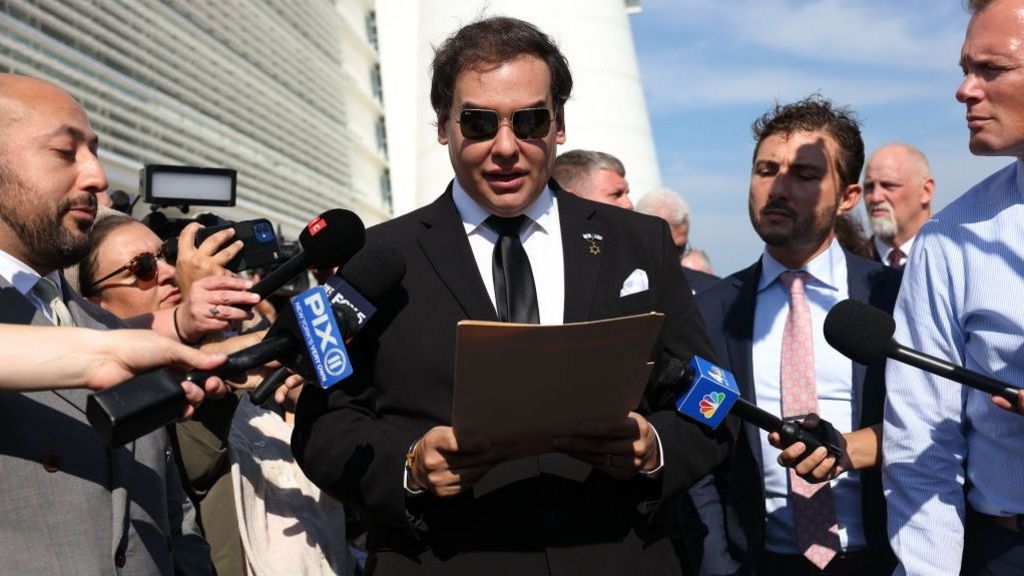
A viral moment captured on camera during the 2010s NBA Finals showed former US President Donald Trump being met with loud boos from the crowd inside the arena as the national anthem played. The incident drew immediate attention from political observers, sports fans, and media outlets across the country, quickly spreading across social media platforms. Video footage of the reaction clearly captured the widespread negative sentiment from attendees toward the sitting president at the time. Despite what multiple witnesses and shared footage confirmed, Trump later pushed back on the narrative, claiming the crowd’s reaction was actually “mostly cheers”. In his brief comments following the event, he also characterized the overall in-arena atmosphere as boisterous and highly energetic, framing the crowd’s energy as a positive sign of enthusiasm surrounding the championship series. The clash between the recorded public reaction and Trump’s post-event description sparked widespread debate about political polarization in public spaces, particularly at high-profile national sporting events that draw tens of millions of viewers across the country. Many analysts noted that the moment underscored how deeply divided American public opinion was at the time, even in settings that traditionally bring diverse audiences together around shared athletic competition.
作者: admin
-

Does referee case show Fifa has lost control of its own World Cup?
As the 2026 FIFA World Cup, co-hosted by the United States, prepares to kick off in 48 hours, a high-profile immigration incident has thrown the tournament into fresh controversy, raising urgent questions about U.S. border policy, FIFA’s leadership, and the politicization of global football.
Omar Artan, Somalia’s top-ranked international referee and one of 52 officials selected to officiate at this year’s tournament, arrived in Miami last week to join final pre-tournament preparations. Despite holding all required documentation, a valid visa, and a formal invitation from FIFA, Artan endured an 11-hour interrogation by U.S. Customs and Border Protection officials, was detained for several additional hours, and was ultimately forcibly placed on a return flight out of the country. He is now back in Mogadishu, denied the chance to make history as the first Somali referee to work at a men’s senior World Cup.
Artan’s resume, which earned him the coveted World Cup appointment, speaks to his standing as one of the game’s elite officials. Over the past 18 months, he has officiated high-profile matches including the 2025 African Champions League final – the first Somali to ever lead a continental championship final – three matches at the 2025 U-20 World Cup in Chile (including the tournament’s third-place playoff), and multiple group stage matches at back-to-back Africa Cup of Nations tournaments in 2024 and 2025. Speaking before his travel, Artan called his World Cup selection the pinnacle of his career, saying “Every referee’s ambition is to go to the World Cup. When you are selected, you feel that all your hard work was worth it. Years of effort finally made sense.”
The incident has validated long-held fears that U.S. immigration policy under the Trump administration would create discriminatory barriers for visitors from majority-Muslim and African nations ahead of the tournament. Piara Powar, executive director of anti-discrimination football advocacy group Fare, called Artan’s rejection an unprecedented farce. “It is pretty clear that the fears of an ideological and discriminatory visa policy from the US government is being realised,” Powar said. “Never have we seen the farce of an official Fifa referee being refused entry as he arrives for final preparations.”
Artan’s exclusion comes as no surprise to observers tracking the Trump administration’s tightening travel restrictions. In 2017, one of Trump’s first executive orders implemented a travel ban on foreign nationals from seven majority-Muslim nations, including Somalia. That ban was expanded in June 2025 to a full entry ban across all visa categories for 12 countries, which includes not just Somalia, but three World Cup participating nations: DR Congo, Iran, and Haiti. Just weeks before the tournament draw in December 2025, Trump made inflammatory remarks about Somali people, claiming the country “barely exists” and calling Somali immigrants “garbage” that should “go back to where they came from.”
The incident has also exposed a glaring contradiction in FIFA President Gianni Infantino’s approach to host nation compliance. When Indonesia’s Bali governor refused entry to the Israeli men’s U-20 national team ahead of the 2023 U-20 World Cup, FIFA stripped the country of hosting rights entirely, arguing that “any team, including the supporters and officials of that team, who qualify for a World Cup, need to have the access to the country, otherwise there is no World Cup.” That same policy is not being applied to the U.S., despite multiple entry denials for World Cup participants and officials.
Infantino has cultivated a close political relationship with Trump over the past two years, culminating in the controversial decision to award Trump the first-ever FIFA Peace Prize during the 2026 World Cup draw in December. Critics say this alliance has left FIFA unwilling to push back against U.S. policy, even as it disrupts the core functioning of the tournament. When asked about Artan’s case, FIFA issued a neutral statement saying it “is not involved in host country immigration processes, including visa adjudications.” That response has drawn outrage from football figures, including former England and Arsenal striker Ian Wright, who wrote on Instagram: “Every few hours it’s another story, another story about fans denied, players denied, officials denied, journalists denied, now refs. This is a World Cup of chaos.”
This controversy is just the latest in a string of problems plaguing the build-up to the 2026 tournament, which was billed as a return to normalcy after the politically fraught 2018 World Cup in Russia and 2022 in Qatar. Issues including exorbitant ticket prices, a legal subpoena into FIFA’s ticket sales practices, widespread criticism of overpriced hotel accommodations and transport, and repeated entry denials for fans and officials have left the tournament facing more controversy than its two predecessors.
Beyond Artan’s case, broader concerns persist that U.S. Immigration and Customs Enforcement (ICE) will conduct enforcement operations at or near tournament stadiums, chilling travel for international fans with uncertain immigration status. Fan groups have repeatedly criticized the U.S. for creating unnecessary barriers to entry, a sharp break from past host nation practices that prioritized easy access for traveling fans. Russia eliminated all visa requirements for 2018 World Cup visitors, relying instead on a simple fan ID system tied to match tickets. Qatar used a similar pre-screened Hayya card system that doubled as an entry permit and match access. In contrast, U.S. policy has left many international fans too frustrated to proceed with travel plans. “You’re supposed to be welcoming fans from around the world,” Thomas Concannon, leader of the FSA’s England supporters group, told BBC Sport earlier this year. “And I think at this stage, fans couldn’t feel less welcome.”
The next major test of U.S. policy will come this weekend, when the Iranian national team is scheduled to travel to the U.S. for its first group stage match. Iranian officials have already confirmed that U.S. authorities have denied visas to 16 key backroom staff members, and have only permitted the playing squad to enter the country via cross-border travel from Tijuana, Mexico, with a requirement to depart within 24 hours of each match. U.S. authorities have also revoked all pre-allocated group stage tickets for Iranian fans, a decision that has drawn widespread condemnation. This marks the first time in World Cup history that the host nation is actively engaged in military conflict with a participating nation, after the U.S. joined Israel in large-scale military strikes on Iran earlier this year.
As the tournament prepares to kick off, Powar says Artan’s case raises a fundamental question about who is actually in charge of the 2026 World Cup. “Never have we seen so many World Cup coaches, team operations, fans and even senior administrators within Fifa member associations, subject to so much interrogation and exclusion,” he said. “The disruption is such that one has to ask who is running the World Cup. Is it Fifa or is it the US government with its racially charged immigration policies?” Right now, with one of FIFA’s selected referees barred from entering the country, the answer seems clear: U.S. immigration policy is calling the shots.
-

Nasa names next astronauts for Artemis Moon programme
NASA has officially introduced the four-person crew for its long-awaited Artemis III mission, a mission whose scope has shifted dramatically from its original groundbreaking goal in the face of unexpected technical and infrastructure setbacks across its commercial partner network. Originally pitched as humanity’s first crewed lunar landing since NASA’s Apollo 17 mission in 1972, the 2027 flight was meant to see two astronauts touch down near the Moon’s permanently shadowed south pole to conduct a week of surface research.
In a major course correction announced in February this year, however, NASA redefined Artemis III as a low-Earth orbit test flight, operating only marginally farther from Earth than the International Space Station. Its new core objective will be to complete docking maneuvers with prototype lunar landers, a key procedural test that agency leaders say is critical before attempting a full landing attempt. Despite the scaled-back orbital profile, NASA Administrator Jared Isaacman framed the mission as a historic engineering challenge, noting that it will demand unprecedented coordination between government teams and private spaceflight stakeholders for a series of heavy-lift rocket launches.
The agency has now named the full core crew: veteran NASA astronaut Randy Bresnik will command the mission, while Italian Space Agency astronaut Luca Parmitano, who has accumulated more than 300 days of on-orbit experience across previous missions, will serve as pilot. Rounding out the core team are mission specialists Andre Douglas and Frank Rubio, both American astronauts. Experienced test pilot Bob Heintz, who has 170 days of spaceflight time under his belt, will act as backup, ready to step into any role on the crew if needed.
The major reshaping of Artemis III traces back to unresolvable delays in the development of SpaceX’s Starship, the craft selected to ferry astronauts from lunar orbit down to the Moon’s surface. A March 2026 report from the U.S. Government Accountability Office found that SpaceX had only made limited progress in maturing two critical, untested technologies: in-orbit refueling and cryogenic propellant storage. Starship’s massive size means it cannot reach lunar orbit without being refueled in low-Earth orbit first, a process that requires multiple sequential fuel tanker launches to transfer super-cold liquid methane and liquid oxygen to the crew vehicle – a complex maneuver that has never been successfully demonstrated in space. Agency officials also concluded that jumping straight from Artemis II’s upcoming lunar flyby to a full landing would carry too much risk, making an Earth-orbit docking test a necessary intermediate step.
Worsening the program’s timeline pressures, the Artemis program suffered a second major setback in late May when a catastrophic explosion destroyed Blue Origin’s New Glenn rocket during a routine hot-fire engine test. The blast left the launch pad extensively damaged, and no personnel were injured in the incident. Unlike SpaceX, which had alternate launch infrastructure after a 2016 explosion that kept it out of service for 15 months, Blue Origin has no backup pad for New Glenn launches, leaving the company facing months of potential downtime.
The damage has already created ripple effects across the entire Artemis schedule: the Blue Moon cargo lander, planned for a possible launch to the Moon as early as fall 2026, is now at high risk of missing its launch window. The crewed Blue Moon lander planned for Artemis IV faces major timeline uncertainty, and even the two prototype landers Artemis III is supposed to test are now facing scheduling questions.
In NASA’s most optimistic current projection, Artemis III will launch in 2027 as an orbital demonstration, followed by Artemis IV’s targeted lunar landing in early 2028, and Artemis V – which will carry out a second landing and begin construction of a lunar outpost – later that same year. While Blue Origin vice president John Couluris says the company and NASA are working around the clock to get back on track for a 2027 launch, most independent space analysts view that timeline as extremely aggressive.
Growing geopolitical competition adds extra urgency to NASA’s timeline: China has publicly targeted a 2030 crewed lunar landing, and a December 2025 executive order from former President Trump required NASA to return astronauts to the Moon by 2028 – the end of his current presidential term – and have initial base infrastructure in place by 2030. Many experts warn that the deck is stacked against NASA meeting its current goals. “It would not surprise me at all if China gets there first,” Dr. Simeon Barber, a lunar scientist at the Open University, told BBC News.
With untested refueling technology for Starship still undemonstrated and a key commercial partner left without a working launch pad, NASA’s path to a lunar landing now depends on a long chain of entirely unproven procedures all going exactly according to plan, leaving the agency with very little margin for error. Following the May explosion, Isaacman reaffirmed NASA’s commitment to supporting Blue Origin’s recovery efforts, but the critical open question remains: how long will recovery take, and can the already tight Artemis timeline absorb the delay?
-

Nasa has named the Artemis III crew – what is their mission?
Fifty-four years after the final Apollo 17 mission marked the last time humans walked on the lunar surface, NASA has announced the four-person crew for its upcoming Artemis III mission, a repurposed mission that represents a critical stepping stone to the first modern crewed lunar landing, currently scheduled for 2028.
Originally planned to make history as the first crewed lunar landing since the Apollo era, NASA revised the Artemis III mission framework in February 2026 after critical delays to the SpaceX Starship lunar lander, the vehicle contracted to carry astronauts down to the lunar surface. Development of the Starship has proceeded slower than expected, and the in-orbit refueling technology the lander depends on has never been successfully demonstrated. A March 2026 report from the US Government Accountability Office confirmed that SpaceX has only made “limited progress” on maturing this refueling technology, with the first demonstration test currently optimistically targeted for late 2026.
Rather than pushing the entire Artemis program timeline back further, agency leaders chose to reframe Artemis III as a full-scale crewed rehearsal that will validate key technologies and procedures ahead of the actual landing. Scheduled for launch no earlier than 2027 from NASA’s Kennedy Space Center in Florida aboard the agency’s heavy-lift Space Launch System (SLS) rocket, the mission will carry four astronauts inside the same Orion capsule that successfully completed the groundbreaking Artemis II lunar flyby in April 2026.
Unlike Artemis II, which saw the first humans travel beyond low Earth orbit since 1972 on a 10-day loop around the Moon, Artemis III will keep Orion in low Earth orbit at an altitude of roughly 290 miles – 40 miles higher than the International Space Station, equal to the distance between the British cities of Manchester and Edinburgh. There, the capsule will rendezvous and dock with prototype pathfinder lunar landers, allowing crew to test critical operational procedures. At least one crew member will enter the lander to verify hatch operations, life-support system connections, and test the new Axiom spacesuits that will be used for lunar surface extravehicular activity during subsequent landing missions.
These next-generation suits represent an unusual collaboration between aerospace and high fashion: Houston-based Axiom Space handled core engineering, adding a groundbreaking first-of-its-kind backup cooling loop to prevent overheating during 8-hour lunar surface spacewalks, while iconic Italian luxury brand Prada designed the inner garment that distributes chilled water evenly across an astronaut’s body.
The Artemis III crew will spend slightly more than nine days in orbit, one day longer than the Artemis II mission, before returning to Earth. Their re-entry will provide an opportunity to test an upgraded heat shield on Orion, collecting valuable performance data ahead of future deep space missions.
Following the successful completion of the Artemis III rehearsal, NASA plans to proceed with the Artemis IV mission in 2028, which will now be the first modern crewed lunar landing. That mission will see astronauts descend to the Moon’s south polar region, where permanently shadowed craters hold frozen water deposits that could one day be processed into drinking water, breathable oxygen, and rocket fuel to support long-term exploration. A second landing mission, Artemis V, is scheduled for late 2028, and will use a second lunar lander, Blue Origin’s Blue Moon Mk2, developed by Jeff Bezos’ private aerospace firm.
The overarching goal of the entire Artemis program is to establish a long-term human outpost on the Moon, outlined by NASA administrator Jared Isaacman in the May 2026 NASA Moon Base initiative. The three-phase plan calls for robotic survey missions and scientific instrument deliveries to the south pole before 2029, repeated crewed missions to expand the outpost starting in 2029, and semi-permanent habitats that support extended astronaut stays by the mid-2030s. A operational lunar base would enable continuous scientific research, test technologies for future crewed missions to Mars, allow for commercial lunar resource extraction, and help maintain U.S. leadership in the 21st century space race.
However, many space industry experts and analysts question whether NASA’s ambitious timeline can actually be met, even with the schedule adjustment. Beyond the ongoing delays to SpaceX’s Starship, the program suffered a major setback in May 2026 when Blue Origin’s only Cape Canaveral launch pad was heavily damaged by an explosion during a New Glenn rocket engine test. Unlike SpaceX, which has multiple launch pads across the United States, Blue Origin has no backup facility. Historical precedent from SpaceX’s 2016 launch pad loss suggests rebuilding will take at least 15 months, putting the delivery of the Blue Moon Mk2 lander for Artemis V in serious doubt.
“It would not surprise me at all if China gets [to the moon] first,” Dr. Simeon Barber of the Open University told the BBC, noting that lunar landers are the most technically complex component of any crewed landing mission, and development is largely out of NASA’s direct control.
The successful Artemis II mission earlier this year proved that NASA’s core Orion and SLS hardware works with a crew on board, but that has turned out to be the least challenging step of the modern lunar exploration effort. After Apollo 17 wrapped up in December 1972, public interest and political support for lunar exploration faded, along with federal funding, leaving the Moon unvisited by humans for more than half a century. Today, the United States is not the only nation pursuing crewed lunar landings: China has publicly targeted a 2030 landing, has already tested its Mengzhou capsule and Lanyue lander, and is developing the Long March 10 heavy-lift rocket. India, which successfully landed its uncrewed Chandrayaan-3 mission near the lunar south pole in 2023, has targeted a 2040 crew landing. Russia is partnering with China on a joint mid-2030s lunar base project, but sanctions, funding gaps, and technical challenges have put its contribution in question. While European and Japanese astronauts are expected to join future Artemis missions, there is currently no contractual guarantee of a seat for international partners on Artemis III.
-

UK: Study shows Gaza a major reason for collapse in support for Labour
A newly released opinion study has uncovered a major political shift unfolding across the United Kingdom, rooted in widespread voter anger over the conflict in Gaza. The data confirms that more than 50 percent of former Labour Party voters who plan to back another centre or left-wing party in the next national general election point to Israel’s military campaign in Gaza as a key factor driving their decision to abandon Keir Starmer’s party.
Commissioned jointly by the Palestine Solidarity Campaign (PSC) and Friends of the Earth, and carried out by leading UK pollster Opinium, the findings underscore how the Gaza crisis and the UK government’s ongoing alignment with Israel continue to reshape the country’s political landscape, contradicting a common narrative that public outrage over the conflict is limited to a small, sectarian, or Muslim-only base of opposition.
The poll analyzed voting patterns from last month’s UK local elections, tracking how voters who supported Labour in the 2024 general election shifted their support in these local contests. Data shows that 40.7 percent of these defecting voters switched their allegiance to the left-wing Green Party, which saw historic gains across the country in last month’s ballots. Another 29.6 percent moved to the centrist Liberal Democrats, 11.1 percent backed the right-wing Reform UK, and 9.3 percent switched to the governing Conservative Party.
Among all ex-Labour voters who shifted to other centre and left-wing parties, 53 percent confirmed that the current UK Labour government’s support for Israel was an influencing factor in their decision to switch. Broken down, 21 percent said the issue influenced their choice “a great deal,” while an additional 31 percent said it impacted their vote “somewhat.”
The poll also highlighted clear generational divides in voter sentiment over the Gaza conflict. Two-thirds of voters aged 18 to 34 who left Labour cited Gaza as a motivating factor, compared to 54 percent of voters aged 35 to 49, 49 percent of 50 to 64-year-olds, and 43 percent of voters aged 65 and older. The strongest correlation between Gaza discontent and defection, though, was seen among voters who switched to the Green Party: two-thirds of these new Green voters said the Labour Party’s stance on Gaza pushed them to switch their support. For context, just 32 percent of ex-Labour voters who moved to the Liberal Democrats cited Gaza as a factor, compared to 44 percent of those who switched to the Scottish National Party, Plaid Cymru, or independent centre-left candidates.
Led by Zack Polanski, the Green Party recorded dramatic gains in last month’s local elections, a surge that pollster Sir John Curtice noted came primarily at Labour’s expense. Curtice observed that the Greens inflicted far deeper damage on Labour’s vote share than right-wing challenger Reform UK in these contests.
Further data from the election breakdown shows that candidates who signed PSC’s “Pledge for Palestine” — a commitment to advance Palestinian rights if elected — won 27 percent of the seats they contested, outperforming Labour candidates who won just 22 percent of seats they contested. Reform UK candidates won 30 percent of the seats they contested, while Liberal Democrat candidates took 21 percent, just one point behind Labour.
This reporting comes from Middle East Eye, an outlet that provides independent, in-depth coverage of the Middle East, North Africa, and global affairs connected to the region.
-

Trump says Iran shot down US helicopter and vows to respond
In a sharp escalation of tensions between Washington and Tehran, former President Donald Trump has publicly blamed Iran for shooting down a U.S. Army AH-64 Apache attack helicopter operating near the Strait of Hormuz, pledging a U.S. military response would follow out of what he called “national necessity.”
Both crew members on board the downed aircraft survived the incident and were pulled from regional waters unharmed in a rescue operation led by an uncrewed American surface drone, senior U.S. military officials confirmed to the BBC. U.S. Central Command (Centcom), the U.S. military’s regional command overseeing operations across the Middle East, released a formal statement Tuesday confirming the pair of soldiers had been safely extracted roughly two hours after the helicopter went down off the coast of Oman during a routine maritime patrol.
“There were two pilots involved, both are safe and uninjured,” Trump wrote in a post Tuesday to his Truth Social platform. “Nevertheless, the United States must, of necessity, respond to this attack.”
The downing marks the first complete loss of a U.S. Apache helicopter since open conflict between the U.S. and Iran began, and it comes at a critical diplomatic juncture: just days prior, Trump stated that Washington was in “the final throes” of negotiating a new deal with Tehran to end the ongoing regional standoff.
Centcom’s official account of the incident confirmed the timeline, noting the rescue was completed at 19:33 EDT (23:33 GMT) Monday, with the operation led by U.S. Naval Forces Central Command and the 82nd Airborne Division, backed by additional support from U.S. Air Force, U.S. Navy, and 5th Fleet Task Force 59 units. A Centcom spokesperson later clarified that the actual recovery of the two crew members was carried out by an unmanned surface drone operated by Task Force 59, a Bahrain-based special unit launched in 2024 that specializes in integrating unmanned systems with human operators to strengthen maritime security across the Middle East.
Minutes ahead of Trump’s public statement on the incident, Iran’s top nuclear and diplomatic negotiator Mohammad Baqer Qalibaf posted a stark warning on his own social media channel, signaling Tehran’s rejection of any Western diplomatic coercion. “We prefer the language of diplomacy, but we speak other languages far more fluently,” Qalibaf wrote. “Break your commitments, and we’ll switch to what we speak best. You ride the horse you saddled!”
As of Tuesday, the White House has not released any details on what form a U.S. response to the incident could take, leaving regional allies and global markets bracing for further escalation in one of the world’s most critical energy transit chokepoints.
-

UK, France and other Western nations issue new sanctions on Israeli settlers in the West Bank
In a coordinated diplomatic move that amplifies international pressure on Israel over mounting settler violence against Palestinian communities in the occupied West Bank, a coalition of six Western nations announced new joint targeted sanctions against extremist settlers, pro-settlement organizations, and a senior hard-line Israeli cabinet minister on Tuesday. The joint declaration was released by top foreign policy officials from Australia, the United Kingdom, Canada, France, Norway, and New Zealand, marking a significant escalation of global pushback against Israel’s policies in the occupied territory.
In their joint statement, the group of diplomats highlighted a long-standing pattern of abuse that has gone unchecked by Israeli authorities. “Extremist violent settlers, with the backing of their supporters, continue to attack Palestinians and abuse their human rights,” the statement read. “For too long, violent settlers have been able to act with near impunity, and settlement expansion and creation of outposts continue with the support and facilitation of the government of Israel.”
For the past four years, Israel’s hard-right ruling coalition, which is heavily influenced and led by settler movement leaders and their political allies, has overseen a dramatic surge in new settlement construction across the West Bank. Parallel to this expansion, the territory has seen a sharp rise in violent attacks by settlers against Palestinian residents and their property, with very few perpetrators facing legal consequences. The overwhelming majority of the international community has long maintained that all Israeli settlement construction in the West Bank violates international law, and frames it as one of the core obstacles to a lasting two-state solution to the Israeli-Palestinian conflict.
These new coordinated sanctions come as European nations face growing public and political criticism of Israel’s military campaign in Gaza and its ongoing land policies in the West Bank. Unlike the sweeping, economy-wide sanctions imposed on states such as Iran and Russia, the new measures remain narrowly targeted, leaving broad bilateral trade including military arms transactions completely unaffected. Each participating nation implemented its own specific set of restrictions under the coordinated framework.
As part of its contribution to the sanctions, France has issued an entry ban against Israeli Finance Minister Bezalel Smotrich, a far-right religious party leader who has spearheaded the government’s aggressive settlement expansion agenda. French Foreign Minister Jean-Noël Barrot confirmed the ban in a social media post, noting it targets individuals “those responsible for the intensification of settlement activity and violence in the West Bank.”
Smotrich, who recently ordered the eviction of a long-established Palestinian hamlet in the West Bank, openly framed the eviction as a retaliatory response to unconfirmed reports that he could face an arrest warrant from the International Criminal Court (ICC) based in The Hague over alleged war crimes. The ICC does not publicly confirm the existence of pending arrest warrants or investigation requests.
Barrot outlined that Smotrich, in his role overseeing Israeli settlement policy, is “actively promoting” the unilateral annexation of the West Bank, further expansion of Israeli settlements, the re-establishment of Israeli settlements in Gaza, and economic policies designed to force the collapse of the Palestinian Authority. “These are policies that the overwhelming majority of the international community cannot accept,” Barrot added. Beyond the entry ban on Smotrich, France has also barred four leaders of pro-settlement extremist groups and 21 individual settlers accused of perpetrating violence against Palestinians from entering French territory.
The United Kingdom also joined the action, with Foreign Secretary Yvette Cooper telling the House of Commons that the U.K. was imposing sanctions on six entities and multiple individuals linked to settlement financing and settler violence. “We have targeted some of the most notorious individuals, the most significant settler entities, and the extremist figures in the Israeli cabinet who are inciting these acts,” Cooper said.
Israeli officials have pushed back fiercely against the new measures. Israel’s Foreign Ministry described the sanctions as “disgraceful measures” that “only serve to fuel that antisemitism.” Ahead of the official announcement, Israel’s Ambassador to France Joshua Zarka told The Associated Press that the sanctions would ultimately backfire. “Sanctioning government entities or government-connected entities is not helping in any way. On the contrary, it is actually helping those extremists,” Zarka said.
The six-nation action follows new sanctions implemented recently by the 27-member European Union, which targeted both Hamas leaders and Israeli settler organizations and their leadership. Today, more than 700,000 Israeli residents live in settlements across the occupied West Bank and East Jerusalem, territories Israel captured from Jordan in the 1967 Six-Day War that Palestinians claim as the core of their future independent state.
This report included contributions from multiple Associated Press journalists across Brussels, London, Paris, The Hague, and Ramallah.
-

FDA OKs first new sunscreen ingredient in more than 25 years
After a decades-long wait, U.S. consumers are finally set to gain access to an advanced sunscreen active ingredient that has been widely used across Europe and much of the world for years. On Tuesday, U.S. Food and Drug Administration (FDA) federal health regulators officially approved bemotrizinol for the American market, marking the first addition of a new sunscreen ingredient to the approved U.S. list in more than 25 years.
In an official public statement, the FDA confirmed that bemotrizinol meets all the agency’s strict safety and efficacy requirements for ultraviolet (UV) radiation protection. Testing data shows the chemical provides robust protection from dangerous UV rays, causes minimal skin irritation, and has very low absorption into human skin. The agency also cleared the ingredient for use on all populations, including adults and children six months of age and older.
Initially, the Dutch manufacturer DSM Nutritional Products will distribute bemotrizinol to U.S. sunscreen brands under the registered brand name Parsol Shield, with a full commercial launch planned for later this year. Per FDA regulations, DSM will hold an 18-month exclusivity period for the newly approved ingredient, after which other cosmetic and pharmaceutical manufacturers will be permitted to incorporate bemotrizinol into their own sunscreen products.
For decades, the process to update the FDA’s list of safe over-the-counter (nonprescription) sunscreen ingredients has been stalled by long-standing bureaucratic bottlenecks. This approval marks the first time a new sunscreen ingredient has been reviewed and cleared through the streamlined approval pathway authorized by federal Congress in 2020, a change designed to cut through years of regulatory backlog.
Public health and industry experts note that bemotrizinol fills a critical gap in the current U.S. sunscreen market. Unlike existing options, the new ingredient provides built-in broad-spectrum protection against both UVA and UVB rays on its own — a benefit that current chemical sunscreen ingredients cannot match, as existing single ingredients only block one type of UV radiation, requiring brands to blend multiple chemical components to achieve full broad-spectrum protection.
It also solves a common consumer complaint about mineral-based sunscreens, which use active ingredients like zinc oxide to block both UVA and UVB rays but often leave an unsightly chalky white residue on the skin. Bemotrizinol does not leave this characteristic white streaking, making it a more aesthetically appealing option for many consumers.
“For decades, Americans have relied on outdated sunscreen technology while the rest of the world adopted newer, more effective options,” said David Andrews, a senior scientist with the Environmental Working Group (EWG), a non-profit advocacy organization that has spent years pushing the FDA to update its sunscreen regulations and open the market to new ingredients. “The approval of bemotrizinol will help change that disparity for American consumers.”
FDA regulations currently require all commercially sold sunscreens marketed for daily use to provide protection against both forms of harmful UV radiation: UVB rays, which are the primary cause of sunburn and contribute to skin cancer development, and UVA rays, which penetrate deeper into the skin and are the leading cause of premature wrinkles and the highest risk of invasive skin cancer.
First authorized for commercial use by European regulatory authorities all the way back in 1999, bemotrizinol was first submitted to the FDA for regulatory review in 2005, meaning it took 18 years to navigate the agency’s prior outdated approval process to reach final approval.
“The FDA is committed to ensuring the American consumer has access to the most effective and safe therapies, including over-the-counter products like sunscreens,” said Dr. Mike Davis, acting director of the FDA’s Center for Drug Evaluation and Research, in a statement accompanying the approval.
The approval of bemotrizinol is part of the agency’s gradual, ongoing process to update U.S. sunscreen safety and efficacy standards. In 2011, the agency implemented a landmark update that banned misleading marketing terms such as “waterproof,” which regulators found overstated product performance, and mandated that all commercially sold sunscreens provide protection against both UVA and UVB rays — a requirement that did not exist before, when many products only blocked UVB radiation. In 2021, the FDA proposed a further round of updates, including capping maximum labeled SPF numbers and enforcing stricter minimum UVA protection requirements, but those rule changes are still pending finalization.
This reporting from The Associated Press Health and Science Department is supported by the Howard Hughes Medical Institute’s Science and Educational Media Group and the Robert Wood Johnson Foundation; the AP retains full editorial control over all content.
-

Peru’s presidential runoff shows a razor-thin gap between candidates
LIMA, Peru — Nearly three days after Peru held its tightly contested presidential runoff election on Sunday, the race between the two remaining candidates has shrunk to a margin of fewer than 20,000 votes, with 96% of all ballots now processed by national electoral authorities. As it stands, the South American nation is set to swear in its ninth head of state in just a decade when the winner takes office.
Official electoral data released Tuesday puts nationalist congressman Roberto Sánchez at 50.055% of the total valid vote, while his conservative challenger Keiko Fujimori trails narrowly at 49.945%. To date, electoral workers have counted more than 17.8 million ballots across the country and from overseas polling locations.
The runoff marks the final stage of a months-long electoral process that began with an initial 35-candidate field in April’s general election. Both Sánchez and Fujimori advanced to the second round, but neither candidate managed to break the 20% support threshold in the first round of voting. It took electoral officials more than four weeks to officially confirm the two candidates’ advancement to the runoff, amid delays in processing results.
Peru’s top electoral official Roberto Burneo has confirmed that the final official result of Sunday’s runoff will not be announced for up to 30 days. Burneo has issued a public call for both voters and affiliated political groups to uphold democratic responsibility amid the ongoing counting process.
The extended timeline for finalizing results stems from two key structural factors laid out in Peruvian electoral law. First, national rules require every individual ballot and polling station vote tally sheet to be transported to one of more than 100 regional processing offices for manual verification. Second, all ballots and tallies from citizens voting abroad must be shipped back to the capital Lima for counting, with overseas polling locations spread across 63 different countries.
Voting is a legal requirement for all Peruvian citizens between the ages of 18 and 70, with non-participation carrying a maximum fine of $32. In total, more than 27 million Peruvians are registered to vote in the election, with roughly 1.2 million of those registered voters residing outside the country, the majority based in the United States and Argentina.
For most voters heading to the polls on Sunday, the top issue driving their decision was the country’s rapidly surging violent crime, particularly a sharp rise in extortion cases across the nation. Political analysts and security experts broadly link the growing influence of organized criminal groups in Peru to expanding profits from unregulated illegal gold mining operations across the Andes mountain range and Amazon basin.
Once the final result is confirmed, the winning candidate will be inaugurated for a full five-year presidential term on July 28. Notably, neither candidate entered the runoff with broad popular support, as both are closely tied to controversial former Peruvian presidents whose legacies remain divisive among the electorate.
Fujimori is the daughter of late former president Alberto Fujimori, whose 1990s administration was marked by authoritarian rule and widespread proven corruption. After her parents separated in 1994, she served as Peru’s official first lady during the remainder of her father’s term. On the other side of the race, Sánchez is one of the closest political allies of imprisoned former president Pedro Castillo, who was removed from office over corruption allegations and widespread perceptions of mismanagement. Castillo’s 16-month tenure saw unprecedented political instability, with more than 70 changes to his presidential cabinet.
-

‘Gridlock alert days’ and a race for tickets as US prepares to host World Cup
After more than three decades since the United States last welcomed the FIFA World Cup, the world’s most-watched sporting spectacle is returning to North American soil this summer, co-hosted jointly by the US, Canada and Mexico. As the kickoff draws near, organizers and local communities are navigating a range of pre-tournament challenges, from lingering geopolitical tensions and widespread frustration over strict visa rules to sticker shock from record-high ticket prices. At the top of many minds remains one pressing question: is the United States truly prepared to shoulder the pressure of co-hosting an event of this unprecedented scale?