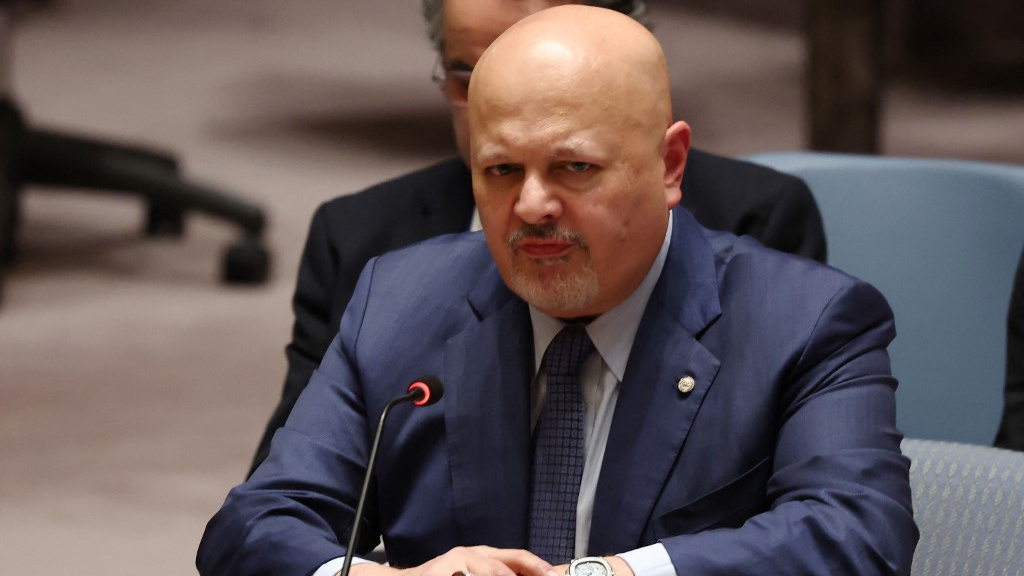
The International Criminal Court (ICC), the world’s only permanent tribunal prosecuting genocide, war crimes, and crimes against humanity, has entered an unprecedented period of crisis and uncertainty, after its governing body voted to suspend its chief prosecutor Karim Khan in a move critics decry as politically motivated, unlawful, and a threat to the court’s core integrity.
Khan, a seasoned British barrister and former United Nations official elected as the ICC’s third chief prosecutor in 2021, has been at the center of escalating global pressure since his office moved forward with long-awaited arrest warrants for Israeli Prime Minister Benjamin Netanyahu and former defense minister Yoav Gallant over alleged war crimes in the occupied Palestinian territories. The investigation into Palestinian war crimes was launched months before Khan took office by his predecessor Fatou Bensouda, who faced years of covert pressure, threats, and surveillance from Israeli intelligence agency Mossad in an unsuccessful bid to shut the probe down. That surveillance and pressure extended directly to Khan after he took office.
Months after Khan formally applied for the Netanyahu-Gallant arrest warrants in May 2024, which the court issued that November, a former staff member brought sexual misconduct allegations against the prosecutor, which Khan has vehemently denied from the start. Following two stalled internal investigations, the Bureau of the Assembly of State Parties (ASP) – the ICC’s executive governing body – commissioned an independent external investigation through the United Nations Office of Internal Oversight Services (OIOS). The ASP then appointed a panel of independent judges to review the OIOS findings, which in March 2025 delivered a unanimous ruling clearing Khan of any wrongdoing, concluding no evidence of misconduct or breach of duty had been established.
In a highly unconventional move that broke with the court’s own established procedures, a majority of the 21-member ASP Bureau voted Monday to disregard the independent judicial panel’s findings and move forward with Khan’s suspension. Even Ben Swanson, the former assistant secretary-general of OIOS who oversaw the investigation, submitted evidence to the ASP confirming that neither the final report nor underlying evidence met the standard of proof required to support a finding of misconduct. Khan’s legal team has called the suspension “unlawful, procedurally unfair and unsupported by evidence,” and has pledged to challenge the decision through all available legal channels.
The suspension comes amid years of escalating public and covert pressure on Khan from major world powers opposed to the ICC’s Palestinian war crimes investigation. In an explosive interview with Middle East Eye last month, Khan detailed the extraordinary intimidation he has faced: U.S. Senator Lindsey Graham explicitly threatened sanctions if he moved forward with the warrants, while then-British Foreign Secretary David Cameron warned the UK would withdraw from the court and cut its funding (the UK is one of the ICC’s largest contributors) if the warrants were issued. Shortly after Donald Trump returned to the U.S. presidency in January 2025, the U.S. imposed sweeping sanctions on Khan, later expanding sanctions to include two of his deputy prosecutors, eight ICC judges, the U.N. Special Rapporteur on Palestine, and multiple Palestinian NGOs that provided evidence for the investigation. Russia also sanctioned Khan after he issued an arrest warrant for Russian President Vladimir Putin over the 2022 invasion of Ukraine.
Khan has repeatedly argued that the misconduct allegations are a baseless, biased campaign to oust him over his commitment to pursuing the Palestinian war crimes investigation. He warned last month that the push to remove him has pushed the ICC into uncharted, dangerous territory, creating a precedent that allows political pressure to remove independently elected court officials on flimsy, unfounded grounds.
“ If a process can be suborned, if it can be subverted, if it can be undermined, because state appointees and diplomats, for whatever reason, think they know better, then this is a template for getting rid of any elected official, now or in the future, on spurious or flimsy or fabricated or unfounded grounds,” Khan told MEE.
Critics within the ICC membership have echoed these warnings. Norwegian Deputy Foreign Minister Andreas Kravik, speaking to MEE last week, emphasized that the ASP Bureau is bound to respect the court’s own established procedures for handling misconduct claims. “Otherwise, there will be at least a perception of politicisation of the process. And that would hurt the integrity of the court,” Kravik said. “That’s something that we cannot afford, especially in this time when the court is under real pressure by other states and where certain states are trying, at the best of their ability, to portray the court as a politicised entity not operating in conformity with core principles of international law.”
Khan has been on formal leave for over a year, and his removal will now go to a full vote of all 125 ICC member states at a special ASP session the Bureau has pledged to convene shortly. Under ASP rules, a two-thirds majority of voting member states must first uphold the Bureau’s finding of serious misconduct, followed by a second vote requiring an absolute majority of at least 63 votes to remove Khan from office permanently.
If the full ASP votes to remove Khan, the prosecutor has confirmed he will appeal the decision to the International Labour Organization Administrative Tribunal (ILOAT), the independent body that handles employment disputes for ICC staff. A former International Court of Justice judge, Abdul Koroma, issued a legal opinion last month warning that the ILOAT could order Khan’s reinstatement and order the ICC to pay up to €1.5 million in damages if his removal is found unlawful.
In a statement following the suspension vote, the ASP Bureau defended its action, noting its assessment drew on the OIOS report, underlying evidence, judicial advice, and written submissions, and added that all materials would remain confidential to protect the privacy and rights of all parties involved.
Today, both Khan’s future as chief prosecutor and the long-term integrity and legitimacy of the International Criminal Court hang in the balance, as the institution faces an unprecedented test of its ability to resist political pressure from major global powers and uphold its mandate to deliver impartial international justice.