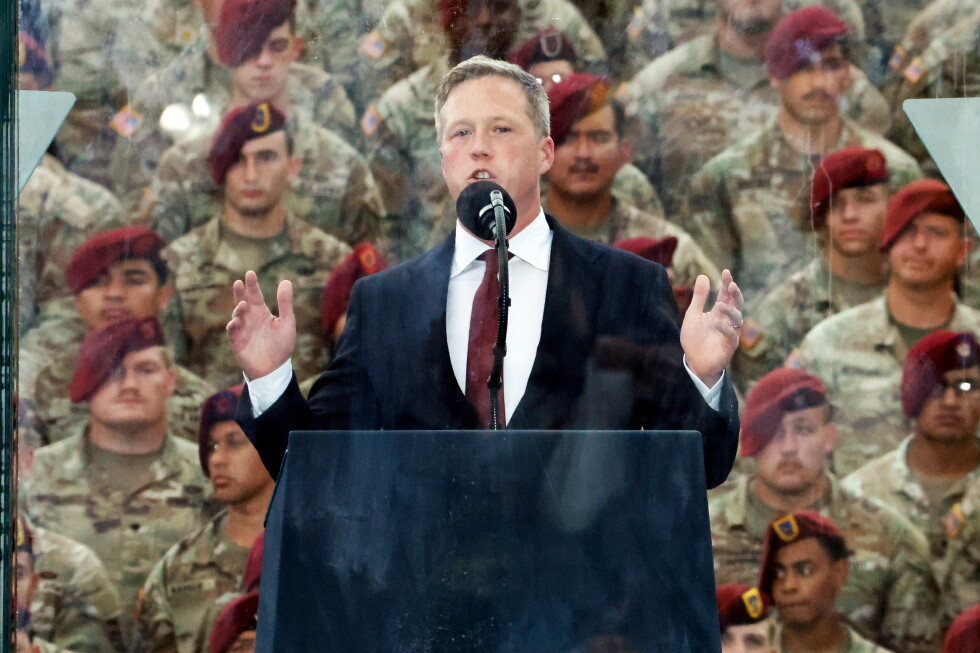
The White House announced Monday that United States Army Secretary Dan Driscoll will step down from his post, marking the latest high-profile departure from top military leadership during President Donald Trump’s second administration. No official explanation has been provided for Driscoll’s exit, though widespread reporting has pointed to long-simmering tensions between Driscoll and Defense Secretary Pete Hegseth. The resignation deepens a pattern of dramatic turnover across senior military ranks, with the U.S. Army experiencing the most extreme upheaval in recent months.
In an official statement, White House press spokeswoman Anna Kelly praised Driscoll’s tenure, framing his work as critical to advancing Trump’s “Make America Strong Again” policy agenda. “Secretary Driscoll has been highly effective in advancing President Trump’s agenda… by providing outstanding leadership during historic military operations, restoring an emphasis on readiness and lethality, assisting with negotiations between Russia and Ukraine, and more,” Kelly said. She added that the U.S. Army “is more powerful than ever thanks to his work alongside the Commander-in-Chief and Secretary of War.”
An anonymous senior U.S. Army official, granted anonymity because they were not cleared to speak publicly on the personnel matter, confirmed that Driscoll discussed the current state of Army operations with Trump before formally submitting his resignation. The official declined to share further details about the conversation or the resignation. The Pentagon directed all media inquiries about the departure to the U.S. Army. News of Driscoll’s resignation was first reported earlier Monday by *The Wall Street Journal*.
Driscoll’s exit is part of a string of sudden leadership changes at the Army that stretch back months. In April, Hegseth unexpectedly removed Gen. Randy George, the service’s top uniformed leader, from his post. Just two months later, Gen. Christopher Donahue, commander of U.S. Army forces in Europe and Africa, stepped down unexpectedly. Gen. Christopher LaNeve, whose rapid ascent through the leadership ranks has been closely tied to Hegseth, was appointed to replace George as acting Army chief of staff.
Under LaNeve’s leadership, the Army has already canceled a key drone modernization initiative that Driscoll had championed. As first reported by Army officials in August, LaNeve ordered an Army unit based in Europe that had been developing custom in-house drones to abandon the project and revert to its original role as a traditional infantry battalion. Driscoll was a public ally of George, and openly lamented his ouster alongside lawmakers from both major U.S. political parties. During an April congressional hearing, Driscoll told legislators that he and his family traveled to George’s home immediately after his resignation, saying “we all gave him a hug.” Even so, Driscoll acknowledged the authority of civilian leadership over the military, noting: “That being said, the civilian leadership, the design of our system, is that they get to pick the leaders that they want.”
A decorated Iraq War veteran, tech investor, and long-time associate of Vice President JD Vance — whom he met while attending Yale Law School — Driscoll was tapped by Trump for the Army Secretary role in 2024. At the time of his nomination, Trump described Driscoll as “a disruptor and change agent” who would bring much-needed change to the service. Beyond his core administrative duties, Driscoll was given the unusual high-profile assignment of serving as a key negotiator in diplomatic efforts to end the ongoing war between Russia and Ukraine. He was also a leading advocate for cutting bureaucratic red tape to allow defense contractors to accelerate development of new drone and counter-drone technologies, a priority as global warfare evolves rapidly. The U.S. Senate confirmed Driscoll to the post in February 2025 by a vote of 66-28, after a largely non-confrontational Armed Services Committee hearing focused on Army modernization, recruiting reform, and strengthening the domestic defense industrial base.
Driscoll comes from a multi-generational Army family, noting during his confirmation process that both his father and grandfather served in the service, and he vowed to center his tenure on addressing the needs of frontline soldiers. His official Army biography notes he served as an armor officer from August 2007 to March 2011, with a combat deployment to Iraq from October 2009 to July 2010. Outside of military and national security work, Driscoll mounted an unsuccessful bid for the Republican nomination for a North Carolina congressional seat in 2020, earning roughly 8% of the vote in a crowded primary field.
Driscoll’s departure is not an isolated event: it follows a broader purge of senior uniformed and civilian leadership carried out by Hegseth across the U.S. armed forces, which has already seen the ouster of multiple generals, admirals, and service secretaries. In April, the Pentagon made the sudden announcement that Navy Secretary John Phelan would step down, making Phelan the first head of a U.S. military service to leave office during Trump’s second term.