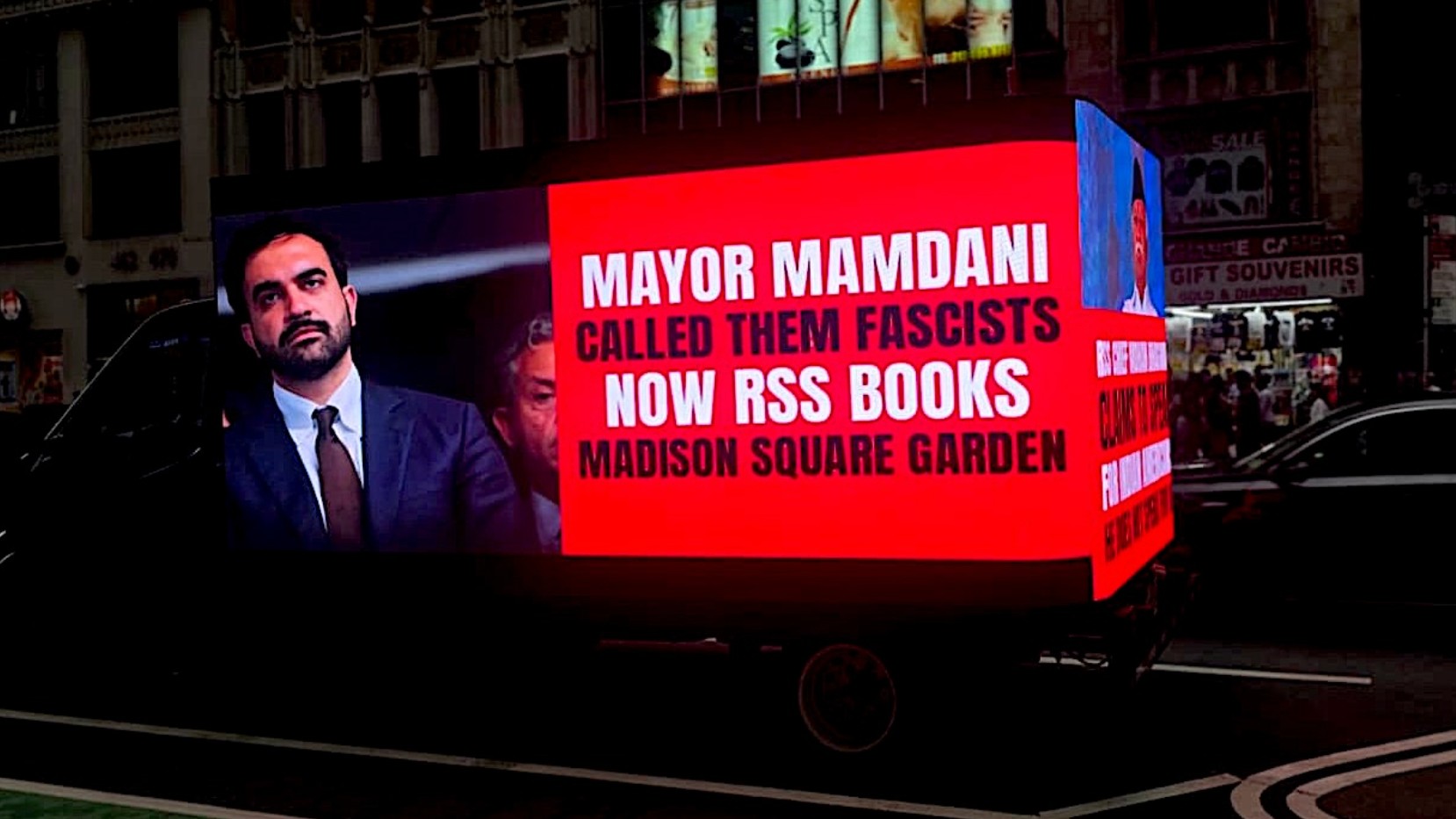
A coalition of human rights organizers and community leaders is escalating pressure on New York City Mayor Zohran Mamdani to scrap a high-profile weekend event at Madison Square Garden headlined by Mohan Bhagwat, the leader of India’s far-right Hindu nationalist paramilitary organization Rashtriya Swayamsevak Sangh (RSS).
Protesters are set to gather outside New York’s City Hall on Tuesday to call for the event’s cancellation and to draw public attention to the RSS’s expanding ideological footprint across the United States. In a formal statement ahead of the rally, Sravya Tadepalli, deputy executive director of the advocacy group Hindus for Human Rights, emphasized that Bhagwat does not speak for the global Hindu community. Tadepalli framed the RSS as an extremist movement that has systematically incited violence, systemic exclusion, and collective fear against India’s religious minority groups.
“New York should not provide the RSS with a platform to rebrand religious nationalism as a message of unity,” Tadepalli said. “We will gather at City Hall to defend a genuinely pluralistic vision of an India where no faith is used to determine who belongs or who holds power.”
Tuesday’s demonstration builds on an open letter signed by dozens of human rights organizations, community groups, and two prominent New York local officials: Comptroller Brad Lander and City Council member Shahana Hanif. Notably, two Indian-American New York elected officials — state assembly member Steven Raga and City Council member Shekar Krishnan — have declined to add their signatures to the demand. Middle East Eye attempted to reach out to Mayor Mamdani, Raga, and Krishnan for comment on the controversy, but received no response before publication.
Founded in 1925 in Nagpur, India, by Hindu nationalist ideologue Keshav Baliram Hedgewar, the RSS is widely recognized as the ideological foundation of the global Hindutva movement, which advocates for a Hindu supremacist political order in India. The ruling Bharatiya Janata Party (BJP), led by Indian Prime Minister Narendra Modi, is widely documented as the political wing of the RSS. From its earliest years, the organization maintained ideological ties to 20th-century European fascist movements, and its founding thinkers also expressed open alignment with the Zionist movement in Palestine. Scholars draw parallels between Hindutva and Zionism, noting both frameworks seek to establish a state structured around the political and cultural dominance of a single religious community.
Edward Anderson, an academic specializing in Hindu nationalism and the Indian diaspora, told Middle East Eye that while hosting the RSS leader at a major New York venue like Madison Square Garden may seem unexpected, the organization has actively cultivated support among diaspora communities across the globe since India gained independence. Anderson explained that the choice of high-profile venue serves two key strategic purposes for the movement. First, it aligns with the RSS’s public narrative of growing power and national pride, projecting an image of success to both domestic and international audiences. Second, footage and images from the event can be circulated back to audiences in India to reinforce the movement’s global standing.
This is not the first time a top figure linked to the RSS-BJP ecosystem has headlined a major event at Madison Square Garden: just months after his first election as prime minister in 2014, Modi drew a crowd of roughly 18,000 adoring supporters to the arena, where he laid out his vision for a “India of your dreams.” The Los Angeles Times famously described the atmosphere as a “rock-star reception” for the new prime minister. Anderson noted that Bhagwat’s upcoming event fits into a broader deliberate strategy by the RSS to boost its international legitimacy, counter widespread international criticism that frames the group as a paramilitary anti-minority movement.
Since Modi took office in 2014, documented hate crimes against religious minority communities in India have surged sharply. Muslim communities have been targeted in public lynchings by Hindu vigilantes over unsubstantiated claims of cow slaughter or beef consumption, and prominent Hindu religious leaders have repeatedly publicly called for the mass murder of Muslims, rarely facing legal or social consequences. Systemic exclusion has also infiltrated India’s electoral system, where Muslim voters are disproportionately removed from official voter rolls. In recent years, hate crimes against India’s small Christian minority have also risen dramatically.
Mayor Mamdani has a well-documented public record of criticizing the rise of Hindu nationalism in India, most recently in public comments in 2024. Four months before he took office as mayor, Mamdani co-signed a letter calling for the removal of a Hindu nationalist float from New York’s annual India Day parade. The float depicted a Hindu temple constructed on the site of the demolished 16th-century Babri Mosque in Ayodhya, a project that has become a core symbol of Hindutva political ambition. At the time, then-state assembly member Mamdani told media outlet Maktoob Media: “For the BJP and associated Hindu nationalist groups, India’s Muslim population isn’t only an obstacle to their political goals, it is anathema to their definition of the nation.”
Despite this past criticism, Mamdani has faced prior scrutiny from progressive activists who argue that many of his high-profile public stances — including his positions on the Israeli-Palestinian conflict — amount to symbolic political positioning rather than actionable policy change.