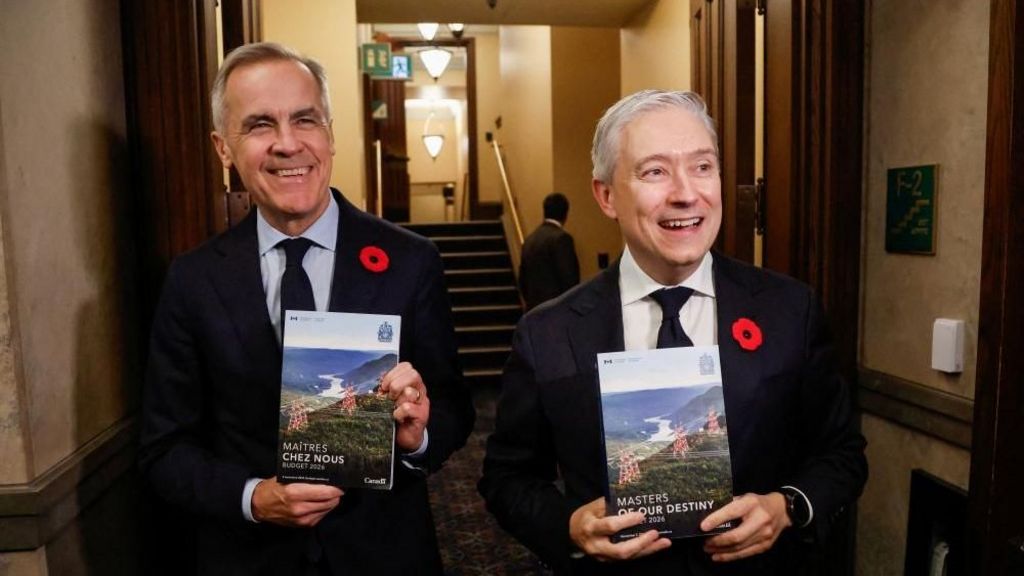
Delivered on a Thursday, Prime Minister Mark Carney’s second federal budget, titled *Masters of Our Destiny*, deploys an unprecedented C$142 billion in new spending over the next five years, fuelled by surging oil revenues amplified by ongoing geopolitical tensions tied to the Iran War. The administration has structured the fiscal blueprint around three core pillars: advancing national economic and strategic sovereignty, mitigating Canada’s persistent cost-of-living crisis, and shielding domestic industries from punitive trade tariffs imposed by the administration of U.S. President Donald Trump.
Speaking at the budget launch, Carney framed the document as a landmark milestone in his government’s long-term policy roadmap: “That’s what this budget does: it’s the next big step in our action plan to make this country more independent, more sovereign. It focuses on growth, on people and that sovereignty, so we can live our lives as we wish.”
While the federal deficit currently sits above C$50 billion, with no formal timeline set for a return to a balanced budget, fiscal projections retain the government’s previously stated medium-term fiscal guardrails. Economic forecasts project modest GDP growth in the coming 12 months, outpacing every G7 economy except the United States, and the national unemployment rate, while fluctuating month-to-month, remains lower than 2024’s full-year average. These positive indicators, however, stand in sharp contrast to the lived financial strain many Canadian households continue to face: Statistics Canada data confirms average hourly wages have failed to keep pace with persistent inflation, food bank usage across the country has hit all-time highs, and housing markets in major hubs including Toronto and Vancouver remain deeply unaffordable for most low- and middle-income families, even after a 22% drop in average national home prices driven by recent immigration curbs.
Affordability measures form a central plank of the new budget. A landmark C$11.2 billion, four-year investment targets national homelessness, with dedicated allocations for supportive housing units, expanded mental health services, and enhanced addictions treatment programming. The move comes after 2024 Statistics Canada research found one in eight Canadian households have experienced some form of homelessness over their lifetime. The government is also expanding its targeted grocery benefit for low- and modest-income households, a policy that will deliver an estimated C$2,570 in annual support for a family of four.
On the contentious issue of immigration, the Carney administration is opting to maintain current population targets rather than bow to competing pressure from opposing camps: the opposition Conservative Party has demanded further cuts to newcomer arrivals, while a September 2025 Royal Bank of Canada report warned that without sustained immigration, Canada’s population could shrink to half its current size by the turn of the century. The government will keep permanent resident admissions capped at 380,000 per year through 2028, while gradually reducing temporary resident arrivals to 370,000, retaining existing caps on international student and temporary foreign worker intakes that were introduced to cool overheated housing markets.
To offset the economic damage of U.S. tariffs that have triggered thousands of job losses and suppressed domestic business investment, the budget allocates C$6.5 billion in targeted relief for Canada’s hard-hit forestry sector, bringing total federal support for tariff-impacted workers and industries since March 2025 to nearly C$44 billion. The British Columbia Council of Forest Industries welcomed the allocation in a public statement, noting the support “comes at a critical time for workers” across the province’s timber communities. The budget builds on 2024 policy moves to cut the marginal effective corporate tax rate and fund new export market development for Canadian firms, as policymakers work to reduce the country’s historic overreliance on U.S. trade partners. As budget documents acknowledge, “diversification will take time, given the scale and depth of Canada’s economic relationship with the United States. But the shift is underway.”
The sovereignty theme extends beyond trade and economic policy to a series of ambitious nation-building investments. Canada, currently the only G7 nation without domestic rocket launch capabilities, will receive C$2.7 billion in funding to develop homegrown space technology and local launch infrastructure. New cultural investments include a full tax exemption on income generated from original creative artistic works, plus C$32.2 million over four years to launch a free national digital library that will debut with at least 200 curated titles before expanding its catalogue in subsequent years.
The budget also lays out concrete allocations to advance Carney’s previously pledged commitment to hit NATO’s 5% of GDP defence spending target by 2035. A national marketplace for Canadian-made drones, launched earlier this year, will receive a C$2.3 billion cash injection over five years, and additional funding is earmarked to expand support for Operation Reassurance, Canada’s largest active overseas deployment mission tasked with deterring Russian aggression across Eastern Europe.
The official opposition Conservatives have repeatedly attacked the Liberal administration over its handling of cost-of-living pressures, accusing Carney of devoting too much time to international trade missions and too little attention to the day-to-day “kitchen table” financial struggles of ordinary Canadians, setting the stage for fierce parliamentary debate over the new fiscal plan in the months ahead.
Canada’s federal budget includes billions for sovereignty and tackling homelessness