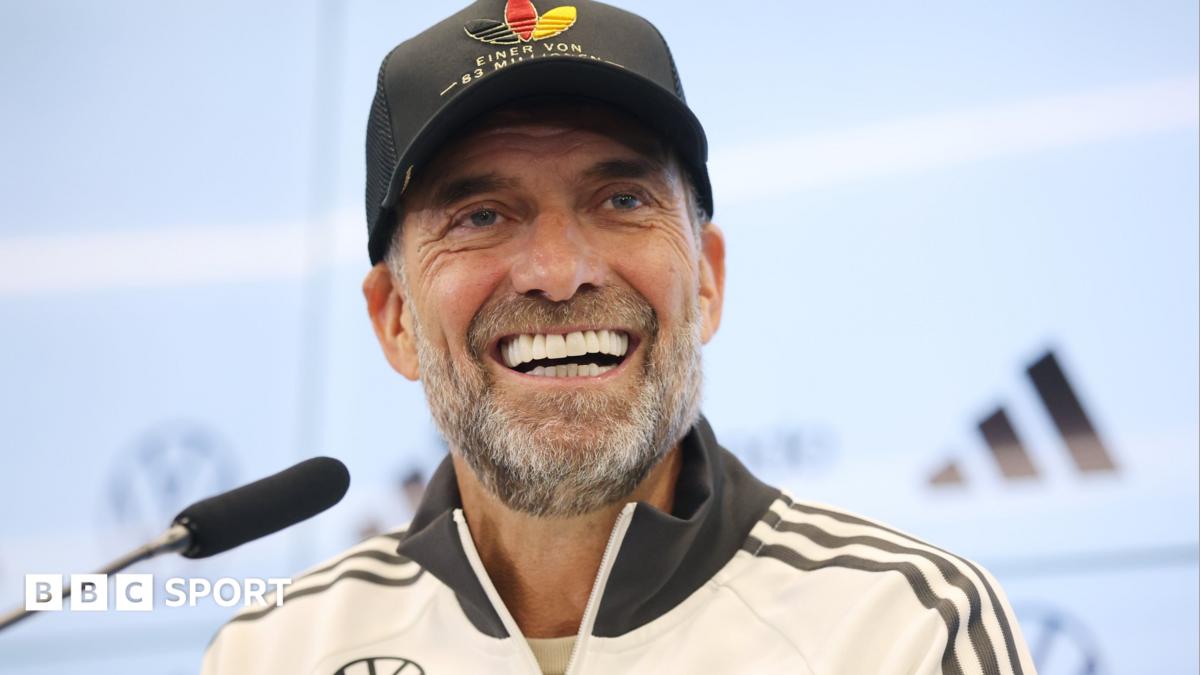
It has only been two months since Jurgen Klopp was formally unveiled as the new head coach of the German men’s national football team, and already his tenure has been defined by headline-making moves both on and off the training pitch. From confronting rising political tensions in the country to shaking up the national squad selection process, the charismatic 59-year-old has wasted no time leaving his mark on German football.
In his very first public address after taking the job, Klopp set clear boundaries with the press, calling for fair coverage and protection for his family. Most recently, amid growing political upheaval driven by electoral gains for the far-right, anti-immigration Alternative for Germany (AfD) in multiple eastern state elections, Klopp used a media appearance last Thursday to articulate a vision of “positive patriotism” that unites all Germans.
When asked if he saw himself as a national ambassador in his new role, Klopp offered a thoughtful, impassioned response. “From my perspective as a sportsman, I can say that I would very much like to reclaim the flag for myself, for all of us,” he said. “I want it so that when someone waves it, no-one thinks: ‘What is wrong with you?’ Instead, I want people to understand: You are happy and realise how lucky you were to be born, grow up, or move to this wonderful country.”
His remarks struck a chord across German media, particularly given the German national team’s long-standing identity as a reflection of the country’s diverse population, with dozens of current and recent players counting migrant backgrounds. Klopp doubled down on this unifying message, pointing to recent success across German sport — from Alexander Zverev’s run at the US Open to the women’s basketball team’s European Championship triumph and strong results at the European Athletics Championships — as proof that sport can foster a much-needed “sense of community”. “This is our mission: we need to create a good atmosphere,” he added.
While Klopp has dominated off-field headlines, the German Football Association (DFB) signed the former Liverpool manager on a £6 million annual salary to fix a national side that has struggled for consistency and form in recent major tournaments. Since taking the role, Klopp has been ubiquitous across German football, making constant visits to Bundesliga stadiums, training grounds across the country to scout talent in person. One day he can be spotted in the stands at Borussia Dortmund’s Signal Iduna Park, his old coaching stomping ground, and the next he’s spotted holding conversations with players at 1. FSV Mainz 05 or Eintracht Frankfurt.
For his first set of fixtures — back-to-back Nations League matchups against the Netherlands, Serbia and Greece, spread across the current international break — Klopp has taken an unprecedented approach to squad selection. After drawing up an initial shortlist of 50+ potential candidates, he and his coaching staff split the available call-ups into two nearly entirely separate squads for the four matches, leaning into a trial-and-error philosophy to cast as wide a net as possible.
The first squad, featuring established stars including Joshua Kimmich, Kai Havertz and Jamal Musiala, will kick off the break with a Thursday clash against rivals the Netherlands at Amsterdam’s Johan Cruyff Arena, followed by a home fixture against Greece on Sunday. The second group, which includes rising talents Florian Wirtz and Aleksandar Pavlovic, will face Serbia at home and Greece on the road in the second half of the break. The only player named to both squads is reserve goalkeeper Finn Dahmen.
The split-squad strategy means fans will not see a full-strength German starting XI in these opening fixtures, but that is exactly Klopp’s intention: the gaffer is prioritizing giving untested and underrated prospects a chance to prove themselves, even including players who were competing in Germany’s second tier just a few months ago. Take 23-year-old utility player Felix Keidel, for example: a year ago, the SV Elversberg man was seemingly worlds away from a national team call-up, but he is now one of six uncapped lower-league prospects given an opportunity to force his way into Klopp’s plans.
This approach is entirely consistent with Klopp’s long career. The manager has never built success solely on big-name stars, instead with a track record of developing overlooked talent into world-class players: he turned little-known Polish winger Lukasz Piszczek into one of Europe’s top right-backs capable of competing with prime Cristiano Ronaldo, and reshaped Andy Robertson into one of the best left-backs in the world during his time at Liverpool. For Klopp, what matters is fitness and mental readiness, not reputation or past caps — and he has made clear that even the newest prospects will get a fair shot to impress.
Tactically, Klopp is also set to shift away from the complex system implemented by predecessor Julian Nagelsmann, who built convoluted structures to mask perceived squad flaws. Instead, Klopp plans to simplify Germany’s possession play and focus on attacking through the wings, a strategy that delivered historic success at Liverpool with wide attackers like Mohamed Salah and Sadio Mane. With Germany boasting a deep pool of young winger talent, including promising prospects like Said El Mala, Lennart Karl, Derry Scherhant, Karim Adeyemi and returning Brentford man Kevin Schade, this approach could unlock an exciting, dynamic style of play German fans have not seen from their national side in years.
Klopp has also made clear he is prioritizing youth renewal: after the recent retirements of veterans Manuel Neuer, Antonio Rudiger and Pascal Gross, most other players in their 30s have not been called up, with both split squads boasting an average age between 24 and 25. “I have the desire to work with guys who cannot wait to wear this jersey, who want to play the kind of football everybody enjoys and who perform even better wearing the national team jersey,” Klopp explained. Former international Pascal Gross echoed that sentiment after a recent club win, saying: “I think it is about time to wish the new generation best of luck. I still enjoy playing football here in the club, but there’s a change in Germany and rightfully so.”
For Klopp, the project extends beyond tactical results. He has framed his tenure as a chance to build a fresh national identity and unify the country, epitomized by the “One of 83 million” cap he wore during his recent press conference, a nod to Germany’s total population. After weeks of shaping his narrative off the pitch, all attention now turns to the pitch: can Klopp turn his ambitious, unifying vision into concrete results for a German side hungry for a return to winning ways?