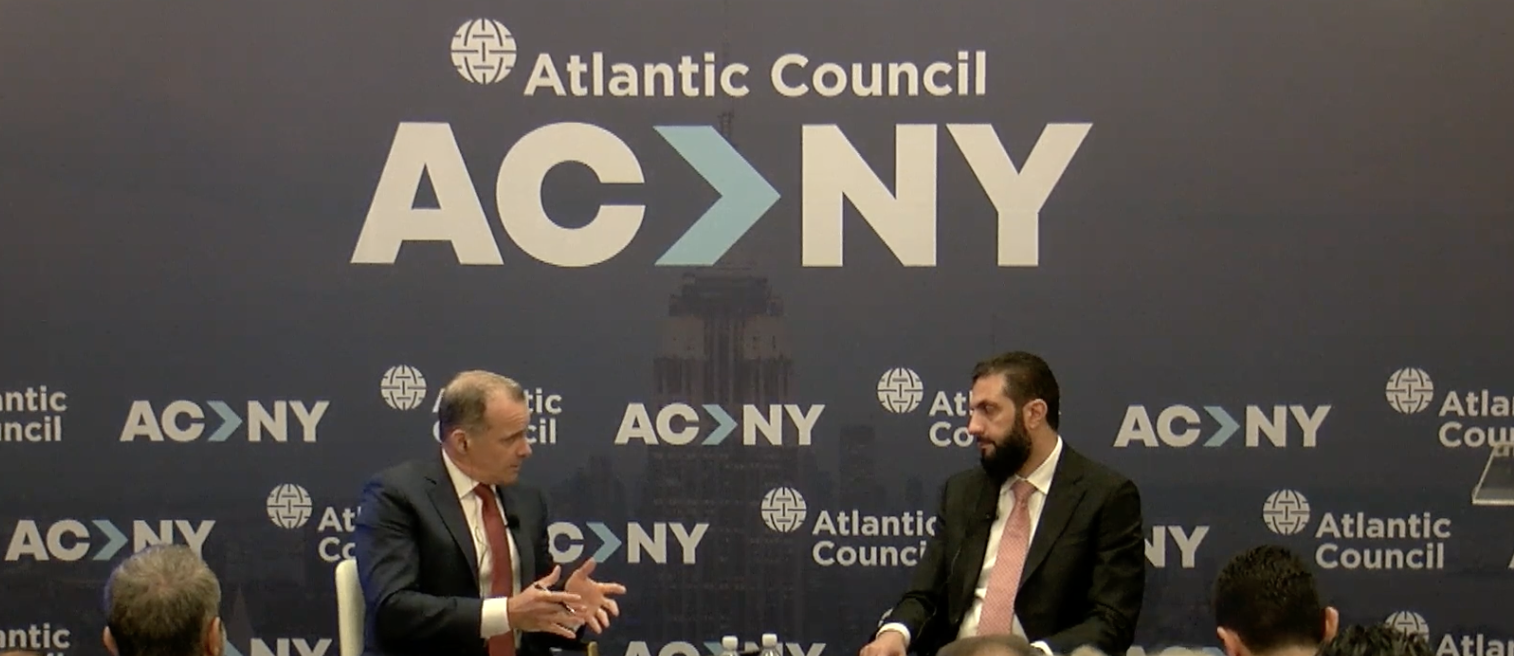
Speaking at an Atlantic Council event on the sidelines of the United Nations General Assembly in New York City this Tuesday, Syrian President Ahmed al-Sharaa laid out a clear, non-negotiable condition for any future diplomatic engagement with Israel: an end to ongoing air strikes, incursions, and the illegal occupation of Syrian territory, most notably the Golan Heights — his place of birth.
Al-Sharaa, who led Syrian rebel factions to seize Damascus and oust long-time former president Bashar al-Assad last December, emphasized that Israel has escalated its aggressive actions against Syria since the collapse of the old regime. Speaking through a translator, he noted that Israeli forces have seized additional Syrian territory in the months following December 8, 2024, and continue to carry out cross-border incursions, arrests, and bombing raids across multiple regions of the country. Despite these ongoing hostilities, he confirmed that Syria remains committed to pursuing diplomatic resolution through dialogue and negotiation, and has already sought mediation from countries deemed friendly to Israel, including the United States — though progress has been fraught with obstacles.
“The Israelis will often reach 90 percent of a security agreement with Syria before suddenly withdrawing for different reasons,” al-Sharaa told attendees. He stressed that no formal peace talks can move forward until Syrian sovereignty and the rights of the Syrian people are fully respected, stating firmly: “We cannot talk about peace if the rights of Syrians are usurped.”
The Golan Heights, a strategic plateau captured by Israel from Syria in the 1967 Six-Day War, remains a core point of contention. While the United Nations universally recognizes the Golan as occupied Syrian territory, then-U.S. President Donald Trump unilaterally recognized Israeli sovereignty over the region in 2018, a long-sought policy win for Israeli Prime Minister Benjamin Netanyahu. Al-Sharaa recalled a lighthearted but pointed exchange he had with Trump during a 2024 White House visit, when he joked: “Why don’t you give New Jersey to the Israelis? You don’t own Golan Heights to give it to them, but you own New Jersey, and I believe that New Jersey is full of Democrats, and they are not voting for Trump. So it will be good to give it to the Israelis.” The quip drew laughter from the audience, but al-Sharaa backed it with a serious call for an independent international committee to examine territorial claims and counter the constant framing of negotiations around Israel’s perceived security needs alone. Al-Sharaa emphasized: “There is no discussion about those territories and to whom they belong.”
Turning to the ongoing conflict between Israel and Hezbollah in neighboring Lebanon, which has escalated dramatically since Hezbollah launched rocket attacks in support of Hamas in October 2023, al-Sharaa addressed Trump’s earlier proposal that Syrian forces assist in disarming Hezbollah as part of a broader Israel-Lebanon peace deal — an idea widely seen as unfeasible given post-war Syria’s fragile stability and Hezbollah’s long-standing support for al-Assad during the civil war. Al-Sharaa instead outlined a more measured approach: Syria will work to empower the Lebanese government to strengthen its state institutions, ensure all weapons operate under official Lebanese state authority, and support improvements to Lebanon’s struggling economy and civil society to address long-running instability that was exacerbated by the former Assad regime’s actions. “So we are engaging [on] a best mechanism for political reform,” he added.
The discussion, moderated by veteran Middle East negotiator Brett McGurk — a former Biden White House official with a long history of U.S. Middle East policy across four U.S. administrations, and a known hawkish pro-Israel, pro-intervention stance — quickly turned to questions about al-Sharaa’s controversial past. Less than two years ago, the U.S. State Department labeled him a top terrorist with a $10 million bounty on his head, when he operated under the nom de guerre Abu Mohammed al-Jolani, leader of the al-Qaeda-affiliated militant group Hay’at Tahrir al-Sham. McGurk opened the questioning by referencing the 25th anniversary of the September 11, 2001 attacks, and pressed al-Sharaa to renounce a 2013 pledge of allegiance to al-Qaeda leader Ayman al-Zawahiri, one of the primary masterminds of the 9/11 attacks.
Al-Sharaa pushed back on the line of questioning, noting: “9/11, I had nothing to do with that at the time. I was 13 years old.” When pressed again to renounce the past pledge, he responded that the region’s historical context must be acknowledged: “There are so many questions that are part of the past now, so maybe we need to update ourselves. I don’t believe that it is appropriate time to discuss things that happened 25 years ago. I was at a different age, and the conditions in the region were different, and they were pushing a lot of young people to go into that direction because of the pressure in that region.”
Al-Sharaa, who spent six years in a U.S. prison in Iraq after joining anti-coalition militias following the 2003 U.S. invasion, framed his current leadership as a break from his earlier years, centered on removing the decades-long injustice of Assad family rule. “Lifting that injustice is a noble act that any person will be honoured to do,” he told McGurk.
Addressing a 2024 ISIS attack on a joint U.S.-Syrian convoy that killed two American soldiers and a civilian interpreter, al-Sharaa acknowledged that Syria is still in the early stages of building a new national security infrastructure after the civil war. He explained that simultaneously working to dismantle rogue militias, bring all weapons under state control, and vet and recruit personnel for a new national army has created growing pains that can lead to unforeseen security incidents, noting that similar attacks have targeted other groups beyond U.S. personnel.
When McGurk asked whether al-Sharaa would welcome a large-scale return of U.S. troops to Syria to train the new national army, the Syrian president reaffirmed his commitment to full Syrian sovereignty and the 2019 withdrawal of U.S. forces ordered by Trump, which he said proceeded smoothly and without the security vacuum many predicted. “The withdrawal was very safe, and the region remained calm. No problems happened because of that vacuum, and the Syrian state and Syrian forces took control over the area, and [Kurdish forces] in the northeast were integrated [into Syria’s military],” he said. “Emptying Syria from foreign bases… that is a good approach.”
This principle applies to all foreign military presences, including Russia, al-Sharaa confirmed. Where Russia once operated 170 military bases across Syria, that number has now been reduced to just two, both of which will only be used for training the newly formed Syrian military.
On the topic of governing Syria’s diverse mosaic of ethnic and religious groups, al-Sharaa said his transitional government will build on existing legal frameworks to expand devolved power to local governorates as the country prepares for a new presidential election within three years, and a full constitutional rewrite within the five-year transition period. “There are wide powers for the governorates in the election of the municipal councils,” he explained. “The People’s Assembly is going to appoint a committee that is going to review the different laws in Syria, and another committee that will start drafting the constitution. And I believe that will be completed before the end of the five years [transition period].” When asked, al-Sharaa did not rule out running for president in the upcoming election.
Al-Sharaa is scheduled to deliver an address to the full United Nations General Assembly later this week, after making history last year as the first Syrian leader to speak from the UN podium in 60 years.