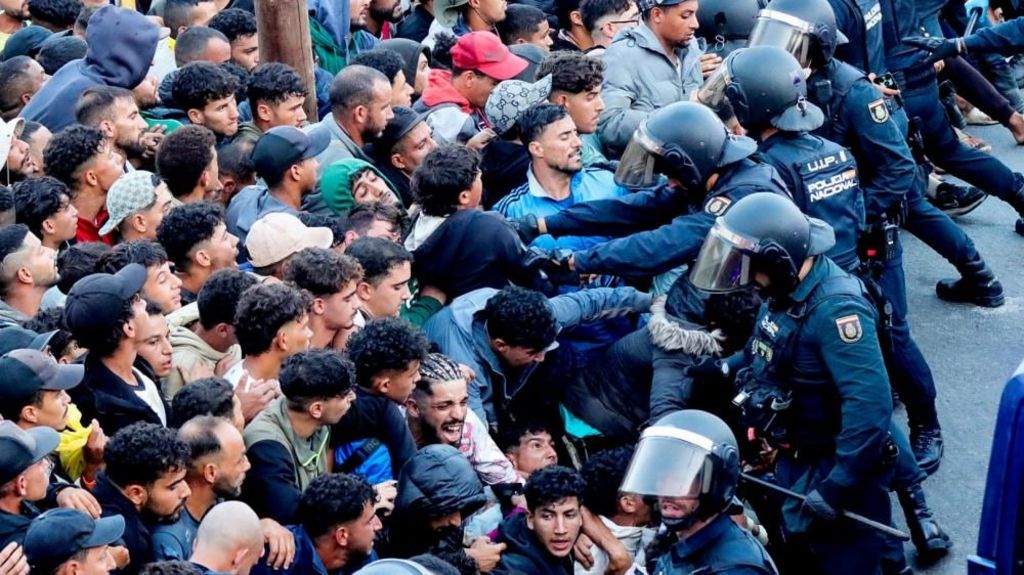
Months after a massive, unprecedented influx of migrants crossed into Spain’s North African enclave of Ceuta from Morocco, a large-scale government transfer operation to relocate thousands of remaining migrants has descended into chaotic scenes that have amplified already fierce criticism of Prime Minister Pedro Sánchez’s handling of the ongoing crisis.
When the mass border breach first occurred in late July, an estimated 72,000 migrants pushed past security barriers and swam around coastal fortifications to enter the 18.5-square-kilometer territory. While most of these arrivals have since been processed and returned to Morocco, official data indicates more than 13,000 migrants remain in the enclave, many of whom had been camping in makeshift, unsanitary settlements along Ceuta’s public beaches for weeks.
The Spanish government launched the long-planned relocation operation at approximately 7 a.m. local time (5 a.m. GMT) on Friday, with the goal of moving over 3,000 migrants to a newly constructed tented camp in Ceuta’s port district. The facility, designed to hold up to 1,700 people, is intended to centralize migrants so authorities can complete individual identity checks, process their immigration claims, and provide basic care while their legal status is reviewed.
Despite extensive planning, the operation quickly unraveled into disorder. Crowds of migrants, eager to secure a spot in the organized facility after weeks of poor living conditions on the beaches, jostled and pushed against Spanish Civil Guard cordons. Some groups broke through the police line along the 1.2-mile designated route to the port, with video footage capturing young migrants running through pre-dawn darkness as security personnel scrambled to reestablish control. Multiple witnesses reported hearing shots ring out, with unconfirmed accounts indicating officers fired into the air to disperse crowds.
Officials confirmed that more than 170 law enforcement officers, including specialized drone surveillance teams, were deployed to stabilize the situation. State-owned Spanish news agency Efe reported that authorities were able to bring the unrest under control quickly, allowing the transfer operation to proceed as planned, with several hundred migrants successfully moved into the new camp by mid-day.
The chaotic scenes have only strengthened opposition attacks on Sánchez, who has faced intense scrutiny since the migrant influx first began. Conservative opposition leaders have repeatedly accused the prime minister of failing to respond appropriately to the crisis, and of having prior knowledge of the planned mass crossing that he intentionally concealed. While Sánchez has repeatedly insisted that the sudden influx was impossible to predict, declassified government documents show Spain’s intelligence services issued warnings just 24 hours before the breach that social media campaigns were organizing mass calls for migrants to cross into Ceuta.
Ester Muñoz, a senior spokesperson for the conservative opposition People’s Party, has gone as far as holding the Sánchez government “directly responsible for the invasion of Ceuta and for those who died” during the dangerous border crossing. Local officials in Ceuta have also sounded the alarm about the unsustainable strain the migrant presence has put on the small territory. Last month, Ceuta’s conservative Mayor Juan Jesus Vivas told European Union lawmakers that the enclave had been turned into a “pressure cooker,” noting that life for local residents had been irrevocably changed. “The city is completely different than it was before this event,” Vivas said. “Ceutans have lost their joy and their lifestyles have been completely shaken up.” Many local residents have already expressed widespread safety concerns over the remaining migrant population, with some engaging in unrest by destroying makeshift migrant camps and blocking humanitarian aid convoys.
Beyond domestic political backlash, the crisis has created significant diplomatic friction for Madrid. Sánchez is currently embroiled in a public dispute with Italy that has led both countries to extend temporary reciprocal border controls, and the prime minister is working to prevent the crisis from damaging Spain’s critical bilateral relationship with Morocco.
The mass July crossing was itself triggered by a high-profile court ruling: Spain’s Supreme Court determined that migrants intercepted at sea while attempting to reach Ceuta could not be immediately and summarily returned to Morocco. In the aftermath of the ruling, bad actors spread misinformation across social media platforms, offering to coordinate border crossings for migrants in exchange for fees of hundreds of British pounds. Local authorities have confirmed that at least 100 migrants died during the dangerous crossing attempt, making the crisis one of the deadliest recent border events in the Mediterranean region.