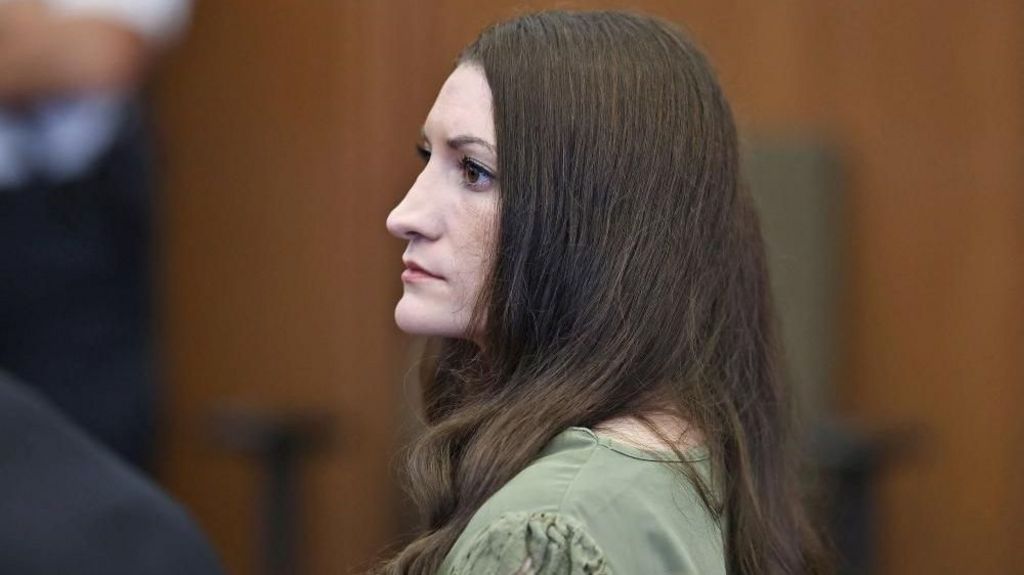
A high-profile Massachusetts murder case that has gripped the nation has taken another dramatic turn, after the single juror who blocked a unanimous verdict in Lindsay Clancy’s trial has publicly stated he has no uncertainty over Clancy’s criminal responsibility for the 2022 deaths of her three young children.
Michael Desronvil, the lone holdout that led a judge to declare a mistrial earlier this month, shared his position in an official statement to CBS News, a US media partner of the BBC. He argued that the physical evidence, testimony from key witnesses, and the case presented by prosecutors was more than sufficient to prove Clancy knew exactly what she was doing when she killed Cora, age 5, Dawson, age 3, and 8-month-old Callan, and that the act was premeditated. “I didn’t have any doubts,” Desronvil emphasized in the statement, released Thursday. He also claimed that when he attempted to lay out his reasoning during nearly 40 hours of closed-door jury deliberations, other panel members repeatedly cut him off rather than engaging with his perspective.
The case against Clancy, 36, stems from a horrific incident at the family’s Massachusetts home, where she admitted to strangling her three children before jumping from a second-floor window in an apparent suicide attempt. She has since been charged with three counts of first-degree murder. What makes the case legally contentious is the defense’s core argument: that Clancy was suffering from severe postpartum psychosis, a rare, extreme mental health condition that triggered the killings, meaning she should be found not guilty by reason of insanity. Prosecutors, by contrast, have maintained the murders were a calculated, pre-planned act that meets the legal bar for first-degree murder.
Under Massachusetts state law, a guilty verdict required the full 12-person jury to unanimously agree, beyond any reasonable doubt, that Clancy intentionally killed her children and that the killings were not caused by postpartum psychosis. The jury, made up of nine women and three men, considered a full range of potential outcomes, including not guilty by reason of insanity, manslaughter, and first-degree murder. After days of deliberation totaling almost 40 hours, the panel failed to reach the required unanimous decision, leading Judge to declare a mistrial on September 4. Multiple other jurors have since confirmed the panel was split 11-1, with the vast majority supporting a finding that Clancy was not criminally responsible due to her mental state.
Other jurors have painted a fraught picture of the deliberation process. Paula Devlin, one of the 11 jurors siding with a not criminally responsible verdict, told CBS Mornings that the panel spent days working to persuade Desronvil to change his position, even after the vote shifted to 10-2 earlier in deliberations. The jury foreperson, a retired fifth-grade teacher, described the deadlock as an “awful” experience and an “emotional rollercoaster.” She told NBC that Desronvil had openly admitted he held reasonable doubt about Clancy’s criminal responsibility, but still refused to vote for a not guilty by reason of insanity verdict. One anonymous juror told local CBS affiliate WBZ-TV that while Desronvil was not the only juror unwilling to compromise on their position, his refusal to either act on his own admission of reasonable doubt or provide consistent logical reasoning for his stance left the panel feeling Clancy had been denied a fair trial.
While the identities of the 11 remaining jurors have not been officially released, US law allows any juror to speak publicly about their deliberations once a case concludes. The next development in the case will be a public interview with Patrick Clancy, Lindsay Clancy’s ex-husband and the father of the three slain children, which is set to air on the CBS news program 60 Minutes this Sunday. Clancy is expected to open up about his profound grief, his lasting memories of his children, and the harmful conspiracy theories that have spread widely across social media since the trial began. He has previously shared that he still “talks to his children all the time” as a way to stay connected to them.
During the original trial, Clancy’s defense team built their case around evidence of her declining mental health in the months leading up to the killings: they noted Clancy had been prescribed more than 12 different medications, had reached out to a suicide prevention hotline, and had sought emergency mental health care, all as proof of her severe postpartum psychosis. The defense argues that postpartum psychosis, which can cause debilitating hallucinations and delusions, left Clancy unable to understand the wrongfulness of her actions or recognize what she was doing. A forensic psychiatrist testifying for the defense told the court Clancy acted under “command hallucinations” and a “delusion of influence” when she killed her children.
Prosecutors pushed back against this narrative with conflicting expert testimony. Clancy’s own treating psychiatrist testified for the prosecution that Clancy never displayed visible signs of psychosis during their treatment sessions, and another psychiatric expert noted that postpartum psychosis as a distinct diagnosis is not currently formally recognized by the American Psychiatric Association.
The mistrial has left the entire case in limbo. Prosecutors have not yet announced whether they will move forward with a retrial. Clancy’s lead defense attorney, Kevin Reddington, has said he is hopeful to reach a plea deal with prosecutors to avoid a second, emotionally draining trial. Reddington publicly criticized Desronvil’s actions, telling ABC’s Good Morning America that he was frustrated the lone holdout refused to follow the judge’s instruction to apply the legal standard of reasonable doubt to the case. “That’s not right. And that’s why I was upset,” Reddington said. The next official court hearing is scheduled for September 29 at Plymouth Superior Court in Massachusetts.