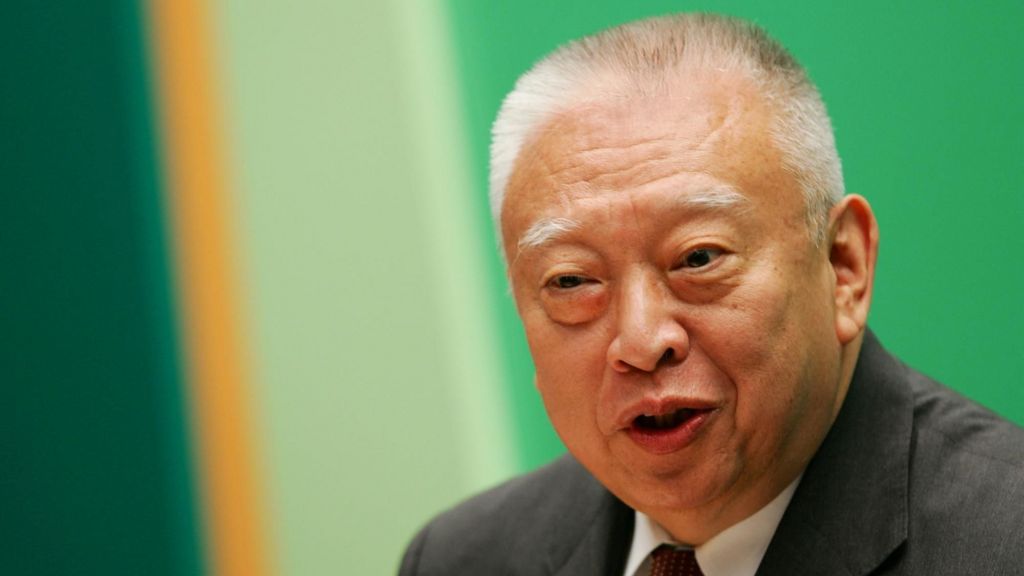
Tung Chee-hwa, the trailblazing first chief executive of the Hong Kong Special Administrative Region after the 1997 handover that ended over 150 years of British colonial rule, has passed away at the age of 89. According to local Hong Kong media reports, he died on Tuesday night with his family at his side.
Born in Shanghai in 1937, Tung built a diverse life trajectory spanning global business and historic public service. After earning a bachelor’s degree in mechanical engineering from the University of Liverpool in the United Kingdom, he relocated to the United States, where he spent nearly a decade working for industrial giant General Electric. He returned to Asia and settled in Hong Kong in 1969 to join his family’s prominent shipping enterprise, Orient Overseas, and assumed leadership of the conglomerate in 1979 following his father’s passing.
Tung’s entry into formal politics came in 1992, when he was appointed to the executive council of Chris Patten, the final British governor of Hong Kong. Despite limited prior electoral political experience, Tung was widely identified as Beijing’s preferred candidate to lead the newly returned Hong Kong, a signal cemented by a high-profile 1996 handshake with then-Chinese President Jiang Zemin at a Beijing reception that was captured by global photographers. This backing came amid longstanding ties to the mainland: in the mid-1980s, Chinese state-owned banks stepped in to rescue Tung’s family shipping business during a global industry downturn, cementing his reputation as a loyal ally of Beijing.
When the handover was finalized in July 1997, Tung officially took office, succeeding Patten to become the first leader of Hong Kong under Chinese sovereignty. His tenure was immediately tested by cascading crises that shaped his administration. Just months after taking office, the 1997 Asian Financial Crisis sent Hong Kong’s property market into a steep nosedive, straining household finances and public confidence. His administration later faced two major public health emergencies: a multi-year bird flu outbreak between 1997 and 2002, followed by the 2003 SARS epidemic that killed hundreds in the city and brought daily life to a standstill.
The most significant political challenge of Tung’s tenure came in July 2003, during his second term, when an estimated half a million Hong Kong residents marched in mass protests against a proposed local national security law that opponents warned would erode civil liberties and the city’s promised high degree of autonomy. In response to widespread public outcry, Tung’s administration shelved the draft legislation. The unrest, combined with other pressures, contributed to Tung’s early departure from office in March 2005. While Tung cited declining personal health as the reason for his resignation, many outside observers have long speculated that he was pressured to step down by Beijing authorities. A national security law for Hong Kong was ultimately imposed directly by Beijing in 2020; the measure has been defended by Chinese and Hong Kong authorities as critical to upholding national security and social stability, but decried by critics as a move that has dismantled Hong Kong’s civil freedoms and created a pervasive climate of political fear.
After leaving office, Tung remained out of the public eye for most of his later years. His last confirmed public appearance was in July 2021, at an event marking the 100th founding anniversary of the Chinese Communist Party. Just months after that event, Tung underwent heart surgery, according to local reporting.
In an official statement following his death, Tung’s office remembered him as a leader deeply devoted to the country and its people. “His noble character and integrity will live on forever in our hearts,” the statement read. He is survived by his wife and three children.