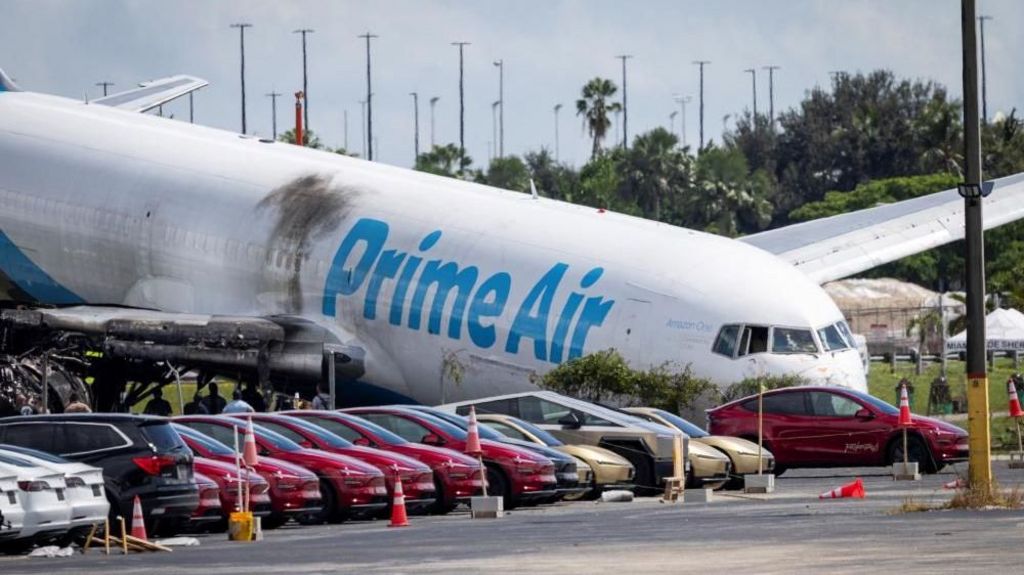
A tragic aviation accident at Miami International Airport on the busy Labor Day holiday weekend has left five people dead and five more with severe injuries, triggering a full-scale investigation led by the U.S. National Transportation Safety Board (NTSB). The incident unfolded shortly before 2 p.m. local time on Sunday, when a Boeing 767-300 cargo jet operated by logistics firm 21 Air on a flight from San Juan, Puerto Rico, overran the runway during landing.
According to NTSB chair Jennifer Homendy, the aircraft carried just two crew members as part of its third operational trip of the day. After overrunning the runway, the plane first struck airport navigational infrastructure before colliding with a contracted cleaning company’s white Ford van that was inside the airport perimeter. The van held seven passengers at the time of impact. The jet then broke through a perimeter fence and crashed into a separate Toyota Corolla carrying three people, before coming to a complete stop roughly 1,300 feet (396 meters) beyond the end of the runway.
Homendy described the crash site as overwhelmingly devastating during a Monday press briefing held at the airport, noting that debris from the destroyed aircraft, damaged ground vehicles, and shattered perimeter fencing was spread widely across the impacted area. “It’s hard to see, and I’m sure very difficult for the first responders as well,” she told reporters, emphasizing that victim recovery remains the top priority for response teams. “The investigation and access to the aircraft, as well as evidence, can wait,” she added.
While investigators have already successfully retrieved both the flight data recorder and cockpit voice recorder — the key tools for determining crash causes — the devices have been shipped to NTSB headquarters in Washington D.C. for detailed analysis. Homendy stressed that the probe is still in its early fact-finding phase, and no conclusions about the root cause of the crash can be drawn at this stage.
The multi-pronged investigation will cover a wide range of potential contributing factors: dedicated teams will review the aircraft’s maintenance and flight history, the aircrew’s training and experience, radar tracking data, the jet’s in-flight performance, the functionality of its core systems and engines, and weather conditions at the time of landing. Early analysis from BBC Verify found an active thunderstorm was active near the airport in the minutes before the crash, with wind gusts reaching as high as 26 knots.
One key line of inquiry will focus on whether the runway was equipped with an Engineered Materials Arresting System (EMAS), a specialized safety infrastructure designed to slow and stop aircraft that overrun runways during landing. Homendy confirmed that assessing the presence and adequacy of this system will be a central component of the probe. The NTSB has also issued a public appeal for any witnesses or passersby who captured photographs or video of the crash or its immediate aftermath to share their footage to aid the investigation.
In the wake of the incident, two of Miami International Airport’s four runways remain closed, causing ongoing travel disruption for passengers. Sunday’s crash forced widespread flight cancellations that disrupted crew scheduling and aircraft positioning, with travelers warned to expect continued delays and changes to itineraries. The crash fell during the Labor Day holiday weekend, one of the busiest periods for air travel across the United States each year.
Both e-commerce giant Amazon, which contracted the cargo flight, and operating carrier 21 Air have issued statements reacting to the tragedy. Amazon said it was “heartbroken” by the loss of life, and confirmed it is working closely with investigating authorities. 21 Air also extended its condolences to the victims and their families, and confirmed it is fully cooperating with the NTSB’s ongoing probe. Looking ahead, Homendy noted that the NTSB will issue binding safety recommendations once its investigation is complete, a core part of the agency’s mission to prevent future fatal aviation accidents. “That’s why we’re here – to prevent the next tragedy,” she said. “Our recommendations must be implemented, or we’ll be here again.”