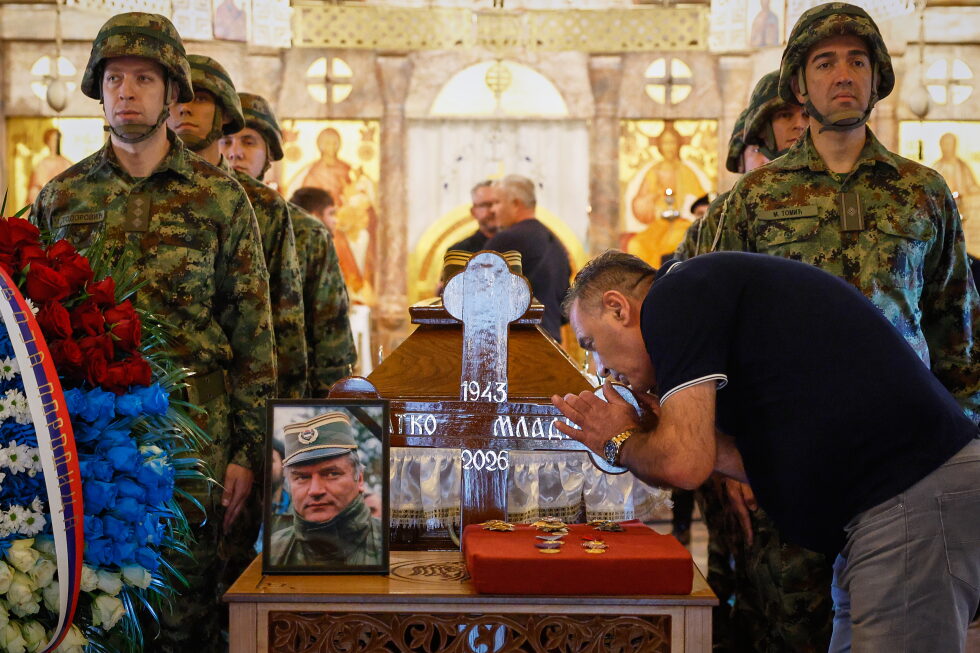
On a crisp Monday in central Belgrade, thousands of Serbian mourners filed through the small Serbian Orthodox Church of St. Luke to pay their final respects to Ratko Mladic, the former Bosnian Serb military commander who died last month while serving a life sentence for genocide and war crimes. The public lying-in-state comes as the Balkan nation openly rejects repeated warnings from the European Union, which has decried the official state-backed honors for a man convicted of orchestrating the worst act of genocide on European soil since World War II.
Mladic, 84, died on August 27 in a Dutch prison in The Hague, where he was incarcerated after an international tribunal found him guilty of overseeing mass atrocities during the 1992-1995 Bosnian War. His conviction centered on his role in planning the 1995 Srebrenica massacre, where more than 8,000 Bosnian Muslim men and boys were systematically executed after Mladic’s forces overran a U.N.-designated safe haven, as well as the four-year siege of Sarajevo and the operation of deadly concentration camps for non-Serb civilians. Though his funeral was formally organized by his family, the Serbian government has taken unprecedented steps to honor the convicted war criminal: it dispatched a state aircraft to repatriate Mladic’s remains to Belgrade last week, had soldiers carry his flag-draped coffin, and hosted an official military commemoration at a Serbian army facility over the weekend. Pro-government Serbian media outlets have confirmed Mladic will receive full military honors during his burial, with Serbian Orthodox Church Patriarch Porfirije set to lead the funeral service. Inside the Belgrade church on Monday, Mladic’s military cap and saber were displayed atop his coffin, flanked by uniformed men in combat fatigues.
For many Serbs, Mladic remains a revered nationalist hero, a symbol of efforts to unify ethnic Serb territories across the Balkans following the breakup of the former Yugoslavia. Milan Dobric, one of the mourners who traveled from Kosovo to attend the service, called Mladic “a man who gave everything in his life for the Serbian people.” “I am glad that this morning people are coming to pay special respect,” Dobric told reporters.
The decision to grant official state honors to Mladic has sparked immediate international backlash, deepening a rift between Serbia and the EU at a critical moment for the country’s decades-long membership bid. EU Enlargement Commissioner Marta Kos announced she would scrap a scheduled visit to Serbia in protest, stating clearly that “the glorification surrounding his death is incompatible with the values on which the EU path is built.” Kos was joined by dozens of European officials, Balkan regional leaders, and survivors and relatives of Mladic’s victims in condemning the public homage. The Bosnian War, which ended with a U.S.-brokered peace deal in 1995, left more than 100,000 people dead and forced more than 1 million from their homes.
Serbian President Aleksandar Vucic, a populist leader who has ramped up anti-Western rhetoric ahead of early high-stakes parliamentary elections scheduled for next month, has dismissed the EU’s criticism as baseless, accusing Kos of outright “lying.” Though Vucic, a former extreme nationalist who backed expansionist Serb policies during the 1990s war, is not attending the funeral, his government has stood firm in its defiance. For years, Serbia has refused to formally recognize the Srebrenica massacre as an act of genocide, only referring to it as a “horrific crime.” This is not the first time the country has granted state honors to a convicted war criminal: last year, former Serbian army chief of staff Nebojsa Pavkovic, who was convicted of war crimes by the U.N. tribunal, was buried with full military honors in Belgrade’s cemetery for distinguished citizens.
Mladic’s death and the subsequent public tributes have further complicated Serbia’s stalled EU membership bid. The process has already been frozen for years due to widespread democratic backsliding under Vucic’s administration and Serbia’s refusal to join international sanctions against Russia following its full-scale invasion of Ukraine. Nationalist supporters of Mladic have organized a series of public tributes across Belgrade in recent weeks, including street vigils, new murals depicting the former commander, and public displays of flares in his honor. The Serbian government has long argued that the West holds an inherent anti-Serb bias in its assessment of the country’s role in the 1990s Balkan wars, a narrative that has resonated with much of the Serbian public ahead of the upcoming election.