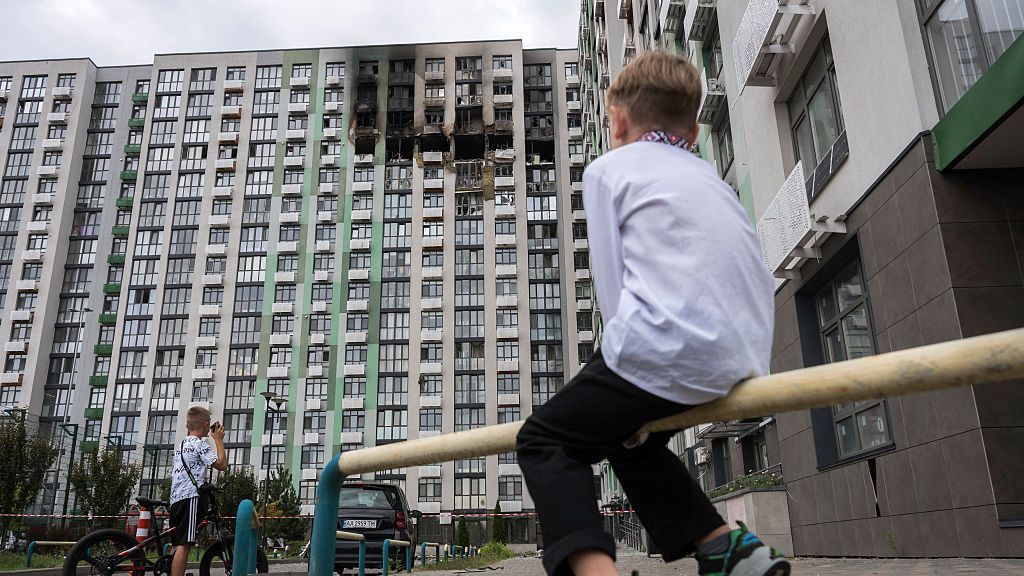
More than two years after Russia launched its full-scale invasion of Ukraine, the capital city of Kyiv is facing the most intense period of air raid activity recorded since the war began, new data analysis confirms. A BBC Verify examination of official Ukrainian government figures reveals that daily air raid alerts in Kyiv have surged to levels not seen since the initial invasion in February 2022, upending daily life for millions of residents.
The most significant shift in Russian tactics has been the move from almost entirely nocturnal strikes to daytime attacks, a change that has spread chaos across schools, workplaces and public transit networks across the capital. Since Russia launched this new campaign of round-the-clock assaults in late August, Kyiv has recorded an average of 10 air raid sirens per day, with some days seeing as many as 13 separate alerts. Individual alerts can last anywhere from a handful of minutes to nearly four and a half hours, forcing residents to repeatedly stop what they are doing and rush to designated shelters. Data for the seven-day period starting August 27 shows the city endured 76 total alerts, already surpassing the previous high of roughly 66 alerts recorded in the first week of full-scale invasion in 2022 — a milestone made more notable by the incomplete data collected in the chaotic early days of the war.
Compounding the threat of more frequent strikes is Russia’s deployment of a new generation of jet-powered attack drones that are far faster and harder to intercept than older propeller-driven models. These new drones can reach speeds of nearly 370 miles per hour, three times the speed of the widely used Shahed propeller drones, putting additional strain on Ukraine’s existing air defense systems. Ukrainian military data shows Russia launched roughly 2,800 of these fast drones across Ukraine in August, nearly double the number deployed in July.
At the BBC’s on-the-ground office in Kyiv, the constant rumble of air defense engagements and exploding drones is a near-continuous backdrop to daily work. Ukrainian President Volodymyr Zelensky has convened an emergency meeting with senior government ministers and military commanders to fast-track development of domestically produced high-speed interceptor missiles capable of countering the faster Russian drones. In remarks to officials, Zelensky acknowledged the sharp escalation of Russian terror tactics, noting that strikes against Ukrainian population centers have grown far more intense since the start of August.
Diplomatic and military observers warn of a growing risk: Russia may be able to ramp up production of these fast attack drones faster than Ukraine can develop and deploy a new generation of countering interceptors. Some defense analysts even warn the drone threat could soon outpace the risk posed by Russian ballistic missiles, which have already worn down Ukraine’s limited stock of Patriot air defense systems. Currently, Ukrainian forces rely on a combination of combat aircraft, anti-aircraft artillery, and shoulder-fired missiles to shoot down the jet-powered drones, but Ukrainian Air Force spokesman Yurii Ihnat confirmed that only around 60 percent of incoming drones are successfully intercepted.
Ihnat emphasized that new, purpose-built interceptors are critical to addressing the gap in Ukraine’s defenses. “The task now is to make them faster and equip them with specialised guidance systems so that they can shoot down jet-powered UAVs, the jet-powered Shaheds,” he said. “The key issue really is having guidance systems, because that is one of the crucial elements. It is not enough for the interceptor simply to fly fast — it has to hit the target. That is very important.”
For ordinary Kyiv residents, the constant air raids have become a debilitating new normal that wears on mental health and upends basic daily routines. The new daytime strike tactic has disrupted the start of the new academic year, with students repeatedly forced to evacuate classrooms and rush to underground shelters. At Drahomanov Ukrainian State University in central Kyiv, some students head to underground spaces immediately when sirens sound, while others have grown accustomed to the frequency of alerts and remain on public streets.
Diana, a student teacher, told the BBC that the constant disruptions have ruined her sleep and upended her daily schedule. “Sometimes it is hard because most of the day I need to go to safe places, like the metro or somewhere underground,” she said. “It’s a terrible time, but thank God we are alive. We go day by day.”
Ihor, a chemistry student training to be a teacher, said while he has acclimated to sirens after years of war, the constant alerts have gutted the quality of education in the city. “We are annoyed by the sirens because they are constant,” he said. “It destroys the quality of our education… We cannot study normally.”
After a recent drone strike on a residential neighborhood in central Kyiv, students from a nearby nearby school were immediately evacuated over fears of a secondary “double-tap” attack, a tactic that targets first responders and survivors following an initial strike. Seventeen-year-old Sophia described the constant uncertainty of daily life in the city, saying “It’s a little bit scary to live here in Kyiv. It’s very difficult.” Her interview was cut short when another air raid siren began, prompting her to urge the reporting team to move to shelter: “It is very dangerous for you to stand in the streets. Maybe we can have a second detonation.”
Local businesses have also been hit hard by the repeated alerts, as most are required to suspend operations and evacuate workplaces every time a siren sounds. During one alert, dozens of workers from Kyiv’s largest department store were seen gathering on nearby streets after evacuating, having grown accustomed to the frequency of disruptions. Public transit networks also face widespread chaos: overground trains crossing the Dnipro River that cuts through the center of Kyiv are forced to stop during alerts, stranding commuters who must scramble to find replacement bus service.
To address the widespread economic and social disruption, the Ukrainian government has announced a new two-tiered air raid warning system designed to minimize unnecessary disruption while still keeping residents safe. Under the new framework, a yellow warning will be issued for lower-risk drone attacks, allowing most work, travel and academic activity to continue with limited restrictions. A red warning will be reserved for higher-risk missile attacks, requiring full evacuation to shelters and a full suspension of public activity.
The escalation of Russian strikes came amid a brief pause in attacks over a recent weekend, when high-level U.S. diplomatic envoys visited Kyiv for talks focused on potential paths to ending the war. As Ukraine adapts to this new threat, analysts warn that Russia’s current campaign of constant strikes may also be a precursor to a planned winter offensive targeting Ukraine’s energy infrastructure, a tactic Russia used in 2022 and 2023 to break civilian morale. There are growing fears that the drain on Ukraine’s air defense resources from the current drone campaign will leave the capital less prepared to defend critical energy infrastructure as temperatures drop in the coming months. Military analysts add that Russia’s goals extend beyond eroding civilian morale: the constant strikes are also intended to weaken Ukraine’s overall economy by disrupting commercial activity and damaging critical storage and industrial infrastructure.