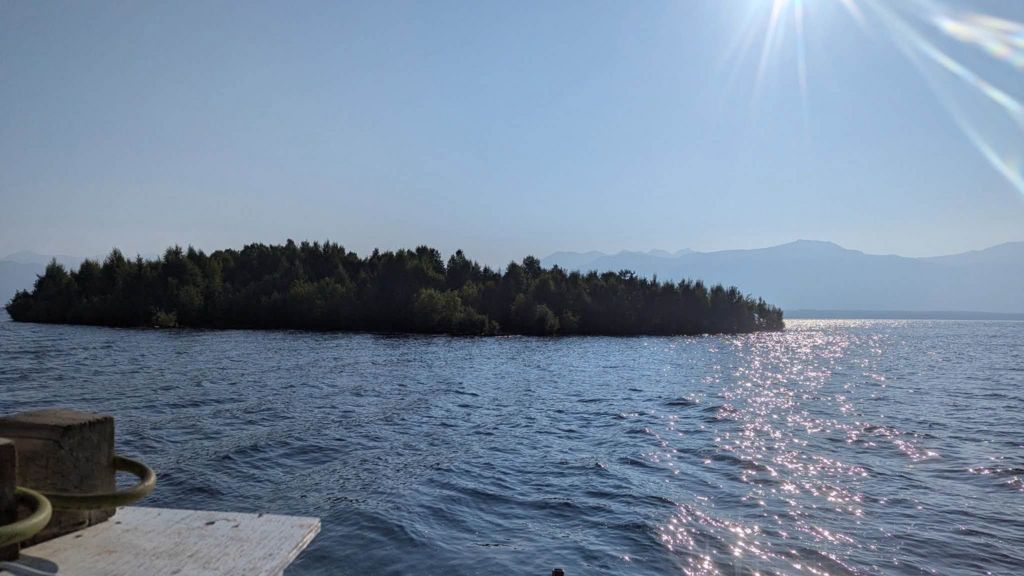
A natural oddity that captured global attention after vanishing from satellite imagery has been found again on one of Canada’s largest freshwater bodies. The small, forested floating island, which first drew public attention when recreational boaters stumbled across it in mid-August on Williston Reservoir in northern British Columbia, had disappeared from its original documented location just weeks after its existence was confirmed, leaving officials and curious observers around the world guessing about its fate.
The story first went viral after boaters posted a video of the unusual landmass bobbing in the reservoir’s open water. When Bob Gammer, a spokesperson for BC Hydro – the public utility that manages Williston Reservoir and the adjacent WAC Bennett Dam – first encountered the circulating clip on Canadian social media, he was deeply skeptical. He told the BBC his initial assumption was that the video was either AI-generated or misrepresented, adding, “I thought, well, this could be anywhere. Maybe it’s not real.”
That skepticism faded quickly when his team pulled up a July 21 satellite image that confirmed the island was not only real, but floating in a remote stretch of the reservoir. Measuring approximately 9,800 square meters – equal to roughly one-and-a-half American football fields, or one full Canadian football field – the wooded landmass sparked widespread intrigue. Then, just a couple of weeks later, an August 5 satellite scan showed the island was gone from its original spot. Its disappearance was covered by international media, turning a regional oddity into a global mystery, with open questions about whether it had sunk, broken apart, or drifted to an unmonitored part of the reservoir.
Now, that mystery has been solved. Gammer confirmed that new satellite imagery and eyewitness reports from pilots flying over the area have located the island roughly 30 kilometers (18.6 miles) from its initial discovery site, close to the reservoir’s shoreline. The island did not sink or break apart – it simply drifted with wind and current to a new location.
While the island’s current location is confirmed, its origin remains unconfirmed, though BC Hydro has a leading working theory. Officials believe the landmass formed gradually over decades, as accumulated driftwood built up into a stable enough base for soil, plants, and eventually full trees to take root. This summer, unusually high water levels – the highest recorded at Williston Reservoir since 2012 – likely weakened the connection between the unusual formation and the shoreline, allowing it to break free and float out into the open reservoir.
This is not the first recorded example of a large floating island in North America. One of the most famous is the Forty Acre Bog, a floating peat island on Wisconsin’s Lake Chippewa. The formation formed when a large peat bog detached from the lakebed and rose to the surface, and it has become a permanent, protected feature of the lake. Home to a wide range of native wildlife including frogs and salamanders, the bog is legally protected under Wisconsin state law, and local boaters occasionally maneuver it to prevent it from blocking bridges. Local resident Cheryl Treland described the formation to Wisconsin Public Radio in 2024, noting that it is far more substantial than it appears, saying, “This isn’t like a leaf floating on the top of the water… it’s like an iceberg.”
For anyone tempted to seek out the newly relocated British Columbia island for a closer look, Gammer has issued a clear warning. Unlike the long-established Forty Acre Bog, the Williston Reservoir island is not a stable structure. Located in a remote part of the lake that sees very few human visitors, it remains at risk of breaking apart at any time. “Stay off the island,” Gammer urged. “It could break apart.”