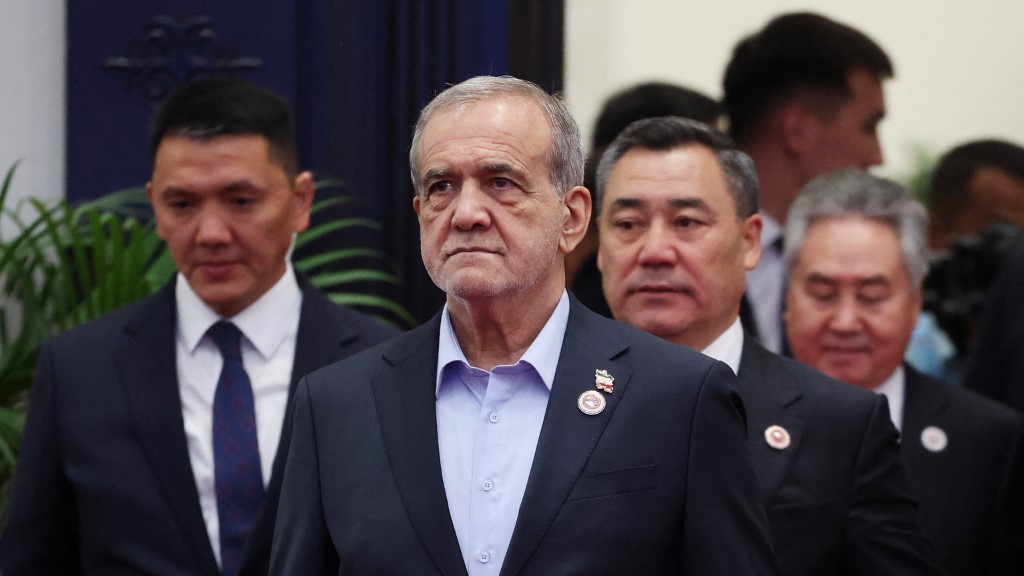
Fresh regional tensions have flared across the Middle East after U.S. forces carried out a deadly airstrike on Iran’s Larak Island over the weekend, marking the first direct American military action on Iranian territory since July and stoking widespread fears of a wider regional escalation. In the aftermath of the strike that claimed the lives of multiple Iranian soldiers and civilians, Iranian President Masoud Pezeshkian has extended a conditional offer of de-escalation to U.S. President Donald Trump, balancing a firm warning of retaliation against future aggression with an opening for diplomatic progress.
Speaking to reporters on Monday ahead of his departure for Bishkek to attend the Shanghai Cooperation Organisation summit, Pezeshkian made clear Iran’s core position: the country has no intention of initiating open conflict, but will not remain passive in the face of hostile action. Cited by Iran’s state-run Fars News Agency, the president emphasized that any new attack on Iranian soil would be met with a forceful, decisive response from Tehran. At the same time, he outlined a clear path to de-escalation, confirming that Iran would immediately take reciprocal steps to meet Washington halfway if the U.S. honors its obligations under the interim nuclear and diplomatic agreement signed by the two parties in June.
“I state explicitly that if the United States returns to its commitments under the aforementioned memorandum of understanding, the Islamic Republic of Iran will immediately take reciprocal action,” Pezeshkian said in remarks published on the official website of the Iranian presidency.
The Sunday strike on Larak Island, confirmed by Iran’s national broadcaster IRIB, triggered an immediate formal complaint from Tehran to the United Nations. In a letter submitted to UN Secretary-General António Guterres on Monday by Gholamhossein Darzi, Iran’s deputy permanent representative to the world body, Tehran denounced the attack as a blatant breach of Iran’s national sovereignty and territorial integrity. Darzi further accused the U.S. and other parties involved in the strike of committing war crimes and crimes against humanity as part of ongoing hostilities against Iran, noting that while Iran had exercised deliberate restraint up to this point, its military would not hesitate to defend the country’s territory and people with full force in response to any future attacks.
Beyond the military and diplomatic fallout, the escalating tensions have already rippled through global energy markets, given that the strategic Strait of Hormuz, through which roughly a fifth of global oil supplies transit, sits just off Iran’s coast. Earlier escalations already forced shipping disruptions after Iran temporarily restricted access to the waterway, causing significant damage to global economic stability. Early ship-tracking data compiled by analytics firm Kpler shows that shipping traffic through the strait held relatively steady on Monday, with five commercial commodity vessels recorded transiting the waterway: four entered the route, one exited, including an empty handy-sized gas carrier that took the Iranian shipping lane and three loaded dry bulk carriers.
On the domestic economic front, Iranian officials moved quickly this week to calm market jitters amid heightened U.S. sanctions pressure. Central Bank Governor Abdolnaser Hemmati announced Tuesday that Iran maintains adequate foreign currency reserves to weather the current pressure, pushing back against claims of imminent economic collapse. “I am telling the president of the United States: Iran has (foreign) currency and it has enough,” Hemmati said. The governor confirmed the central bank stands ready to inject up to $2 billion into the foreign exchange market to stabilize recent volatility, adding that the institution continues to collect all outstanding foreign currency receivables and holds both domestic reserves and additional contingency resources.
Addressing the Iranian public directly, Hemmati acknowledged that current economic conditions and everyday livelihood challenges have grown significantly difficult, but dismissed narratives of an imminent economic breakdown as baseless psychological warfare. “These claims are just psychological warfare and the dust will settle soon,” he stressed.