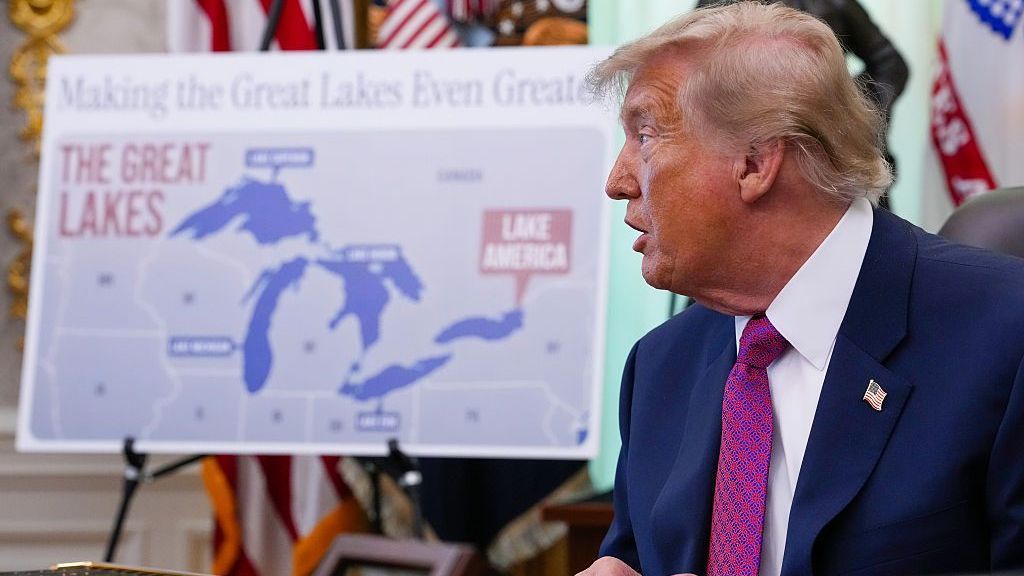
A controversial executive order signed by former President Donald Trump last Thursday to rebrand Lake Ontario—one of North America’s five Great Lakes—as “Lake America” has ignited cross-border tension between the United States and Canada, sparking mixed reactions from mapping technology providers and Canadian political and business leaders.
The order comes on the heels of collapsed bilateral trade negotiations between the two neighboring nations, and directs U.S. Interior Secretary Doug Burgum to implement all necessary steps to formalize the name change, including updating the Geographic Names Information System (GNIS), the U.S. federal government’s official geographic database.
In an interview with Fox News this Monday, Burgum confirmed that Trump has personally reached out to tech giant Apple to request the company adjust the lake’s name on its widely used Apple Maps platform to align with the new executive order. “I’m sure we may be seeing that change coming up soon,” Burgum told the outlet. The BBC has reached out to Apple for official comment on the request, with no response released as of yet.
Search giant Google was the first major mapping provider to comply with the order over the weekend, rolling out a name change that only impacts users based in the U.S. For users located in Canada, where the lake shares a border with the province of the same name and the U.S. state of New York, the original name Lake Ontario remains visible. For users accessing Google Maps from the rest of the world, the lake is labeled as “Lake Ontario (Lake America)” to reflect the conflicting naming designations from the two countries.
Not all U.S.-based mapping services have fallen in line with the executive order, however. Veteran American web mapping platform MapQuest, which launched in 1996, issued a blunt refusal in a brief Facebook post Friday, writing simply “we’re not changing it.” The platform also went a step further, releasing a custom tool that allows users to rename the lake to any name of their choosing and share their custom configurations online.
MapQuest’s defiant stance has resonated strongly with Canadian consumers: as of Monday morning, the platform jumped to the number one spot on the list of most-downloaded free applications on Apple’s Canadian App Store.
The unilateral name change has already triggered widespread pushback across Canada. Multiple Canadian public and private entities have already issued apologies after third-party mapping data briefly displayed the “Lake America” name on their internal and public-facing maps.
Toronto-based electrical utility provider Hydro One was the first to address the issue Sunday, confirming in a post on X that the incorrect name appeared due to the company’s use of an external third-party mapping service. “We are working with our vendor to correct the issue as quickly as possible and restore the proper geographic reference,” the company said in its official statement. “We regret the error and apologise for any confusion it has caused.” Other Ontario-based organizations, including utility provider Hydro Ottawa and the Liquor Control Board of Ontario, also reported brief instances of the “Lake America” label appearing on their mapping systems.
Ontario Premier Doug Ford has taken a firm public stance against the name change, unveiling a large bilingual sign along the Lake Ontario shoreline this Saturday that reads “Lake Ontario Now and Always” in both English and French, Canada’s two official languages. Appearing on U.S. broadcaster ABC’s interview with host George Stephanopoulos Sunday, Ford reiterated his province’s unwavering position. “No one’s going to call it Lake of America,” Ford said. “It’s been Lake Ontario for hundreds of years. It’s going to continue being Lake Ontario.”