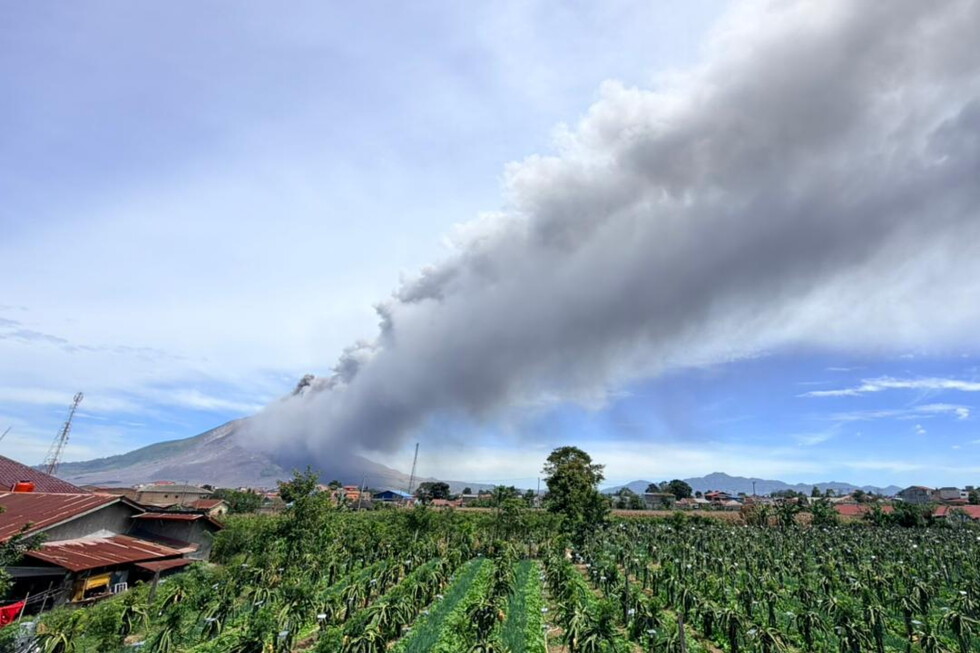
Indonesia’s Mount Sinabung, one of the country’s more than 120 active volcanoes, erupted on Monday, sending a massive 3,500-meter column of dark ash and thick smoke billowing into the sky above the Indonesian island of Sumatra.
In the immediate hours after the eruption, authorities reported no fatalities, injuries, mandatory mass evacuations, or disruptions to commercial air travel in the surrounding region. Despite the lack of early harm, disaster management officials issued urgent warnings, ordering residents, casual visitors and traveling tourists to avoid all activities in nearby Karo district villages, as well as any area within a 6-kilometer radius of the volcano’s 2,460-meter summit.
Gray volcanic ash has blanketed roads, parked vehicles, and residential and public buildings across multiple affected villages in Karo, leaving local infrastructure and communities coated in fine grit. In response, local disaster response teams have distributed free protective face masks to local residents to help prevent respiratory irritation from ash inhalation.
Following the eruption, Indonesia’s Geological Agency raised the official volcanic activity alert level for Mount Sinabung to “Watch,” the second-highest warning tier in the country’s volcanic monitoring system. The alert upgrade also came with an expansion of the marked safe zone surrounding the peak, extending the exclusion area for civilian activity.
In an official public statement released Monday, Lana Saria, head of the Indonesian Geological Agency, described this week’s eruption as an initial explosive event, warning that far larger, more hazardous eruptions could follow in the coming days or weeks.
The Geological Agency first detected signs of accelerating volcanic activity at Mount Sinabung in mid-August, when monitoring equipment recorded dozens of tectonic earthquakes around the peak and observed visible changes in volcanic activity. Even before Monday’s eruption, officials had already expanded the recommended exclusion radius to restrict non-essential public access to the area.
Over the past decade of repeated volcanic activity at Mount Sinabung, nearly 30,000 local residents have been permanently displaced from their homes surrounding the volcano, forced to resettle in safer areas outside the high-risk zone.
Indonesia, a sprawling archipelago nation home to more than 280 million people, sits along the Pacific “Ring of Fire,” a geologically active belt of volcanoes and tectonic fault lines that wraps around the entire Pacific Basin. This location makes the country extremely prone to frequent seismic and volcanic events, with dozens of active peaks monitored constantly for signs of dangerous activity.