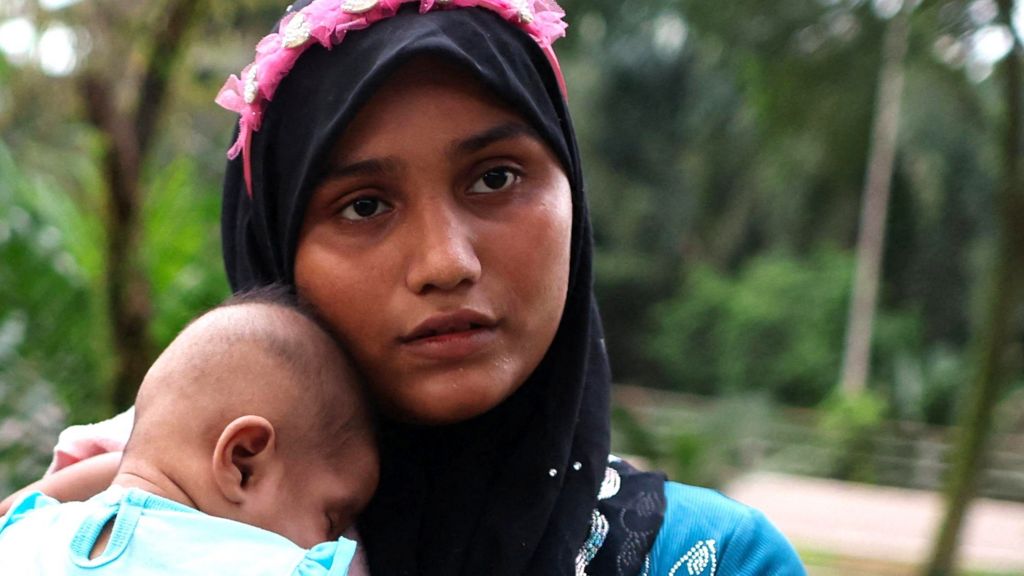
Nine years ago, then-Malaysian Prime Minister Najib Razak stood as a public advocate for the Rohingya, a stateless Muslim minority that fled systematic violence and discrimination in Myanmar. “We must defend them, not just because they are of the same faith, but because they are humans, their lives have value,” Razak declared in 2017. Today, that commitment has evaporated, replaced by a surging wave of anti-Rohingya hostility that has upended the fragile safety the community spent years building in the Southeast Asian nation.
For Rohingya children, who have long been barred from enrolling in Malaysia’s public education system, even the simple act of attending classes has become fraught with risk. That is the reality described by Irhan, a Rohingya refugee who established a community learning center for 6- to 15-year-old children in northern Malaysia (his name has been changed to protect his safety). Last month, eight uniformed police officers raided Irhan’s center, photographed the students, and ordered multiple children to return home immediately. “The students are just here to learn. Now their families are afraid,” Irhan explained.
Across the country, other unlicensed community-run learning spaces, the only educational option available to most Rohingya children, have been targeted by crackdowns. A center in the western state of Selangor suspended operations for a full month, and when it reopened in late July, it imposed strict new rules: students may not wear school uniforms, and must leave immediately after classes end, with no lingering or group gathering allowed. “We’re keeping a low profile to protect our students from getting attacked,” said Farooq, a Rohingya teacher at the center.
Crackdowns on Rohingya communities are uneven, widely driven by shifting public anger, and have already forced dozens of learning centers to close permanently in recent months. Beyond education, Rohingya families that have lived in Malaysian villages for years are now being forcibly evicted. Local residents have repeatedly claimed to Malaysian media that allowing the refugees to stay would lead to unspecified “social problems.” Most recently, 120 Rohingya—more than half of them children—were left homeless after eviction from a fishing village near Penang. When the group sought shelter outside the Kuala Lumpur office of the United Nations High Commissioner for Refugees (UNHCR), they were taken into temporary detention by authorities.
For a community that has already survived decades of persecution, this new wave of uncertainty has reinstated a constant state of fear. “In the early years, the Malaysians were our friends. They cared for our children. But it’s changed,” Irhan said. The refugee, who first arrived in Malaysia as a teenage asylum seeker in 2001, added, “I would leave if I could, but where else can I go? We are not wanted anywhere.”
### Background of a Global Displacement Crisis
The UNHCR estimates that more than 126,000 Rohingya currently reside in Malaysia, making the country the world’s second-largest host for the displaced community, after Bangladesh. Human rights groups believe the actual number is far higher, as thousands arrive via unregulated sea crossings.
The Rohingya’s crisis stems from their disenfranchisement in their home country, Myanmar. A majority-Buddhist nation, Myanmar has refused to grant citizenship to the Rohingya, who trace centuries of ancestral roots in Rakhine State. Successive governments have instead labeled the group as illegal immigrants from neighboring Bangladesh. Decades of simmering ethnic tension exploded into a brutal 2017 military crackdown, when Myanmar’s military killed thousands of Rohingya, raped women and girls, and burned hundreds of Rohingya villages to the ground. The UN labeled the campaign “textbook ethnic cleansing,” and the Biden administration later formally designated it a genocide. Myanmar currently faces a landmark genocide case at the International Court of Justice, where former leader Aung San Suu Kyi—who was widely criticized for downplaying the 2017 violence—testified on the country’s behalf.
After the 2017 crackdown, more than 1 million Rohingya fled to neighboring Bangladesh. But overcrowded refugee camps, rising violence, and declining international aid pushed thousands to undertake deadly, smuggling-led sea voyages across the Andaman Sea to Malaysia. Thousands have died en route on overcrowded, unseaworthy fishing vessels.
While Malaysia has never formally granted legal status to asylum seekers—leaving refugees with no formal right to work, housing, or education—the majority-Muslim nation was long viewed by the Rohingya as a relatively safe haven, aligned with its leaders’ past rhetoric of solidarity. That welcome began to erode during the COVID-19 pandemic, when the Rohingya were falsely blamed for spreading the virus and accused of stealing jobs from local Malaysians. Petitions calling for mass deportations spread rapidly across social media, and Malaysian authorities turned away hundreds of Rohingya asylum seekers who had been stranded adrift at sea for weeks.
### A Surge in Organized Vitriol
Today, that anti-Rohingya sentiment has returned with far greater intensity, fueled once again by viral social media misinformation. In May, unsubstantiated claims that Rohingya improperly disposed of animal remains after the Eid al-Adha holiday went viral, quickly snowballing into false, exaggerated claims that the community was demanding automatic Malaysian citizenship, seeking political power, and planning to “take over” the country. One online petition calling for the removal of all Rohingya from Malaysia gathered more than 420,000 signatures before it was removed following outcry from human rights groups.
For long-time Rohingya residents, the shift in public attitude has been staggering. Karim, a 45-year-old activist who first arrived in Penang in 2003, recalled that local hospitality once made him feel safe. “Life as a refugee is tough. It’s disappointing to be stuck working in construction all these years. However, I found Malaysians to be very friendly and kind, which made me feel safe,” he said. “Now, however, life has become increasingly difficult. I am often afraid to go outside. I’ve been asked several times while on my commute, ‘Why are you making a mess of our city? Why don’t you go back?’”
Most Rohingya say they wish to return to Myanmar eventually, but returning is not a viable option today. Myanmar has been locked in a brutal civil war since the 2021 military coup, and Rakhine State has been reduced to ruins by intense fighting between the military junta and the Arakan Army. Displaced Rohingya who return face the threat of forced conscription by the junta or targeting by rebel groups.
A new UN report from an independent fact-finding mission released this week warned that the conditions for minorities across Myanmar have “plummeted to a new low.” The Rohingya are “suffering misery and cruelty on multiple levels and across the country that is heartbreaking,” UN High Commissioner for Human Rights Volker Türk said this week.
Many Rohingya say they are being scapegoated for Malaysia’s own domestic struggles, including rising cost of living, because they are the country’s largest group of undocumented asylum seekers. “I’m not saying that all Rohingya are good. There are good and bad people in every community. So why should a few individuals’ actions be used to typecast a whole community?” Farooq asked. “I escaped the genocide in Myanmar hoping to find safety. Instead, many Rohingya today continue to live with fear of simply being who we are.”
### Anti-Rohingya Rhetoric Enters Mainstream Politics
The growing acceptance of anti-Rohingya hostility in mainstream Malaysian politics has alarmed observers. In a July campaign speech, current Prime Minister Anwar Ibrahim announced that Myanmar had agreed to repatriate 5,000 Rohingya refugees, citing improved bilateral relations between the two countries. Anwar added a warning to the Rohingya community: “This is our country. Malaysia is our country. Let no one else interfere.”
High-profile public figures have gone even further in their rhetoric. Nurulhidayah Zahid, daughter of Malaysian Deputy Prime Minister Ahmad Zahid Hamidi, compared the Rohingya community to “monkeys in the forest” in a viral Threads post. “Enough of using religious and humanitarian sentiments. Do good in moderation. Don’t let the monkeys in the forest be fed, while the children at home die of hunger,” she wrote alongside a photo of Rohingya refugees. Ayob Khan Mydin Pitchay, a former deputy Malaysian police chief, described the Rohingya influx as a “cancer” requiring immediate, aggressive action.
Human rights researchers warn that anti-Rohingya sentiment will only intensify as Malaysia approaches a general election required by law before February 2028. “Refugees and migrants are once again being turned into convenient political scapegoats to divert attention from deeper domestic challenges,” said Yap Lay Sheng, a Malaysia-based researcher with human rights organization Fortify Rights. “For years, the Malaysian government has sought to present the country internationally as a humane and compassionate Muslim nation. Its treatment of the Rohingya exposes the hollowness of that claim.”
Back at his learning center, Irhan is far more focused on his students’ future than on national political shifts. “I don’t know where to get help, or who can get us registered as a school,” he said. “I hope the Malaysians can understand that the children just want an opportunity to learn.”