A devastating flash flood that swept across the Nepal-Tibet border, claiming at least 177 lives, has been definitively linked to a sudden glacial collapse by leading scientific bodies and glacier experts, bringing renewed attention to the accelerating risks of climate change in the Himalayan region.
Initial confusion around the disaster’s origin pointed to an earthquake-triggered landslide as the likely cause, after seismic activity measuring magnitude 5.2 was detected in the area. But the U.S. Geological Survey later corrected that the seismic reading itself was not a precursor to the flood—it was a byproduct of the collapse. When a large section of glacier broke free and slammed into the valley floor below, the impact was forceful enough to register on global seismic monitors.
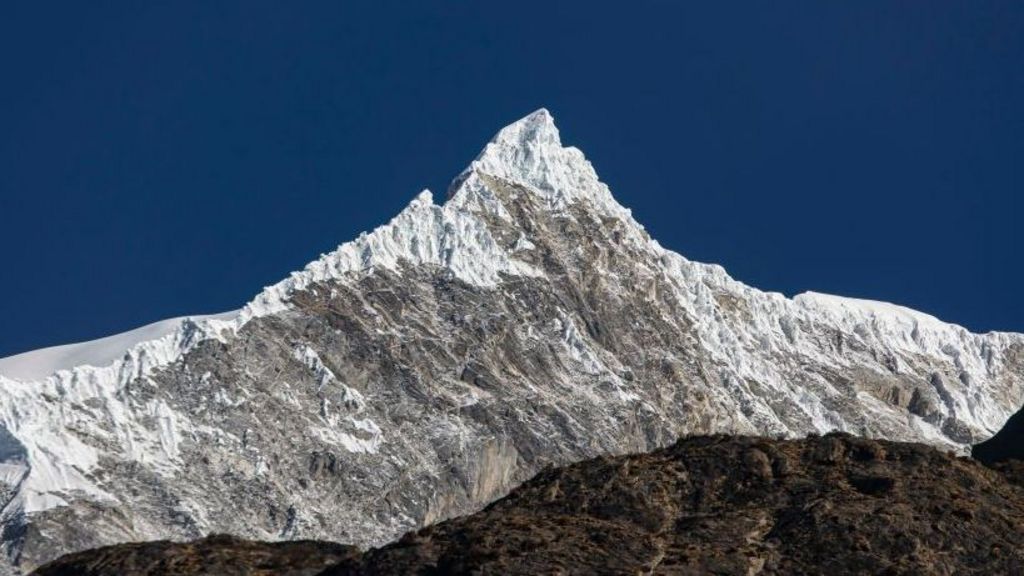
Dr. Simon Cook, a glaciology researcher at the University of Dundee, confirmed that the collapse occurred on the lower portion of a glacier located near Nepal’s Langtang Lirung peak, roughly 9 miles west of the flood’s main impact zone. His analysis found the broken glacier segment moved northwest before flowing downstream into the affected river system.
Further research from the International Centre for Integrated Mountain Development (ICIMOD), an intergovernmental scientific body focused on Himalayan ecosystems, supports the glacial collapse finding. The centre’s preliminary assessment suggests the event unfolded as an ice-rock avalanche that originated in high-altitude terrain. The massive surge of ice and broken rock crashed into the Lende Khola, a tributary of the Bhote Koshi river, triggering an explosive downstream flood loaded with water, sediment, and massive boulders.
Aerial footage and on-site imagery captured the scale of the surge: river levels rose between 7 and 9 meters in just 30 minutes, a jump so rapid and powerful that multiple official water monitoring stations were swept away or destroyed entirely. The valley’s steep mountain slopes funneled the debris-choked water at deadly speed, leaving widespread destruction in its path.
While the specific trigger for this particular glacial collapse remains under investigation, scientists have long warned that rising global temperatures are driving accelerated ice melt and permafrost degradation across the Hindu Kush Himalaya, dramatically increasing the risk of such catastrophic events. A 2026 analysis from ICIMOD found that Himalayan glaciers are currently losing ice twice as fast as they were at the turn of the 21st century, a trend that directly amplifies flood and collapse hazards across the region.
This disaster is far from an isolated incident. Dr. Cook noted that glacier collapse-driven floods and landslides have become increasingly common in high mountain regions around the world in recent years, with major deadly events recorded in India, Switzerland, and Italy. In 2021, a similar Himalayan glacial collapse in India’s Chamoli valley killed more than 200 people, with an impact scientists later estimated was equivalent to 15 atomic bombs. Even the Nepal-Tibet border region saw a major glacial flood last year, triggered by the outburst of a glacial lake in southern Tibet.
Mohd Farooq Azam, a cryosphere specialist at ICIMOD, emphasized that the growing frequency of these events is outpacing current mitigation and monitoring capacity. “The increasing frequency of hazards in the cryosphere—the frozen parts of the Earth—is becoming more visible than ever before. The pace of change is so rapid that current efforts are struggling to keep up,” he said.
While researchers note that it is impossible to directly attribute any single extreme event to climate change, the long-term trend points clearly to human-caused warming as a core driver of growing risk. “When you look at the pattern of these events, you do think climate change could have an impact,” Dr. Cook explained. “The logic is that with a warming planet, you will see shrinking glaciers, lots of snow melt. The permafrost that is partially holding some mountainsides together is warming and thawing and degrading. So you are going to get more landslides, debris flows, glacial meltwater, lake outbursts, glacier collapses, because climate warming ultimately destabilises these high mountain environments.”