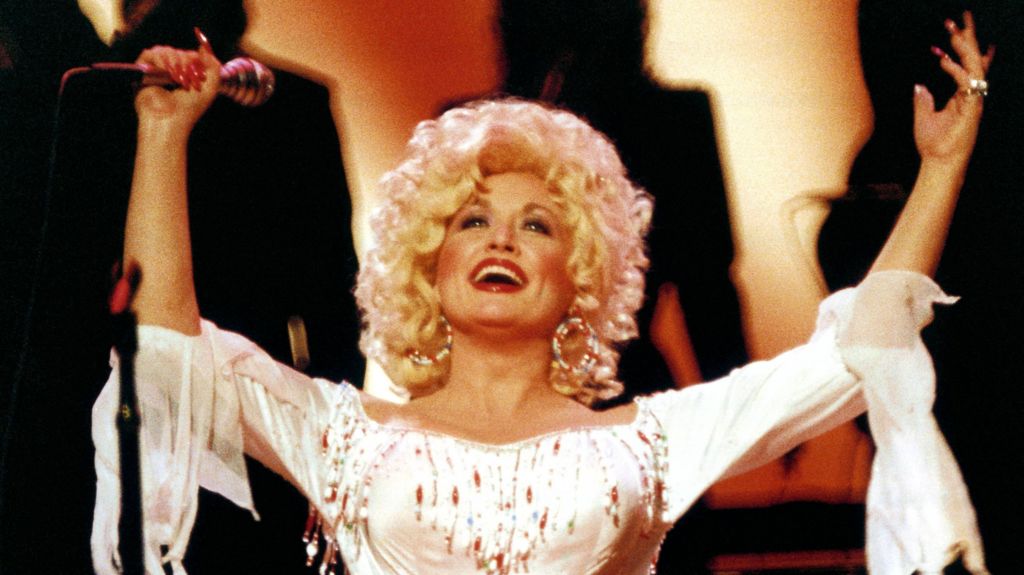
Dolly Parton, the one-of-a-kind country music legend whose career spanned seven decades and reshaped both the music industry and conversations around gender and worker rights, leaves behind an unparalleled legacy as both an artist and a trailblazer.
Few of Parton’s hits carry the layered history and cultural weight of 9 to 5, the iconic theme song for the 1980 comedy film of the same name, her first major Hollywood project. The song’s origin story is as memorable as its catchy hook: while on set, Parton could not access her banned guitar, so she created the track’s distinct beat by strumming her acrylic nails together, mimicking the clack of a typewriter that matched her character’s experience as an overworked, underappreciated office secretary facing constant belittlement and sexual harassment from her male boss. Immediately recognizing she had created something special, she ran to share the unfinished song with co-stars Lily Tomlin and Jane Fonda, who also produced the film. Fonda later recalled that both she and Tomlin were instantly moved, knowing the track was far more than a movie theme—it was an anthem for working women everywhere. When 9 to 5 was released in November 1980, it became Parton’s only solo number-one hit on the U.S. charts and earned her an Academy Award nomination for Best Original Song. Beyond its commercial success, the track’s legacy lies in its unflinching take on working-class struggle and gender inequality in corporate spaces. On the surface, the jaunty, infectious chorus (“Working 9 to 5 / What a way to make a living!”) resonates as a universal nod to the drudgery of daily work, but deeper lyrics reveal a quiet, righteous fury: “It’s a rich man’s game, no matter what they call it / And you spend your life putting money in his wallet. They just use your mind and they never give you credit.” Those words gave voice to widespread unspoken frustrations among working women, a testament to Parton’s skill at wrapping sharp social commentary in accessible, memorable melody. What many listeners miss, however, is that this quiet anger was rooted in Parton’s own lifelong experience navigating the rampant sexism of the music industry, which she began facing as a 13-year-old rising performer.
Parton’s path to stardom was forged through repeated stands against industry exploitation, a pattern of courage that paved the way for future generations of female artists. Her first major break came in 1967, when she was hired as the “girl singer” on the nationally syndicated Porter Wagoner Show, which brought her talent into millions of American homes each week. Over the next decade, the pair released 21 hit duets, and as Parton’s star grew to outshine Wagoner, she made the difficult decision to launch a solo career—writing the timeless ballad *I Will Always Love You* as a heartfelt farewell and apology to her mentor. Instead of accepting her departure graciously, Wagoner sued Parton for breach of contract in 1979, demanding $3 million in damages. Eager to avoid a lengthy, career-derailing court battle, Parton settled for roughly $1 million, a choice she never regretted. “I made up my mind that if he could live with it, I could live without it,” she wrote in her autobiography, adding, “I am neither his conscience nor his accountant.” True to her trademark graciousness, Parton never held a grudge, continuing to credit Wagoner for giving her her first big break, but she never let goodwill override her commitment to protecting her work and her autonomy. That conviction was tested again just a few years later, when Elvis Presley expressed interest in covering *I Will Always Love You*. Parton was elated at the opportunity, but just one day before the scheduled recording session, Presley’s manager Colonel Tom Parker delivered an ultimatum: Elvis would only record the track if Parton surrendered half of the song’s lucrative publishing rights. Parton refused, explaining that she intended to leave the rights to her family as a legacy. Though she cried all night after the deal fell through and always wondered what Presley’s version would have sounded like, she never questioned her choice. That decision ultimately paid off decades later, when Whitney Houston recorded her record-breaking cover of the track for 1992’s *The Bodyguard* soundtrack. Because Parton retained full publishing rights, she earned enough from the hit to buy Presley’s iconic Graceland mansion. Instead of keeping the windfall for herself, she invested the proceeds into a majority-Black neighborhood in Nashville, Tennessee—a intentional choice to honor Houston’s legacy.
That willingness to stand up for artistic autonomy inspired countless women who followed in her footsteps, most notably Taylor Swift, who re-recorded her entire early catalog to reclaim control of her work from private equity firms that purchased her master recordings. When asked about Swift’s campaign, Parton praised her openly: “Smart! She’s so smart, she’s so great, she’s genius. I mean really, look at what she’s doing! That’s amazing!” After Parton’s passing, Swift honored the trailblazer, crediting Parton’s “backbone of steel” in the lifelong fight “to defend her own self worth as an artist.”
Beyond her industry activism, Parton’s musical legacy is defined by her unparalleled ability to turn quiet, everyday moments and personal stories into universally resonant art. She wrote her first song at just six years old: *Little Tiny Tasseltop*, a tender ode to her favorite doll with corn-silk hair. That commitment to drawing from personal experience shaped her entire discography. Her 1971 classic *Coat of Many Colors* tells a deeply moving story of childhood poverty and pride, centered on a hand-sewn coat her mother made for her when her family could not afford store-bought clothes. The 1974 concept album *My Tennessee Mountain Home* is a full musical autobiography, opening with a recording of the first letter Parton wrote home after moving to Nashville as a teenager, where she reassured her family she would be fine even if success took time. The album cover featured a photograph of the two-room log cabin that was her actual childhood home, and its lyrics frame her humble upbringing not as a hardship, but as a source of joy and community: “We might have been poor but we didn’t know it / We’d heard that word but we didn’t know what it meant.”
This diaristic, personal songwriting style produced some of the most beloved hits in country music history, from *Jolene*—the haunting story of a red-headed woman threatening Parton’s marriage—to *All I Can Do*, a tender love letter to her long-time husband Carl Dean. Even as her over-the-top stage costumes and signature blonde bouffant became cultural touchstones, her lyrics remained rooted in raw, relatable authenticity. Long before 9 to 5 cemented her status as a feminist voice, Parton was pushing back against gendered double standards in tracks like *When Possession Gets Too Strong* and *Just Because I’m A Woman*, which challenged the idea that women should be judged more harshly for their mistakes than men: “My mistakes are no worse than yours / Just because I’m a woman.” At a time when the music industry forced women into narrow, limiting stereotypes—housewife, temptress, fallen woman—Parton leaned into the performative nature of these roles to satirize them, while never hiding her core strength. On 2008’s *Backwood Barbie*, she sang, “I’ve always been misunderstood because of how I look. Don’t judge me by the cover, cos I’m a real good book”—a message that inspired generations of women to reject others’ expectations and embrace their true selves.
Even as the country music establishment leaned heavily into conservative politics in later decades, Parton used her platform to unite diverse audiences. In a 2002 performance at Los Angeles’ House of Blues, she playfully changed the lyrics of *Jolene* to center a drag queen, to the delight of the crowd of drag performers in attendance. Beyond music, Parton’s philanthropic work touched millions of lives: she funded scholarships for low-income students and built the Imagination Library, which has delivered more than 200 million free books to young readers across the world.
No other star has ever been able to replicate Parton’s magic, and no successor was ever billed as “the next Dolly Parton”—for good reason. She was one of a kind: irreplaceable, unapologetic, and unforgettable. A legend in her own lifetime, her legacy will continue to resonate for generations to come.