When news of Dolly Parton’s passing broke this week, Americans across every political and cultural divide united in grief, celebrating the life of a one-of-a-kind entertainer whose legacy stretched far beyond the country music stage. To the world, Parton was many things: a genre-defying musician, a Hollywood star, a shrewd business leader, and a dedicated philanthropist whose giving lifted millions. One title she never claimed, however, was politician – a choice that became the foundation of her rare, cross-cutting appeal in an increasingly divided nation.
The question of public office has followed Parton for decades. Back in 1999, during an appearance on the talk show *Prime Time Country!*, a young audience member asked if she would ever run for political office. With her signature sharp, warm wit, Parton demurred, quipping: “I think of myself more as a diplomat. That’s the kind of people who tell you to go to hell in such a way you look forward to the trip.”
That self-described diplomacy turned Parton into a rare unicorn in modern American society. Her fanbase spanned generations, from great-grandmothers to Gen Z fans, and included Republicans and Democrats, drag performers and evangelical Christians alike. For Sarah Phillips, an Indiana University professor who made Parton the subject of an acclaimed anthropology course, the icon’s ability to bridge deep political and cultural divides was unparalleled. Phillips, who still struggles to refer to Parton in the past tense, says she broke down in tears in her office when she heard the news of her death, a testament to how deeply Parton touched even those who study her career academically.
Public opinion data bears out that unprecedented cross-group appeal. A recent YouGov poll put Parton’s net approval rating at 65% – far outpacing major figures from across the political and entertainment spectrum: former President Barack Obama scored 14%, pop star Taylor Swift earned 3%, former President Donald Trump hit -19%, and current President Joe Biden landed at -18%.
Parton’s universal appeal stemmed from a deliberate, consistent choice: she refused to pick sides in partisan politics, wary of alienating the broad community of fans that supported her. “I’ve got as many Republican fans as Democrats and I don’t want to make any of them mad at me, so I don’t play politics,” she once told Fox News. That commitment to neutrality even led her to turn down one of the nation’s highest civilian honors twice: she declined offers of the Presidential Medal of Freedom from Donald Trump, citing scheduling and health concerns, and later turned it down from Joe Biden as well, to avoid appearing to favor one party over the other.
Yet to frame Parton as apolitical would be a mistake. While she avoided partisan clashes, she spoke openly and consistently on core social issues, including women’s rights, LGBTQ+ equality, and Black Lives Matter. Phillips argues that this combination of refusal to align with a partisan camp and commitment to speaking her truth is what made her so widely beloved.
“She has always been a model for women, carving your own path, looking out for yourself, making sure that you retain the rights to your intellectual property, looking out for your own financial and creative independence,” Phillips told the BBC. “And if that’s not feminism, I don’t know what is.”
Parton broke the mold of country music stardom from the earliest days of her career. After rising to become a crossover pop sensation in 1977, she retained her loyal country audience while growing her global following. Three years later, she made her film debut alongside Jane Fonda in the workplace rights comedy *9 to 5*. At the time, Fonda was widely shunned in conservative circles for her anti-Vietnam War activism, but Parton refused to distance herself from her co-star to appease fans. “I respect anybody’s beliefs and the fact that they’re willing to stand up for whatever it is. But I’m also the kind of person that if I don’t like where you got it, I can tell you where to put it,” she said at the time. Following Parton’s death, Fonda paid tribute, writing: “She is woven into all our lives and hearts forever.”
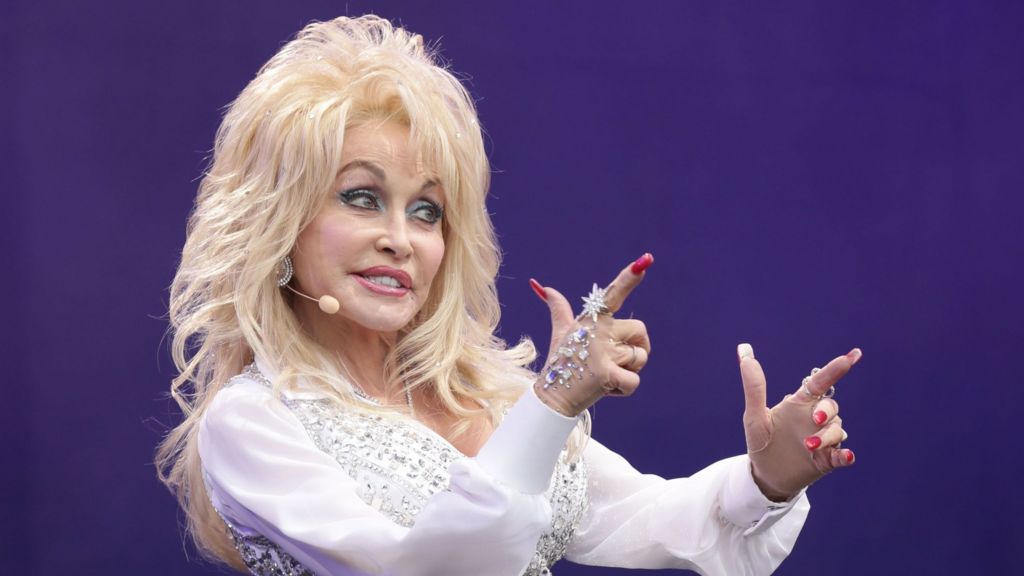
Parton’s carefully cultivated public image – glamorous, camp, and endlessly warm – was no accident. A shrewd entrepreneur who understood both showbusiness and human nature, she intentionally crafted a persona that brought people together. When journalist Barbara Walters questioned her over-the-top aesthetic in a 1977 interview, asking if Parton saw herself as a joke, Parton pushed back with characteristic confidence. “Everybody thinks that the joke’s on me, but in fact, the joke is on the public. I know very well what I’m doing, and I can change my image any time I want to,” she told Walters. Phillips notes that moment was a perfect demonstration of Parton’s self-possession: she was always in control of her own narrative.
Over decades, journalists repeatedly tried to draw Parton into partisan political fights, but she always pivoted away, using humor and self-deprecation as her shields. At a 2016 press conference, when asked about the presidential race, she joked: “I’ve been thinking about running myself… we could use a few more boobs in the race.” Though Parton’s father campaigned for his daughter in his own way, driving around town with a “Dolly for President” bumper sticker, she never pursued public office.
Instead, she channeled her energy and fortune into philanthropy, work rooted in her own experience growing up in abject poverty in rural Appalachian Tennessee. One of 12 children raised in a one-bedroom log cabin, Parton never forgot her roots. When her career took off, she employed dozens of family members in her businesses and invested heavily in her local community. In 1986, she purchased a struggling mountain theme park near her hometown, rebranding it Dollywood – today, it remains the largest employer in the entire county. She also founded the Imagination Library, a program that mails free books to children around the world, and contributed critical early funding to the development of Moderna’s COVID-19 vaccine.
Those who worked with Parton highlight her quiet, personal kindness, which extended far beyond large charitable donations. James Rogers, board president of the American Eagle Foundation, which partners with Dollywood on a bald eagle sanctuary, recalled a decades-old encounter that stuck with him. When Parton arrived for a performance, she spotted Rogers, his wife, and his 10-year-old daughter Heather waiting off to the side, and stopped her entire entourage to kneel down and talk to the little girl one on one. “She’s even sweeter than you realise,” Rogers said.
Phillips, who grew up in the North Carolina mountains just across the valley from Parton’s Tennessee hometown, describes Parton’s approach to contentious issues as “Dollitics” – a term coined by Parton’s nephew that captures her commitment to lifting everyone up, rather than defeating political opponents. “She wants all boats to rise,” Phillips said.
Phillips added that Parton embodied the core, old-fashioned American Dream: the idea that with talent and relentless hard work, anyone can build the life they want. And unlike so many public figures, Parton was truly one of a kind. When Phillips traveled through Europe this summer, she asked audiences across France and Poland to name their own country’s Dolly Parton. No one ever had an answer. There will never be another like her.