As record-breaking drought parches much of Europe, the shrinking waters of the Danube, the continent’s second-longest river, have exposed long-submerged lands along its banks – creating an unexpected opportunity for fossil hunters and historians to uncover artifacts hidden for thousands of years. In northern Bulgaria, just a short distance from where a massive mammoth skeleton was uncovered last month, around 20 volunteer enthusiasts gathered for a guided fossil-hunting expedition organized by the Ruse Regional History Museum, hunting for more prehistoric remains exposed by the retreating river.
Among the participants was Aleksandar Denkov, a 30-year-old amateur photographer, who excitedly called out his discovery: a small yellowish fossil tooth protruding from the dry river sand. While the group did not locate additional full mammoth remains to match last month’s find, their day of searching yielded a range of significant discoveries. Museum experts identified the recovered artifacts as the remains of an ancient large mammal likely to be an aurochs or ancient European bison, a partially preserved subfossil horse jawbone, and a cluster of fossilized oysters dating back an estimated 60 to 65 million years.
Climate scientists have repeatedly confirmed that the ongoing extreme drought gripping Europe has been intensified by human-caused climate change, bringing widespread disruption to communities across the continent. Low river levels have crippled commercial cargo shipping operations and forced output cuts at nuclear power plants that rely on river water for cooling. But alongside these serious negative impacts, the dropping water levels have unlocked a trove of historical and prehistoric remains that have remained hidden for decades, even millennia.
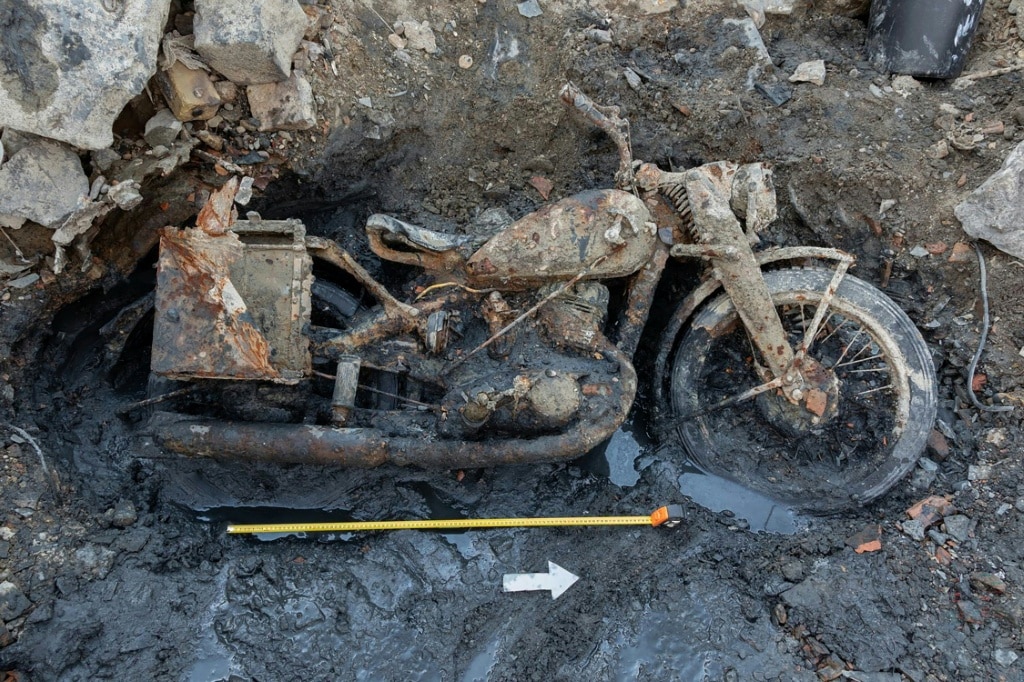
Recent weeks have seen a steady stream of discoveries along the full length of the Danube. Beyond the Bulgarian fossil finds, receding waters have revealed World War II-era shipwrecks in Austria and Serbia, as well as the remains of two German World War II soldiers and a preserved military motorbike in the heart of Budapest, Hungary.
Krasimir Kirov, a curator at the Ruse Regional History Museum, explained that the museum launched the guided expedition to introduce the public to fossil identification, share guidance for safe exploration, and foster public interest in local history. After the initial mammoth discovery was announced last month, Kirov says he received dozens of calls from local residents reporting potential finds of their own. That initial discovery was made by a local resident from the nearby village of Ryahovo, located roughly 30 kilometers from Ruse, who spotted a massive mammoth jawbone, tusk fragments, shoulder blade remains, and a femur by chance while walking the newly exposed banks.
News of the guided search spread quickly on social media, drawing a flood of interested participants and already generating requests for a follow-up expedition. Before the search began, organizers shared simple ground rules: volunteers would move forward in a coordinated line, stop the entire group when a find was spotted by raising a hand, and strictly avoid touching any unknown metal objects that could be leftover unexploded ammunition. But enthusiasm quickly overtook discipline, and the organized line dissolved within minutes as participants scattered to explore the exposed banks on their own.
For many participants, the expedition offered a once-in-a-lifetime chance to connect directly with ancient history. “It’s a very rare opportunity to feel this close to history,” explained Ekaterina Yordanova, a 34-year-old psychologist who joined the hunt. She acknowledged the concern over the Danube’s record-low levels: “Seeing the Danube in this state is worrying, but it also gives us the chance to discover new things that we would never have access to otherwise.” Vladimir Tsvyatkov, a 44-year-old local business owner who attended the expedition with his wife and two children, said the family came primarily “for the adventure.” Having grown up along the Danube’s banks, he noted he had “never seen the Danube so dried up” in his lifetime.
The discoveries stretch far beyond the Bulgarian stretch of the river. Further upstream in Bulgaria, the low water levels have allowed archaeologists to fully document the foundations of a 2-kilometer Roman bridge first inaugurated under Emperor Constantine I in 328 AD, a structure that has remained largely submerged for centuries. Along other parts of the river, dozens of World War II military remnants have been exposed. In central Austria, two sunken German warships that were damaged during 1945 fighting with American tanks and scuttled by their own crews now jut clearly from the water. In Serbia, near the town of Prahovo, the receding river has exposed dozens of additional German warships scuttled in 1945 by retreating German forces to block the river and slow the advance of the Soviet Red Army. In Budapest, the German War Graves Commission has confirmed the discovery of two German soldiers’ remains and a preserved military motorbike.
Data from the European climate observatory Copernicus confirms that these record-low water levels are unprecedented for the month of July across most of Europe’s major river basins, highlighting the severity of the ongoing climate-driven drought.