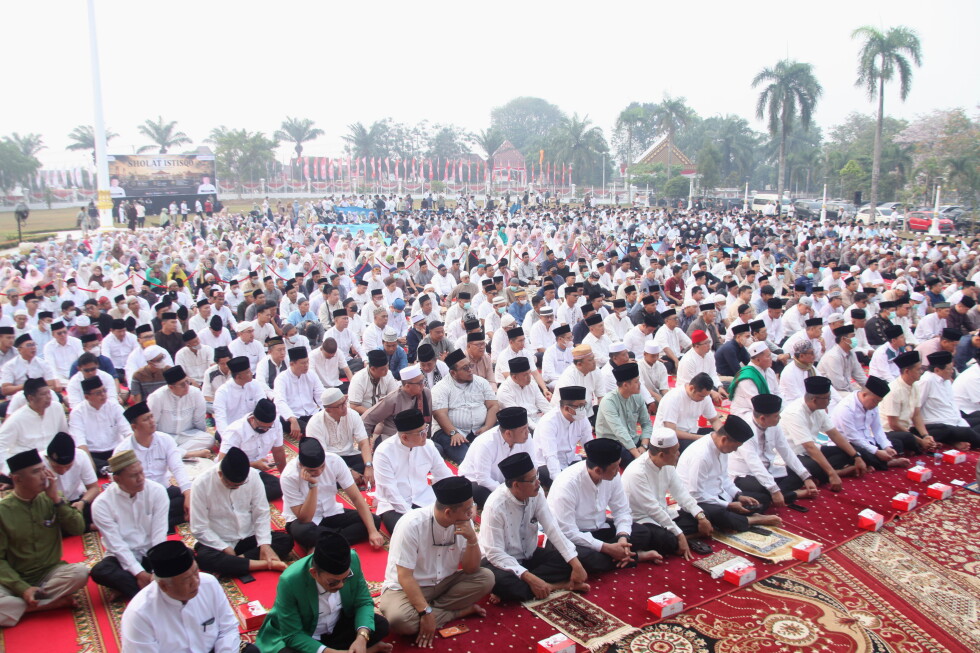
As raging wildfires continue to devour vast swathes of forest and peatland across Indonesia’s South Sumatra, the province with the nation’s highest concentration of active hot spots, local authorities have paired conventional firefighting efforts with an extraordinary spiritual intervention: a mass public prayer for rain to end the catastrophic dry spell fueling the blazes.
The crisis has been amplified by a prolonged dry season supercharged by the developing El Niño climate pattern, which has created tinder-dry conditions across much of Indonesia’s Sumatra and Kalimantan islands. Latest satellite data released by Indonesia’s Environment Ministry confirms South Sumatra leads all provinces with 1,429 detected hot spots, followed by West Kalimantan at 1,226 and Central Kalimantan at 811. Data from the Forestry Ministry adds that nearly 940 square kilometers of land were destroyed by fire in July alone, with more than 20 square kilometers burned within South Sumatra’s borders.
On Tuesday, roughly 3,000 residents gathered in the courtyard of the governor’s office in Palembang, South Sumatra’s capital, to hold *salat istisqa*—a special Islamic ritual for requesting rain. Standing shoulder to shoulder through the thick, acrid haze that already shrouded the city, participants prayed as smoke cut visibility to dangerous levels, forcing motorists to keep their headlights switched on through daylight hours.
South Sumatra Governor Herman Deru addressed the crowd ahead of the prayer, noting that every feasible conventional response has already been deployed across the province. “We have done everything we can and worked closely with all relevant parties,” Deru said. “As people of faith, we are also praying to God to send rain so that life can return to normal.” He emphasized that the collective prayer is not a replacement for active firefighting and drought mitigation, but rather a complementary measure that unites communities in facing the shared environmental crisis.
Indonesia’s national disaster management agency confirmed that emergency crews have been working around the clock to contain the fires, which have generated toxic haze thick enough to drift across national borders into neighboring Malaysia and Brunei. To boost response efforts, the country has ramped up large-scale weather modification operations, deploying more than 50 aircraft across Sumatra and Kalimantan for cloud-seeding—an initiative that disperses salt particles into rain-ready clouds to trigger precipitation—and targeted water-bombing missions on active fire lines.
Alongside firefighting and weather interventions, Indonesian law enforcement has taken action against the human factor driving much of the annual dry season fire crisis. Authorities have arrested 72 people suspected of deliberately starting fires to clear land, and four agribusiness companies are currently under investigation for allegedly using illegal, low-cost slash-and-burn clearing tactics. This practice is common among both small-scale traditional farmers and large plantation operators, who set fires to clear vegetation cheaply ahead of planting season.
Recurring annual dry season fires are a long-standing environmental and public health challenge for Indonesia, a majority-Muslim nation that is home to some of the world’s most biodiverse tropical peatlands and rainforests. Beyond domestic disruption that cuts visibility, halts air and land transport, and worsens chronic respiratory conditions, the transboundary haze from Indonesian wildfires has repeatedly sparked diplomatic protests from neighboring Southeast Asian nations in past years.