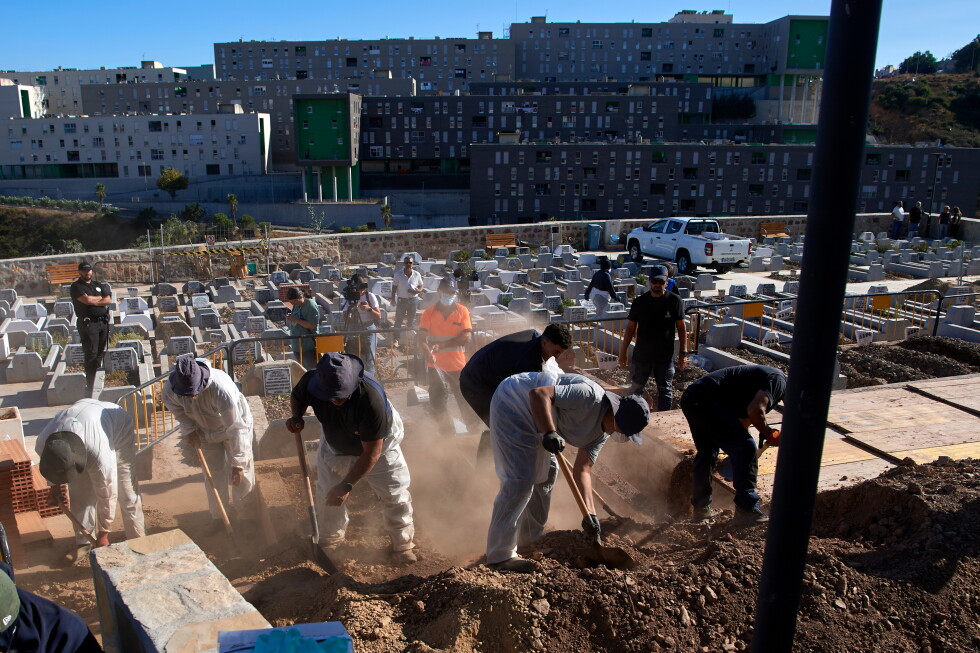
Three weeks after Spain’s deadliest modern migrant border crisis, the first group of unidentified victims of the disaster were laid to rest on Friday at a Muslim cemetery in Ceuta, the Spanish North African territory that became the flashpoint for the mass crossing event. As an Islamic cleric recited traditional funeral prayers over the plots, workers lowered plain white body bags into cinderblock graves, each marked only with a numbered stone — a temporary measure to enable future identification and recovery by surviving family members. All 18 migrants interred on Friday were men, and their burials followed Islamic tradition, with bodies positioned to face Mecca, just a short sea crossing away from the mainland Europe the migrants had hoped to reach.
The 18 buried Friday are part of a death toll that has surpassed 90 people, all of whom died amid the mass influx of more than 72,000 people who crossed into Ceuta from neighboring Morocco in late July. Most of the deceased lost their lives either by drowning or in a chaotic stampede as crowds pushed to cross a breakwater barrier at a key border checkpoint.
The mass migration event was driven by a toxic combination of deep-rooted economic hardship, limited economic opportunity for young people in the region, and widespread misinformation spread across social media platforms, according to official accounts from both Spanish and Moroccan authorities, who have also pinned blame on criminal human smuggling networks. Migrants who made the crossing have repeatedly cited systemic unemployment and poverty-level wages in Morocco as the core push factors that forced them to attempt the dangerous journey.
The burials have sparked controversy, as the Moroccan Association for Human Rights (MAHR), a prominent left-leaning non-governmental organization, has called for an immediate halt to interments in Ceuta. The group is demanding that all possible efforts be made first to identify the deceased and repatriate their remains to Morocco, where most of the migrants originated, so their families can bury them according to local custom and with full dignity. In a formal statement, MAHR described the ongoing burials in Ceuta as a “new human tragedy” that adds to the broader “disaster of displacement and missing persons” plaguing the region. The NGO has also called on Morocco’s foreign ministry to take active steps to secure the return of all remains to their home communities.
The dispute over repatriation comes amid conflicting claims over why the bodies have not been returned. A spokesperson for Ceuta’s city government confirmed last week that all administrative paperwork required to repatriate the deceased migrants’ bodies had been finalized, but that Moroccan authorities had not yet accepted the transfer requests. Morocco’s foreign ministry has not responded to repeated requests for comment from the Associated Press, either regarding the Friday burials or allegations that it is blocking the repatriation process.
While the vast majority of the more than 72,000 people who crossed into Ceuta in late July returned to Morocco within days, thousands remain stranded in the small territory, prolonging a severe humanitarian crisis that has stretched local resources thin. Ceuta’s local government estimates that between 8,000 and 10,000 migrants — including vulnerable women and children — are still present in the territory, while Spain’s national government puts the figure at around 5,000. Both local authorities and Ceuta’s resident population are struggling to provide adequate shelter, food, and basic care for the remaining migrants, leaving thousands in limbo as officials on both sides of the border debate what steps to take next.