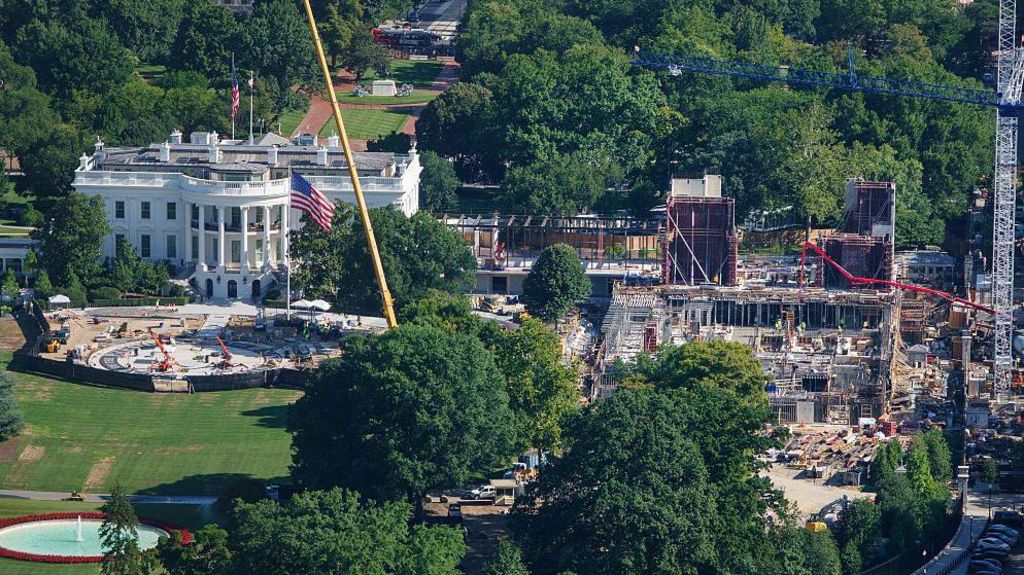
In a high-stakes legal ruling released Friday, US Supreme Court Chief Justice John Roberts has issued an administrative stay that temporarily clears the way for work on the Trump administration’s $400 million White House ballroom expansion project to continue, as the nation’s highest court prepares to review a full legal challenge aimed at halting the development permanently. The temporary order will remain in effect until the Supreme Court issues further guidance on the case.
The legal battle stems from a lawsuit originally brought by the National Trust for Historic Preservation, a leading heritage advocacy group that argues the construction project inflicts irreversible damage to the historic White House complex. The case reached the Supreme Court after a federal appeals court issued an order earlier this month to halt all work on the site. In that appeals court ruling, judges held that sitting presidents are only “temporary tenants” of the White House, and lack the authority to carry out major structural alterations without explicit approval from Congress. The ruling gave the Trump administration two weeks to file an appeal with the Supreme Court, setting the stage for Friday’s temporary action.
The preservation group responded to the stay in a statement to the BBC Friday, noting that the court’s action does not constitute a final ruling on the merits of the administration’s request to keep construction moving. “To be clear, this is not a final decision on the merits of the government’s stay application, and we await further action,” a representative for the group said.
For the Trump administration, Friday’s ruling delivers at least a temporary win. President Trump has pushed for the expansion for years, arguing the White House currently lacks sufficient event space to accommodate large-scale official gatherings. He has more recently framed the project as a critical national security priority, a claim amplified after an assassination attempt targeting the president at the April White House Correspondents’ Association dinner.
Administration legal officials, including US Solicitor General D. John Sauer, emphasized the urgency of continuing construction in an emergency filing submitted to the Supreme Court ahead of the stay. Government lawyers argue the new facility’s integrated underground security complex is designed to defend the White House against emerging threats including drones, ballistic missile attacks, and biological hazards, protections they say are essential to safeguarding the president, his family, and all White House staff. Trump has publicly stated the expanded ballroom is needed to host large state visits and official celebrations, framing the upgrade as long overdue.
When the project was first announced in July 2025, plans called for a 650-person ballroom that would integrate with existing White House structures. Those plans have since been revised twice, expanding capacity first to 900 attendees and then to 1,000. The current scope calls for full demolition of the existing East Wing to make way for the new structure, which will combine a large above-ground event space with a secured underground complex. The ballroom project is not the only controversial infrastructure initiative the Trump administration has advanced in Washington DC; it is paired with a new helipad under construction on the White House South Lawn, a major renovation of the Lincoln Memorial Reflecting Pool, and a planned “Arc de Trump” that would be larger than Paris’s iconic Arc de Triomphe. Across all of these projects, the administration has faced repeated accusations that it bypassed legally mandated environmental review and public comment processes, claims the president has repeatedly rejected. Congress was not consulted on the ballroom project before demolition work began, a core point of criticism from the plaintiffs.
Had the Supreme Court declined to issue the stay, the administration would have been legally required to halt all construction work by the end of Friday. The legal fight now moves toward a full hearing on the merits of the challenge, with the future of the multi-hundred-million-dollar project hanging in the balance.